
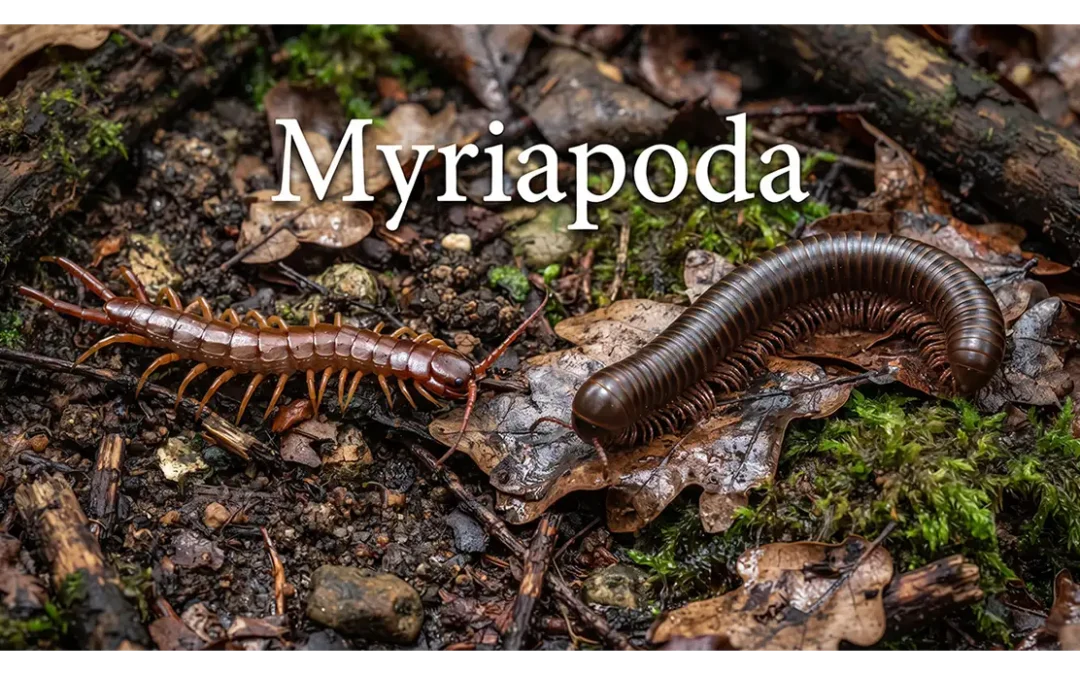
Myriapoda is a subphylum of arthropods that includes centipedes, millipedes, pauropods, and symphylans. These animals are known for their elongated bodies, numerous legs, and segmented structure. Most live on land, especially in moist environments such as soil, leaf litter, forests, and decaying wood.
Although myriapods share several features, their lifestyles vary considerably. Centipedes are mainly predators that use venom to capture prey, while most millipedes feed on dead plant material and help break it down. Pauropods and symphylans are much smaller animals that commonly live in soil and other sheltered habitats.
Myriapods play important roles in terrestrial ecosystems. They help process organic matter, contribute to food webs, and influence the communities of small soil-dwelling organisms. Studying them also helps scientists understand the diversity and evolution of arthropods.
What Is Myriapoda?
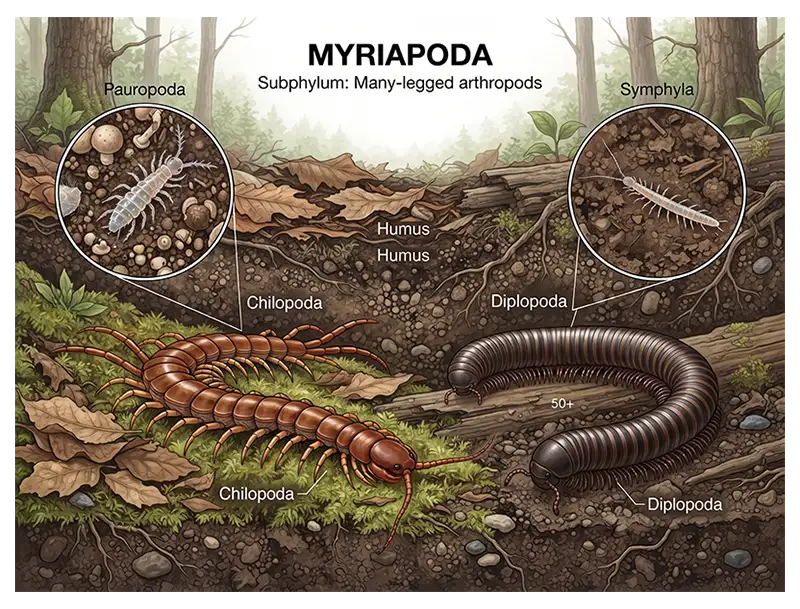
Myriapoda is a subphylum within Arthropoda, the large animal group that includes insects, spiders, crustaceans, and many other invertebrates. Myriapods are distinguished by their elongated, segmented bodies and numerous pairs of legs.
The name Myriapoda comes from Greek roots associated with many and feet. It refers to their numerous legs, although the number varies widely among species. Despite the name, not every myriapod has an extremely high leg count.
Four major groups of living myriapods are commonly recognized:
- Chilopoda: Centipedes, which are primarily predators.
- Diplopoda: Millipedes, most of which consume decaying plant material.
- Pauropoda: Tiny, soft-bodied animals that live mainly in soil.
- Symphyla: Small, pale arthropods found in soil and leaf litter.
Myriapods are not insects. Insects generally have six legs and three main body regions: a head, thorax, and abdomen. Myriapods have a head followed by an elongated trunk made up of multiple segments, many of which bear legs.
They also differ from arachnids, such as spiders and scorpions, which usually have eight legs as adults. Myriapods are therefore a distinct branch of arthropod diversity with their own anatomical features and ecological roles.
What Are the Main Characteristics of Myriapods?
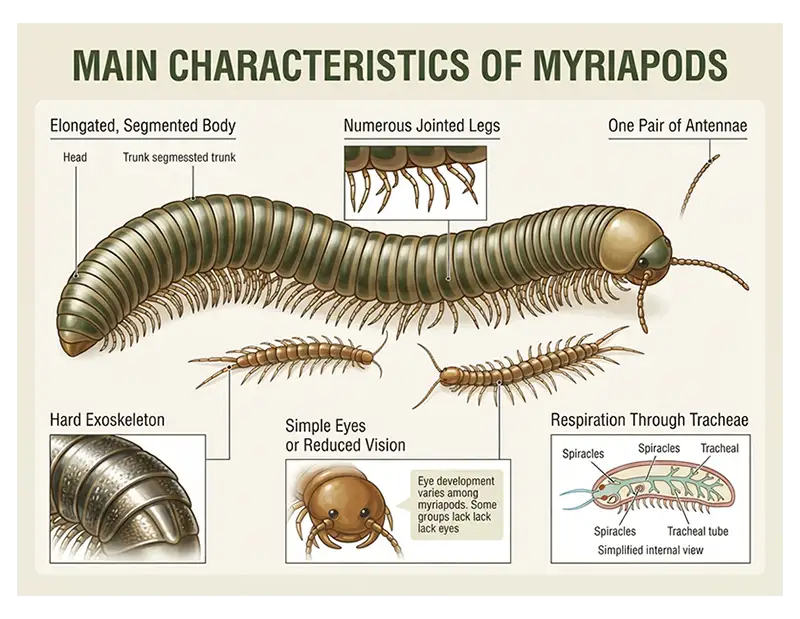
Myriapods share several structural features that distinguish them from other arthropods. Their bodies are adapted mainly for life on land, and their many trunk segments provide space for numerous walking legs.
Elongated, segmented body: Most myriapods have a long body composed of a head and a series of trunk segments. The number and arrangement of these segments differ among groups and species.
Numerous jointed legs: Their legs are attached to the trunk and help them move through soil, leaf litter, vegetation, and narrow spaces. Leg number depends on the species and its stage of development.
Chitinous exoskeleton: Like other arthropods, myriapods have an external skeleton containing chitin. This structure supports the body and protects internal tissues. Growth requires periodic molting, during which the animal sheds its old exoskeleton.
One pair of antennae: Most myriapods have a single pair of antennae on the head. These sensory appendages help them detect their surroundings, including potential food, obstacles, and other organisms.
Simple eyes or reduced vision: Many myriapods have simple eyes or clusters of light-sensitive units called ocelli. Some species have reduced eyes or lack them, especially those adapted to life in dark soil environments.
Land-based respiration: Most myriapods exchange gases through a system of air tubes called tracheae. Air enters through small openings known as spiracles. The details of this system vary across the groups.
These shared characteristics provide a useful general description, but no single feature explains the entire group. Centipedes, millipedes, pauropods, and symphylans differ in body shape, leg arrangement, feeding structures, and other adaptations.
How Are Myriapods Classified?
Myriapods belong to the phylum Arthropoda, which contains animals with jointed appendages and an external skeleton. Within this phylum, Myriapoda is recognized as a distinct subphylum.
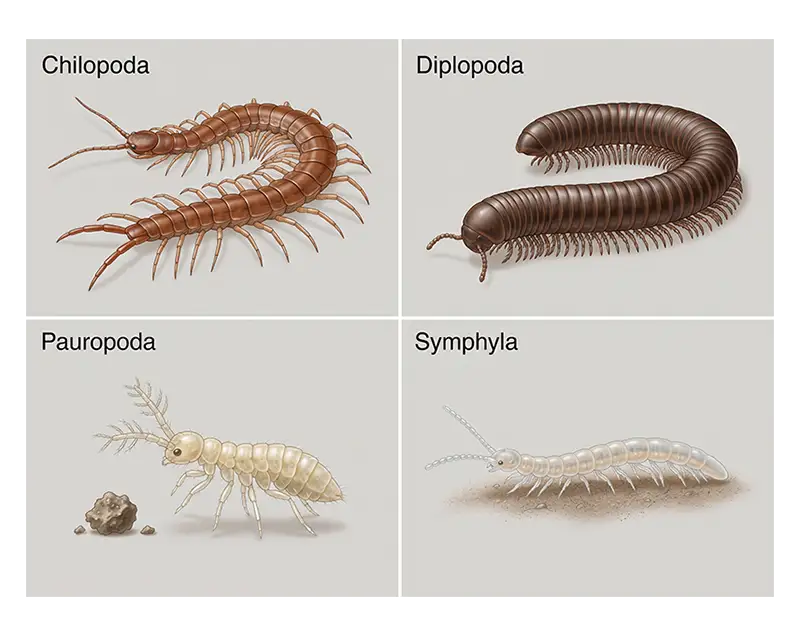
The four major living groups are generally treated as classes in traditional classifications.
Chilopoda — Centipedes
Centipedes are elongated predators with one pair of legs on each trunk segment. Their first trunk appendages are modified into venom-delivering structures called forcipules. They use these to subdue prey, including insects, spiders, and other small animals. Centipedes vary greatly in size and appearance. Some are small soil-dwelling species, while others are much larger and can deliver painful bites.
Diplopoda — Millipedes
Millipedes usually have rounded or flattened bodies and two pairs of legs on most apparent trunk segments. These paired leg arrangements result from the fusion of certain underlying body segments during development. Most millipedes feed on decaying leaves, wood, and other organic matter. Many also have defensive glands that release irritating chemicals when threatened.
Pauropoda — Pauropods
Pauropods are tiny, soft-bodied myriapods that commonly inhabit moist soil and decomposing plant material. They are often pale and have branched antennae, which help distinguish them from other myriapods. Because of their small size and hidden lifestyle, they are less familiar than centipedes and millipedes. They contribute to the complex communities of organisms living in soil.
Symphyla — Symphylans
Symphylans are small, pale arthropods with elongated bodies and long antennae. They live mainly in soil, beneath leaf litter, and around plant roots. They have many similarities to centipedes in general body form but lack the prominent venom-delivering forcipules found in centipedes.
Some symphylans feed on decaying organic matter and fungi, while others can feed on living plant tissues and become agricultural pests. The classification of myriapods reflects their shared ancestry and anatomical similarities. Scientists also use DNA evidence and other evolutionary data to investigate relationships among these groups and with other arthropods.
What Is the Difference Between Centipedes and Millipedes?
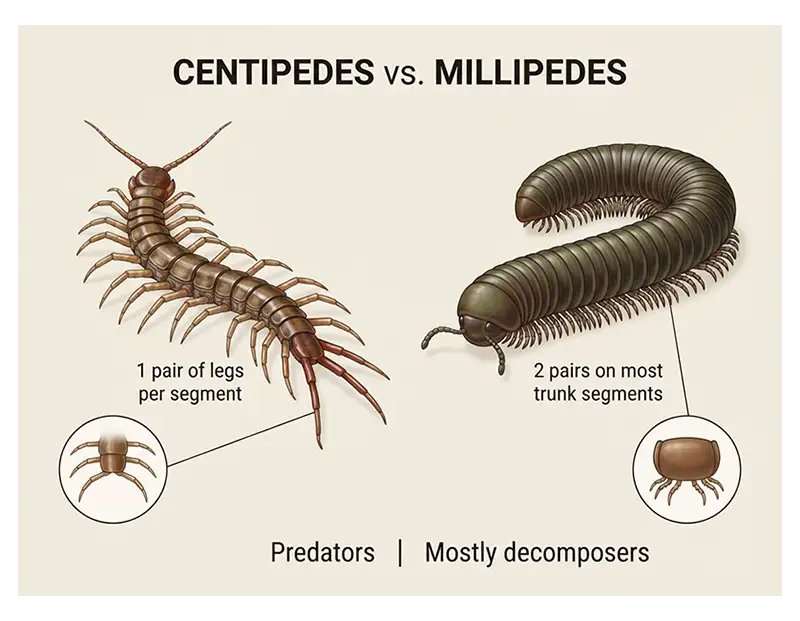
Centipedes and millipedes are the best-known myriapods, but they differ in body structure, leg arrangement, feeding behavior, movement, and defense.
| Feature | Centipedes | Millipedes |
|---|---|---|
| Scientific class | Chilopoda | Diplopoda |
| Body shape | Usually flattened | Usually rounded or flattened |
| Legs per trunk segment | One pair | Two pairs on most apparent trunk segments |
| Main diet | Mostly small animals | Mostly decaying organic matter |
| Movement | Often relatively fast | Usually slower |
| Defense | Venom-delivering forcipules and escape behavior | Curling up and, in many species, defensive chemicals |
| Ecological role | Predators of small invertebrates | Important consumers of dead plant material |
The difference in leg arrangement is one of the easiest ways to distinguish the two groups. Centipedes have one pair of legs per trunk segment, whereas millipedes typically have two pairs on most body segments visible as rings.
Their feeding habits also differ. Centipedes are predators that capture living prey. Millipedes are mainly detritivores, meaning they consume dead organic material, although some species have different diets.
Both groups may hide under stones, logs, or leaf litter during the day. However, their defensive strategies are not the same. Centipedes rely on their forcipules to deliver venom when capturing prey and may bite defensively. Many millipedes protect themselves by curling into a tight shape and releasing chemical secretions.
Neither group should be judged by its name alone. The word centipede means “hundred feet,” and millipede means “thousand feet,” but these names do not describe the exact leg count of every species.
What Does a Myriapod's Body Look Like?
A myriapod's body has two principal regions: the head and the trunk. The head contains the main sensory structures and mouthparts, while the trunk carries the legs and contains many of the internal organs.
The head
The head usually bears one pair of antennae, which detect chemical and physical signals in the environment. The mouthparts include structures used to handle or process food. Their shape varies according to the animal's diet.
In centipedes, the first trunk appendages are transformed into forcipules, which curve forward beneath the head and deliver venom. Millipedes do not have these structures.
The trunk
The trunk consists of multiple segments. These segments differ in number, shape, and arrangement among myriapod groups. Centipedes generally have a more flattened body, while many millipedes have a cylindrical shape that helps them move through soil and leaf litter.
Pauropods and symphylans are much smaller and have softer bodies than many familiar centipedes and millipedes. Their small size allows them to occupy spaces within the soil that larger arthropods cannot easily enter.
The legs
The legs are jointed appendages used for walking and moving through narrow spaces. Centipedes generally have one pair on each trunk segment. Millipedes have two pairs on most apparent trunk segments, while leg arrangements in pauropods and symphylans vary.
The exoskeleton
The exoskeleton provides external support and protection. Because it cannot expand continuously like the internal skeleton of a vertebrate, a growing myriapod must molt. After shedding the old covering, the animal expands before the new exoskeleton hardens.
The combination of a segmented trunk, jointed legs, sensory antennae, and a protective exoskeleton allows myriapods to function effectively in many terrestrial habitats.
What Do Myriapods Eat?
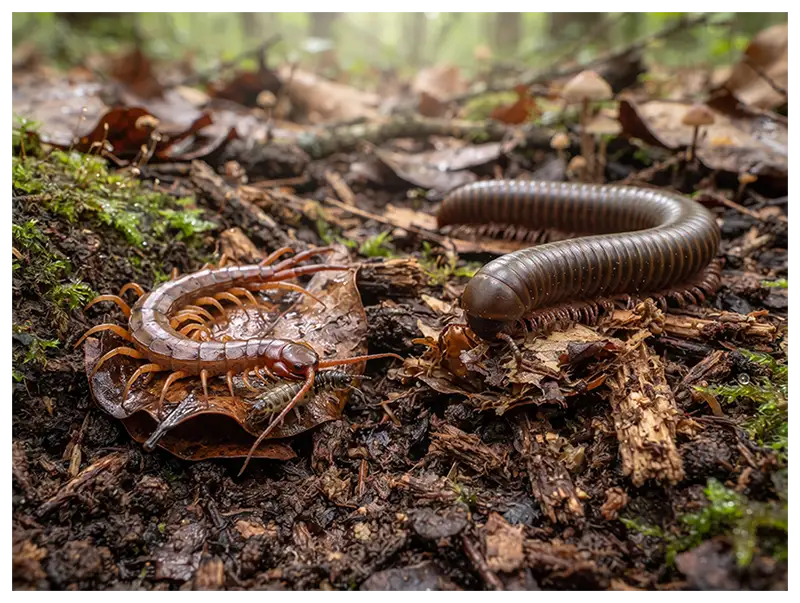
Myriapod diets vary among the four groups. Their mouthparts and feeding behavior reflect the food sources available in their habitats.
Centipedes are mainly predators. They feed on insects, spiders, worms, and other small animals. Larger species may capture relatively large prey. Their venom-delivering forcipules help immobilize or subdue prey before it is eaten.
Millipedes mainly consume dead organic material. Fallen leaves, decaying wood, and decomposing plant fragments form important parts of the diet of many species. By breaking down this material and producing waste that can be processed further by other organisms, millipedes contribute to nutrient cycling.
Some millipedes also eat fungi, algae, or other organic matter. A smaller number may feed on living plant tissues or other food sources, so their diet should not be described as identical across the entire group.
Pauropods feed on microscopic and decaying materials. Their diets are less familiar and can vary among species. They live in soil and decomposing organic matter, where they interact with fungi and other tiny organisms.
Symphylans feed on organic material and, in some cases, living roots. Certain species consume fungi and decaying matter, while others can damage fine roots, seeds, or underground plant tissues. Their effects on crops depend on the species and local conditions.
These different feeding strategies allow myriapods to occupy several positions in terrestrial food webs. Some act mainly as predators, while others help process dead material or interact directly with living plants.
Where Do Myriapods Live?
Myriapods occur in many terrestrial environments, including forests, grasslands, gardens, agricultural land, and other habitats with suitable shelter and food. Many species spend much of their lives hidden beneath the surface or within decaying material.
Soil and leaf litter provide shelter, moisture, and food. These environments are particularly important for millipedes, pauropods, and symphylans, which often depend on decomposing organic material or live in the spaces between soil particles.
Under stones and fallen logs is a common place to find centipedes and millipedes. Such sheltered locations reduce exposure to direct sunlight and help limit water loss. They also provide access to prey or decomposing material.
Forests and woodland floors support diverse myriapod communities because fallen leaves, rotting wood, and moist soil create a steady supply of food and hiding places.
Gardens and agricultural soils can also support many species. Some help break down organic matter, while others may feed on seedlings, roots, or other living plant tissues.
Moisture is important for many myriapods because they can lose water through their body surfaces and respiratory openings. Some species avoid dry conditions by remaining underground, hiding in damp crevices, or becoming active mainly at night.
Not all myriapods have the same habitat requirements. Their distribution depends on temperature, humidity, soil conditions, food availability, and adaptations specific to each species.
How Do Myriapods Reproduce and Develop?
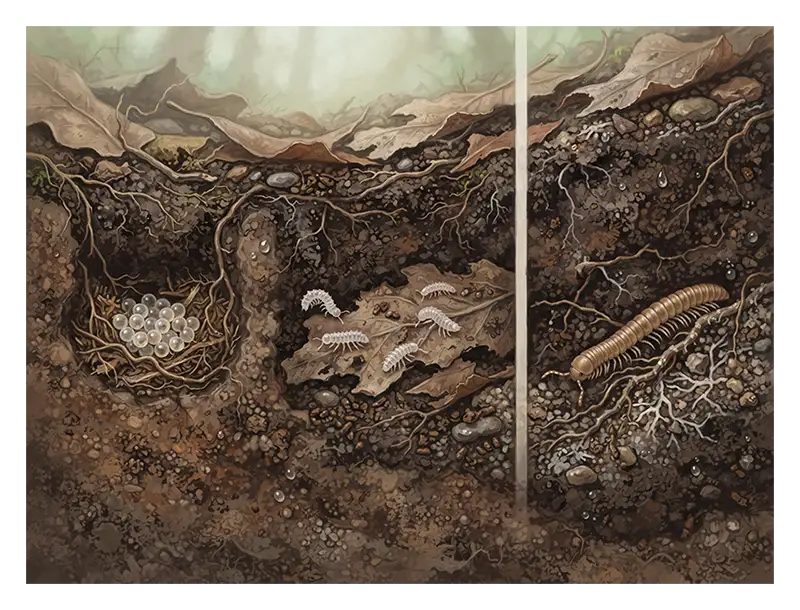
Myriapods reproduce sexually, although the details differ among groups. In many species, males transfer sperm to females directly or deposit sperm in a structure that the female collects. The exact method depends on the species.
Eggs are generally laid in protected places, such as soil, small chambers, or decomposing organic material. These locations can help shield developing embryos from predators and harsh environmental conditions.
After hatching, young myriapods resemble small versions of adults, but they may have fewer body segments or legs. Their bodies develop as they grow, and the number of segments or legs can increase through successive molts in many species.
Centipedes show different developmental patterns. In some species, young hatch with most of their eventual leg-bearing segments already present. In others, additional segments and leg pairs develop as the animal grows.
Millipedes commonly add body segments and leg pairs over multiple molts. The number of legs therefore changes during development, and adults of different species may have very different totals.
Pauropods and symphylans are small and less frequently observed, so their reproductive biology is less familiar to general readers. However, they also undergo development through stages before reaching adulthood.
Growth through molting is a shared arthropod feature, but the timing, number of molts, and mature body form vary considerably across Myriapoda.
How Do Myriapods Protect Themselves?
Myriapods face threats from predators such as birds, amphibians, reptiles, mammals, and other arthropods. Their defensive methods vary, depending on body structure and lifestyle.
Centipedes use venom-delivering forcipules. These modified appendages help capture prey and can also be used defensively. Some larger centipedes can inflict painful bites on humans, so wild specimens should not be handled carelessly. Centipedes may also escape by moving quickly into cracks, soil, or other sheltered spaces. Their flattened bodies allow many species to hide in narrow gaps.
Many millipedes curl up when threatened. By bending the body into a coil, they protect the softer underside and legs. Some species also release chemical secretions from specialized glands. These substances can irritate or deter potential predators.
The chemicals produced by millipedes differ among species. They may cause skin or eye irritation, so it is sensible to avoid rubbing the eyes after touching a millipede and to wash hands after accidental contact. Pauropods and symphylans depend heavily on their small size and hidden lifestyles.
Their ability to live within soil particles and sheltered organic matter makes them less exposed to many surface-dwelling predators. Defense is therefore not the same across all myriapods. Venom, chemical secretions, body curling, rapid escape, and concealment each provide advantages in particular circumstances.
What Role Do Myriapods Play in Ecosystems?
Myriapods influence terrestrial ecosystems through feeding, decomposition, predation, and their interactions with other soil organisms.
Decomposition and nutrient cycling: Many millipedes consume fallen leaves, dead plant fragments, and decaying wood. Their feeding breaks this material into smaller pieces, making it more accessible to microorganisms and other decomposers. This contributes to the movement of nutrients through soil ecosystems.
Soil processes: By moving through leaf litter and soil, myriapods can alter the arrangement of organic material and help mix decomposing matter into their surroundings. Their effects depend on their abundance, feeding habits, and habitat.
Predator-prey relationships: Centipedes feed on many small invertebrates. They form part of terrestrial food webs and can influence the abundance of prey populations. At the same time, centipedes themselves are prey for various vertebrates and other predators.
Interactions with plants: Most millipedes are associated with decomposing material, but some myriapods can feed on living plant tissues. Certain symphylans, for example, may damage fine roots or seedlings when their populations are high.
Support for biodiversity: Myriapods form part of the wider community of organisms living in soil and leaf litter. Their different sizes, diets, and behaviors allow them to occupy distinct ecological roles.
Their ecological value is not limited to a single function. Some contribute primarily to decomposition, others act as predators, and a few may become pests under certain conditions. Together, they form an important part of many terrestrial ecosystems.
Conclusion
Myriapoda is a diverse subphylum of arthropods that includes centipedes, millipedes, pauropods, and symphylans. Although these animals share elongated, segmented bodies and numerous legs, they differ in anatomy, feeding habits, development, and ecological roles.
Centipedes are mainly predators equipped with venom-delivering forcipules, while most millipedes feed on decaying organic matter and contribute to decomposition. Pauropods and symphylans are smaller, less familiar members of the group that live mainly in soil and other sheltered environments.
By participating in food webs, processing organic material, and interacting with soil communities, myriapods contribute to the functioning of terrestrial ecosystems. Their diversity demonstrates how a shared arthropod body plan can support a wide range of lifestyles.
Myriapoda comes from Greek roots meaning “many” and “feet.” It refers to a subphylum of arthropods with elongated, segmented bodies and numerous legs.
No. Both myriapods and insects belong to Arthropoda, but they have different body structures. Insects generally have six legs and three main body regions, while myriapods have an elongated, many-segmented trunk.
The number varies by group, species, and developmental stage. There is no single leg count for all myriapods, and a millipede does not necessarily have 1,000 legs.
Most myriapods are not a serious threat to humans. Some centipedes can deliver painful bites, and defensive chemicals released by certain millipedes may irritate skin or eyes. Avoid handling unfamiliar species.
They contribute to terrestrial food webs. Many millipedes help break down dead plant material, while centipedes prey on small invertebrates. Other myriapods are part of the diverse communities living in soil.