
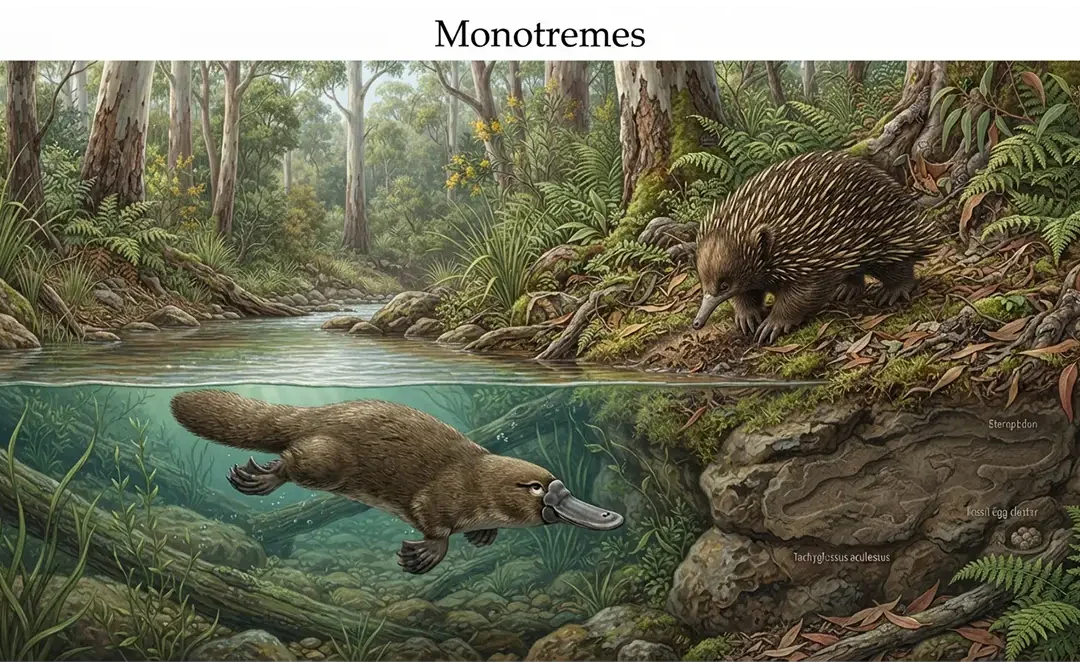
Monotremes are a small and unusual group of mammals that lay eggs instead of giving birth to live young. The living monotremes are the platypus and echidnas, which are found naturally in Australia and New Guinea. Although they reproduce differently from most other mammals, they still have important mammalian features, including hair, lungs, and milk production.
Monotremes are especially important in biology because they show how different reproductive, feeding, and sensory adaptations can develop within mammals. Their fossil record also reveals that this lineage has a long history extending back to the age of dinosaurs.
What Are Monotremes?
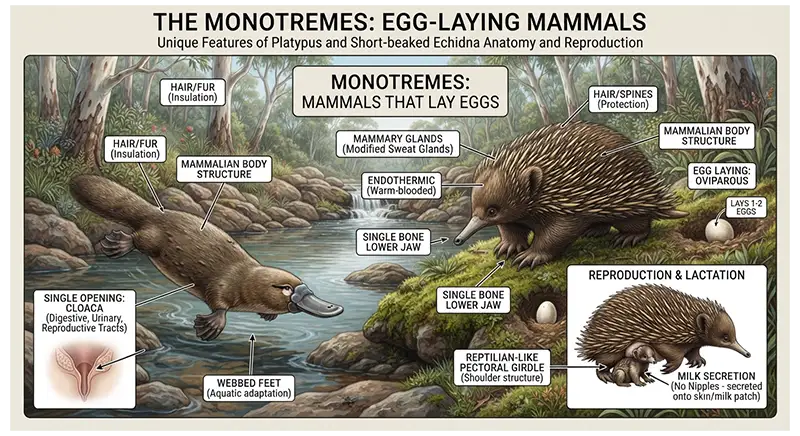
Monotremes are mammals belonging to the order Monotremata. They are different from marsupials and placental mammals because they reproduce by laying eggs. Today, only two types of monotremes survive: the platypus and echidnas. The platypus is represented by one living species, while four species of echidna are currently recognized.
Monotremes share several basic characteristics with other mammals. They have hair, breathe with lungs, produce milk, and are endothermic, meaning they generate most of their body heat internally. Their reproductive anatomy is unusual. Monotremes have a cloaca, a single opening through which the digestive, urinary, and reproductive systems connect with the outside of the body.
The living species are restricted to Australia and New Guinea. The platypus is closely associated with freshwater environments, while echidnas are mainly terrestrial and occupy a variety of habitats. Monotremes are not simply unchanged survivors from an ancient period. Like all living animals, they have continued to evolve and have developed specialized features suited to their environments.
What Makes Monotremes Unique Among Mammals?
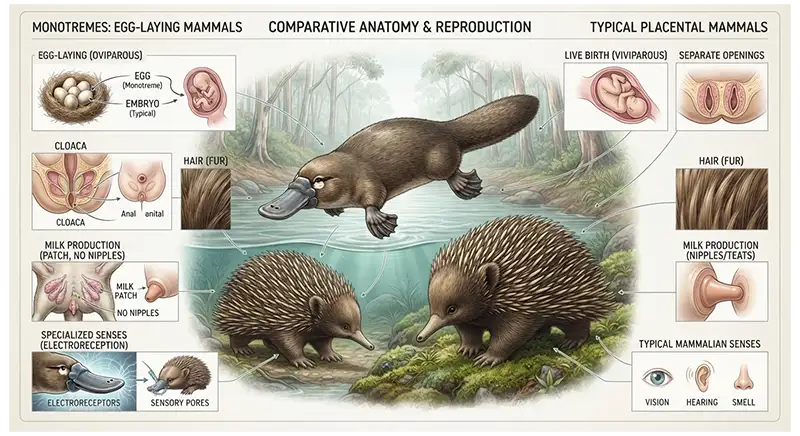
Monotremes combine several mammalian features with characteristics that are rare among living mammals. This combination makes them particularly interesting to scientists. The most obvious difference is their egg-laying reproduction. Instead of carrying their young through a long pregnancy and giving birth to live offspring, female monotremes produce eggs that develop outside the body for part of their early development.
Their eggs have a soft, leathery covering rather than the hard shell seen in birds. Another unusual feature is the cloaca. Most mammals have separate openings for different body systems, but monotremes retain a single external opening. Monotremes also produce milk but do not have conventional nipples. Their mammary glands release milk through specialized areas of the skin.
The platypus has another remarkable adaptation: electroreception. Receptors in its bill allow it to detect weak electrical signals produced by animals in the water. This helps it locate prey when its eyes, ears, and nostrils are closed underwater. Echidnas have their own specialized features, including strong digging limbs, sharp spines, and long tongues used to collect ants and termites.
These characteristics show that monotremes are highly specialized mammals rather than simple representatives of an earlier stage of mammalian evolution.
How Do Monotremes Reproduce?
Monotreme reproduction differs from that of most mammals because the female lays eggs after fertilization. Fertilization occurs inside the female. After the eggs develop, they are laid outside the body. The eggs are relatively small and have a flexible, leathery shell.
A female platypus usually lays one to three eggs. Echidnas generally produce one egg. Platypuses incubate their eggs by curling their bodies around them. Echidnas use a temporary pouch to hold the egg during incubation. The young hatch in a very undeveloped condition. They are tiny, weak, and unable to survive independently. After hatching, they continue growing while receiving milk from the mother.
This means that much of the young animal's development occurs after hatching. The mother provides protection and nourishment during this important period. Monotreme reproduction therefore combines egg-laying with prolonged parental care, giving these mammals a reproductive system that differs greatly from that of most other living mammals.
How Do Monotremes Produce Milk Without Nipples?
Monotremes produce milk through mammary glands, but females do not have the typical nipples found in most other mammals. Instead, milk is released through small openings in specialized areas of the skin. The milk spreads across the surrounding skin and fur, where the young can obtain it.
This method allows the mother to nourish her young after they hatch. Milk is especially important because newly hatched monotremes are not fully developed. They need continued nutrition while their bodies grow and their muscles, sensory systems, and other organs mature.
The presence of mammary glands and milk production is one of the important reasons monotremes are classified as mammals despite their egg-laying reproduction. Their unusual lactation system also demonstrates that mammalian milk production does not depend on the presence of conventional nipples.
What Are the Main Types of Monotremes?
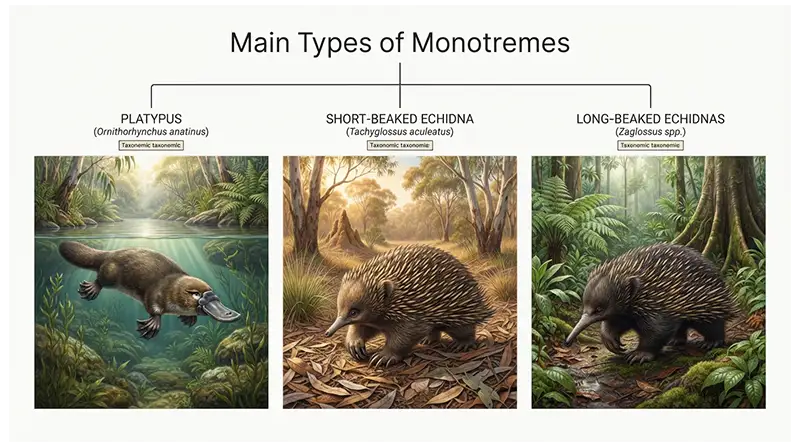
Only five monotreme species are alive today, and they belong to two main groups: the platypus and echidnas. Although these animals share the basic monotreme features of egg-laying, milk production, hair, and a cloaca, they have very different body shapes, habitats, and feeding habits.
Platypus
The platypus (Ornithorhynchus anatinus) is the only living species in the family Ornithorhynchidae. It is a semi-aquatic mammal native to eastern Australia and Tasmania. The platypus has a streamlined body, dense waterproof fur, a broad sensitive bill, webbed feet, and a flattened tail. These features help it swim and search for food in freshwater environments.
Its bill contains electroreceptors and other sensory structures that help it locate prey underwater. It feeds mainly on small aquatic animals such as insect larvae, worms, and crustaceans. The platypus is also unusual among mammals because males have venomous spurs on their hind legs. These spurs are mainly associated with interactions between males.
Echidnas
Echidnas form the second major living group of monotremes. They belong to the family Tachyglossidae and are divided between the genera Tachyglossus and Zaglossus. Unlike the aquatic platypus, echidnas are mainly terrestrial. They have compact bodies covered with hair and sharp spines, along with strong limbs and claws for digging.
Their long, narrow tongues are specialized for collecting ants, termites, and other small invertebrates. Their powerful claws also allow them to break into insect nests and dig through soil. Echidnas can survive in a variety of environments, depending on the species.
Short-Beaked Echidna
The short-beaked echidna (Tachyglossus aculeatus) is the most widely distributed living monotreme. It occurs across much of Australia and also lives in parts of New Guinea. It can occupy forests, woodlands, grasslands, dry regions, and mountainous areas. Its ability to feed on ants and termites allows it to use many different terrestrial environments.
The short-beaked echidna has a relatively short snout compared with the long-beaked species and is covered with numerous protective spines.
Long-Beaked Echidnas
The long-beaked echidnas belong to the genus Zaglossus and are native to New Guinea. Several species are recognized within this genus. They generally have longer snouts and larger bodies than the short-beaked echidna. Their long beaks and tongues help them search through soil and leaf litter for food.
Long-beaked echidnas are associated with forested and mountainous environments and have more restricted distributions than the short-beaked echidna.
Living Monotremes at a Glance
| Group | Living species | Main distribution | Typical lifestyle |
|---|---|---|---|
| Platypus | 1 | Eastern Australia and Tasmania | Semi-aquatic |
| Short-beaked echidna | 1 | Australia and parts of New Guinea | Terrestrial |
| Long-beaked echidnas | 3 | New Guinea | Terrestrial |
Together, the platypus and echidnas represent the only surviving branches of monotremes. Their differences show how the same basic mammalian lineage can develop very different adaptations for aquatic and terrestrial environments.
How Is the Platypus Adapted to Its Environment?
The platypus is a semi-aquatic mammal that spends much of its time in and around freshwater. Its broad bill is one of its most distinctive features. The bill contains sensitive receptors that can detect electrical signals and movements produced by prey.
When the platypus dives, it can close its eyes, ears, and nostrils. Its sensitive bill then becomes especially important for finding food. Its broad front feet are webbed and provide strong propulsion during swimming. The hind feet help with steering and movement in the water. A thick layer of fur helps insulate the body and reduces heat loss in cool water. The platypus feeds mainly on small aquatic animals.
Its diet can include insect larvae, worms, small crustaceans, and other aquatic invertebrates. It often searches along the bottom of streams and rivers, collects prey in its bill, and temporarily stores food in cheek pouches before eating. Male platypuses also possess a venomous spur on each hind leg. The spur is mainly used during interactions between males, particularly during competition.
How Are Echidnas Adapted for Survival?
Echidnas are mainly terrestrial and have body structures suited to digging and insect feeding. Their backs are covered with numerous spines mixed with coarse hair. These spines provide protection from predators. Echidnas have strong forelimbs and powerful claws. They can dig into soil, break apart insect nests, and create shelter when necessary.
Their long, narrow tongues are adapted for collecting ants and termites. An echidna can extend its tongue into narrow spaces and quickly draw prey into its mouth. Echidnas do not depend on teeth for processing their food in the same way as many other mammals. Their specialized mouth and tongue are better suited to their insect-based diet.
When threatened, an echidna may dig rapidly into the ground or curl its body so that its spines protect the softer parts of its body. These adaptations allow echidnas to survive in a wide range of terrestrial environments.
Where Do Monotremes Live and What Do They Eat?
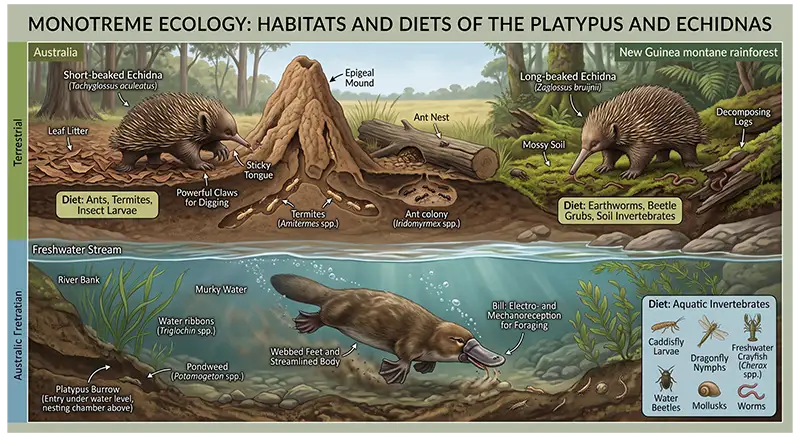
Living monotremes occur only in Australia and New Guinea. The platypus is associated with freshwater environments. It commonly lives near rivers and streams where suitable food and shelter are available. Echidnas are more widely distributed across land. Short-beaked echidnas can live in forests, woodlands, grasslands, deserts, and mountainous areas, while long-beaked echidnas are found in New Guinea.
Their diets are strongly influenced by their habitats. Platypuses mainly eat small aquatic animals such as:
- Insect larvae
- Worms
- Small crustaceans
- Other aquatic invertebrates
Echidnas mainly feed on:
- Ants
- Termites
- Other small invertebrates
The two groups therefore use very different feeding strategies. The platypus searches for prey in water, while echidnas use their claws and tongues to reach insects in soil, leaf litter, and nests.
How Did Monotremes Evolve and What Do Their Fossils Reveal?
Monotremes have a long evolutionary history, and the living species represent only a small part of that history. Fossil evidence shows that monotremes existed during the Cretaceous Period, when dinosaurs still dominated many terrestrial ecosystems. One important fossil monotreme is Steropodon, which lived in Australia during the Early Cretaceous. Fossil material from this animal provides evidence that monotremes were already present more than 100 million years ago.
Other fossil discoveries have revealed additional extinct monotreme forms and have expanded our understanding of how diverse the group once was. The fossil record also shows that ancient monotremes were not identical to modern platypuses and echidnas. Different species evolved different body structures and occupied different ecological roles.
Monotremes belong to an early-diverging branch of living mammals. Their evolutionary history is therefore useful for studying the early diversification of mammals and the development of features such as lactation, specialized jaws, sensory systems, and reproductive structures.
Their evolution should not be viewed as a straight line from an ancient animal to today's platypus or echidna. Instead, it involved multiple branches, extinct species, and adaptations that appeared at different points in time.
Why Are Monotremes Important to Mammal Evolution?
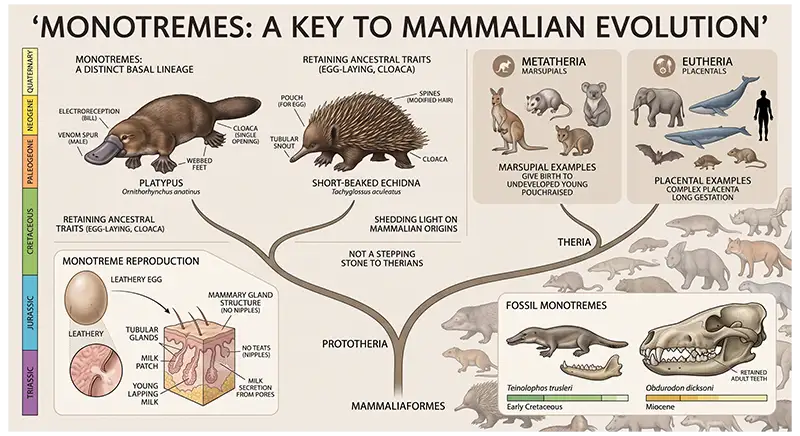
Monotremes are important to evolutionary science because they provide living examples of a distinctive mammalian lineage. Their reproduction helps scientists investigate how egg-laying and mammalian traits can occur together. Their biology also provides information about the evolution of milk production and parental care.
The platypus offers valuable evidence about sensory evolution. Its electroreceptive bill shows how a mammal can develop a specialized system for detecting prey in an aquatic environment. Echidnas provide a different example. Their digging limbs, protective spines, and long tongues show how mammals can become highly specialized for feeding on insects and living on land.
Fossil monotremes add evidence from the past. They demonstrate that the group has existed for a very long time and that its diversity was greater than the few living species might suggest. By comparing living monotremes with fossil forms and other mammals, scientists can investigate how mammalian anatomy, reproduction, feeding, and ecological adaptations changed through geological time.
Conclusion
Monotremes are a distinctive group of mammals that lay eggs but still possess important mammalian features such as hair and milk production. The living group consists of the platypus and echidnas, which have developed different adaptations for life in water and on land.
The platypus uses its sensitive bill, webbed feet, and dense fur to thrive in freshwater environments, while echidnas rely on strong claws, protective spines, and long tongues to find food and avoid predators.
Their fossil record reveals that monotremes have a deep history extending into the age of dinosaurs. Studying both their living species and extinct relatives helps scientists understand how mammals diversified and how different reproductive, sensory, and ecological adaptations evolved over time.
Yes. They have key mammalian characteristics, including hair, milk production, lungs, and internal temperature regulation.
There are five living species: one platypus species and four echidna species.
Yes. Egg-laying is the defining reproductive feature that distinguishes monotremes from marsupials and placental mammals.
Yes. Fossil evidence shows that monotremes were present during the Cretaceous Period.
Monotremes help scientists understand mammalian evolution, reproduction, lactation, sensory systems, adaptation, and the fossil history of early mammals.