
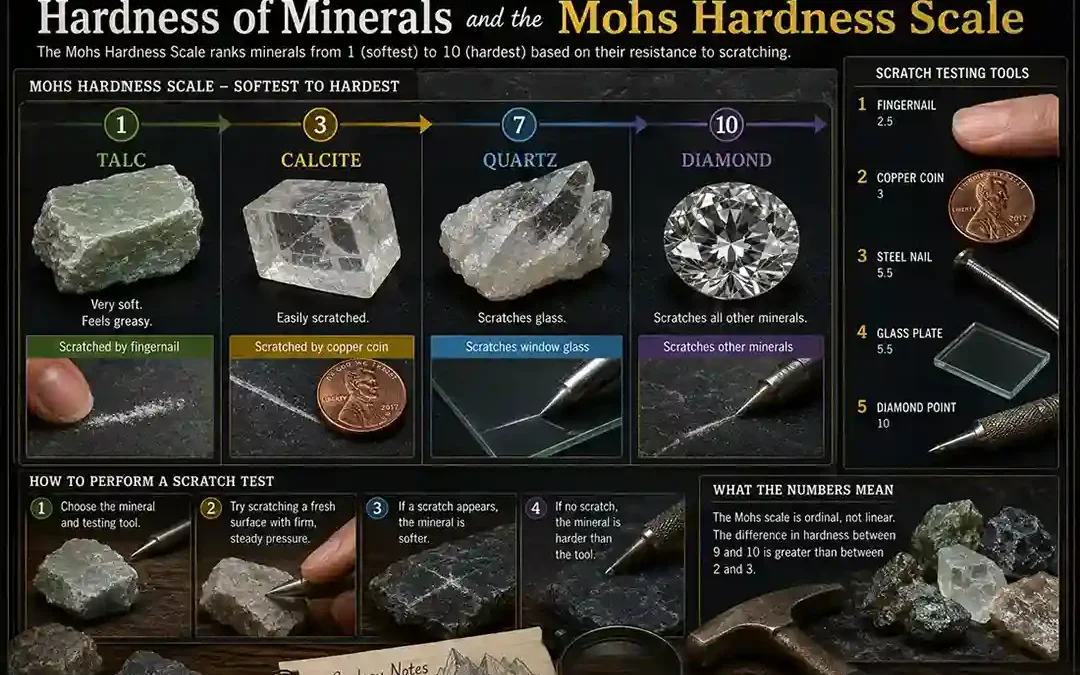
Hardness is one of the most important physical properties used in mineral identification. It measures a mineral's resistance to scratching and helps geologists distinguish between minerals that may otherwise look similar.
The most widely used system for measuring mineral hardness is the Mohs Hardness Scale. Developed in 1812 by German mineralogist Friedrich Mohs, the scale ranks minerals from 1 (softest) to 10 (hardest).
Hardness testing is simple, reliable, and commonly used in geology laboratories, classrooms, mining operations, and field studies.
Learn more → characteristics of minerals
What Is Mineral Hardness?
Mineral hardness is a mineral's resistance to scratching. A harder mineral can scratch a softer mineral.
For example:
- Quartz scratches calcite
- Diamond scratches nearly every natural mineral
Hardness does not measure:
- toughness
- strength
- resistance to breaking
It only measures scratch resistance.
The Mohs Hardness Scale
| Mohs Number | Mineral |
|---|---|
| 1 | Talc |
| 2 | Gypsum |
| 3 | Calcite |
| 4 | Fluorite |
| 5 | Apatite |
| 6 | Orthoclase Feldspar |
| 7 | Quartz |
| 8 | Topaz |
| 9 | Corundum |
| 10 | Diamond |
Understanding the Mohs Scale
The Mohs scale is a relative scale, not a linear scale. The difference between the hardness values is not equal.
The scale can be visualized as:
1<2<3<4<5<6<7<8<9<10
Diamond (10) is much harder than corundum (9), even though they differ by only one number.
The Softest Mineral: Talc
Talc has a hardness of: 1
Characteristics:
- very soft
- easily scratched with a fingernail
- greasy feel
Talc is commonly used in:
- cosmetics
- ceramics
- industrial products
The Hardest Mineral: Diamond
Diamond has a hardness of: 10
Characteristics:
- extremely hard
- exceptional scratch resistance
- strong crystal bonding
Diamond is used in:
- jewelry
- cutting tools
- drilling equipment
Its hardness comes from a very strong crystal structure.
Learn more → crystal structure in minerals
How Geologists Test Hardness
Geologists determine hardness by:
- Selecting a reference mineral.
- Attempting to scratch the unknown mineral.
- Comparing results with known hardness values.
Example
If a mineral:
- scratches calcite (3)
- does not scratch quartz (7)
Its hardness lies between 3 and 7.
Everyday Objects Used for Hardness Testing
| Object | Approximate Hardness |
|---|---|
| Fingernail | 2.5 |
| Copper Coin | 3 |
| Knife Blade | 5–5.5 |
| Glass Plate | 5.5 |
| Steel File | 6.5 |
These tools allow quick field testing without laboratory equipment.
Why Hardness Matters in Mineral Identification
Hardness helps distinguish minerals that share:
- color
- luster
- crystal habit
Example
Quartz and calcite may appear similar.
However:
| Mineral | Hardness |
|---|---|
| Calcite | 3 |
| Quartz | 7 |
The hardness difference makes identification much easier.
Learn more → mineral identification guide
Factors That Control Hardness
Mineral hardness depends largely on:
- atomic bonding strength
- crystal structure
- chemical composition
Stronger atomic bonds generally produce higher hardness values.
This is why diamond is much harder than graphite even though both are made of carbon.
Hardness and Common Minerals
| Mineral | Hardness |
|---|---|
| Talc | 1 |
| Gypsum | 2 |
| Calcite | 3 |
| Fluorite | 4 |
| Feldspar | 6 |
| Quartz | 7 |
| Topaz | 8 |
| Corundum | 9 |
| Diamond | 10 |
Hardness Comparison of Common Minerals
HDiamond=10>HCorundum=9>HQuartz=7>HFeldspar=6>HCalcite=3>HTalc=1
This comparison shows how mineral hardness varies across common geological materials.
Hardness vs Toughness
Many people confuse hardness with toughness.
| Property | Hardness | Toughness |
|---|---|---|
| Measures | Scratch resistance | Resistance to breaking |
| Example | Diamond | Jade |
| Testing Method | Scratch test | Impact resistance |
A mineral can be:
- very hard
- but still brittle
Diamond is a classic example.
Applications of Mineral Hardness
Hardness is important in:
Geology
- mineral identification
- rock classification
Mining
- ore processing
- drilling operations
Industry
- abrasives
- cutting tools
- manufacturing
Gemology
- gemstone durability
- jewelry design
Hardness and Weathering Resistance
Harder minerals generally resist physical wear better.
Examples
- Quartz often survives weathering
- Softer minerals break down more easily
This is one reason quartz is so common in:
- sand
- sedimentary rocks
- river deposits
Mineral hardness is a mineral's resistance to scratching.
A scale that ranks minerals from 1 (talc) to 10 (diamond).
Diamond is the hardest naturally occurring mineral.
Yes. Hardness measures scratch resistance, not toughness.
Final Thoughts
The hardness of minerals is one of the most valuable properties used in geology and mineral identification. Through the Mohs Hardness Scale, geologists can quickly compare minerals and distinguish between similar-looking specimens. From soft talc to extremely hard diamond, hardness reflects the strength of atomic bonding and crystal structure within minerals.
Understanding mineral hardness provides a strong foundation for studying mineralogy, geology, mining, and Earth science.