
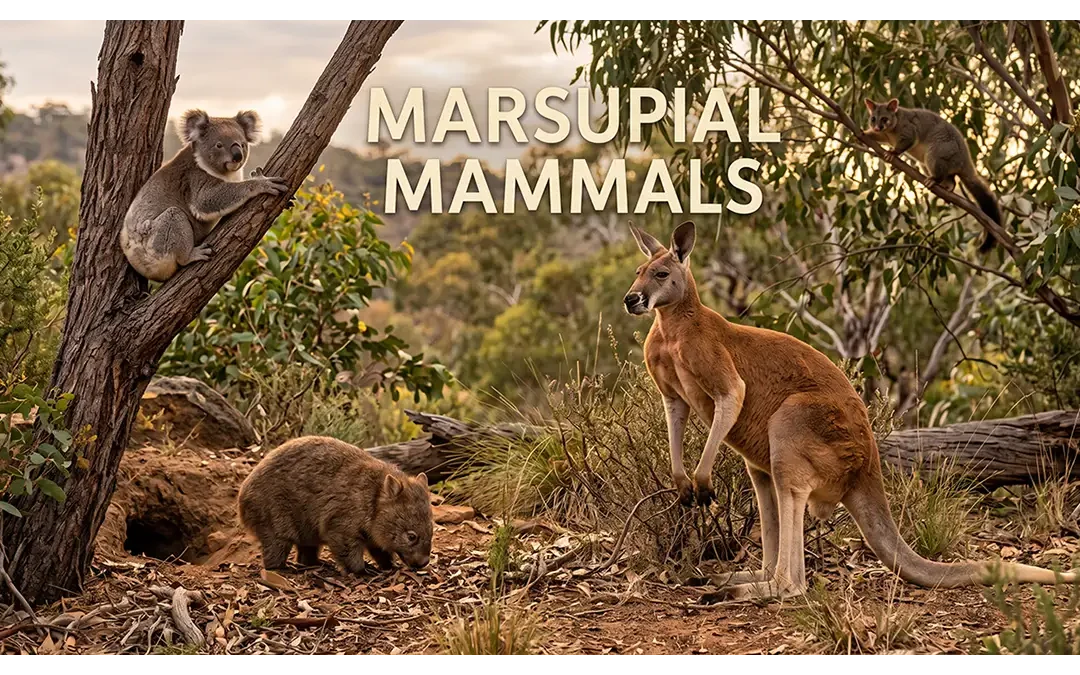
Marsupial mammals are a specialized group of mammals whose young are born at a very early stage of development and continue growing after birth while attached to a teat. Kangaroos, koalas, wombats, possums, bandicoots, quolls, Tasmanian devils, and opossums are among the best-known examples.
Marsupials have evolved into many different forms and occupy environments ranging from tropical forests and grasslands to deserts and temperate woodlands. Although they are especially diverse in Australia and New Guinea, marsupials also occur in the Americas. Their unusual reproductive biology, wide ecological diversity, and long evolutionary history make them an important group for understanding mammalian evolution.
What Are Marsupial Mammals?
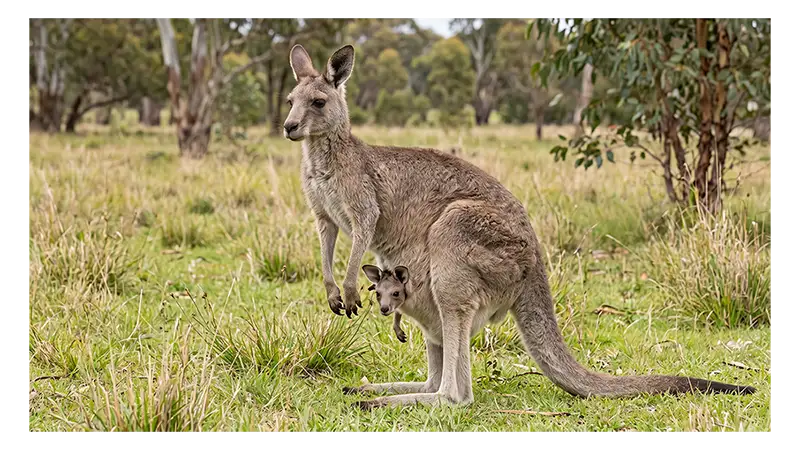
Marsupial mammals are mammals belonging to Marsupialia, a group within the larger mammalian lineage. Their most distinctive feature is their reproductive pattern: the young are born after a relatively short pregnancy while still at an extremely immature stage.
A newborn marsupial is usually tiny compared with its mother. Its forelimbs and mouth are sufficiently developed to help it reach and attach to a teat, where it receives milk and continues developing.
Many marsupials have a pouch, but not every marsupial has a permanent external pouch. Pouch structure varies considerably among species. In some animals, the pouch is deep and well developed, while in others it is reduced or replaced by folds of skin.
Marsupials also display considerable variation in body form. A kangaroo is adapted for powerful hopping, a wombat has a compact body suited to digging, and a sugar glider has a membrane that allows it to glide between trees. This diversity shows that marsupials are not defined by one particular lifestyle or body shape.
They belong to the mammalian branch of the animal kingdom, meaning they share fundamental mammalian traits such as hair and milk production. Their distinctive feature is the way reproduction and early development are organized.
What Are the Main Types of Marsupials?
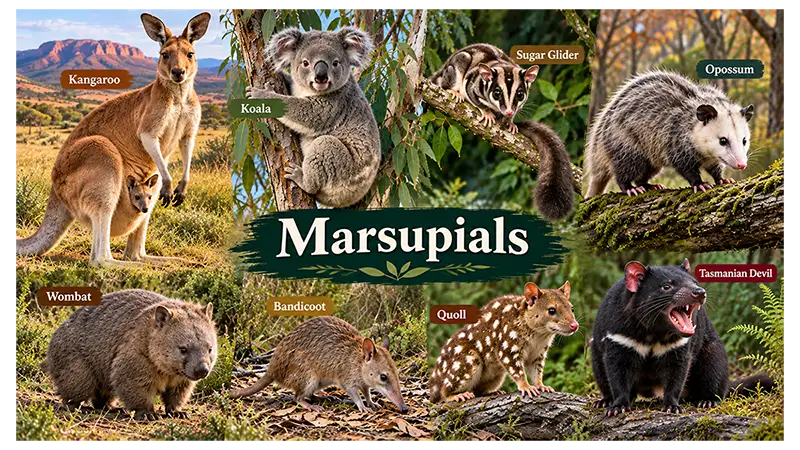
Marsupials include many different species with specialized body forms, diets, and lifestyles. They can be grouped into several well-known types based on their evolutionary relationships and characteristics.
1. Kangaroos and Wallabies
Kangaroos and wallabies are members of the macropod group. They have powerful hind legs, large feet, and strong tails that help with balance during movement. Kangaroos are among the largest living marsupials, while wallabies are generally smaller.
2. Koalas
Koalas are tree-dwelling marsupials native to Australia. They spend much of their time in eucalyptus trees and feed mainly on eucalyptus leaves. Their specialized digestive system helps them process this relatively low-energy food.
3. Wombats
Wombats are sturdy, ground-dwelling marsupials adapted for digging. Their powerful limbs and strong claws allow them to construct underground burrows, where they can shelter from environmental extremes.
4. Possums and Gliders
Possums and gliders include numerous mostly arboreal species. Many are excellent climbers, while gliders such as the sugar glider have a membrane between their limbs that allows them to glide from tree to tree.
5. Bandicoots and Bilbies
Bandicoots and bilbies are generally small to medium-sized marsupials with pointed snouts. Depending on the species, they may feed on insects, small animals, seeds, fruits, or other plant material.
6. Quolls
Quolls are carnivorous marsupials found mainly in Australia and New Guinea. They have spotted coats, strong jaws, and sharp teeth that help them capture and consume animal prey.
7. Tasmanian Devil
The Tasmanian devil is the largest living carnivorous marsupial. It has a compact, powerful body and strong jaws, allowing it to consume meat, carrion, and bones.
8. American Opossums
American opossums are marsupials found across parts of the Americas. They are generally adaptable animals with flexible diets and can occupy forests, grasslands, agricultural areas, and human-modified environments.
These groups demonstrate the remarkable diversity of marsupials, from large grassland herbivores and specialized leaf eaters to tree-dwelling gliders and active predators.
How Do Marsupial Mammals Reproduce?
Marsupial reproduction begins with fertilization inside the female reproductive tract. Compared with many placental mammals, pregnancy is generally short, although the exact duration varies among species.
The embryo develops for a limited period before birth. When birth occurs, the newborn is extremely small and immature. Its hind limbs and many other body systems are not yet fully developed, but its forelimbs and mouth are sufficiently functional for the next stage.
After birth, the young animal makes its way toward a teat. In species with pouches, it usually enters the pouch and attaches to a teat. The mother then provides milk while the young continues developing.
Milk composition changes during development. As the offspring grows, the nutritional needs of the young change as well, and the mother's milk adjusts accordingly.
The young eventually becomes more independent. In pouch-bearing species, it may begin leaving the pouch for short periods before becoming capable of living outside it permanently.
This reproductive system means that a large part of early development takes place after birth. Maternal care therefore remains especially important during the first stages of a marsupial's life.
What Makes Marsupials Different From Other Mammals?
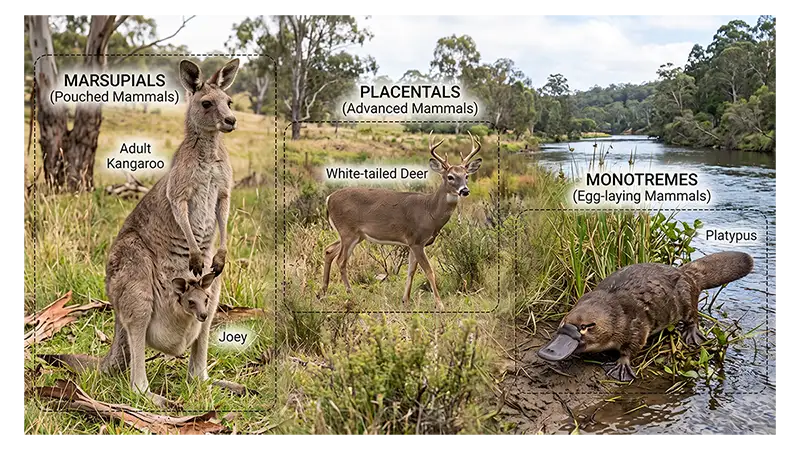
Marsupials are mammals, but their reproductive biology differs significantly from that of placental mammals and monotremes.
| Feature | Marsupials | Placental Mammals | Monotremes |
|---|---|---|---|
| Reproduction | Give birth to very undeveloped young | Usually give birth to more developed young | Lay eggs |
| Milk production | Yes | Yes | Yes |
| Pouch | Present in many species, but not all | Absent | Absent |
| Early development | Much development occurs after birth | Much development occurs before birth | Embryonic development occurs inside eggs |
| Examples | Kangaroos, koalas, wombats, opossums | Humans, dogs, elephants, whales | Platypus, echidnas |
The biggest distinction is the timing of development. In marsupials, the newborn enters the world at a much earlier developmental stage than is typical for placental mammals.
Their reproductive anatomy also contains distinctive features associated with their evolutionary history. Female marsupials generally have reproductive structures that differ from those of placental mammals.
Another important point is that the pouch is not the defining feature of every marsupial. It is a common adaptation, but different species have evolved different arrangements for protecting and nursing their young.
Marsupials also show considerable anatomical variation because their ancestors diversified into many ecological roles. Therefore, a kangaroo, koala, and opossum may look very different despite belonging to the same broad evolutionary group.
Where Do Marsupials Live?
Marsupials have a broad but geographically distinctive distribution. Today, their greatest diversity occurs in Australia and New Guinea, with additional species found in parts of the Americas.
Australia is particularly notable for its marsupial diversity. Kangaroos, wallabies, koalas, wombats, possums, gliders, bandicoots, quolls, and the Tasmanian devil represent different branches and ecological lifestyles.
Tasmania is home to several distinctive marsupials, including the Tasmanian devil. New Guinea also supports a diverse collection of marsupials, especially possums, tree kangaroos, and other forest-dwelling forms.
In the Americas, opossums represent the living marsupial diversity. The Virginia opossum, for example, occurs across a broad region of North America.
The presence of marsupials on different continents reflects a long evolutionary history involving changing geography, dispersal, isolation, and diversification.
What Do Marsupials Eat?
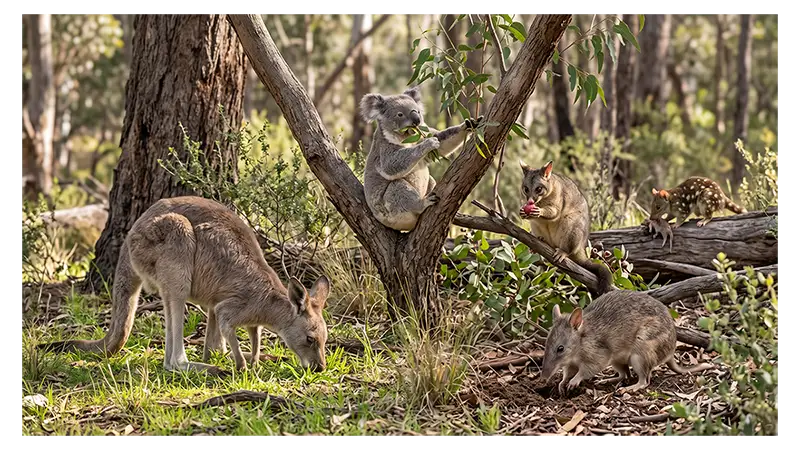
Marsupial diets vary widely because different species have evolved to exploit different food resources.
Herbivorous marsupials include kangaroos, wallabies, wombats, and koalas. They consume grasses, leaves, roots, or other plant material depending on their species.
Koalas have a particularly specialized diet centered on eucalyptus leaves. Because these leaves contain relatively low levels of available nutrients and can contain defensive chemicals, koalas have evolved specialized digestive systems and feeding behavior.
Carnivorous marsupials include animals such as quolls and the Tasmanian devil. They may consume insects, small vertebrates, carrion, or larger prey depending on the species.
Insectivorous species rely heavily on insects and other small invertebrates. Bandicoots, for example, commonly search through soil and leaf litter for food.
Omnivorous marsupials consume a mixture of plant and animal foods. Several possums and opossums have flexible diets that can change according to seasonal and local food availability.
Some marsupials also consume fruit, flowers, nectar, or other plant resources. This dietary variety allows marsupials to occupy numerous ecological roles.
How Are Marsupials Adapted to Their Environments?
Marsupials have evolved specialized physical and behavioral traits that allow them to survive in very different environments.
Powerful Hind Limbs
Kangaroos and related macropods have exceptionally strong hind limbs. Their long feet and large tendons help them move efficiently through open landscapes using hopping locomotion.
Burrowing Abilities
Wombats have compact bodies, strong limbs, and powerful claws that help them excavate underground burrows. These shelters provide protection and create a stable environment away from extreme surface conditions.
Climbing Adaptations
Many arboreal marsupials have feet and claws suited to gripping branches. Their flexible limbs allow them to move through forest canopies and search for food above the ground.
Gliding Membranes
Gliding marsupials such as sugar gliders possess a membrane extending between their limbs. By stretching this membrane, they can glide from one tree toward another without true powered flight.
Specialized Feeding Structures
Different diets have produced different teeth and jaw structures. Herbivores generally have features suited to processing plant material, while carnivorous species possess teeth and jaws adapted for capturing and consuming animal prey.
Water Conservation
Some marsupials living in dry environments have physiological and behavioral adaptations that help them reduce water loss. Activity patterns, shelter use, and food selection can all contribute to survival in arid conditions.
Nocturnal Activity
Many marsupials are active mainly at night. Nocturnal behavior can reduce exposure to daytime heat and allow animals to search for food when temperatures are lower.
These adaptations demonstrate that marsupial diversity is closely connected to the environments and ecological opportunities available to different species.
How Did Marsupials Evolve?
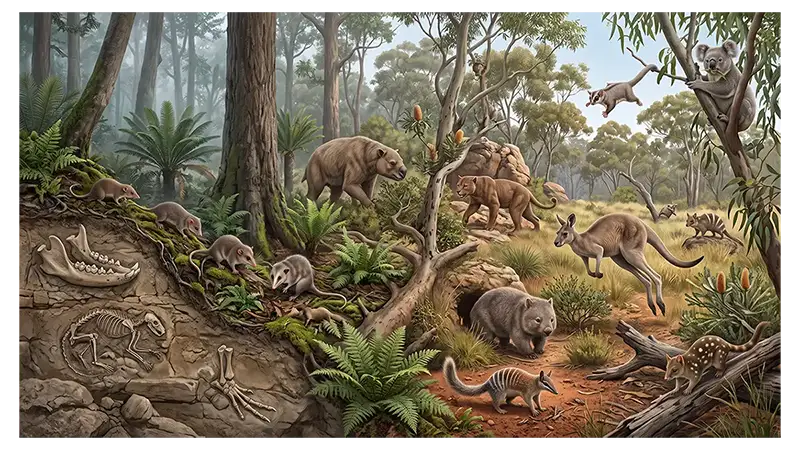
The evolutionary history of marsupials extends deep into the Mesozoic Era. Their early relatives were small mammals living alongside many other mammalian lineages and dinosaurs.
Fossil evidence shows that the history of marsupials and their close relatives is more complicated than a simple progression from one modern species to another. Multiple branches developed over millions of years, and many extinct forms had characteristics unlike any living marsupial.
Marsupial evolution is strongly associated with both the Americas and the southern continents. Their ancestors diversified in ancient environments before different lineages became established in regions that eventually included South America, Antarctica, Australia, and surrounding areas.
Australia later became a major center of marsupial diversification. Geographic isolation and the availability of different ecological opportunities allowed marsupials to evolve into herbivores, predators, climbers, burrowers, and gliders.
The fossil record is especially valuable because many extinct marsupials were very different from modern examples. Fossils help scientists reconstruct how body size, feeding strategies, locomotion, and other traits changed through time.
Marsupial evolution is therefore an example of adaptive diversification, in which related organisms evolve different characteristics as they occupy different ecological roles.
What Threats Do Marsupials Face and How Can They Be Protected?
Many marsupial species face environmental pressures caused by habitat changes and human activity. The severity of these threats varies considerably among species.
Major Threats
Habitat loss is one of the most important problems. Clearing forests, woodlands, grasslands, and other natural environments reduces the areas available for feeding, breeding, and shelter.
Habitat fragmentation can divide previously connected populations into smaller groups. This may restrict movement and reduce opportunities for animals to interact with other populations.
Introduced predators can create severe pressure on native marsupials, particularly small species that evolved without certain non-native predators.
Road mortality is another major concern. Animals crossing roads can be killed by vehicles, especially in areas where roads pass through wildlife habitat.
Wildfires and changing climate conditions can also alter food availability, shelter, and habitat quality. Some species are particularly vulnerable when environmental changes occur faster than populations can adapt.
Conservation Measures
Protected areas can preserve important habitat and provide safer places for marsupial populations to survive.
Wildlife corridors can reconnect fragmented habitats and allow animals to move between isolated areas. This is particularly useful for species that require large home ranges or need to move seasonally.
Habitat restoration can improve damaged ecosystems by allowing native vegetation to recover and restoring suitable feeding and shelter areas.
For some threatened species, captive breeding and carefully planned reintroduction programs can increase population numbers or restore animals to parts of their former range.
Predator management, disease monitoring, safer road designs, and community conservation programs can provide additional protection.
Successful conservation depends on the needs of individual species. A strategy that works for a large herbivorous kangaroo may not be appropriate for a small forest-dwelling marsupial.
Conclusion
Marsupial mammals represent one of the most distinctive branches of mammalian diversity. Their early birth and extended development after birth give them a reproductive strategy unlike that of most placental mammals, while their varied body forms show how successfully they have adapted to different ecological conditions.
From hopping kangaroos and burrowing wombats to tree-dwelling gliders and predatory quolls, marsupials occupy remarkably different ecological roles. Their evolutionary history, preserved through both living species and fossils, also provides valuable evidence for understanding how mammalian lineages diversify.
Today, habitat loss, introduced predators, roads, fire, disease, and environmental change place pressure on some marsupial populations. Protecting their habitats and maintaining connected ecosystems are therefore essential for preserving this distinctive part of mammalian biodiversity.
No. Many marsupials have pouches, but pouch structure varies among species, and some have reduced or absent external pouches.
No. Australia and New Guinea contain the greatest diversity of living marsupials, but opossums and their relatives also occur in the Americas.
Marsupial babies are born very early in development and continue growing after birth while attached to a teat. In many species, the young spends part of this period inside a pouch.
The red kangaroo is generally considered the largest living marsupial, with large males capable of reaching several times the body mass of many smaller marsupial species.
Yes. Opossums are marsupials and represent the largest living marsupial group in the Americas.