
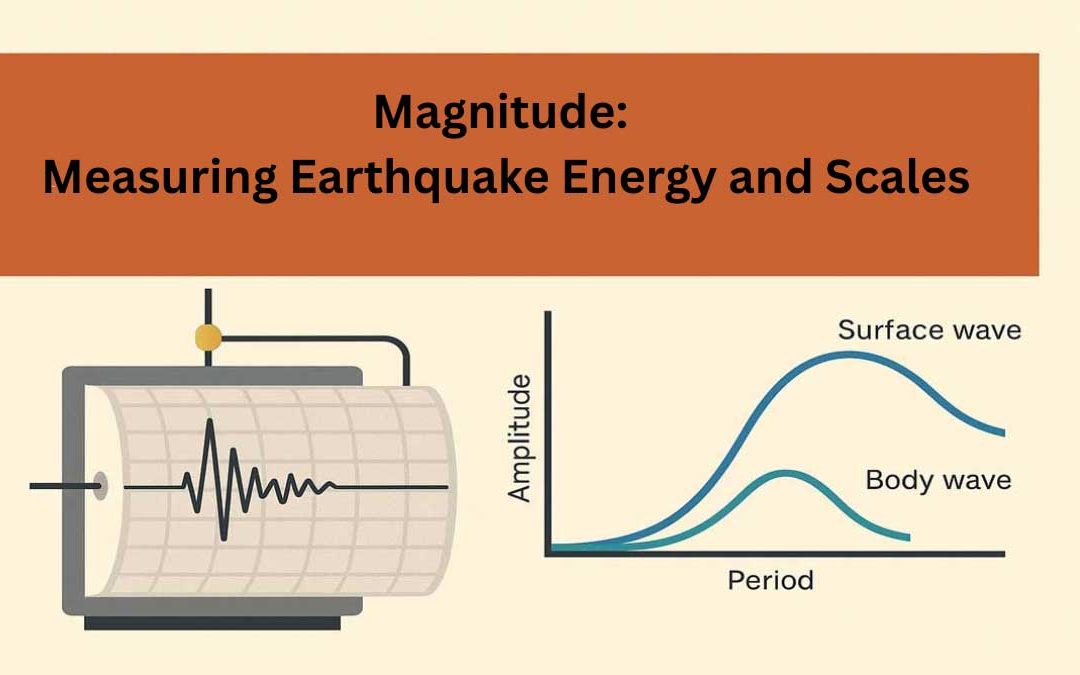
Magnitude is a measurement of the energy released by an earthquake. Earthquake magnitude scales in general do not directly represent any physical parameters of the source. Magnitude scales can be used to represent the relative size of earthquakes.
Why Are Magnitude Scales Important?
- The simplicity of magnitude scales allows us to process large numbers of events very quickly.
- Providing the public with quick information on the size of an earthquake.
- Fundamental data to be included in earthquake catalogs, which are the basis for a variety of scientific research projects.
How Are Magnitude Scales Calculated?
The magnitude scales currently used to measure the relative sizes of earthquakes are based on empirical formulas that depend on the wave types and frequency bands used.
Use our latest earthquake energy calculator
Types of Magnitude Scales:
We will review several magnitude scales: ML, MS, mB, mb (P), mb (Lg), and Mw.
1. Richter’s Local Magnitude (ML or Richter Scale)
- The first earthquake-magnitude scale was the Richter scale, devised by Charles F. Richter, a seismologist at the California Institute of Technology.
- The Richter scale is based on the amplitude of seismic waves – the stronger the earthquake, the stronger the seismic vibrations it causes. The Richter magnitude of an earthquake is expressed as a decimal number, such as 6.7.
- The most important thing to remember about Richter magnitude is that it is a logarithmic scale, meaning that an increase of one in magnitude corresponds to a factor of tenincrease in the amplitude of ground motion. For example, a magnitude 6.7 earthquake causes shaking 10 times greater in amplitude than a magnitude 5.7 earthquake and 100 times greater than a magnitude 4.7 earthquake.
2. Other Magnitude Scales
Simulation of traditional short– and long–period seismograms from digital, broadband record. We determine:
- mb(P) from WWSSN-SP (World Wide Standardized Seismographic Network) short-period record.
- mB and Ms from WWSSN-LP record.
Frequency Bands and Instruments Used for Magnitude Determination:
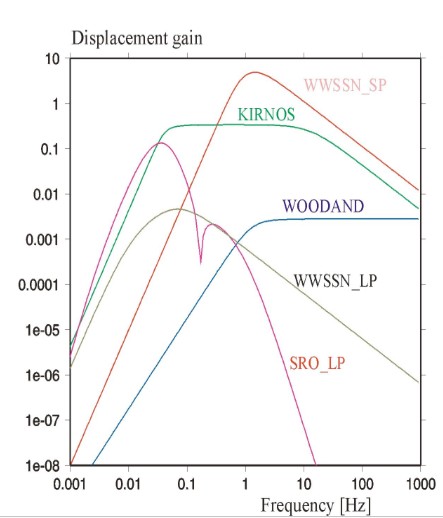
Instruments Used Worldwide:
- WOODAND = Wood-Anderson torsion seismograph, T0=0.8s
- WWSSN-SP = World-Wide Standardized Seismographic Network, short-period (T0=1s)
- WWSSN-LP = Press-Ewing long-period seismograph (T0=15s)
- KIRNOS = long-period SKD seismometer
- SRO = Seismic Research Observatory borehole seismometer with T0=30s
Amplitude and Period Measurements:
- B = zero-to-peak amplitude
- 2B = peak-to-peak amplitude
- B ~ ½ (2B)
- T = period
Wave Types Measured
a) & b) Teleseismic body-wave
c) Regional P- or S-wave train
d) Regional S or Rayleigh wave
e) Surface wave
Magnitude Calculations Based on Waveforms
- A – [Amax] → ML (Richter scale)
- A/T – [Amax / T] → Ms, mB, mb(P)
- (A/T)max → mb(Lg)
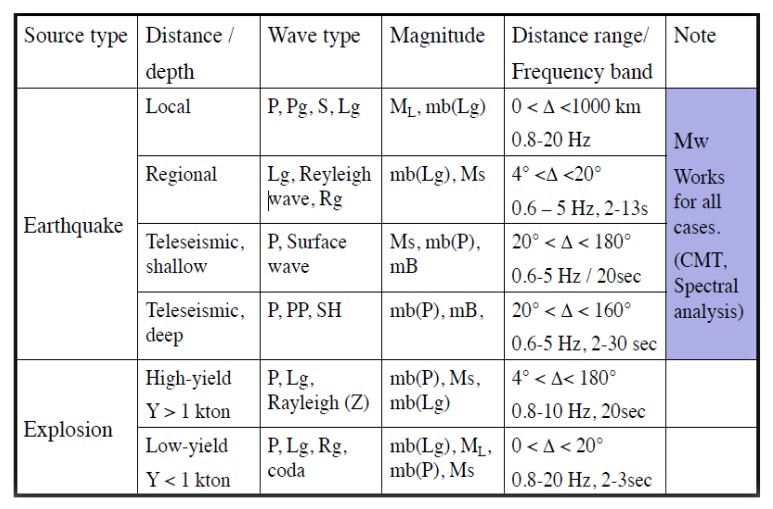
Usage of various Magnitude Scales, a Summary Table:
Magnitude vs Intensity
Magnitude and intensity describe different aspects of an earthquake.Magnitude describes the size of an earthquake at its source. Each earthquake has one magnitude.
Intensity describes the strength of shaking and its effects at a particular location. Intensity can vary considerably from one place to another depending on factors such as distance from the rupture, local geology, and the characteristics of the earthquake.
In the United States, scientists commonly use the Modified Mercalli Intensity (MMI) Scale to describe earthquake intensity. The scale uses Roman numerals to represent observed effects and shaking.
Therefore:
Magnitude = size of the earthquake
Intensity = shaking and effects at a particular location
Earthquake Magnitude Scale Comparison
| Magnitude Scale | Main Basis | Typical Use |
|---|---|---|
| ML | Local seismic-wave amplitude | Smaller and local earthquakes |
| mb | Short-period body waves | Teleseismic and moderate earthquakes |
| Ms | Surface waves | Large, shallow earthquakes |
| mb(Lg) | Lg surface waves | Regional earthquakes |
| Mw | Seismic moment | Modern measurement of earthquake size |
| Md | Duration of shaking | Some small earthquakes |
| Me | Radiated seismic energy | Energy-based earthquake measurement |
The exact applicability of each scale depends on earthquake size, distance, available instruments, and the seismic data recorded.
Magnitude Scale and Instrument Correlation:
| Magnitude Scale | Instruments Used |
| mb(P) | WWSSN-SP, KIRNOS |
| mB | Benioff 1-90, WWSSN-LP, KIRNOS |
| Ms | WWSN-LP, SRO, KIRNOS |
| ML | WOODAND |
| Mw | broadband |
Yes. Local magnitude (ML), commonly called the Richter scale, is still used for some smaller, local earthquakes. However, it is not the preferred scale for large worldwide earthquakes, for which moment magnitude (Mw) is generally more appropriate.
Moment magnitude (Mw) is the preferred modern scale for many earthquakes, particularly large earthquakes. Other magnitude types are still used when they are more appropriate for the earthquake and available seismic data.
ML, or local magnitude, is based on the amplitude of seismic waves recorded at relatively short distances. Mw is based on seismic moment and the physical characteristics of the earthquake source. Mw is more suitable for measuring large earthquakes.
A magnitude 7 earthquake produces approximately 10 times greater measured seismic-wave amplitude than a magnitude 6 earthquake. However, it releases approximately 32 times more energy.
Yes. Different magnitude methods may produce slightly different values because scientists use different seismic measurements and calculation procedures. Earthquake catalogs therefore may list several magnitude estimates for the same event.
Conclusion:
Earthquake magnitude scales provide standardized ways to describe and compare earthquake sizes. Scientists developed the original Richter scale, or local magnitude (ML), for local earthquakes, and it remains useful for smaller events. Scientists also developed other scales, including body-wave magnitude (mb), surface-wave magnitude (Ms), and Lg-wave magnitude, to measure specific seismic waves and conditions.
Modern seismology relies heavily on moment magnitude (Mw) because it uses the physical characteristics of the earthquake source and provides a more reliable measure for large earthquakes. Traditional magnitude scales can saturate as earthquake size increases, while Mw works across a much wider range.
Scientists also distinguish between magnitude and intensity. Magnitude describes an earthquake's size, while intensity describes the shaking and effects at a particular location. Together, these measurements help scientists study earthquakes and communicate their potential effects more accurately.