
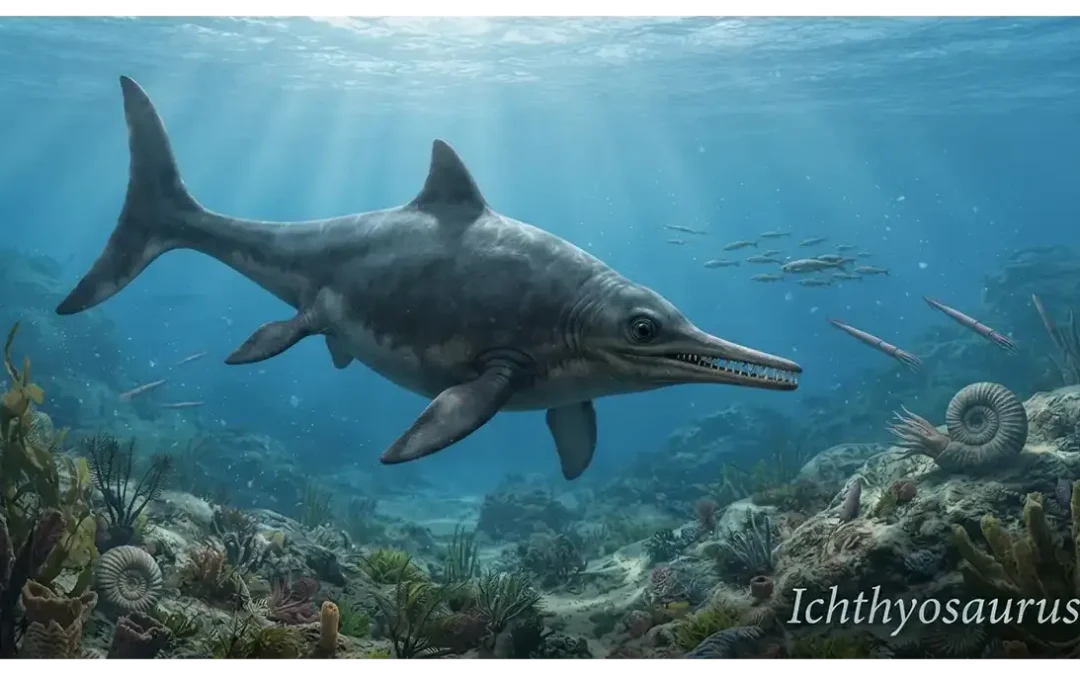
Ichthyosaurus was a marine reptile that lived in the oceans during the Mesozoic Era. Its streamlined body, large eyes, powerful tail, and paddle-like limbs made it highly adapted to life in the sea.
Although Ichthyosaurus looked somewhat like a modern dolphin, it was not a mammal. It was a reptile belonging to the ichthyosaurs, an extinct group of marine reptiles that evolved from land-dwelling ancestors and became highly specialized for swimming.
Ichthyosaurus fossils are especially important because they preserve detailed evidence of marine reptile anatomy, diet, reproduction, and evolution. Some fossils even preserve embryos or young individuals, providing clues about how these animals reproduced.
What Was Ichthyosaurus?
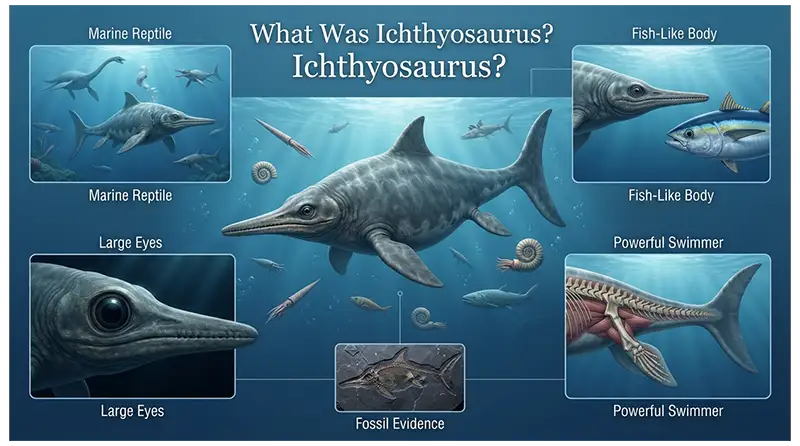
Ichthyosaurus was a genus of extinct marine reptiles belonging to the group Ichthyosauria. The name Ichthyosaurus means “fish lizard,” reflecting its fish-like body shape.
Ichthyosaurus lived mainly during the Triassic and Jurassic periods. Its fossils are particularly well known from rocks in Europe, especially the United Kingdom and Germany, although related ichthyosaurs had a much wider distribution. Despite its fish-like appearance, Ichthyosaurus was a reptile. Its ancestors were terrestrial reptiles, but over evolutionary time their descendants became increasingly specialized for marine life.
The body was streamlined for swimming, and the limbs were modified into paddles. A strong tail provided much of the propulsion needed for fast movement through the water. Ichthyosaurus was therefore an excellent example of convergent evolution. Its overall shape became similar to that of fish and dolphins because swimming efficiently in the ocean placed similar demands on very different groups of animals.
What Did Ichthyosaurus Look Like?
Ichthyosaurus had a streamlined body with a narrow snout, large eyes, paddle-like limbs, and a powerful tail. Its appearance was strongly adapted to moving through water.
Streamlined Body
The body was shaped to reduce resistance as the animal moved through the ocean. A smooth, streamlined form allowed Ichthyosaurus to swim efficiently. Its body was relatively compact compared with the long, flexible bodies of some other marine reptiles.
Large Eyes
Ichthyosaurus had remarkably large eyes. Large eyes were particularly useful for an active marine predator because they could help the animal see in dim underwater conditions. Some ichthyosaurs had exceptionally large eyes compared with other vertebrates. This feature may have been especially useful when hunting prey at greater depths or during periods of low light.
Paddle-Like Limbs
The forelimbs and hind limbs were transformed into flattened structures used mainly for steering and controlling movement. They were not shaped like the legs of a land reptile. Instead, their bones were packed into compact paddle-like structures.
Tail
The tail was one of the most important parts of the swimming system. The rear portion of the body narrowed toward the tail, which provided powerful movement through the water. The tail was suited to rapid side-to-side motion and helped Ichthyosaurus pursue prey.
How Big Was Ichthyosaurus?
The size of Ichthyosaurus varied depending on the species and individual. Some species were relatively small, while others were larger. Many Ichthyosaurus individuals were several meters long. One commonly known species, Ichthyosaurus communis, reached roughly 2 to 3 meters in length, although size estimates can vary among specimens.
It is important not to confuse Ichthyosaurus with the largest ichthyosaurs. Some later ichthyosaur genera, such as Shonisaurus and Ichthyotitan, reached much greater sizes. Ichthyosaurus was therefore a relatively moderate-sized member of a much larger evolutionary group. Its streamlined shape allowed it to combine speed and maneuverability, making it well suited to hunting smaller marine animals.
How Was Ichthyosaurus Adapted to Life in the Ocean?
Ichthyosaurus had several physical and biological adaptations that allowed it to live and hunt efficiently in marine environments. Its body was shaped for swimming, while its eyes, limbs, teeth, and reproductive strategy helped it survive in the open ocean.
Streamlined Body
Ichthyosaurus had a long, streamlined body that reduced resistance as it moved through water. Its body shape was broadly similar to that of modern fast-swimming marine animals, although this similarity resulted from convergent evolution rather than close relationship. A streamlined form allowed Ichthyosaurus to travel efficiently while searching for prey or escaping predators.
Powerful Tail
The tail was one of the most important structures for swimming. Its vertebral column extended into the tail, which ended in a vertically oriented fin. Side-to-side movements of the tail produced forward thrust and helped Ichthyosaurus maintain speed while pursuing prey.
Paddle-Like Limbs
Ichthyosaurus had four modified limbs that functioned as flippers. These limbs were no longer suited for walking on land and were mainly adapted for controlling movement in water. The forelimbs and hind limbs helped with steering, stability, and changes in direction while swimming.
Large Eyes
Ichthyosaurus had remarkably large eyes compared with many other vertebrates. Large eyes could have been particularly useful for detecting prey and navigating in environments where light levels were low, including deeper water. Their excellent visual capacity may also have helped during hunting.
Strong Swimming Muscles
The body and tail were supported by well-developed muscles that allowed repeated swimming movements. This combination of a streamlined body, powerful tail, and specialized limbs made Ichthyosaurus an active marine swimmer rather than a slow-moving animal that simply drifted with ocean currents.
Specialized Teeth and Jaws
Ichthyosaurus had jaws equipped with numerous pointed teeth. These teeth were useful for gripping slippery prey such as fish and small marine animals. Its feeding structures were therefore well suited to a predatory lifestyle in the ocean.
Live Birth
One of the most important adaptations to a fully aquatic lifestyle was live birth. Ichthyosaurs did not need to return to land to lay eggs. Fossils containing embryos and young individuals provide evidence that reproduction occurred in the water. This allowed Ichthyosaurus to remain marine throughout its life.
Large Body and Efficient Movement
A relatively large, streamlined body provided advantages for movement through water and helped maintain momentum during swimming. Combined with its tail propulsion and paddle-like limbs, this body design allowed Ichthyosaurus to move through Mesozoic seas while searching for food and avoiding danger.
A Combination of Ocean Adaptations
Ichthyosaurus was therefore adapted to marine life through a combination of features rather than a single specialized structure. Its streamlined body, powerful tail, paddle-like limbs, large eyes, predatory teeth, swimming muscles, and live-bearing reproduction worked together to support life in the ocean. These adaptations made Ichthyosaurus one of the distinctive marine reptiles of the Triassic and Jurassic seas.
What Did Ichthyosaurus Eat?
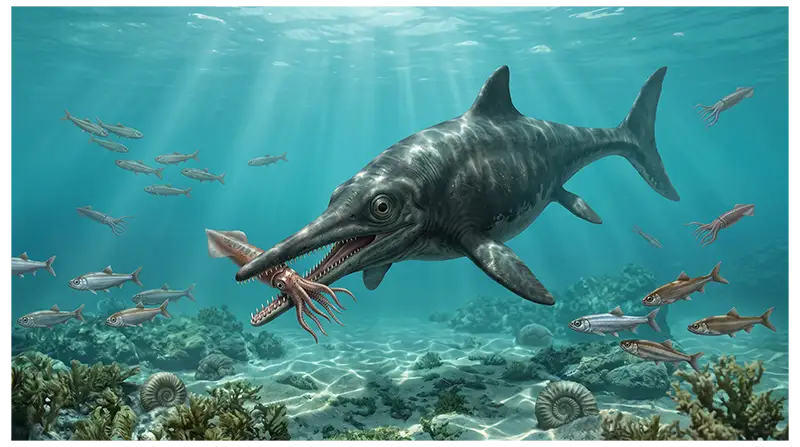
Ichthyosaurus was a carnivorous marine predator. Its diet probably included small animals that were abundant in Mesozoic seas.
Potential prey included:
- Fish
- Small marine reptiles
- Squid-like cephalopods
- Belemnites
- Other soft-bodied marine animals
Its long jaws and numerous pointed teeth were well suited to catching slippery prey. The teeth could help hold animals such as fish and cephalopods while the predator swallowed them.
Feeding in the Ocean
Ichthyosaurus probably searched for prey using its strong vision and other sensory abilities. Its streamlined body allowed it to move quickly through the water, while its large eyes may have helped it locate prey in low-light conditions. Fossil stomach contents and associated remains from ichthyosaurs provide additional evidence about the diets of these marine reptiles.
How Did Ichthyosaurus Hunt?
Ichthyosaurus was an active marine predator. Its streamlined body and powerful tail allowed it to move rapidly through the water. This would have been useful when chasing fish and other fast-moving prey. Its large eyes were another important feature. Good vision could help it detect prey in the open ocean, particularly where light levels were low.
Hunting Small Marine Animals
Fish and cephalopods were likely important parts of its diet. Ichthyosaurus could use its jaws and teeth to grasp prey before swallowing it. Some evidence from ichthyosaur fossils suggests that members of the group had different feeding strategies. Their diets were influenced by jaw shape, tooth structure, body size, and the prey available in different marine environments.
This means that Ichthyosaurus should not be viewed simply as a generalized “fish eater.” Its feeding ecology was more closely connected to the available marine food web.
Where and When Did Ichthyosaurus Live?
Ichthyosaurus lived in marine environments during the Triassic and Jurassic periods. Its fossils are especially well known from Europe, including regions that are now part of the United Kingdom and Germany. During the Mesozoic Era, the geography of Earth was very different from today. Continents were positioned differently, and large shallow seas covered many regions.
These marine environments supported abundant fish, cephalopods, marine reptiles, and other organisms that provided food for predators such as Ichthyosaurus.
Triassic and Jurassic Seas
The earliest ichthyosaurs appeared during the Triassic Period after the end-Permian mass extinction. Over time, ichthyosaurs diversified and occupied many marine environments. Ichthyosaurus itself is particularly associated with the later Triassic and Jurassic fossil record.
Its fossils demonstrate that marine reptiles were important parts of ancient ocean ecosystems long before the appearance of modern marine mammals.
How Did Ichthyosaurus Reproduce?
One of the most interesting features of ichthyosaurs is their method of reproduction. Unlike many modern reptiles, they did not need to return to land to lay eggs. Fossils show evidence of live birth.
Embryos Inside Fossils
Some ichthyosaur fossils preserve embryos or very young individuals inside the body cavity of an adult. These discoveries provide direct evidence that ichthyosaurs gave birth to live young. The young were delivered directly into the marine environment.
Why Was Live Birth Important?
Live birth was an important adaptation for a fully aquatic animal. An animal as specialized for swimming as Ichthyosaurus would have been poorly suited to crawling onto land to lay eggs. Reproduction in the water allowed ichthyosaurs to complete their entire life cycle in marine environments.
The evolution of live birth in ichthyosaurs is an important example of how reproductive strategies can change as animals become adapted to new environments.
What Do Ichthyosaurus Fossils Reveal?
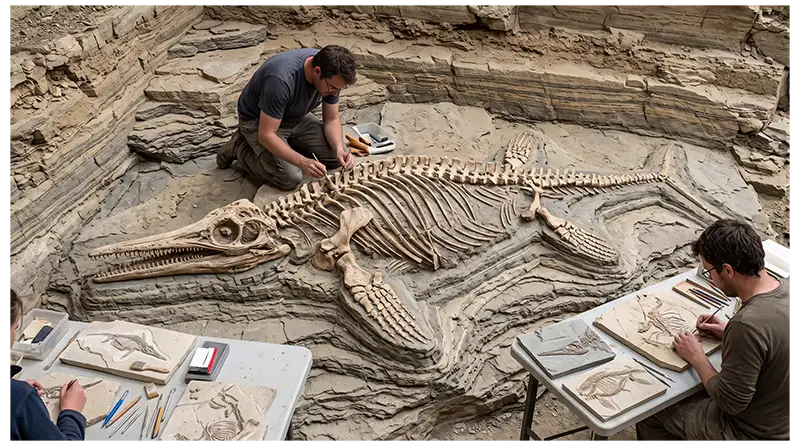
Ichthyosaurus fossils provide some of the most detailed evidence available for studying ancient marine reptiles.
The fossil record includes:
- Complete skeletons
- Skulls
- Jaws
- Teeth
- Limbs
- Vertebrae
- Tail structures
- Embryos
- Young individuals
- Occasionally preserved soft-tissue impressions
Complete Skeletons
Complete Ichthyosaurus skeletons can reveal the overall body shape of the animal. They show how the skull, backbone, ribs, limbs, and tail were arranged. This allows paleontologists to reconstruct how the animal moved and lived.
Fossil Embryos
Fossils containing embryos are especially valuable because they provide evidence about reproduction and development. They show that young ichthyosaurs developed inside the mother's body before being born into the water.
Fossil Teeth
Teeth provide clues about feeding behavior. Their shape and arrangement can help researchers determine whether an animal was adapted for catching fish, cephalopods, or other prey.
Fossil Distribution
The locations of Ichthyosaurus fossils also provide information about ancient oceans. When fossils are studied together with the surrounding rocks, scientists can reconstruct aspects of the marine environments in which these animals lived.
How Did Ichthyosaurus Evolve?
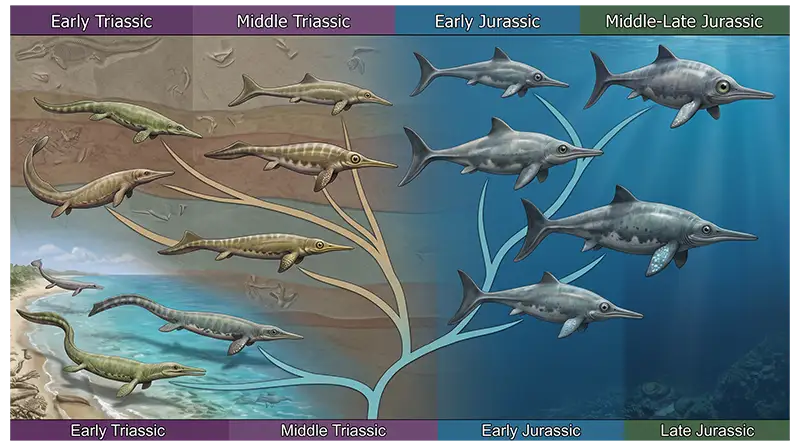
Ichthyosaurus was part of a much larger evolutionary history of ichthyosaurs. The earliest ichthyosaurs appeared during the Triassic Period, relatively soon after the end-Permian mass extinction. Their ancestors were terrestrial reptiles, but their descendants gradually developed adaptations for life in the ocean.
From Land to Sea
The transition involved major anatomical changes. Over evolutionary time, ichthyosaur ancestors developed:
- Streamlined bodies
- Paddle-like limbs
- Specialized tails
- Large eyes
- Strong swimming muscles
- Marine reproductive adaptations
These changes allowed them to become increasingly independent of life on land.
Convergent Evolution
Ichthyosaurs are a classic example of convergent evolution. Their body shape resembles that of modern dolphins and some large predatory fish, but these animals are not closely related. The similarity developed because all of them faced similar physical challenges while moving rapidly through water. This makes ichthyosaurs especially valuable for studying how evolution can produce similar body designs in unrelated groups.
How Did Ichthyosaurus Become Extinct?
Ichthyosaurus eventually disappeared from the fossil record as part of the broader changes that affected ichthyosaurs. However, it is important to distinguish the extinction of Ichthyosaurus as a genus from the much later extinction of the entire ichthyosaur group. Ichthyosaurs survived for millions of years after Ichthyosaurus disappeared and remained important marine predators during much of the Mesozoic.
Several factors may have influenced changes in ichthyosaur diversity, including:
- Changes in marine ecosystems
- Changes in available prey
- Climate changes
- Ocean conditions
- Competition with other marine predators
- Long-term evolutionary turnover
Ichthyosaurs eventually became extinct completely near the end of the Cretaceous Period, well after the time of Ichthyosaurus. Therefore, the disappearance of Ichthyosaurus should not be described as the final extinction of all ichthyosaurs.
Why Is Ichthyosaurus Important to Paleontology?
Ichthyosaurus is one of the most important marine reptiles for understanding the evolution of life in the oceans. Its fossils show how a group of reptiles evolved from land-dwelling ancestors into highly specialized marine predators. The genus is particularly useful because some fossils preserve remarkably complete skeletons.
These fossils help scientists investigate:
- Marine reptile anatomy
- Swimming adaptations
- Feeding behavior
- Reproduction
- Embryonic development
- Evolution
- Ancient marine ecosystems
- Convergent evolution
Ichthyosaurus also helped scientists recognize that extinct animals could have body forms very different from those of living reptiles. Its discovery and study played an important role in the development of vertebrate paleontology during the nineteenth century. The fossils therefore provide a direct connection between biology, geology, evolution, and Earth's ancient marine environments.
Conclusion
Ichthyosaurus was a highly specialized marine reptile that evolved a streamlined body, powerful tail, paddle-like limbs, large eyes, and other features suited to life in the ocean.
It was a carnivorous predator that likely fed on fish and cephalopods and used its streamlined body to move efficiently through the water. Unlike many modern reptiles, it gave birth to live young, allowing it to complete its life cycle entirely at sea.
Its fossils provide valuable evidence about ancient marine ecosystems, feeding behavior, reproduction, swimming adaptations, and evolutionary change. They also demonstrate how terrestrial reptiles could undergo major anatomical transformations after entering marine environments.
Although Ichthyosaurus eventually disappeared, its wider evolutionary group survived for millions of years afterward. For paleontology, it remains an important example of marine adaptation, convergent evolution, fossil preservation, and the long history of reptiles in Earth's oceans.
No. Ichthyosaurus was a marine reptile and belonged to Ichthyosauria, a group separate from dinosaurs.
No. It was a reptile that evolved a fish-like body through adaptation to marine life.
Many Ichthyosaurus individuals were around 2 to 3 meters long, although size varied among species.
It was a carnivore that likely ate fish, cephalopods, belemnites, and other small marine animals.
No. Evidence from ichthyosaur fossils shows that these animals gave birth to live young in the water.