
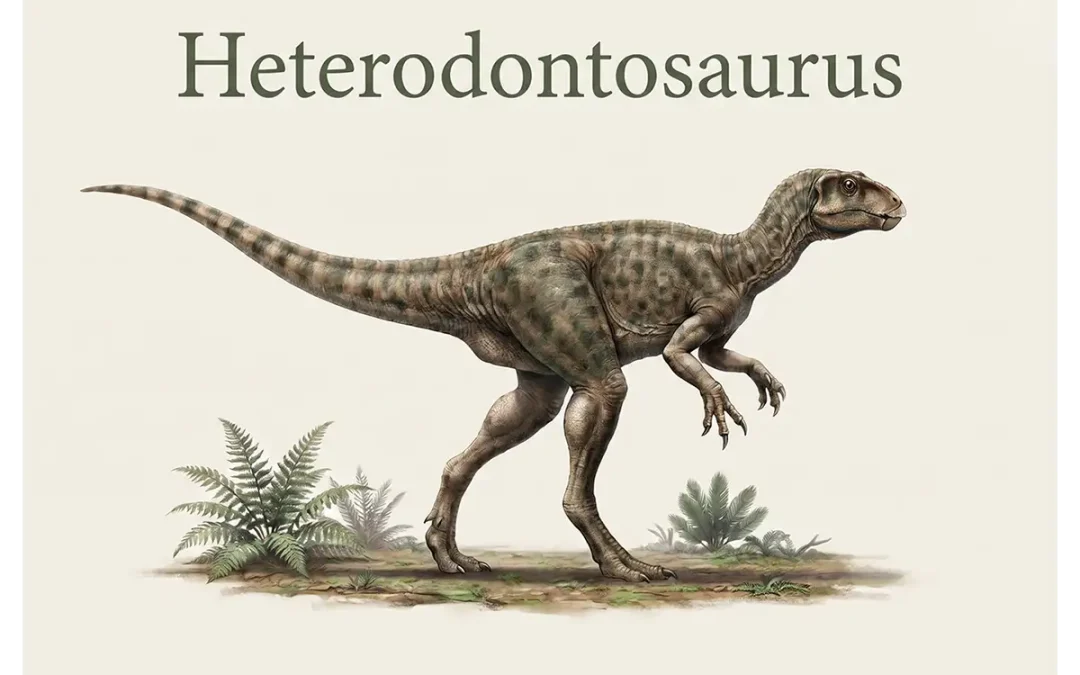
Heterodontosaurus was a small dinosaur that lived in southern Africa during the Early Jurassic Period. It is best known for its unusual teeth, which included small teeth for processing food and prominent canine-like teeth near the front of its jaws. These features make it an important animal for understanding the early evolution of ornithischian dinosaurs.
Despite its modest size, Heterodontosaurus had a distinctive skull, strong hind limbs, and grasping forelimbs. Its fossils provide clues about how early dinosaurs fed, moved, and adapted to their environments. However, some aspects of its diet, behavior, and appearance remain uncertain.
This article explores the anatomy, feeding adaptations, size, habitat, fossils, and evolutionary importance of Heterodontosaurus in simple, informative language.
What Was Heterodontosaurus?
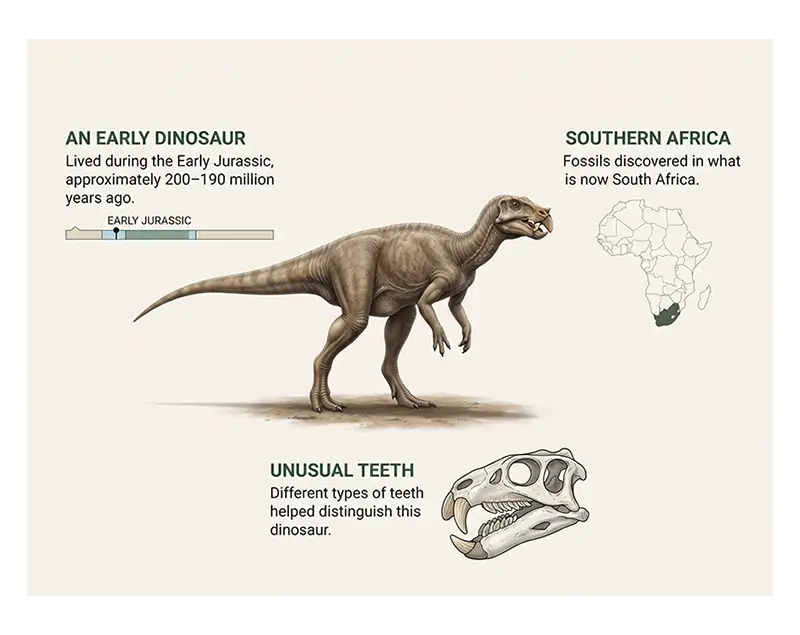
Heterodontosaurus was a small, early ornithischian dinosaur that lived approximately 200–190 million years ago, during the Early Jurassic. Its fossils are known from the region that is now South Africa. The best-known species is Heterodontosaurus tucki.
Its name means “different-toothed lizard,” referring to the different kinds of teeth in its jaws. Unlike many dinosaurs with more uniform teeth, this animal had a combination of small, leaf-shaped cheek teeth and enlarged canine-like teeth. A beak-like structure at the front of its jaws also helped distinguish it from many other early dinosaurs.
Heterodontosaurus belonged to Heterodontosauridae, a group of small ornithischian dinosaurs known for their distinctive dental anatomy. Ornithischians were a major dinosaur group that included later animals such as Triceratops, Stegosaurus, and Ankylosaurus.
Although those famous dinosaurs appeared in different periods and developed very different body forms, studying early ornithischians helps scientists investigate how this broad group evolved. Heterodontosaurus is particularly valuable because its well-preserved fossils reveal details of the skull and skeleton that are difficult to study in many other early dinosaurs.
What Did Heterodontosaurus Look Like?
Heterodontosaurus had a compact body, a relatively large head, long hind limbs, shorter forelimbs, and an extended tail. Its overall build suggests that it was a lightweight animal capable of moving quickly when necessary, although its exact running speed is unknown.
Its skull was one of its most distinctive features. The jaws contained several kinds of teeth, while the front of the mouth formed a beak-like region. These adaptations indicate that feeding involved more than simply biting and swallowing food.
The forelimbs were relatively short compared with the hind limbs, but they were not merely reduced structures. The hands had grasping fingers and claws that may have helped the animal handle food or interact with its surroundings. The precise range of hand movements and their everyday uses remain uncertain.
Its long tail likely helped balance the body during movement. The hind limbs were comparatively powerful, while the lighter front half of the body may have allowed different postures during feeding and locomotion.
Scientists can reconstruct much of its basic shape from fossil bones. However, details such as its exact skin color, external covering, and the appearance of soft tissues are less certain because these features are not clearly preserved in the known skeletal material.
Why Did Heterodontosaurus Have Different Types of Teeth?
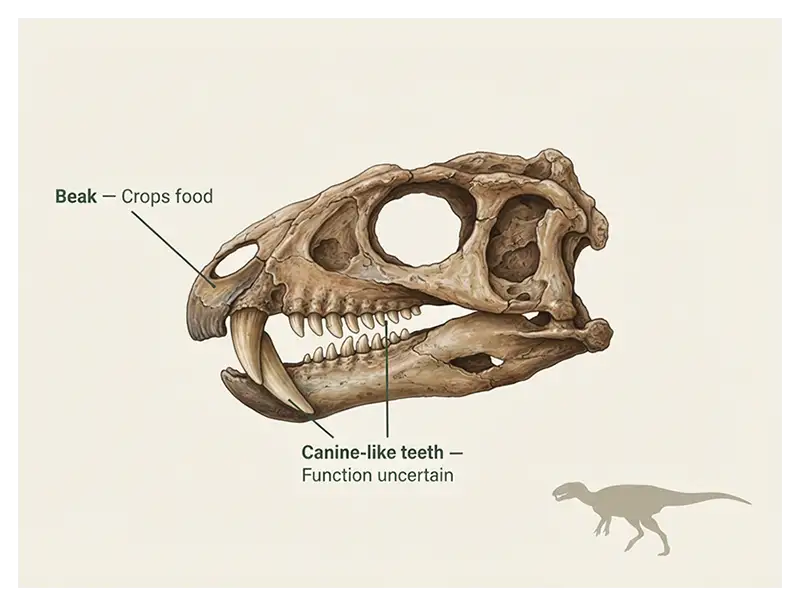
The most recognizable feature of Heterodontosaurus was its heterodont dentition, meaning that it had different types of teeth in the same mouth. This arrangement is unusual among reptiles and provides important evidence about how the animal processed food.
Its teeth can be divided into three main functional regions.
- Front of the jaws: A beak-like structure helped crop or grasp food. The front teeth were reduced compared with the enlarged cheek teeth farther back.
- Cheek teeth: These teeth had leaf-shaped crowns and specialized wear surfaces. They helped break down food during jaw movement.
- Enlarged canine-like teeth: Prominent, pointed teeth projected from the jaws. Their exact role remains uncertain.
The cheek teeth are especially interesting because their surfaces show distinctive patterns of wear. These patterns suggest that the upper and lower teeth interacted in a specialized way as the jaws closed. Research published in the Zoological Journal of the Linnean Society describes unusual tooth shapes, jaw anatomy, and evidence for a distinctive feeding mechanism.
Scientists have also studied the microscopic structure of its tooth enamel and dentine. A 2023 study found a wear-resistant band of dentine that contributed to the cutting edge of the cheek teeth. This discovery helps explain how the animal maintained effective food-processing surfaces.
Its canine-like teeth raise a separate question. They might have helped with display, competition between individuals, defense, or handling certain foods. However, fossils do not establish one definite function. Their presence alone does not prove that Heterodontosaurus regularly hunted other animals.
The combination of these dental features makes the dinosaur important for understanding how complex feeding adaptations evolved early in ornithischian history.
What Did Heterodontosaurus Eat?
Heterodontosaurus is generally interpreted as a dinosaur adapted primarily for plant eating, but its precise diet remains debated. Its beak-like front jaws and specialized cheek teeth support the idea that it could crop and process vegetation. The enlarged canine-like teeth, however, make its feeding habits more difficult to reconstruct with certainty.
Possible plant foods included soft leaves, young shoots, and other low-growing vegetation available in its environment. These are reasonable ecological possibilities rather than a confirmed menu: no direct evidence identifies every plant species it consumed.
Its cheek teeth likely played an important role in breaking down food. Tooth wear and the shape of the chewing surfaces indicate that the jaws were adapted for more than a simple up-and-down bite. This would have helped it process plant material before swallowing.
Some researchers have considered whether heterodontosaurids may have eaten a wider range of foods than strictly herbivorous dinosaurs. The enlarged teeth could have been used in social interactions or other behaviors instead of feeding, so an omnivorous diet cannot be established from those teeth alone.
The most careful conclusion is that Heterodontosaurus had specialized feeding adaptations consistent with substantial plant consumption, while the full range of foods it ate remains uncertain.
How Big Was Heterodontosaurus?
Heterodontosaurus was small compared with many better-known dinosaurs. A well-known skeletal reconstruction of Heterodontosaurus tucki is approximately 1.25–1.3 metres (about 4 feet) long. Estimates can vary with the specimen and reconstruction method.
Its relatively light build and compact body made it very different from the large, heavily built herbivores that appeared later in the Mesozoic Era. Its size also helps explain why its anatomy is often studied in discussions of early dinosaur diversity.
The skull was proportionally substantial, giving room for its distinctive teeth and jaw muscles. Its hind limbs were well developed, and its long tail extended behind the body. The forelimbs were also strongly built for an animal of its size, rather than being simple, functionless remnants.
Exact body mass is harder to establish than length because it depends on assumptions about muscle, organs, and other soft tissues that are rarely preserved. For that reason, estimated dimensions should be treated as reconstructions rather than direct measurements of a living animal.
How Did Heterodontosaurus Move?
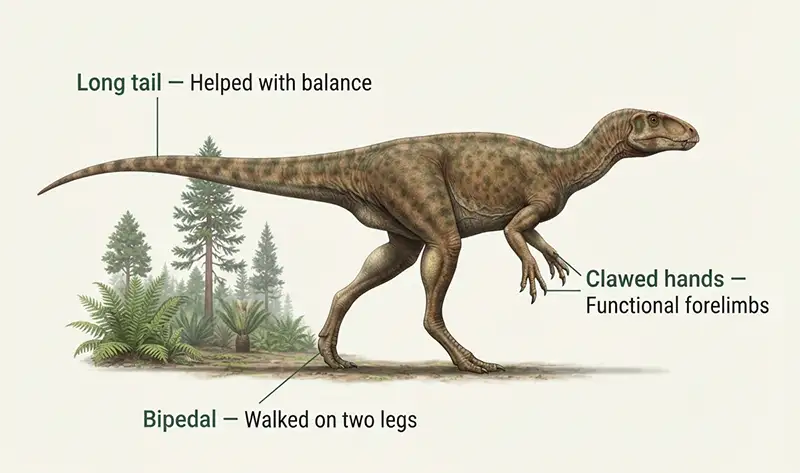
The skeleton of Heterodontosaurus suggests that it was capable of moving on two legs. Its hind limbs supported most of its body during bipedal locomotion, while its long tail likely helped with balance. Its lightweight build may have allowed rapid movement, although there is no reliable basis for assigning it a precise top speed.
Its forelimbs are particularly noteworthy. The arms were relatively long for an early ornithischian, with strong muscle attachment areas and grasping hands. The first finger had a large, curved claw, while other digits also carried claws or differed in size and structure. These features indicate that the forelimbs could perform useful movements.
The hands may have helped the dinosaur manipulate food or interact with objects in its surroundings. However, a specific behavior cannot be confidently assigned to every claw or finger. The anatomy shows what movements may have been possible, not exactly how often the animal used them.
It is also important not to assume that every small dinosaur was an exceptionally fast runner. Limb proportions can provide clues about locomotion, but speed depends on several factors, including muscle mass, stride length, and body mechanics.
Overall, Heterodontosaurus combined a bipedal body plan with functional forelimbs, giving it a different set of movement and handling capabilities from later, larger herbivorous dinosaurs.
When and Where Did Heterodontosaurus Live?
Heterodontosaurus lived during the Early Jurassic, approximately 200–190 million years ago. Its fossils have been discovered in rocks of the Upper Elliot Formation in what is now South Africa. These deposits preserve evidence of ancient environments and the animals that inhabited them.
At that time, southern Africa formed part of the southern portion of the supercontinent Gondwana. The landscape and climate were not identical everywhere, and conditions changed through geological time. The fossil record provides only a partial picture of the environment in which individual animals lived.
The Upper Elliot Formation contains fossils of several vertebrates, making it valuable for studying terrestrial ecosystems in the Early Jurassic. Heterodontosaurus shared its broader world with other animals, including other early dinosaurs, though the presence of fossils in the same geological formation does not necessarily mean that every species lived together at precisely the same time.
The surrounding sediments, fossil bones, and other geological evidence allow researchers to reconstruct aspects of the ancient setting. Yet many details of the dinosaur's day-to-day life—such as its preferred shelter or exact foraging range—cannot be directly established.
Its southern African fossils are particularly important because early ornithischian remains are relatively uncommon compared with fossils of some later dinosaur groups. Each well-preserved specimen helps clarify the anatomy and diversity of dinosaurs near the beginning of ornithischian evolution.
How Is Heterodontosaurus Related to Other Dinosaurs?
Heterodontosaurus belonged to Dinosauria and, more specifically, Ornithischia—the major dinosaur group traditionally recognized by its distinctive pelvic anatomy. Within Ornithischia, it is classified in Heterodontosauridae, a group of small-bodied dinosaurs known for their unusual teeth and varied feeding adaptations.
Heterodontosaurids are important for studying early ornithischian evolution because they combine distinctive skull features with a range of skeletal characteristics. Their exact position on the dinosaur family tree has been debated, and researchers continue to test relationships using anatomical comparisons and evolutionary analyses.
Other dinosaurs traditionally assigned to Heterodontosauridae include Abrictosaurus, Fruitadens, and Tianyulong. These animals were not all identical in size, anatomy, or geological age. Their shared classification reflects proposed evolutionary relationships, not a claim that they all lived in the same place or at the same time.
The group should also not be confused with later ornithischians such as Iguanodon or Triceratops. Those dinosaurs belonged to different branches of Ornithischia and evolved their own specialized features over millions of years.
One reason Heterodontosaurus is significant is that its anatomy shows that early ornithischians were already experimenting with complex feeding systems and diverse body structures. It was not simply a primitive version of a later dinosaur; it was a specialized animal in its own right.
What Do Heterodontosaurus Fossils Reveal?
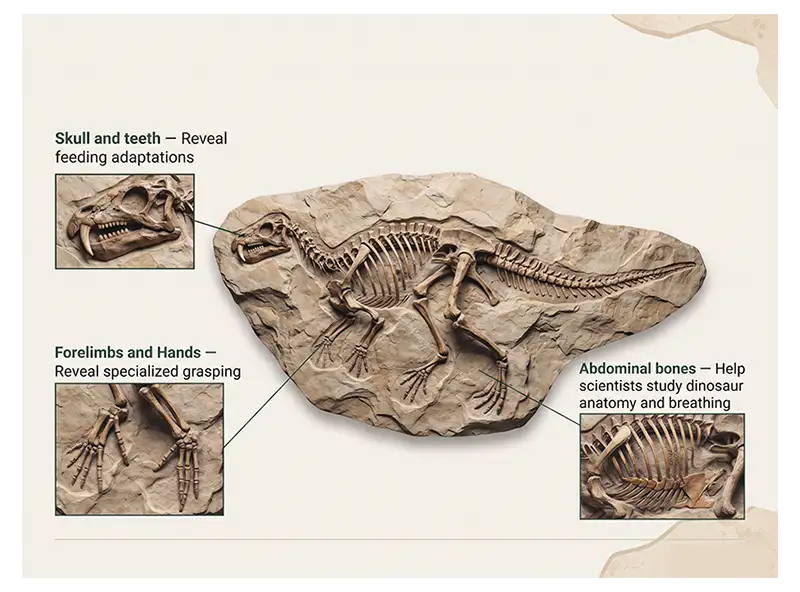
Fossils provide the main evidence for understanding Heterodontosaurus. Its preserved skull, teeth, and other skeletal elements have allowed scientists to examine its anatomy in considerable detail. Some specimens preserve enough connected bones to reveal how different parts of the body fit together.
Several important discoveries have expanded scientific understanding of this dinosaur.
- Skull anatomy: Detailed studies have documented the structure of the jaws, the arrangement of the teeth, and the areas where muscles attached. These observations help researchers reconstruct how the animal fed.
- Tooth wear and microstructure: Worn tooth surfaces and microscopic examination of dental tissues provide evidence about how food was processed and how the teeth resisted wear.
- Limb function: Fossil hands, arms, and legs reveal the proportions of the limbs, the structure of the claws, and the anatomy associated with muscle attachment.
- Breathing anatomy: A more recently studied, articulated skeleton preserved unusual structures, including a complete series of gastralia—rib-like bones in the abdominal region. The specimen also revealed distinctive sternal structures, providing evidence relevant to the evolution of dinosaur breathing systems.
These discoveries demonstrate why fossils are more than preserved shapes. Their surfaces, internal structures, and patterns of wear can reveal biological functions that are not obvious from appearance alone.
Nevertheless, the fossil record has limitations. Bones rarely preserve the complete soft tissues of a living dinosaur, and different specimens may preserve different parts of the skeleton. Researchers must therefore combine direct evidence with comparisons to related animals and careful anatomical analysis.
What Is Still Uncertain About Heterodontosaurus?
Although Heterodontosaurus is well studied, some aspects of its biology remain unresolved. Recognizing these uncertainties helps separate scientific evidence from speculation.
Its complete diet: The teeth indicate specialized food processing, but they do not establish every food item the animal consumed. A primarily plant-based diet is a reasonable interpretation, while the possibility of a broader diet remains difficult to assess.
The function of its enlarged teeth: Its prominent canine-like teeth may have played a role in display, competition, defense, feeding, or a combination of behaviors. No single explanation has been conclusively demonstrated.
Its external appearance: Fossils provide strong evidence for its skeleton, but they do not establish its exact skin color or full body covering. Reconstructions of its outer appearance should therefore be treated cautiously.
Its behavior: Its limbs suggest possible movement and grasping abilities, but activities such as digging, nest building, or specific social rituals cannot be confidently inferred from anatomy alone.
Its precise evolutionary relationships: Studies have proposed different placements for heterodontosaurids within Ornithischia. New fossil discoveries and revised analyses may change how scientists interpret the group's early history.
These questions do not make Heterodontosaurus less scientifically valuable. Instead, they show how paleontology develops by testing competing explanations against new evidence.
Conclusion
Heterodontosaurus was a small but highly specialized dinosaur whose fossils offer valuable insights into early ornithischian evolution. Its different types of teeth, unusual jaw anatomy, clawed hands, and distinctive skeleton show that early dinosaurs developed a wide range of adaptations long before many of the famous giant herbivores appeared.
Its feeding system is particularly significant. The arrangement and wear of its teeth reveal complex food-processing abilities, while its enlarged canine-like teeth leave important questions about behavior and diet unanswered. Research into its skeleton has also helped scientists investigate the evolution of dinosaur anatomy and breathing systems.
Although some details of its life remain uncertain, Heterodontosaurus demonstrates how carefully studied fossils can reveal the biology of animals that disappeared millions of years ago. Its importance lies not in its size, but in the evidence it provides about the early diversity and evolution of dinosaurs.
FAQ's
It is generally considered primarily herbivorous because its beak-like jaws and specialized cheek teeth were suited to processing plant material. However, the exact range of its diet is uncertain, and its enlarged canine-like teeth have prompted alternative interpretations.
A commonly cited skeletal reconstruction of Heterodontosaurus tucki is approximately 1.25–1.3 metres (about 4 feet) long. This is an estimated length rather than a direct measurement of a living animal.
It lived during the Early Jurassic, approximately 200–190 million years ago, in the region that is now South Africa.
Its name means “different-toothed lizard.” It refers to the different types of teeth in its jaws, including smaller cheek teeth and enlarged canine-like teeth.
It had prominent, pointed canine-like teeth commonly described as tusks. Their exact function is unknown; they may have been involved in display, competition, defense, feeding, or several activities.