
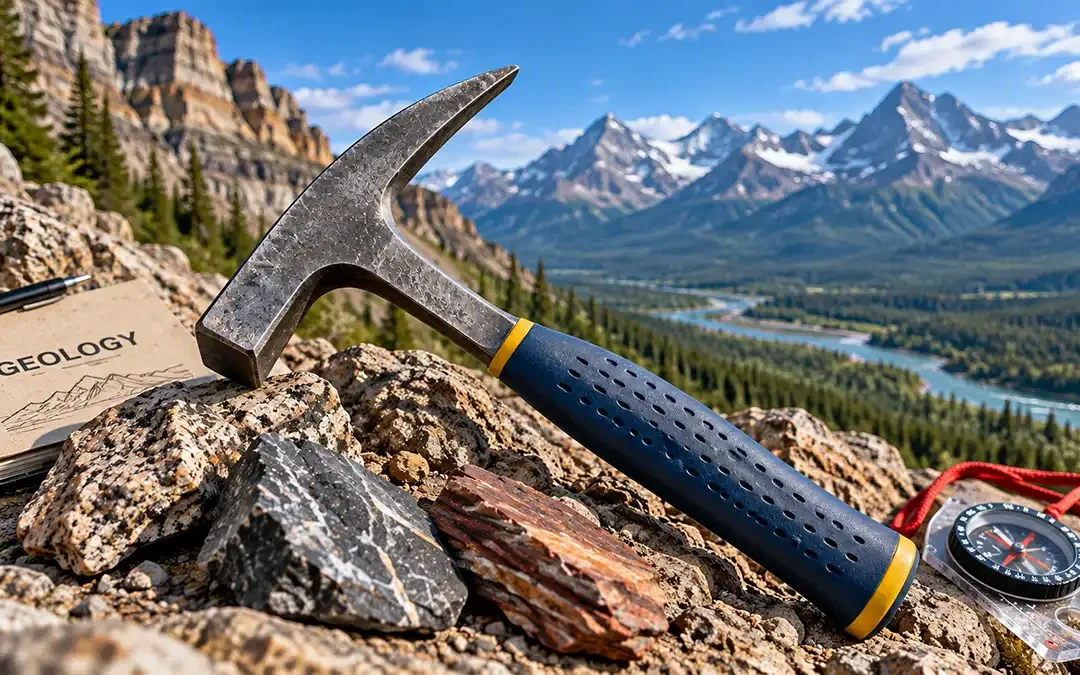
A geological hammer is one of the most recognizable tools in field geology. Whether you're a geology student heading out for your first field class, a professional geologist collecting rock samples, or someone interested in minerals and fossils, the right hammer can make fieldwork much easier.
But choosing one isn't simply a matter of buying the heaviest hammer you can find.
Geological hammers come in different designs, including pointed-tip rock picks, chisel-tip hammers and heavier crack or drilling hammers. Their weight, head shape and intended use can make a noticeable difference in how easy the tool is to control.
In this guide, we'll explain what a geological hammer is, what it's used for, the main types available, how much a geology hammer should weigh, what to look for before buying one, and some popular options to consider.
Ready to Choose Your Geological Hammer?
Compare geological hammers, rock picks and different sizes on Amazon before choosing the right tool for your fieldwork.
Check Geological Hammers on Amazon → As an Amazon Associate, Gelogia earns from qualifying purchases. Product prices and availability may change on Amazon.What Is a Geological Hammer?
A geological hammer is a specialized hand tool used by geologists to break, split or expose rocks during fieldwork.
It is also commonly called a:
- Geology hammer
- Geologist's hammer
- Rock hammer
- Rock pick
- Geological pick
- Geo pick
The basic purpose is straightforward: a geologist may need to expose a fresh surface of a rock to examine its minerals, texture, grain size, structure or other geological characteristics.
A weathered rock surface can sometimes hide important characteristics. Breaking or chipping the rock can reveal a fresher surface for examination.
Geological hammers are also used in some forms of mineral and fossil collecting, although collecting regulations and site restrictions should always be checked before removing material.
What Is a Geological Hammer Used For?
A geological hammer can have several uses in the field.
1. Breaking Rock
The main use is breaking or splitting suitable rock to expose a fresh surface.
2. Collecting Rock Samples
Geologists may use a hammer to obtain representative pieces of rock for later examination.
3. Mineral Collecting
A suitable rock hammer can help expose mineral specimens in appropriate collecting locations.
4. Geological Fieldwork
Students and professional geologists may carry a geological hammer during field mapping and geological investigations.
5. Fossil Collecting
Specialized hammers and chisels can be used in appropriate fossil-collecting settings, although the right tool depends on the material and collecting method.
6. Light Chiseling
Some geological hammers have a face suitable for light chisel work, but a geological rock pick shouldn't automatically be treated as a substitute for a dedicated drilling or crack hammer.
Types of Geological Hammers
There isn't one geological hammer that works perfectly for every situation.
The most important differences are head shape, weight and intended use.
1. Pointed-Tip Geological Hammer
A pointed-tip rock hammer has a pointed end on one side and a striking face on the other.
The pointed end can be useful for working around rocks, loose material and specimens, while the flat face is used for striking.
Estwing currently offers pointed-tip rock picks in 14 oz and 22 oz head weights. Its E3-22P has a 22 oz (616 g) head and a 13-inch overall length.
This style is particularly recognizable as a traditional field geology tool.
Common names
You may see it listed as:
- Rock pick
- Pick hammer
- Geological pick
- Prospector's hammer
- Pointed-tip rock hammer
- Hard-rock hammer
2. Chisel-Tip Geological Hammer
A chisel-tip hammer has a chisel-like end rather than a pointed pick.
This can be useful when you want to work along a crack, bedding plane or other narrow area.
Different weights are available. Geology.com currently lists chisel-tip rock hammers in 12-, 16-, 20- and 24-ounce sizes.
For many students and field geologists, a medium-weight hammer can provide a balance between control and striking power.
3. Crack Hammer
A crack hammer is heavier and has a conventional striking head.
It is generally intended for harder, heavier striking work rather than functioning as a lightweight field pick.
This distinction is important.
If you need a geological field pick, buying an extremely heavy crack hammer isn't automatically an upgrade.
The correct tool depends on the task.
What Geological Hammer Weight Should You Choose?
This is one of the most common questions beginners ask.
The answer depends on your strength, experience, fieldwork and intended use.
A heavier hammer can deliver more impact, but it can also be more tiring and harder to control.
A lighter hammer may be easier to carry and control, especially during a long field day.
Geology.com specifically notes that even a few ounces can make a meaningful difference in control and fatigue during field use.
General comparison
| Hammer weight | General use |
|---|---|
| 12–14 oz | Lightweight fieldwork and smaller specimens |
| 16 oz | Lightweight/medium field use |
| 20 oz | Medium/heavier geological work |
| 22 oz | Common pointed rock-pick size |
| 24 oz+ | Heavier work and experienced users |
| 2–4 lb | Heavy striking/crack-hammer applications |
These aren't strict rules. Your choice should depend on the specific hammer design and the work you actually intend to do.
14 oz vs 22 oz Geological Hammer
This is a particularly useful comparison for beginners.
14 oz
A lighter hammer can be easier to control and carry.
It may suit:
- Geology students
- Beginners
- Light fieldwork
- Smaller specimens
- Long days in the field
- People who prefer a lighter tool
22 oz
A 22 oz rock pick provides more head mass while remaining a portable field tool.
It may suit:
- Experienced geology students
- Field geologists
- Harder rock work
- General geological fieldwork
Estwing currently lists its E3-14P at 14 oz / 392 g and its E3-22P at 22 oz / 616 g, with the latter having a 13-inch overall length.
Don't assume that heavier automatically means better. Control and safe handling matter.
What Should You Look for in a Geological Hammer?
Before buying a geological hammer, look at more than the product photo.
Head Weight
Consider how much weight you can comfortably control.
If you're carrying the hammer throughout a field day, weight matters twice: you're carrying it and repeatedly swinging it.
Head Design
Decide whether you need:
- Pointed tip
- Chisel tip
- Flat striking face
- Heavy square head
Your fieldwork should determine the design.
One-Piece Construction
Some geological hammers are forged as a single piece of steel.
For example, Estwing says its E3-22P has a forged head and handle in one piece.
This can be an attractive feature when you're looking for a durable field tool.
Grip
A comfortable grip matters because geological hammer work involves repeated impacts.
Estwing's E3-22P uses its Shock Reduction Grip, which the manufacturer says is designed to reduce vibration and improve comfort.
Remember that manufacturer comfort claims aren't the same as an independent hands-on test.
Length
A longer handle can affect leverage and swing characteristics, while a shorter hammer can be easier to carry and maneuver.
Choose based on your intended use rather than simply choosing the longest model.
Sheath
A sheath is worth considering if you're going to carry your geological hammer on a field belt.
It can make transportation safer and more convenient.
Popular Geological Hammer to Consider
Estwing E3-22P Pointed-Tip Rock Pick
The Estwing E3-22P is one of the most recognizable geological rock picks.
According to Estwing, it has:
- 22 oz / 616 g head weight
- 13-inch overall length
- Pointed tip
- Smooth striking face
- Forged steel construction
- Shock Reduction Grip
- One-piece head and handle
- Made in the USA
It is therefore a useful model to include in a geological hammer buying guide because its specifications are clearly documented by the manufacturer.
Who might consider it?
It may be worth comparing if you're looking for a traditional pointed geological rock pick for fieldwork and can comfortably handle its 22 oz head.
If you're new to geology hammers or prefer a lighter tool, compare it with a 14 oz option before buying.
Ready to Choose Your Geological Hammer?
Compare geological hammers, rock picks and different sizes on Amazon before choosing the right tool for your fieldwork.
Check Geological Hammers on Amazon → As an Amazon Associate, Gelogia earns from qualifying purchases. Product prices and availability may change on Amazon.Pointed-Tip vs Chisel-Tip Geological Hammer
If you're unsure which style to buy, start with the kind of fieldwork you'll actually perform.
| Feature | Pointed Tip | Chisel Tip |
|---|---|---|
| Pointed end | Yes | No |
| Flat striking face | Usually | Usually |
| Field geology | Very suitable | Suitable |
| Working loose material | Useful | Less specialized |
| Chisel-style work | Limited | More suitable |
| Common rock-pick design | Yes | Yes |
| Best choice depends on | Field conditions | Field task |
Neither design is universally correct.
A geology student doing general field mapping may want a different hammer from someone doing intensive mineral collecting or heavier rock work.
Geological Hammer vs Regular Hammer
A geological hammer isn't simply a regular household hammer with a different shape.
Its design is intended for geological fieldwork.
A pointed rock pick, for example, combines a striking face with a pointed end. Estwing specifically categorizes its rock picks as geological tools and describes them as designed for geological digs and field conditions.
A normal claw hammer is designed primarily for woodworking and nails.
Using the wrong hammer for geological work can make the job less controlled and less suitable for the task.
Do You Need a Geological Hammer as a Geology Student?
If you're studying geology and have regular field classes, a geological hammer can become one of the most useful items in your field kit.
However, you don't necessarily need the heaviest or most expensive model.
For a student, consider:
- Weight
- Control
- Field course requirements
- Type of rocks you'll encounter
- How often you'll use it
- Whether your department already provides field equipment
- Whether you need a pointed or chisel tip
If your university provides a recommended equipment list, follow that first.
Geological Hammer Safety
This is one section I would not skip on a geology affiliate page.
Breaking rocks can produce flying fragments, and striking tools can become dangerous if damaged or used incorrectly.
Always wear safety goggles
Estwing specifically recommends safety goggles for users and nearby people when using striking tools.
Don't strike hardened objects with the wrong tool
Estwing warns against striking a hammer or striking tool against another tool or hardened object.
Inspect the hammer
Don't continue using a hammer if you notice serious damage such as:
- Chips or dents on the striking face
- Mushrooming
- Cracks
- Handle damage
Estwing's current safety guidance specifically identifies these as reasons to discard a damaged tool.
Keep other people away
Rock fragments can travel unexpectedly.
Make sure other people are at a safe distance before striking.
Use the right hammer for the job
A geological rock pick isn't automatically suitable for every heavy striking application.
Estwing's safety guidance emphasizes selecting a hammer of suitable size and weight for the task.
Geological Hammer Buying Checklist
Before clicking Buy, check these points:
✓ Correct hammer type
Pointed, chisel or crack hammer?
✓ Suitable weight
Can you control it comfortably?
✓ Appropriate length
Does the handle suit your intended work?
✓ Strong construction
Check the manufacturer's construction details.
✓ Comfortable grip
Especially important for repeated use.
✓ Protective sheath
Useful for carrying the hammer in the field.
✓ Safety equipment
Always include appropriate eye protection.
✓ Current price
Amazon prices can change, so check the live listing before purchasing.
Geological Hammer for Rock Collecting
Rock collectors often need a different setup depending on what they're collecting.
For smaller specimens and light work, a lighter hammer may be easier to control.
For harder rocks, a heavier hammer or different tool combination may be more appropriate.
A pointed rock pick can be useful in some collecting environments, while a chisel-tip hammer can be more appropriate for certain tasks.
Don't choose purely based on hammer weight.
Think about the rock, the collecting location and the type of work you're actually doing.
Geological Hammer for Mineral Collecting
Mineral collecting requires precision.
You don't necessarily want to hit as hard as possible.
A controlled strike can be more useful than simply using a very heavy hammer.
Your hammer should therefore be chosen around:
- Specimen size
- Host rock
- Your experience
- Required precision
- Local collecting rules
And remember: some locations prohibit collecting entirely or require permission.
Geological Hammer for Field Geology
For general field geology, portability becomes particularly important.
You're likely carrying several other items:
- Field notebook
- Geological compass
- Hand lens
- GPS or smartphone
- Sample bags
- Water
- Safety equipment
- Maps
- Measuring tools
A geological hammer that's unnecessarily heavy can become frustrating after several hours.
For this reason, many field geologists choose a hammer that provides a practical balance between weight, control and striking ability.
Frequently Asked Questions
A geological hammer is a specialized hammer used by geologists to break, split and expose rocks during fieldwork. Common designs include pointed-tip rock picks and chisel-tip rock hammers.
It can also be called a geology hammer, geologist's hammer, rock hammer, rock pick, geological pick or geo pick.
There isn't one correct size. Common field-hammer weights range from lightweight models around 12–14 oz to heavier 20–24 oz tools. Choose a weight you can control comfortably for your intended work.
Not necessarily, but it is heavier than a 14 oz model. Estwing currently offers both 14 oz and 22 oz pointed-tip rock picks. A beginner should consider control, strength and how long they'll be using the tool rather than assuming heavier is better.
The terminology overlaps. A rock pick generally refers to a geological hammer with a pointed end, while "geological hammer" is a broader term covering several designs.
Final Thoughts
A geological hammer is a simple tool, but choosing the right one requires more thought than simply picking the heaviest model.
For general geological fieldwork, start by deciding whether you want a pointed-tip rock pick or chisel-tip hammer. Then consider the head weight, handle length, grip, construction and how much time you'll actually spend carrying and using it.
If you're a geology student, don't overlook weight. A hammer that feels manageable for ten minutes can feel very different after a full day in the field.
And before buying, check your university's field-equipment requirements and compare the current specifications and availability of the models you're considering.
Ready to Choose Your Geological Hammer?
Compare geological hammers, rock picks and different sizes on Amazon before choosing the right tool for your fieldwork.
Check Geological Hammers on Amazon → As an Amazon Associate, Gelogia earns from qualifying purchases. Product prices and availability may change on Amazon.