
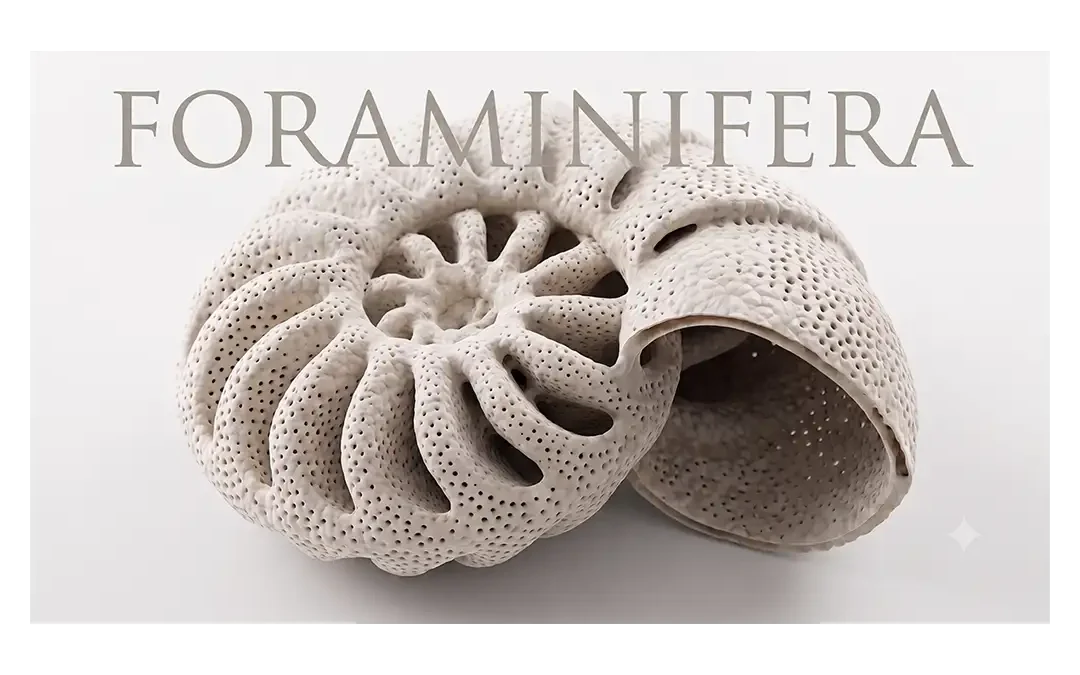
Foraminifera are tiny, single-celled organisms with intricate shells called tests, made of calcium carbonate or agglutinated particles. These marine microorganisms are essential in geology and environmental science, helping date rock layers, track climate changes, and monitor ocean health. Their diverse shapes and structures make them key tools for understanding Earth's history and ecosystems.
Definition of Foraminifera:
Foraminifera are Rhizopoda, which, with few exceptions, have a solid single or many-chambered test of a secretory origin (opal, calcium carbonate) or an agglutinated one. It is a unicellular organism.
What Are Foraminifera?
Foraminifera (often shortened to "forams") are single-celled marine organisms belonging to the kingdom Protista. Unlike animals or plants, a foram consists of a single cell of protoplasm. To feed, move, and anchor themselves, they extend thin, branching, net-like threads called reticulopodia (a type of pseudopod, or "false foot") through small openings in their shells.
The most defining feature of a foram is its protective shell, known scientifically as a test. Depending on the species, these tests are constructed in one of two main ways:
- Calcareous Shells: Built by extracting dissolved calcium and carbonate ions from seawater to precipitate hard calcium carbonate (CaCO3) crystals (chalk and limestone are largely made of these).
- Agglutinated Shells: Built by collecting tiny grains of sand, mineral fragments, or sponge spicules from the surrounding seafloor and gluing them together with organic cement.
As a foram grows, it continually adds new chambers to its shell in specific patterns—such as spirals, linear rows, or overlapping spheres. These unique chamber arrangements allow scientists to classify thousands of fossil and living species.
Types of Foraminifera
Geologists classify foraminifera into two primary ecological groups based on where they live in the ocean: benthic and planktonic.
Benthic Foraminifera (Seafloor Dwellers)
Benthic foraminifera live on or within the sediment at the bottom of the ocean. They first appeared in the fossil record during the early Paleozoic Era (over 500 million years ago) and make up the vast majority of all foram species.
- Habitat: Found in every marine environment, from shallow coastal estuaries to the deepest ocean trenches.
- Role: They feed on organic debris, bacteria, and algae on the seafloor, helping cycle nutrients in marine ecosystems.
Planktonic Foraminifera (Open Ocean Floaters)
Planktonic foraminifera float freely in the upper, sunlit layers of the open ocean. They evolved much later than benthic types, appearing during the Jurassic Period (roughly 170 million years ago).
- Habitat: Drift with ocean currents in the upper 200 meters of open seawater.
- Role: They often feature thin, light, porous shells—sometimes with long protective spines—that help them stay buoyant in the water column.
Characteristics of foraminifera:
Composition of the test:
Agglutinated, calcareous, micro granular, calcareous hyaline perforate, wall structure in cross-section, changes in material and structure, including perforation during ontogeny in microspheres and mesospheric forms.
Proloculus:
Visible or not visible from outside, microspheres or mesospheric form.
Chambers:
Total number of chambers, number of chambers in the last whorl, number of whorls, shape-size, and internal structure of chambers.
Arrangement of Chambers:
Uniserial, biserial, plan spiral evolute or partly evolute, trochoidal-high, medium on low trochoid, multiline, biloculine, trilocular, etc.; annular or cyclic arrangement of Chambers.
Sutures:
Chamber suture, spiral suture; smooth raised or depressed, simple, direction in relation to test surface - straight, bent on curved backwardly or forwardly.
Aperture:
Position and shape, primary Simple, Single or multiple apertures, or modified aperture.
Ornamentation:
Smooth- shiny, rough, granular - fine to coarse.
Importance of Foraminifera:
- Foraminifera are ideal zonal indices for marine rocks, as they are small, abundant, widely distributed, and often extremely diverse.
- The intricate morphology they have allows for readily tracing evolutionary changes.
- Planktonic foraminifera provide an important intercontinental correlation of Mesozoic and Cenozoic rocks.
- Benthic foraminifera are used as indicators of the depth of deposition.
- The narrow temperature ranges of living planktonic species are useful tools in paleo-climatology, especially of Quaternary sediments.
- They are helpful in paleo-ecology and paleo-oceanography.
- Foraminifera can be used in monitoring pollution.
How Geologists Use Foraminifera
Because foraminifera are abundant, widely distributed, and easily preserved in sedimentary rocks, they are among the most useful microfossils in geology.
Index Fossils and Stratigraphic Dating
Certain species of planktonic foraminifera evolved rapidly and died out quickly over specific geological windows. When geologists find these specific index fossils inside a rock layer, they can immediately date the age of the rock formation relative to the geologic time scale.
Reconstructing Past Climates (Paleoclimatology)
Foraminifera shells act as ancient thermometers. Because planktonic species are sensitive to water temperature and chemistry, changes in the species composition within ocean sediment cores tell scientists how ocean temperatures shifted over millions of years.
Petroleum and Oil Exploration
In the energy sector, micropaleontologists analyze foram fossils extracted from well drills. Because drill bits crush larger fossils like shells or bones, tiny microfossils remain completely intact. Identifying the forams in rock chips helps geologists match subterranean rock layers across drilling sites and locate potential oil reserves.
Foraminifera are single-celled marine organisms (protists) that build hard, protective outer shells called tests out of calcium carbonate or glued sand grains.
Neither. Foraminifera belong to the kingdom Protista. They are single-celled eukaryotic organisms, distinct from true animals, plants, or fungi.
Benthic foraminifera live on or inside the ocean floor sediment, while planktonic foraminifera float freely in the upper layers of open seawater.
Chalk and limestone are sedimentary rocks made largely of compressed, microscopic calcareous tests from dead foraminifera and other marine plankton that sank to the ocean floor.
Conclusion
Although foraminifera are tiny, single-celled protists, their impact on Earth science is massive. By building durable shells that survive in ocean floor sediments for hundreds of millions of years, they provide geologists with an unbroken record of Earth's environmental evolution. From dating rock layers and guiding oil exploration to uncovering the secrets of ancient ice ages, these microscopic organisms remain one of the most powerful tools in paleontology and oceanography.