
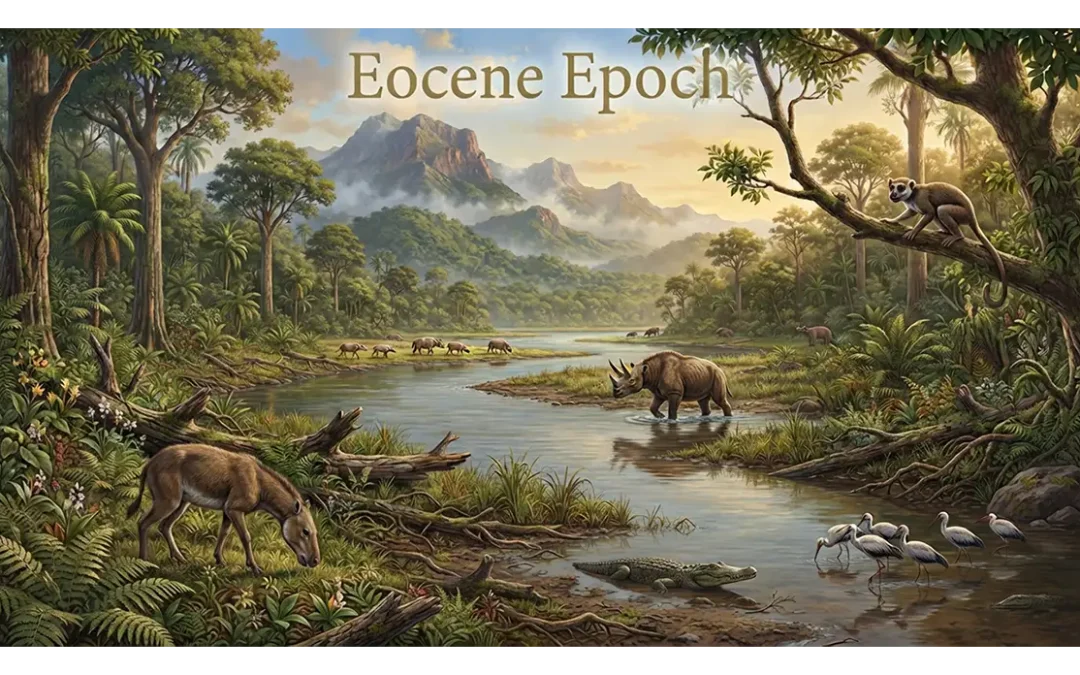
The Eocene Epoch was a major chapter in Earth's history when global temperatures were generally high, forests extended into polar regions, and mammals diversified into many new ecological roles. Early relatives of horses, bats, primates, and whales lived during this time, while continents continued moving toward their modern positions.
Spanning approximately 56 to 33.9 million years ago, the Eocene formed the middle part of the Paleogene Period within the Cenozoic Era. Its geological record preserves evidence of dramatic climate changes, evolving ecosystems, mountain building, and the development of animal groups that remain important today.
Studying the Eocene helps scientists understand how organisms respond to environmental change and how the modern world developed over millions of years.
What Was the Eocene Epoch?
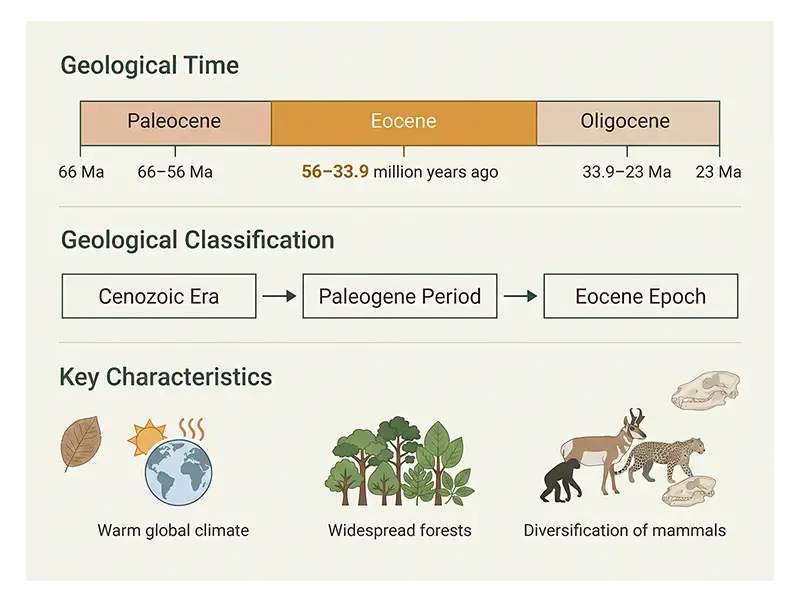
The Eocene Epoch was the second epoch of the Paleogene Period, following the Paleocene and preceding the Oligocene. It began after a major episode of global warming near the Paleocene–Eocene boundary and ended when Earth's climate cooled substantially around 33.9 million years ago.
The name Eocene comes from Greek roots associated with “dawn” and “recent.” It refers to the appearance and diversification of many animal groups with recognizable modern relatives.
The Eocene belongs to the Cenozoic Era, often called the Age of Mammals. Although mammals had already diversified after the extinction of non-avian dinosaurs at the end of the Cretaceous, the Eocene was especially important for their expansion into terrestrial, aerial, and aquatic environments.
During this epoch, Earth's ecosystems included dense forests, wetlands, rivers, lakes, coastal environments, and marine habitats. Many landscapes looked different from those of today because continents were positioned differently and the climate was warmer, particularly at high latitudes.
The Eocene is divided into three stages:
- Ypresian: The earliest stage, marked by major warming and the diversification of many mammal groups.
- Lutetian: The middle stage, when warm conditions continued but longer-term cooling trends became increasingly important.
- Bartonian and Priabonian: The later stages, during which further climatic changes helped prepare Earth for the cooler Oligocene.
These divisions allow geologists to compare rocks, fossils, and environmental changes across different parts of the world.
What Was Earth's Climate Like During the Eocene?
The Eocene began under exceptionally warm conditions. Temperatures were high across much of the planet, and the difference between tropical and polar climates was smaller than it is today.
One of the most important events was the Paleocene–Eocene Thermal Maximum (PETM), a rapid warming episode that occurred approximately 56 million years ago, near the beginning of the epoch. It involved a large release of carbon into the atmosphere and oceans, although the precise sources and sequence of releases remain subjects of scientific research.
This event caused a sharp rise in global temperatures, changes in ocean chemistry, and disruptions to ecosystems. Some marine organisms experienced significant losses, while many land mammals underwent changes in body size and distribution.
Warm conditions and polar forests
During the early Eocene, forests grew in areas that are now extremely cold. Fossils from high latitudes show that trees, reptiles, and other organisms could survive in environments that would be unsuitable for many of their modern relatives.
There were no large, permanent Antarctic ice sheets comparable to the modern one during much of the early Eocene. The Arctic also had a much warmer environment, although seasonal differences in daylight still occurred at high latitudes.
The long-term cooling trend
The Eocene did not remain equally warm throughout its duration. Global temperatures gradually declined after the early Eocene warmth, although the trend included fluctuations rather than a perfectly steady fall.
By the late Eocene, changes in ocean circulation, atmospheric carbon dioxide, and the positions of continents contributed to cooler conditions. This long-term transition eventually led to major Antarctic ice-sheet growth near the Eocene–Oligocene boundary.
The Eocene climate record is important because it shows how atmospheric composition, ocean systems, and continental geography interact to shape Earth's temperature.
What Did Earth Look Like During the Eocene?
The continents were closer to their modern positions than they had been during the age of dinosaurs, but the planet's geography was still changing significantly.
The Atlantic Ocean continued widening as the Americas moved away from Europe and Africa. India was moving northward toward Asia, eventually contributing to the formation and uplift of the Himalayan region. Australia was also moving away from Antarctica, although the separation and development of ocean gateways occurred gradually.
These tectonic movements changed coastlines, mountain ranges, and connections between marine environments. They also influenced the distribution of plants and animals by creating barriers, migration routes, and new habitats.
Mountains and changing landscapes
Mountain building continued in several regions during the Eocene. In western North America, geological processes associated with the development of the Rocky Mountain region affected drainage systems and inland environments. In Asia, the collision between India and Eurasia contributed to major tectonic deformation and the long-term development of the Himalayas and Tibetan Plateau.
Rivers transported sediment from rising mountains into basins and lowlands. Lakes formed in some of these basins, preserving layers of fine sediment that later became valuable fossil deposits.
Forests, rivers, and lakes
Much of the land supported wooded environments, including tropical and subtropical forests, temperate forests, swamps, and river corridors. The exact vegetation depended on latitude, rainfall, elevation, and local drainage.
Large grassland ecosystems like many modern savannas were not yet widespread across most regions. Forests and woodland habitats were particularly important for many herbivorous mammals, which commonly fed on leaves, shoots, fruits, and other plant material.
The combination of changing landforms and warm conditions created a diverse range of environments in which organisms could evolve and spread.
Which Animals Lived During the Eocene Epoch?
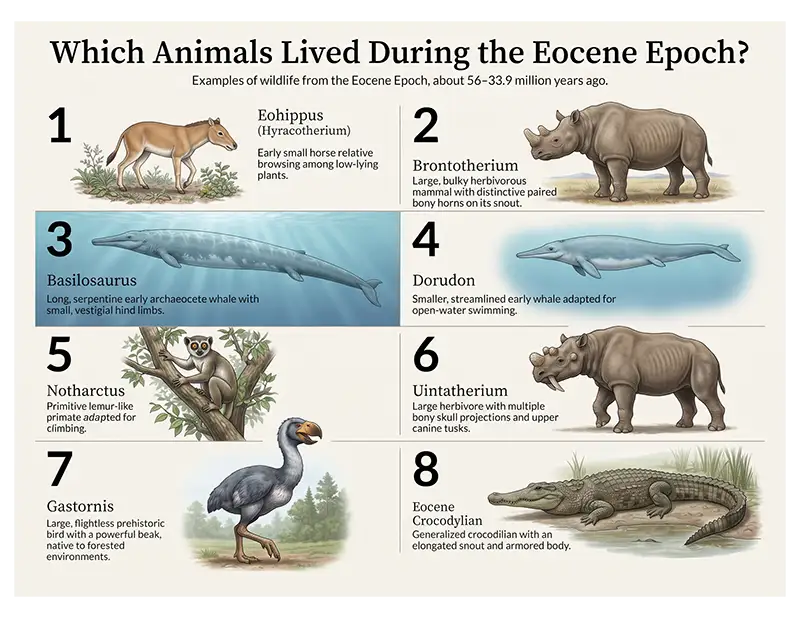
The Eocene supported a remarkable variety of animals, from tiny insects and early bats to large herbivorous mammals and marine predators. Many groups that are familiar today had early representatives, although these animals often differed from modern species in their anatomy and behavior.
Land mammals
Forests and woodland environments supported early horses, tapirs, rhinoceros relatives, primates, rodents, and many extinct mammal groups. Some species were small and adapted to life among trees, while others became larger and occupied different feeding roles.
One notable group was the brontotheres, large herbivorous mammals related to the broader group of odd-toed ungulates. Some later Eocene brontotheres developed distinctive bony projections on their skulls.
Predatory mammals also occupied terrestrial ecosystems. Several extinct groups hunted other animals, while early members of lineages related to modern carnivorans were beginning to diversify.
Birds and reptiles
Birds were important members of Eocene ecosystems. Some were small forest-dwelling species, while others were large ground-dwelling predators. Crocodilians, turtles, lizards, and snakes also inhabited suitable terrestrial and freshwater environments.
Unlike the non-avian dinosaurs of the Mesozoic, birds survived the mass extinction at the end of the Cretaceous and continued diversifying during the Eocene.
Marine animals
The oceans contained sharks, bony fish, mollusks, marine reptiles that had survived the earlier extinction, and a growing diversity of marine mammals. Early whales were especially important because they reveal how a group of land-dwelling mammals adapted to life in water.
The Eocene therefore provides evidence of major evolutionary changes across land, freshwater, and marine ecosystems.
What Plants and Habitats Existed During the Eocene?
Plants formed the foundation of Eocene terrestrial ecosystems. Warm conditions allowed many forest types to flourish, including broad-leaved forests, tropical vegetation, swamp forests, and woodlands in temperate and high-latitude regions.
Flowering plants were already diverse by this time. Trees and shrubs provided leaves, fruits, seeds, and shelter for insects, birds, and mammals. Conifers also remained important in many environments, particularly where climate and soil conditions favored them.
Forests at high latitudes
Fossil leaves, wood, pollen, and other plant remains show that forests extended into regions now occupied by tundra or cold landscapes. Dawn redwoods and other tree groups grew at high northern latitudes, while forests also covered portions of the southern continents.
These plants adapted to strong seasonal differences in daylight. At high latitudes, some regions experienced months with little or no direct sunlight during winter and long daylight periods during summer.
The early development of grass-dominated habitats
Grasses existed during the Eocene, but widespread modern-style grasslands had not yet become dominant across most continents. Many herbivorous mammals relied on browsing rather than grazing.
This distinction matters because the expansion of open grasslands later in the Cenozoic changed food sources, habitats, and the evolutionary pressures affecting numerous mammal groups.
Plant fossils also help researchers reconstruct ancient rainfall, temperature, and forest structure. Their distribution provides clues about how climate and geography influenced ecosystems over time.
How Did Mammals Evolve During the Eocene?
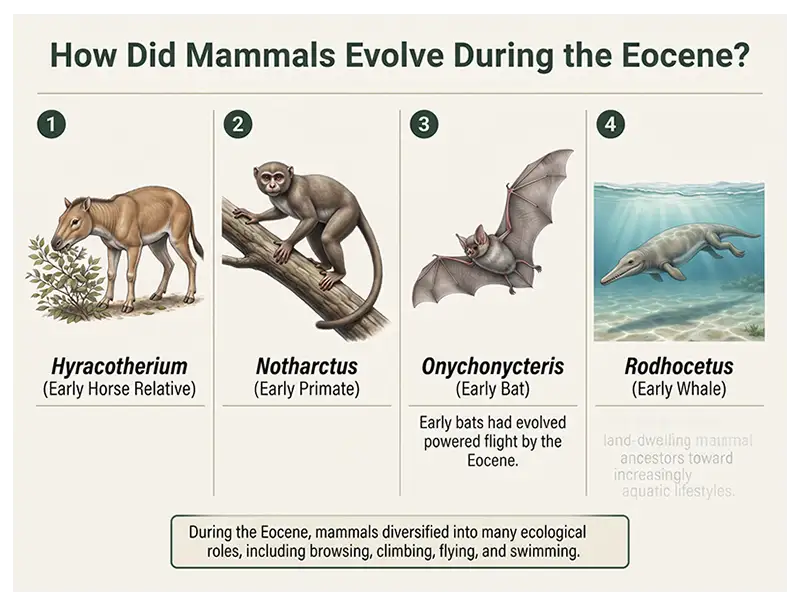
The Eocene was a significant period of mammalian diversification. Many groups developed new body forms, feeding adaptations, and ways of occupying habitats. However, evolution was not a simple progression toward modern animals; it involved branching lineages, ecological experiments, and the extinction of many forms.
Early horses
Early horses were much smaller than most modern horses. Forms such as Hyracotherium are associated with the early evolution of the horse lineage, although the classification and use of this name have changed in scientific literature.
These early animals generally had multiple toes and lived in wooded habitats. Over evolutionary time, different horse relatives developed changes in limb structure, teeth, and body size, reflecting adaptations to changing environments and diets.
The familiar single-hoofed horse appeared much later in the evolutionary history of the group.
Primates and bats
Early primates diversified in forest environments, where adaptations for moving through trees and handling food were useful. Their fossils help scientists investigate the early evolution of features associated with living primates.
Bats were also present during the Eocene. Exceptionally preserved fossils show that early bats already possessed important adaptations for powered flight. Some fossils provide evidence about the development of echolocation, although the timing and details of its evolution remain active research topics.
The evolution of whales
One of the most remarkable mammalian changes during the Eocene was the transition of whale ancestors from land to water. Early whale relatives, including Pakicetus, retained features associated with land-dwelling mammals. Later forms such as Ambulocetus had adaptations suited to movement in water, while more advanced archaeocetes became increasingly aquatic.
By the middle and late Eocene, some whales had developed streamlined bodies and powerful tails for swimming. Their hind limbs became reduced over evolutionary time, and their skulls and sensory systems changed as they adapted to marine life.
These fossils document a major evolutionary transition and demonstrate how mammals can undergo extensive anatomical changes as they occupy new environments.
What Fossils Tell Us About the Eocene Epoch?
Fossils provide direct evidence of the animals, plants, and environments that existed during the Eocene. Researchers study bones, teeth, leaves, pollen, shells, footprints, and microscopic remains to reconstruct ancient ecosystems.
Fossil evidence becomes particularly powerful when it is combined with geological information about the sediment in which specimens were preserved.
The Messel Pit fossil site
The Messel Pit in Germany is one of the world's most important Eocene fossil sites. Its oil shale preserves an exceptional variety of plants and animals, including mammals, birds, reptiles, fish, insects, and other organisms.
Some specimens retain fine anatomical details, and the site has yielded fossils with evidence of feathers, hair, and stomach contents. These discoveries help researchers investigate diet, ecology, and relationships among ancient organisms.
The Green River Formation
The Green River Formation in the western United States contains extensive Eocene lake deposits. It is especially well known for beautifully preserved fish fossils, along with plants and other organisms.
The fine sediments accumulated in ancient lake environments, allowing some remains to be preserved in remarkable detail. The formation helps scientists reconstruct freshwater ecosystems and regional environmental conditions.
How scientists interpret fossils
Fossils do more than identify extinct species. Tooth shape can indicate likely feeding habits, limb bones can reveal aspects of movement, and plant remains can help estimate ancient climate conditions.
Scientists also use radiometric dating, magnetic signatures in rocks, and comparisons among fossil assemblages to establish the ages of deposits. No single fossil necessarily tells the entire story; reliable reconstructions depend on multiple lines of evidence.
Why Did the Eocene Epoch End?
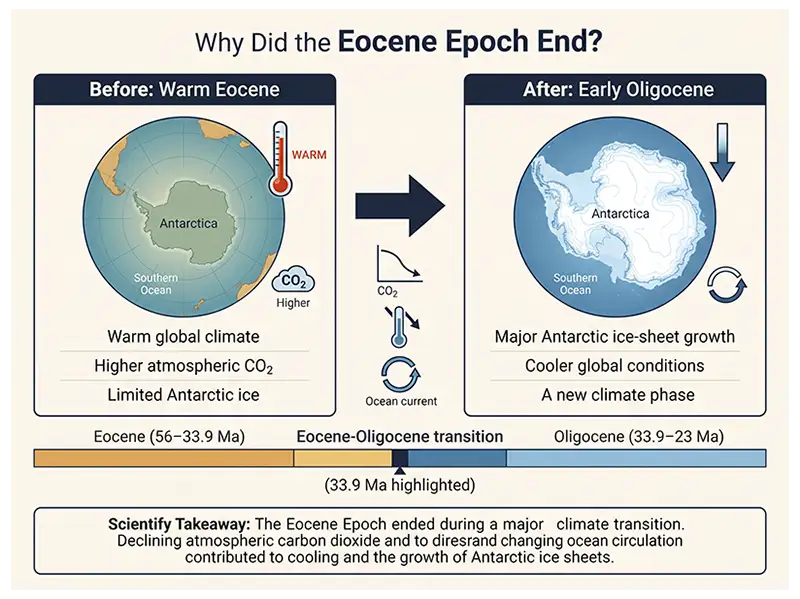
The Eocene ended approximately 33.9 million years ago, near a major climatic transition known as the Eocene–Oligocene transition. This interval was marked by substantial global cooling and the growth of a large Antarctic ice sheet.
The change was not caused by a single event. Several long-term processes interacted, including changes in atmospheric carbon dioxide, continental positions, and ocean circulation.
Declining atmospheric carbon dioxide
Atmospheric carbon dioxide is an important influence on Earth's temperature because it affects how much heat the atmosphere retains. A long-term decline in carbon dioxide contributed to the cooling trend that developed during the Eocene.
The reasons for this decline involved several processes, including the movement and chemical weathering of rocks, changes in the carbon cycle, and interactions between land and ocean systems. Scientists continue to investigate the relative importance of these mechanisms.
Antarctic isolation and ocean circulation
As Australia moved farther away from Antarctica and ocean gateways changed, circulation around the southern continent developed. The opening and deepening of passages between major ocean basins influenced how water moved around Antarctica, although the exact timing and climatic effects of these changes remain subjects of research.
Cooling conditions allowed a large Antarctic ice sheet to develop near the Eocene–Oligocene boundary. The growth of this ice altered sea levels and affected ocean chemistry and ecosystems.
Effects on life
Cooling and environmental changes affected the distribution of plants and animals. Forest communities changed in some regions, and species adapted to warmer environments faced shifting habitats.
The transition did not end mammalian evolution. Instead, it marked a change in environmental conditions that shaped later Cenozoic ecosystems.
How Was the Eocene Different From the Paleocene and Oligocene?
The Eocene sits between two epochs that help place its climate and biological developments into context.
| Feature | Paleocene | Eocene | Oligocene |
|---|---|---|---|
| Approximate age | 66–56 million years ago | 56–33.9 million years ago | 33.9–23 million years ago |
| Climate trend | Recovery and warming after the end-Cretaceous extinction | Very warm early conditions followed by long-term cooling | Generally cooler conditions than the early Eocene |
| Mammals | Diversified after the extinction of non-avian dinosaurs | Expanded into many ecological roles, including marine environments | Continued diversification under cooler climates |
| Vegetation | Forests and flowering plants became important | Extensive forests, including high-latitude forests | Many regions experienced further changes in forest cover and open habitats |
| Major significance | Early Cenozoic recovery | Major mammalian diversification and whale evolution | Antarctic glaciation and further ecosystem changes |
The boundaries between epochs represent formal divisions in the geological time scale, not abrupt changes everywhere on Earth. Climate, vegetation, and animal communities shifted at different rates across different regions.
The comparison shows why the Eocene is especially important: it records both exceptionally warm conditions and the beginning of major changes toward the cooler world that followed.
Conclusion
The Eocene Epoch was a transformative period in Earth's history. Its warm early climate supported extensive forests and diverse ecosystems, while mammals developed new adaptations and expanded into terrestrial, aerial, and marine environments.
Fossils from sites such as Messel Pit and the Green River Formation preserve evidence of these ancient worlds. Geological records also reveal changing continents, evolving ocean circulation, and the long-term cooling that culminated in Antarctic ice-sheet growth near the end of the epoch.
By studying the Eocene, scientists gain a clearer understanding of mammalian evolution, ancient climates, and the interconnected geological processes that continue to shape Earth.
The Eocene began approximately 56 million years ago and ended about 33.9 million years ago. It was the second epoch of the Paleogene Period.
The Eocene records major mammalian diversification, the evolution of early whales, the presence of bats and primates, extensive forests, and significant changes in Earth's climate.
Yes. The early Eocene was much warmer than the modern climate, especially at high latitudes. Temperatures declined over the course of the epoch, and substantial cooling occurred near its end.
Non-avian dinosaurs had already become extinct approximately 66 million years ago, before the Eocene began. Birds, which are living dinosaurs, continued to diversify during the epoch.
Eocene mammals included early horses, primates, bats, rodents, brontotheres, and early whales, along with numerous extinct groups that have no living representatives.