
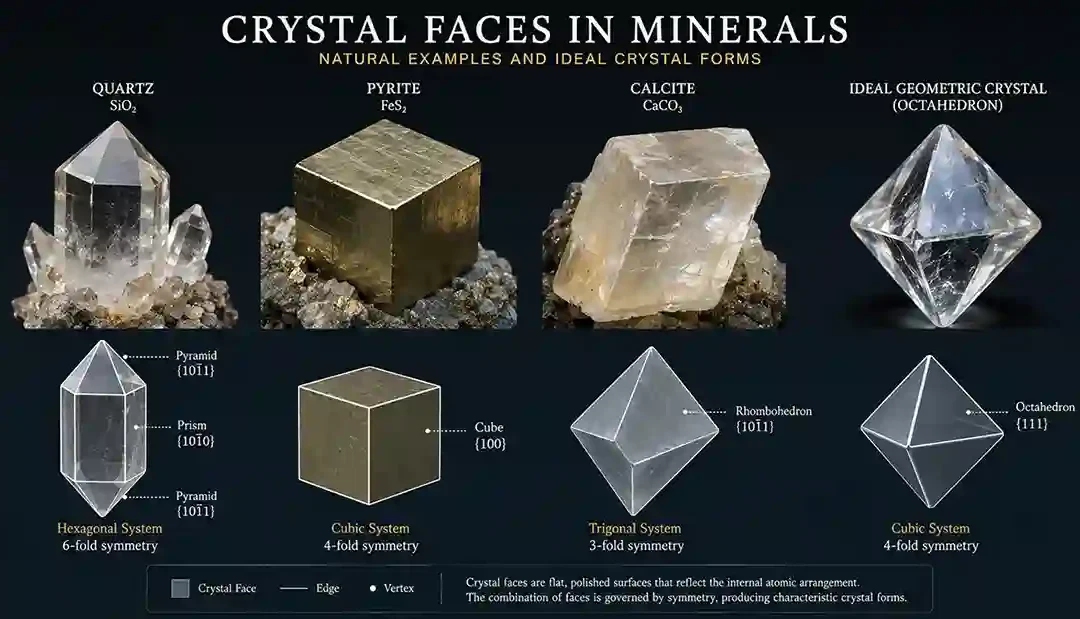
Crystal faces are the flat surfaces that form on the outside of a crystal during growth. These surfaces develop in response to the crystal's internal atomic structure and are one of the most important features used in mineral identification.
Well-developed crystal faces often create beautiful geometric shapes that reflect the symmetry of the mineral. Geologists study crystal faces to understand crystal growth, identify minerals, and classify crystal systems.
Crystal faces provide valuable clues about:
- crystal symmetry
- crystal structure
- mineral identity
- growth conditions
- geological environment
Learn more → crystal symmetry explained
What Are Crystal Faces?
Crystal faces are flat external surfaces of a crystal. These surfaces form naturally as atoms arrange themselves in an orderly pattern during crystal growth. A crystal face represents the outer boundary of a growing crystal.
When crystal growth occurs freely, minerals often develop smooth, well-defined faces.
Crystal Face Components
| Crystal Feature | Description |
|---|---|
| Face | Flat surface |
| Edge | Line where faces meet |
| Corner (Vertex) | Point where edges meet |
| Crystal Form | Group of similar faces |
How Crystal Faces Form
Crystal faces develop as atoms attach to a growing crystal. Different crystal surfaces grow at different rates. Slow-growing surfaces remain visible longer and eventually become crystal faces.
Crystal growth is influenced by:
- temperature
- pressure
- chemical composition
- available space
- growth rate
Crystal Faces and Crystal Structure
Crystal faces directly reflect crystal structure
The arrangement of atoms inside a crystal determines:
- face orientation
- face angles
- crystal symmetry
- crystal shape
This is why minerals consistently produce characteristic crystal forms.
Learn more → crystal structure in minerals
Crystal Faces and Crystal Symmetry
Crystal faces are arranged according to crystal symmetry.
Examples:
Isometric Crystals
- Equal faces
- High symmetry
Hexagonal Crystals
- Six-sided face arrangement
Trigonal Crystals
- Three-fold symmetry
The arrangement of faces helps geologists determine the crystal system.
Learn more → crystal symmetry explained
Crystal Faces in Different Crystal Systems
| Crystal System | Typical Face Arrangement |
|---|---|
| Isometric | Cubic faces |
| Tetragonal | Square prisms |
| Orthorhombic | Rectangular faces |
| Monoclinic | Inclined faces |
| Triclinic | Irregular faces |
| Hexagonal | Six-sided faces |
| Trigonal | Rhombohedral faces |
Quartz Crystal Faces
Quartz is famous for its well-developed crystal faces.
Typical quartz crystals display:
- six prism faces
- pyramid faces at crystal ends
- excellent crystal symmetry
Quartz is one of the best minerals for studying crystal faces.
Learn more → hexagonal crystal system
Pyrite Crystal Faces
Pyrite commonly forms:
- cubes
- pyritohedrons
- combinations of crystal forms
Its crystal faces are often smooth and highly reflective.
These well-developed faces make pyrite easy to recognize.
Calcite Crystal Faces
Calcite commonly develops:
- rhombohedral crystal faces
- angled crystal surfaces
- trigonal symmetry
Calcite crystal faces help distinguish it from similar minerals.
Perfect vs Imperfect Crystal Faces
Not all minerals develop ideal crystal faces.
Perfect Faces
Characteristics:
- smooth
- flat
- well-developed
Imperfect Faces
Characteristics:
- rough
- distorted
- partially formed
Crystal quality depends on available growth conditions.
Factors Affecting Crystal Face Development
| Factor | Effect |
|---|---|
| Growth Space | Better face development |
| Slow Growth | Larger faces |
| Rapid Growth | Poorly formed faces |
| Impurities | Distorted faces |
| Pressure Changes | Irregular growth |
Euhedral, Subhedral, and Anhedral Crystals
Geologists classify crystals based on face development.
Euhedral
- Well-developed faces
- Excellent crystal shape
Subhedral
- Partially developed faces
Anhedral
- No visible crystal faces
This classification is widely used in petrology and mineralogy.
Learn more → mineral texture guide
Crystal Faces and Mineral Identification
Crystal faces help geologists identify minerals by examining:
- face angles
- crystal shape
- symmetry
- crystal form
Many minerals can be recognized solely from their crystal face geometry.
Relationship Between Crystal Structure and Faces
Crystal Structure→Crystal Symmetry→Crystal Faces→Crystal Form
This relationship explains why crystal faces are so important in mineral identification.
Importance of Crystal Faces in Geology
Crystal faces are used in:
- mineral identification
- crystallography
- petrology
- gemstone studies
- materials science
They provide direct evidence of crystal growth and internal atomic arrangement.
Learn more → crystal systems explained
Crystal faces are flat surfaces that form on the outside of a crystal during growth.
They help geologists identify minerals and understand crystal symmetry.
The internal atomic arrangement and crystal structure determine crystal face positions.
Quartz, pyrite, calcite, and fluorite commonly develop well-defined crystal faces.
No. Some minerals grow in confined spaces and may not develop visible crystal faces.
Final Thoughts
Crystal faces are among the most visible and informative features of mineral crystals. They reveal how crystals grow, reflect crystal symmetry, and provide important clues for mineral identification.
By studying crystal faces, geologists can connect the external appearance of minerals to their internal atomic structure, making crystal faces a fundamental concept in mineralogy and crystallography.
Continue learning with → crystal symmetry explained and crystal structure in minerals.