
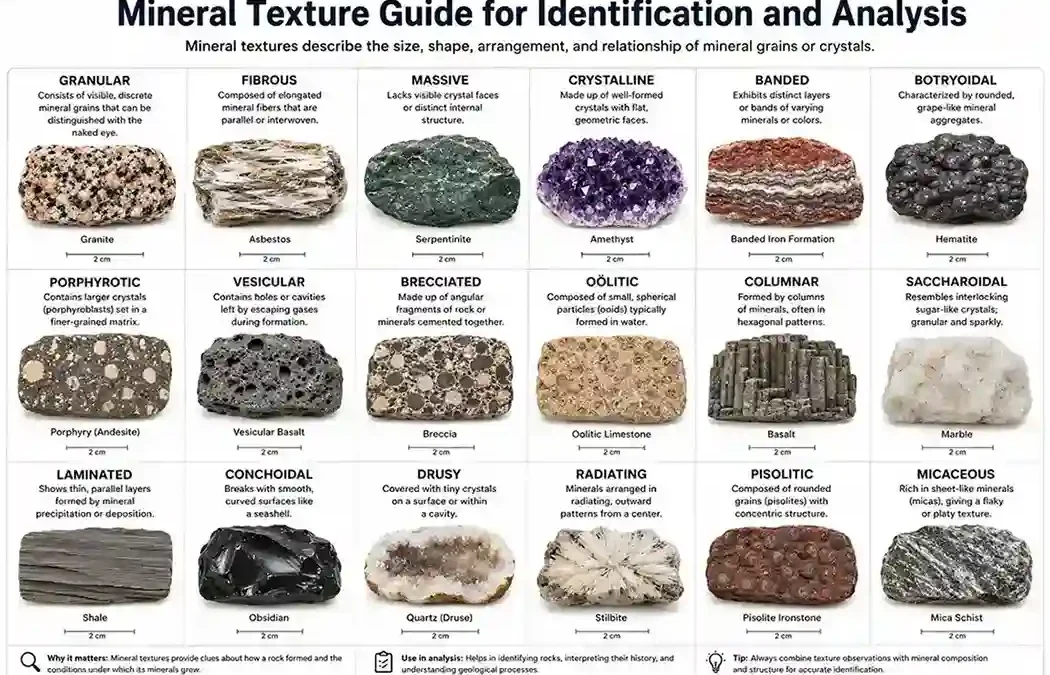
Mineral texture refers to the appearance, arrangement, size, and relationship of mineral grains or crystals within a specimen. Texture provides important clues about how a mineral formed and the geological environment in which it grew.
Geologists study mineral textures to:
- identify minerals
- understand crystal growth conditions
- interpret geological history
- classify rocks and mineral deposits
Texture can vary from large visible crystals to extremely fine-grained structures that require magnification.
Understanding mineral textures is an important part of mineralogy, petrology, and economic geology.
Learn more → mineral-habit-explained
Common Mineral Textures
Common Mineral Textures
Major mineral textures observed in geology and mineralogy.
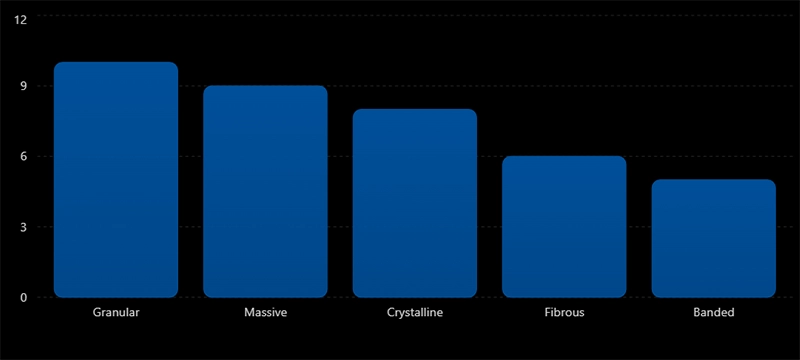
What Is Mineral Texture?
Mineral texture describes the size, shape, and arrangement of mineral grains. Unlike mineral habit, which focuses on the external crystal shape, texture examines:
- grain relationships
- crystal size
- internal appearance
- growth patterns
Texture often reveals how a mineral formed and evolved.
Granular Texture
Granular texture consists of many interlocking mineral grains.
Characteristics
- visible crystals
- rough appearance
- tightly packed grains
Common Examples
- Quartz aggregates
- Feldspar-rich specimens
- Granite-forming minerals
Granular texture is one of the most common mineral textures.
Crystalline Texture
Crystalline texture develops when crystals grow freely and become visible.
Characteristics
- distinct crystal faces
- organized crystal growth
- well-developed shapes
Examples
- Quartz crystals
- Calcite crystals
- Fluorite crystals
Crystalline textures often indicate slower growth conditions.
Massive Texture
Massive texture occurs when individual crystals are difficult to distinguish.
Characteristics
- compact appearance
- no obvious crystal boundaries
- dense structure
Common Examples
- Massive hematite
- Massive magnetite
- Massive quartz veins
Massive texture is common in many ore deposits.
Fibrous Texture
Fibrous texture consists of thin thread-like crystals
Characteristics
- silky appearance
- elongated fibers
- parallel crystal growth
Examples
- Chrysotile
- Satin spar gypsum
- Some amphiboles
Fibrous textures often develop in fractures and veins.
Banded Texture
Banded texture contains alternating layers of mineral material.
Examples
- Agate
- Malachite
- Banded iron formations
These textures form through:
- repeated mineral deposition
- chemical changes
- fluid circulation
Mineral Texture vs Mineral Habit
| Feature | Mineral Texture | Mineral Habit |
|---|---|---|
| Focus | Internal appearance | External shape |
| Examines | Grain arrangement | Crystal form |
| Example | Granular texture | Prismatic habit |
| Use | Formation history | Mineral identification |
Both texture and habit are useful for identifying minerals.
Crystal Size and Texture
Texture is strongly influenced by crystal size
Coarse-Grained Texture
- large visible crystals
- slower growth
Fine-Grained Texture
- tiny crystals
- rapid growth
Crystal size often reveals formation conditions.
Factors Affecting Mineral Texture
Several factors influence mineral texture:
Geological Factors
- temperature
- pressure
- cooling rate
- fluid chemistry
- available growth space
Different environments produce different textures.
Learn more → how-minerals-form
Texture and Formation Environment
| Environment | Common Texture |
|---|---|
| Slow cooling magma | Coarse crystalline |
| Rapid cooling | Fine-grained |
| Hydrothermal veins | Fibrous |
| Ore deposits | Massive |
| Chemical precipitation | Banded |
Why Mineral Texture Matters
Geologists use mineral textures to:
- identify mineral specimens
- interpret geological processes
- understand ore formation
- classify rocks
- reconstruct geological history
Texture provides valuable information that cannot always be obtained from chemical composition alone.
Learn more → mineral-identification-guide
Mineral texture refers to the size, shape, and arrangement of mineral grains or crystals.
Texture describes internal grain relationships, while habit describes external crystal shape.
Granular texture is one of the most common textures found in minerals and rocks.
It helps determine how minerals formed and the geological environment in which they developed.
Final Thoughts
Mineral texture is a key tool for understanding how minerals grow, interact, and form within Earth's crust. By studying textures such as granular, crystalline, massive, fibrous, and banded structures, geologists can gain valuable insights into geological history and mineral formation processes.
Understanding mineral texture is an essential step toward mastering mineral identification, mineralogy, and Earth science.