
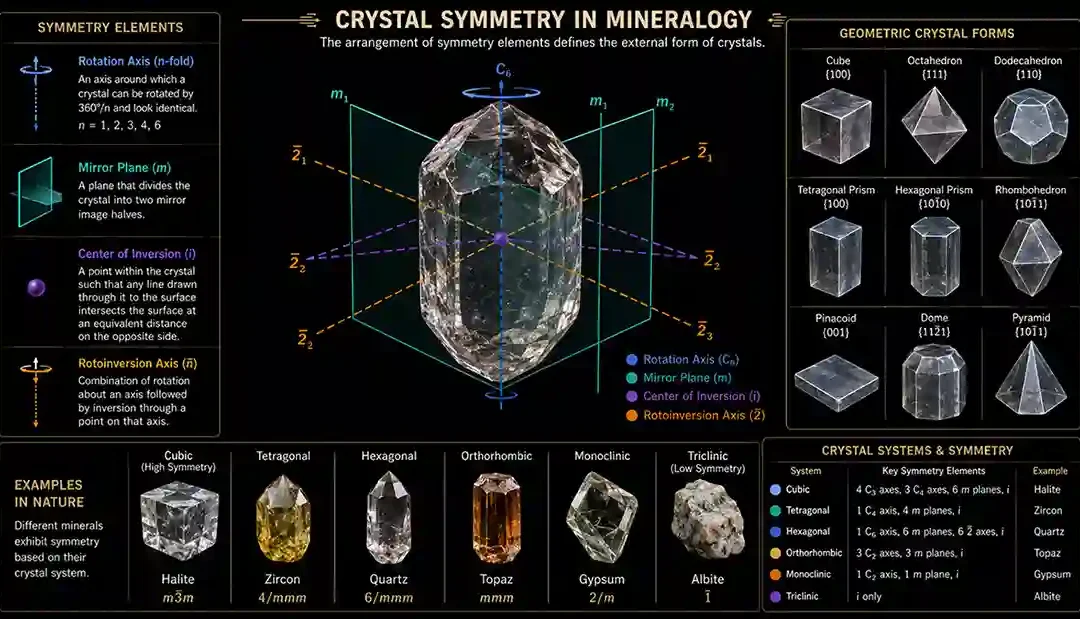
Crystal symmetry is one of the most important concepts in mineralogy and crystallography. It describes the balanced arrangement of crystal faces, edges, and corners around a crystal's center.
The symmetry of a crystal reflects the orderly arrangement of atoms within its crystal structure. Because of this relationship, crystal symmetry helps geologists classify minerals into crystal systems and identify unknown specimens.
Crystal symmetry is used to:
- classify minerals
- understand crystal growth
- study crystal structures
- identify crystal systems
- interpret geological processes
Every mineral possesses some degree of symmetry, although some crystals are much more symmetrical than others.
Learn more → crystal systems explained
What Is Crystal Symmetry?
Crystal symmetry is the balanced repetition of crystal features around a central point. A crystal is symmetrical when certain movements or operations leave its appearance unchanged.
These operations include:
- rotation
- reflection
- inversion
Symmetry helps scientists describe crystal geometry in a precise and consistent way.
Why Crystal Symmetry Matters
| Application | Importance |
|---|---|
| Mineral Identification | Very High |
| Crystal Classification | Very High |
| Crystallography | Essential |
| Materials Science | Important |
| Geology | Important |
Relationship Between Crystal Structure and Symmetry
Crystal symmetry originates from crystal structure
The arrangement of atoms determines:
- crystal faces
- crystal shape
- crystal angles
- symmetry elements
The external crystal form is often a visible expression of the internal atomic arrangement.
Learn more → crystal structure in minerals
Symmetry Elements in Crystals
Crystals contain specific symmetry elements used in crystallography.
The three most important are:
- Rotation Axes
- Mirror Planes
- Centers of Symmetry
These elements help define crystal systems and mineral classes.
Rotation Axis (Axis of Symmetry)
A rotation axis is an imaginary line around which a crystal can rotate and appear unchanged
Common rotational symmetries include:
| Type | Rotation Angle |
|---|---|
| 2-fold | 180° |
| 3-fold | 120° |
| 4-fold | 90° |
| 6-fold | 60° |
For example:
- Trigonal crystals have 3-fold symmetry.
- Tetragonal crystals have 4-fold symmetry.
- Hexagonal crystals have 6-fold symmetry.
Mirror Plane (Plane of Symmetry)
A mirror plane is an imaginary plane dividing a crystal into two mirror-image halves. If one half reflects the other exactly, the crystal possesses mirror symmetry.
Mirror planes are common in:
- cubic crystals
- hexagonal crystals
- many prismatic minerals
Center of Symmetry
A center of symmetry exists when every crystal face has an equivalent face directly opposite it. This creates a balanced crystal geometry. Many minerals possess a center of symmetry, while others do not.
Common Symmetry Elements
| Symmetry Element | Description |
|---|---|
| Rotation Axis | Crystal repeats after rotation |
| Mirror Plane | Crystal reflects across a plane |
| Center of Symmetry | Opposite faces match |
Crystal Symmetry and Crystal Systems
Crystal systems are classified largely by symmetry.
Examples
| Crystal System | Main Symmetry |
|---|---|
| Isometric | Highest symmetry |
| Tetragonal | 4-fold symmetry |
| Hexagonal | 6-fold symmetry |
| Trigonal | 3-fold symmetry |
| Orthorhombic | Three perpendicular axes |
| Monoclinic | One inclined axis |
| Triclinic | Lowest symmetry |
Learn more → isometric crystal system
Highest and Lowest Symmetry Crystal Systems
Highest Symmetry
Isometric (Cubic) System
Examples:
- Halite
- Pyrite
- Diamond
Lowest Symmetry
Triclinic System
Examples:
- Albite
- Microcline
- Kyanite
These systems represent the extremes of crystal symmetry.
Symmetry Ranking of Crystal Systems
| Crystal System | Relative Symmetry |
|---|---|
| Isometric | Highest |
| Hexagonal | Very High |
| Tetragonal | High |
| Trigonal | Moderate-High |
| Orthorhombic | Moderate |
| Monoclinic | Low |
| Triclinic | Lowest |
Symmetry in Mineral Identification
Crystal symmetry helps geologists:
- identify minerals
- classify crystal systems
- recognize crystal habits
- interpret crystal growth
Even when crystals are incomplete, symmetry can reveal important clues about mineral identity.
Learn more → mineral habit explained
Crystal Symmetry in Nature
Crystal symmetry can be seen in many natural minerals:
Examples
- Quartz → six-sided symmetry
- Pyrite → cubic symmetry
- Calcite → trigonal symmetry
- Garnet → highly symmetrical crystal forms
These natural shapes result directly from atomic organization.
Symmetry and Crystal Growth
Crystal Shape∝Crystal Structure∝Symmetry. This simplified relationship shows how crystal growth and symmetry are closely connected.
Importance of Crystal Symmetry
Crystal symmetry is essential in:
- mineralogy
- crystallography
- materials science
- geology
- gemstone studies
It provides the foundation for understanding crystal classification and mineral properties.
Learn more → trigonal crystal system
Crystal symmetry describes the balanced arrangement of crystal faces and geometric features around a crystal.
It helps classify minerals, identify crystal systems, and understand crystal structures.
Rotation axes, mirror planes, and centers of symmetry.
The isometric (cubic) crystal system.
The triclinic crystal system.
Final Thoughts
Crystal symmetry is one of the fundamental principles of mineralogy and crystallography. It explains why crystals develop specific shapes and how minerals are classified into different crystal systems.
By understanding symmetry elements such as rotation axes, mirror planes, and centers of symmetry, geologists can identify minerals more accurately and gain deeper insights into the atomic structures that shape Earth's minerals.
Continue learning with → crystal systems explained and crystal structure in minerals.