
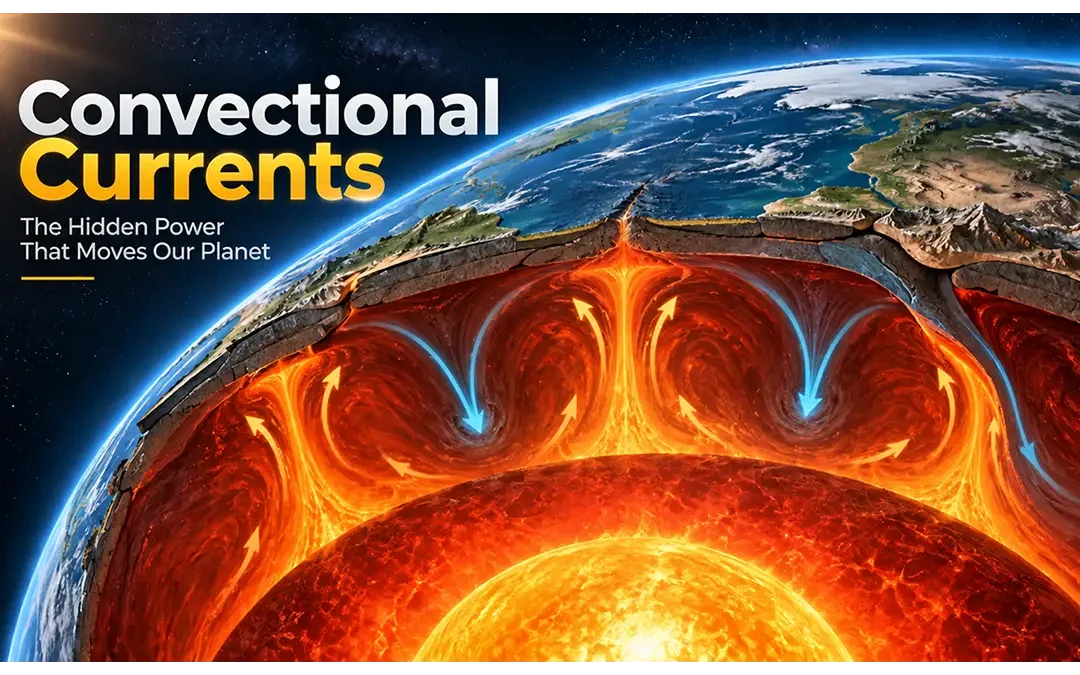
Convectional currents are movements of material caused by differences in temperature and density. They are an important way of transferring heat through fluids and slowly moving materials. Convection occurs in many natural systems, including the atmosphere, oceans, Earth's mantle, and outer core.
The basic process is simple: warmer material generally becomes less dense and tends to rise, while cooler and denser material tends to sink. This movement can create a continuous circulation when a suitable source of heat is present.
On Earth, convection is especially important because it helps redistribute heat and contributes to the dynamic behavior of our planet. Mantle convection is closely connected with the processes that shape Earth's crust, while atmospheric and oceanic convection influence weather and climate.
What Are Convectional Currents?
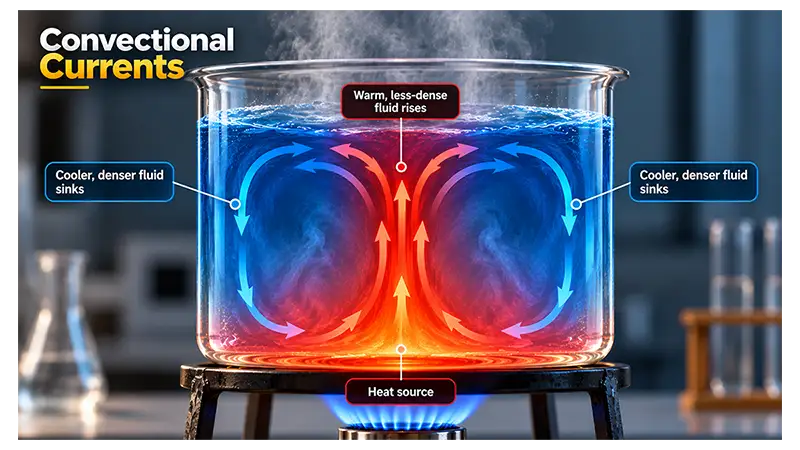
A convectional current is a circulating movement produced when differences in temperature create differences in density within a material. When part of a material becomes warmer, its particles usually move more vigorously and the material expands.
As a result, the same amount of material occupies more space and becomes less dense. Under gravity, the warmer material tends to move upward. At the same time, cooler material is usually denser. It can move downward and replace the rising warmer material. This creates circulation.
A simple example is a container of water being heated from below. Water near the heat source becomes warmer and rises. Cooler water from above moves downward to take its place. The process continues while heating maintains the temperature difference.
Convectional currents can occur in fluids such as air and water. They can also occur in Earth's mantle, where solid rock can deform and flow extremely slowly over millions of years.
Basic Features of Convectional Currents
- They require a source of heat or a temperature difference.
- Temperature differences can produce density differences.
- Warmer, less-dense material generally rises.
- Cooler, denser material generally sinks.
- Gravity helps organize the movement.
- The moving material transfers heat from one region to another.
- The pattern can continue as long as the conditions driving it remain.
Convection is therefore both a movement process and a method of heat transfer.
What Are the Main Types of Convection?
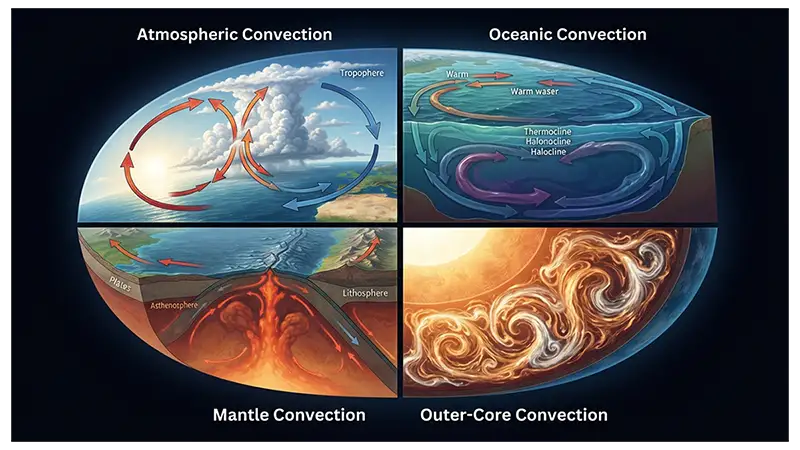
Convection occurs in several major Earth systems. The basic principle remains similar, but the materials, energy sources, and results differ.
Mantle Convection
Mantle convection involves the extremely slow movement and deformation of hot rock within Earth's mantle. It helps transfer heat from deeper parts of Earth toward shallower regions.
Atmospheric Convection
Atmospheric convection occurs when unevenly heated air develops density differences. Warm air can rise while cooler air sinks, producing vertical air movement. This process contributes to clouds, thunderstorms, and other forms of atmospheric circulation.
Oceanic Convection
Seawater can move because of differences in temperature and density. Differences in salinity also affect seawater density, making ocean circulation more complex than simple temperature-driven convection.
Outer-Core Convection
Earth's outer core is a liquid layer made mainly of iron and nickel, along with other elements. Heat and compositional differences can drive movement within this layer.
This convection is important because the movement of electrically conducting liquid metal contributes to Earth's magnetic field through the geodynamo.
Each of these systems demonstrates the same broad idea—density differences can cause material to move and transport energy—but they operate under very different physical conditions.
How Do Convectional Currents Form?
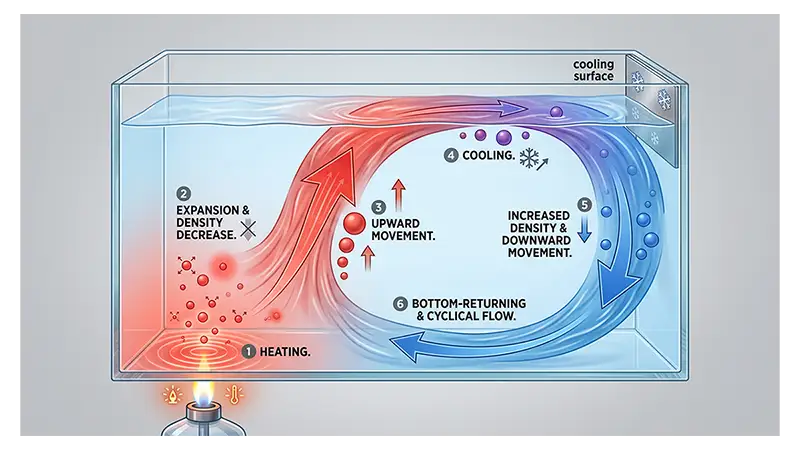
Convectional currents develop through a repeated process of heating, movement, cooling, and replacement.
1. Heating Begins
A heat source warms part of a material. The source may be a flame, sunlight, Earth's internal heat, or another source of thermal energy.
2. The Material Warms Up
As the material gains thermal energy, its temperature increases. In many fluids, the material expands.
3. Density Changes
Expansion usually makes the heated material less dense than the cooler material around it. Density is important because gravity causes denser material to tend toward lower positions and less-dense material to move upward.
4. Warm Material Rises
The warmer, less-dense material moves upward through the surrounding cooler material.
5. Cooler Material Sinks
As warm material moves upward, cooler and denser material moves downward to replace it.
6. Heat Moves With the Material
The moving material carries thermal energy from one location to another. This is what makes convection an effective heat-transfer process.
7. Circulation Continues
If heating continues, the cycle of rising and sinking can continue. The result is a convectional current or a system of convection currents.
The exact behavior depends on the material, its physical properties, gravity, the strength of the heat source, and the surrounding environment.
What Causes Convectional Currents?
The main cause of convection is a difference in temperature that produces differences in density. However, several factors work together to create and maintain the movement.
Temperature Differences
A temperature difference provides the energy needed to produce convection. Without a suitable temperature contrast, there may be little or no buoyancy-driven movement.
Density Differences
Density determines how material responds to gravity. Warmer material is often less dense, while cooler material is often denser. However, temperature is not the only factor that can affect density. Changes in composition can also create density differences.
Gravity
Gravity gives buoyancy its direction. Less-dense material tends to rise relative to denser surrounding material, while denser material tends to sink.
Solar Heating
The Sun is a major source of energy for atmospheric convection. Earth's surface absorbs solar energy unevenly, creating temperature differences in the air above it.
Earth's Internal Heat
Earth contains substantial internal heat. Some of this heat comes from the energy left over from Earth's formation, while radioactive decay inside the planet continues to produce heat. This internal energy contributes to thermal movement within Earth's deep interior.
Composition
In some systems, differences in chemical composition can influence density. This is particularly important in parts of Earth's interior, where changes in composition can affect buoyancy.
For example, processes associated with the formation and cooling of Earth's outer core involve both thermal and compositional effects.
How Do Convectional Currents Work in Earth's Mantle?
Earth's mantle is one of the most important places to study convection from a geological perspective. The mantle extends from beneath Earth's crust to the boundary with the core. It is made mainly of solid silicate rock. Although it is solid, mantle rock can deform and flow extremely slowly when subjected to high temperatures and pressures over geological periods.
Earth's Internal Heat
Heat from Earth's deep interior creates temperature differences within the mantle. Hotter material at depth can become buoyant relative to surrounding material and move upward. Near the surface, mantle material can lose heat. Cooler material can then become denser and move downward in some regions. This creates large-scale movement that helps transport heat through Earth's interior.
Upwelling
Upwelling occurs when relatively hot mantle material moves toward shallower levels. Some upwelling occurs beneath mid-ocean ridges, where mantle material rises as tectonic plates move apart. Other forms of mantle upwelling can occur beneath volcanic regions or as deeper mantle structures.
Downwelling
Downwelling occurs when relatively dense material moves downward. One of the clearest examples occurs at subduction zones. Cold oceanic lithosphere becomes denser as it cools and can sink into the mantle. This descending material affects mantle circulation and contributes to the recycling of Earth's crust and lithosphere.
Why Mantle Convection Is So Slow
Mantle rock does not flow like water in an ordinary container. The enormous pressure and high viscosity of mantle materials make the movement extremely slow.
Individual mantle movements may occur over millions of years. Scientists therefore study mantle convection mainly through indirect evidence, physical models, seismic observations, geochemistry, and computer simulations.
How Do Convectional Currents Affect Plate Tectonics?
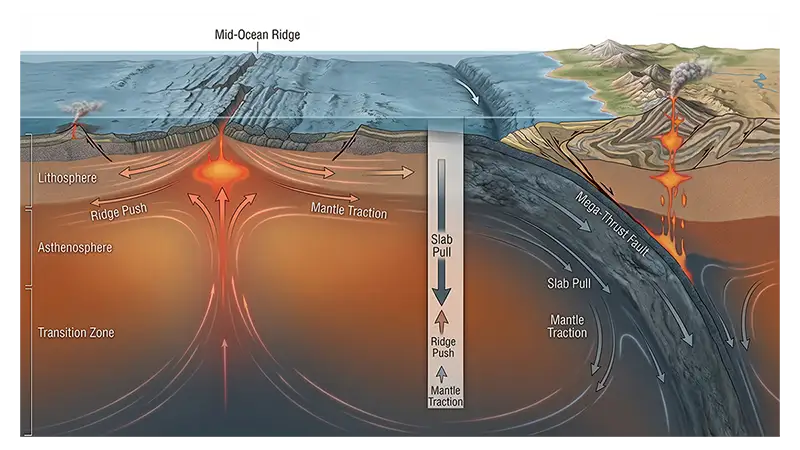
Convection within Earth's mantle is closely related to plate tectonics, but the relationship is more complex than the simple idea of a giant circular current carrying every tectonic plate.
Earth's rigid outer shell, called the lithosphere, is divided into tectonic plates. These plates move over the hotter and mechanically weaker asthenosphere and interact at their boundaries.
Mid-Ocean Ridges
At divergent plate boundaries, tectonic plates move apart. Mantle material rises beneath the spreading region, partially melts, and contributes to the formation of new oceanic crust. This process produces seafloor spreading.
Subduction Zones
At convergent boundaries, dense oceanic lithosphere can sink beneath another plate and descend into the mantle. This process is called subduction. The sinking slab is an important source of force on tectonic plates and contributes to the circulation and recycling of material within Earth.
Ridge Push
Elevated mid-ocean ridges can contribute to the movement of oceanic plates away from the ridge. This gravitational effect is commonly called ridge push.
Slab Pull
A cold, dense oceanic plate can sink into the mantle at a subduction zone. The sinking slab can exert a strong pulling force on the rest of the plate. This is known as slab pull.
The Complete Picture
Modern plate-tectonic science views plate movement as the result of several interacting forces. Mantle flow matters, but slab pull, ridge-related forces, plate density, basal tractions, and other processes also contribute.
Therefore, it is more accurate to say that mantle convection is part of Earth's overall system of heat transfer and material circulation and interacts with the forces that drive plate tectonics.
What Are the Effects of Convectional Currents?
Convection can produce important effects at different scales, from small movements of air to major geological changes.
Heat Redistribution
The most fundamental effect is the transfer of heat. Moving material carries thermal energy from warmer regions toward cooler regions.
Plate Movement
Mantle processes interact with tectonic forces and contribute to the dynamic environment in which Earth's plates move.
Seafloor Spreading
Upwelling beneath divergent boundaries contributes to the formation of new oceanic crust as plates separate.
Subduction and Crustal Recycling
Downward movement at subduction zones helps return old oceanic lithosphere into Earth's interior.
Volcanic Activity
Convection-related mantle processes can contribute to melting and magma generation. Volcanism is particularly common at divergent boundaries and subduction zones, although volcanic activity can also occur in other settings.
Earthquakes
Convection does not directly cause every earthquake. However, the tectonic plate movements associated with Earth's dynamic interior create stresses that can eventually produce earthquakes.
Mountain Building
When tectonic plates converge, their interactions can compress and deform Earth's crust. Over long periods, these processes can produce mountain ranges.
Atmospheric Circulation
Convection in the atmosphere causes warm air to rise and cooler air to descend. This movement contributes to weather systems and the development of clouds and storms.
Ocean Circulation
Density differences caused by temperature and salinity help drive large-scale ocean circulation. These movements redistribute heat and influence Earth's climate system.
How Do Scientists Study Convectional Currents?
Scientists cannot directly watch most convection occurring deep inside Earth. Instead, they combine observations, experiments, mathematical calculations, and computer models.
Seismic Waves
Earthquakes produce seismic waves that travel through Earth's interior. By studying how these waves move, scientists can investigate changes in the structure and properties of the mantle.
Seismic Tomography
Seismic tomography uses information from many seismic waves to create three-dimensional models of Earth's interior. These models can reveal regions that may have different temperatures or compositions and help scientists investigate mantle circulation.
Computer Models
Researchers use numerical models to simulate the behavior of Earth's mantle, atmosphere, and oceans. Models allow scientists to test how heat, density, viscosity, gravity, and other variables interact.
Laboratory Experiments
Scientists can reproduce some aspects of convection using controlled experiments. Materials with physical properties similar to geological materials can be used to investigate how fluids or deformable materials respond to heating.
Gravity Measurements
Variations in Earth's gravity field provide information about differences in density beneath the surface. These observations can contribute to studies of Earth's interior.
Magnetic Observations
Earth's magnetic field provides evidence about processes occurring in the outer core. Changes in the magnetic field help scientists study the behavior of electrically conducting liquid metal deep inside Earth.
Geochemical Evidence
The chemical composition of volcanic rocks and mantle-derived materials provides clues about processes occurring inside Earth. By combining these different forms of evidence, scientists can develop increasingly detailed models of convection and Earth's internal dynamics.
How Do Scientists Study Convectional Currents?
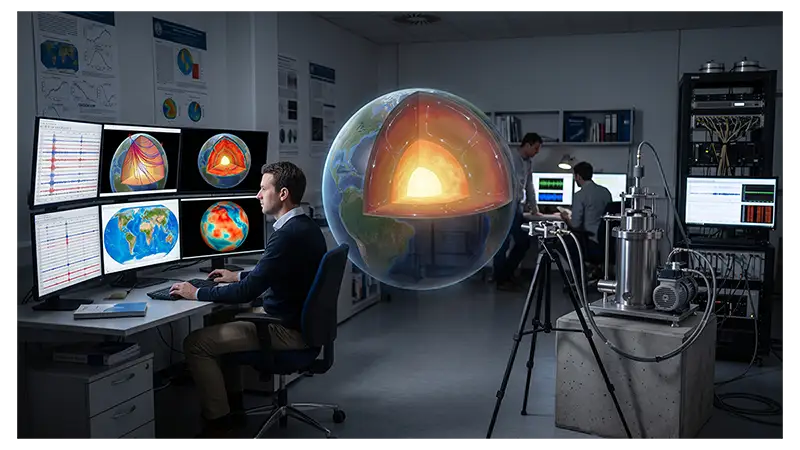
Scientists cannot directly watch most convection occurring deep inside Earth. Instead, they combine observations, experiments, mathematical calculations, and computer models.
Seismic Waves
Earthquakes produce seismic waves that travel through Earth's interior. By studying how these waves move, scientists can investigate changes in the structure and properties of the mantle.
Seismic Tomography
Seismic tomography uses information from many seismic waves to create three-dimensional models of Earth's interior. These models can reveal regions that may have different temperatures or compositions and help scientists investigate mantle circulation.
Computer Models
Researchers use numerical models to simulate the behavior of Earth's mantle, atmosphere, and oceans. Models allow scientists to test how heat, density, viscosity, gravity, and other variables interact.
Laboratory Experiments
Scientists can reproduce some aspects of convection using controlled experiments. Materials with physical properties similar to geological materials can be used to investigate how fluids or deformable materials respond to heating.
Gravity Measurements
Variations in Earth's gravity field provide information about differences in density beneath the surface. These observations can contribute to studies of Earth's interior.
Magnetic Observations
Earth's magnetic field provides evidence about processes occurring in the outer core. Changes in the magnetic field help scientists study the behavior of electrically conducting liquid metal deep inside Earth.
Geochemical Evidence
The chemical composition of volcanic rocks and mantle-derived materials provides clues about processes occurring inside Earth. By combining these different forms of evidence, scientists can develop increasingly detailed models of convection and Earth's internal dynamics.
Why Are Convectional Currents Important?
Convectional currents are important because they help move heat and material through many Earth systems.
They Transfer Heat
Convection transports thermal energy through moving material. This prevents heat from remaining concentrated in one location when the conditions allow circulation.
They Help Explain Earth's Dynamic Interior
Earth is not a static planet. Heat continues to move from its interior toward the surface, and convection is one of the processes involved in this transfer.
They Contribute to Plate-Tectonic Processes
Mantle circulation interacts with tectonic plates and the forces acting on them. Understanding convection therefore helps explain why Earth's surface is continually changing.
They Influence Weather
Atmospheric convection helps move heat and moisture vertically. It plays an important role in cloud formation, thunderstorms, and other weather processes.
They Redistribute Ocean Heat
Ocean circulation moves warm and cold water between different regions. This contributes to the redistribution of energy across the climate system.
They Help Generate Earth's Magnetic Field
Convection within the electrically conducting liquid outer core contributes to the geodynamo that produces Earth's global magnetic field. For these reasons, convection is not just a laboratory concept. It is part of several processes that make Earth an active planet.
Conclusion
Convectional currents are an important mechanism of heat transfer in which differences in temperature and density produce movement within a material. Warm, less-dense material generally rises, while cooler, denser material sinks, creating circulation when the conditions support continued movement.
On Earth, convection occurs in several major systems. Atmospheric convection helps move heat and moisture, oceanic circulation redistributes energy through seawater, and convection in the liquid outer core contributes to Earth's magnetic field.
In geology, mantle convection is particularly important. The mantle is predominantly solid rock, but it can flow slowly over millions of years. Its movement transfers heat and interacts with the forces involved in plate tectonics, helping explain processes such as seafloor spreading, subduction, volcanism, and long-term changes to Earth's surface.
Understanding convectional currents therefore provides a foundation for understanding how heat moves, Earth's interior remains active, and many geological and atmospheric processes continue to shape our planet.
Warm material often expands and becomes less dense than the surrounding cooler material. Under gravity, the less-dense material tends to rise relative to denser material.
Cooler material is often denser than warmer material around it. Gravity causes the denser material to move downward.
Yes. The mantle is mostly solid rock, but it can deform and flow very slowly over geological time. Heat-driven movement within the mantle helps transfer energy through Earth's interior.
Yes. Both air and water can develop convection currents when temperature or density differences cause parts of the material to rise and sink.
Mantle convection is related to plate tectonics, but plate movement is controlled by several interacting forces. Slab pull and ridge-related forces are especially important, so plate motion should not be explained as the result of simple convection cells alone.