
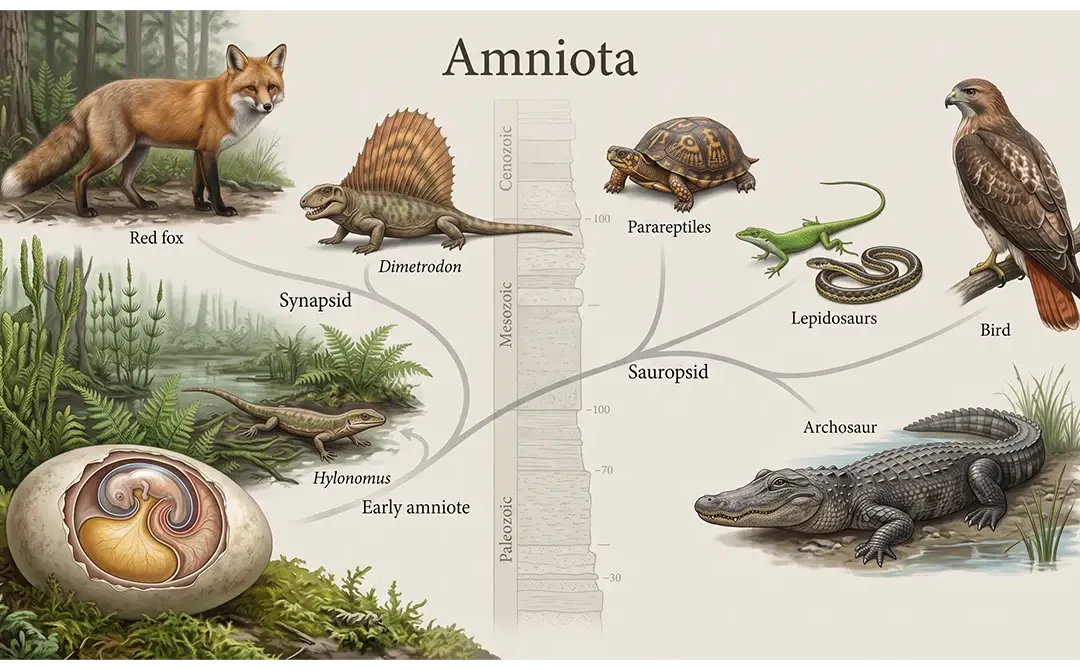
Amniota is a major group of land vertebrates that includes reptiles, birds, and mammals. Amniotes are distinguished by an evolutionary development called the amniotic egg, which allowed embryos to develop with greater protection from drying and other environmental conditions.
The group includes animals with very different body forms and lifestyles, from turtles and snakes to birds and humans. Although many amniotes lay eggs, mammals are also amniotes, and most living mammals give birth to live young.
Amniotes have played an important role in vertebrate evolution because their reproductive and anatomical adaptations helped vertebrates become successful across a wide range of terrestrial environments.
What Is Amniota?
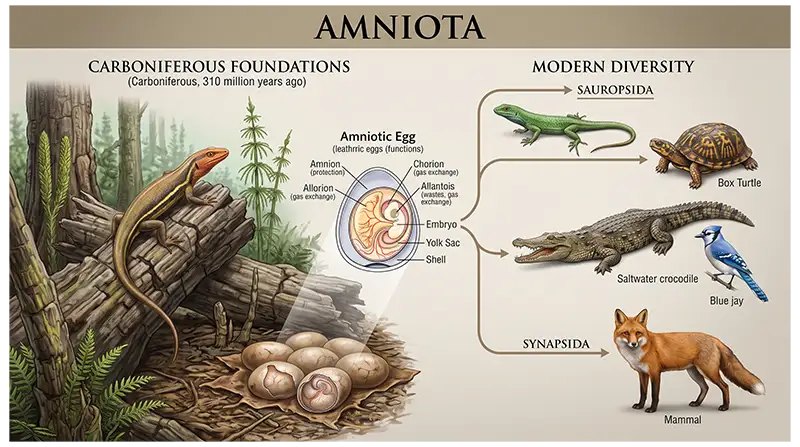
Amniota is a major clade of vertebrates that includes all living mammals and sauropsids, the group containing reptiles and birds, along with their extinct relatives. The name comes from the amnion, a membrane that surrounds the developing embryo. The amnion is one of several extraembryonic membranes that support development inside an egg or within the mother's body.
The earliest amniotes appeared during the Carboniferous Period, more than 300 million years ago. They evolved from earlier tetrapods and developed reproductive features that reduced their dependence on water for reproduction.
Living amniotes include:
- Mammals
- Birds
- Turtles
- Lizards
- Snakes
- Crocodilians
- Several other reptile lineages
Extinct amniotes include many important groups that once dominated terrestrial ecosystems, including non-avian dinosaurs, pterosaurs, and numerous synapsids and early reptiles.
A major point to understand is that Amniota is not defined simply by laying eggs. The group is defined by its evolutionary relationship and the presence of the amniotic condition in development. Mammals remain amniotes even though most living mammals give birth to live young.
What Are the Main Characteristics of Amniotes?
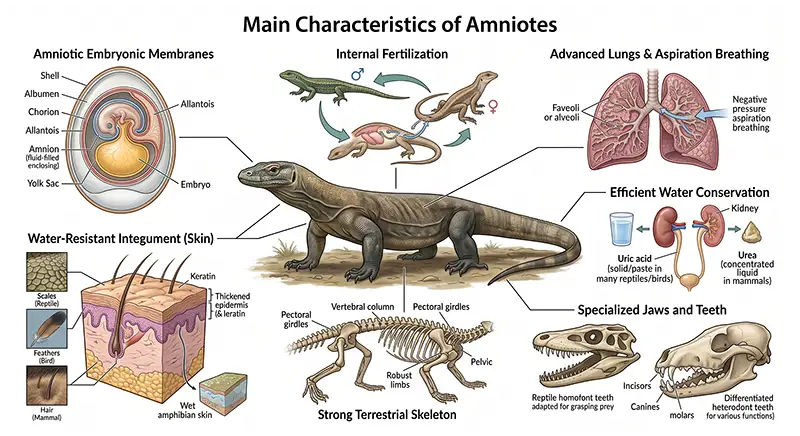
Amniotes have several biological features that distinguish them from earlier groups of land vertebrates. Their most important feature is the amniotic developmental system, which protects the embryo and allows reproduction to become less dependent on open water. Other characteristics involve their skin, lungs, skeleton, and overall body structure.
Amniotic Embryonic Membranes
The defining feature of amniotes is the presence of specialized membranes around the developing embryo. The amnion surrounds the embryo and contains fluid that protects it from drying and physical damage. Other membranes, including the chorion, yolk sac, and allantois, perform additional functions such as gas exchange, nutrient transfer, and waste storage. These membranes are important whether development occurs inside an externally laid egg or inside the mother's body.
Reproduction Less Dependent on Water
Many earlier tetrapods depended on water or very moist environments for reproduction. Amniotes developed a reproductive system that allowed embryonic development in a protected environment. This was a major advantage for animals living in dry terrestrial habitats. Modern amniotes use different reproductive strategies. Birds and many reptiles lay eggs, while most mammals give birth to live young. Despite this difference, both retain the fundamental amniotic developmental condition.
Well-Developed Lungs
Amniotes breathe air using lungs. Their respiratory systems are more specialized than those of many earlier vertebrates. Different groups developed different solutions. Mammals use lungs supported by a diaphragm and other respiratory muscles, while birds have highly specialized lungs connected to air sacs. These systems allow amniotes to obtain oxygen efficiently while living primarily in air.
More Water-Resistant Skin
Amniote skin generally provides better protection against water loss than the moist skin of many amphibians. Different groups have developed different outer coverings. Reptiles commonly have scales, birds have feathers, and mammals have hair or fur. These structures also provide protection and can contribute to temperature regulation, movement, camouflage, or communication.
Strong Support for Life on Land
Amniotes have skeletons and muscles capable of supporting the body in terrestrial environments. Their vertebral columns, limbs, joints, and muscles have evolved into many different forms. Some species walk on four limbs, some run on two, some climb, and others have modified their limbs for swimming or flying.The basic amniote body plan has therefore been adapted for a wide variety of forms of movement.
Specialized Jaws and Teeth
Many amniotes have highly developed jaws and teeth that allow them to exploit different food sources. Carnivorous species may have sharp teeth for catching and cutting prey, while herbivorous species can have teeth and jaw structures suited to processing plant material. Birds provide an important exception because modern birds lack teeth and use beaks instead.
Internal Fertilization
Internal fertilization is another important feature of amniotes. Sperm is transferred inside the female reproductive system, which protects reproductive cells from drying and makes reproduction more suitable for terrestrial environments. The details of reproduction vary greatly among mammals, reptiles, and birds, but internal fertilization is widespread across Amniota.
Efficient Water Conservation
Life on land requires animals to control how much water they lose from their bodies. Amniotes have several adaptations that help conserve water, including relatively resistant skin and specialized kidneys and excretory systems. These adaptations are especially important for species living in dry environments such as deserts and semi-arid regions.
Diverse Body Coverings
Amniotes have evolved several types of protective body coverings.
- Reptiles commonly have scales or scutes.
- Birds have feathers.
- Mammals have hair or fur.
These structures are not identical, but each evolved from the developmental systems of its particular lineage and provides protection and other specialized functions.
Together, these characteristics helped amniotes become one of the most successful groups of land vertebrates. Their ability to reproduce with less dependence on water, conserve moisture, breathe efficiently, and develop specialized body structures allowed them to spread into many different environments.
What Is the Amniotic Egg and How Does It Work?
The amniotic egg is one of the most important evolutionary developments associated with Amniota. Unlike the eggs of many amphibians, an amniotic egg contains specialized membranes that help the embryo develop in a protected environment. The main extraembryonic membranes are the amnion, chorion, yolk sac, and allantois.
Amnion
The amnion surrounds the embryo and contains fluid. This fluid helps protect the developing embryo from physical damage and prevents it from drying out.
Chorion
The chorion is an outer membrane involved in gas exchange. It allows oxygen to reach the developing embryo and helps carbon dioxide move away.
Yolk Sac
The yolk sac surrounds and helps process the yolk, which provides nutrients to the developing embryo.
Allantois
The allantois helps store nitrogenous wastes and also contributes to gas exchange in many egg-laying amniotes. Together, these membranes create a controlled environment for embryonic development. The amniotic egg also has protective outer layers that help reduce water loss. In many reptiles and birds, the egg has a shell, while monotremes produce softer eggs.
Mammals have taken this system in another direction. In most mammals, the embryo develops inside the uterus rather than inside an externally laid egg. The same basic developmental membranes remain important, although they function within the mother's body.
What Are the Main Groups of Amniota?
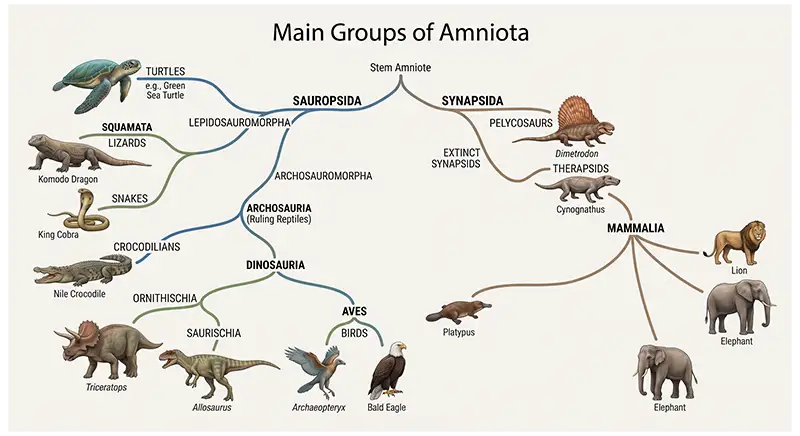
Living Amniota is commonly divided into two major evolutionary branches: Sauropsida and Synapsida.
Sauropsida
Sauropsids include living reptiles and birds, together with their extinct relatives.
This branch contains:
- Turtles
- Lizards
- Snakes
- Crocodilians
- Birds
- Many extinct reptile groups
- Dinosaurs
- Pterosaurs
Birds are living dinosaurs and therefore belong within the sauropsid branch. Sauropsids have developed a huge range of body forms. Some are small and terrestrial, while others are large, aquatic, flying, or adapted to extreme environments.
Synapsida
Synapsids include mammals and their extinct relatives. Modern mammals belong to this branch, but many earlier synapsids had reptile-like body shapes while possessing important differences in their skulls and other anatomical structures. Over geological time, synapsids developed increasingly specialized features associated with the mammalian lineage.
Living synapsids include:
- Humans
- Bats
- Whales
- Elephants
- Dogs
- Cats
- Rodents
- Primates
- Other mammals
These two major branches represent one of the most important divisions in amniote evolutionary history.
How Did the First Amniotes Evolve?
The first amniotes evolved from earlier tetrapods during the Carboniferous Period, more than 300 million years ago. Earlier tetrapods were already capable of living on land, but their reproduction remained closely connected to moist environments. Their eggs generally required water or very damp conditions for successful development.
The evolution of the amniotic condition changed this limitation. An embryo protected by specialized membranes could develop in a more controlled environment. This reduced the need for adults to return to open water to reproduce. Early amniotes were not all identical. They represented a group of animals that gradually developed different body structures, feeding strategies, and ecological roles.
Fossils of early amniotes help scientists understand this transition. Some early forms were small, lizard-like animals that lived in terrestrial environments. Over millions of years, their descendants diversified into the major evolutionary branches that eventually produced modern reptiles, birds, and mammals.
How Did Early Amniotes Adapt to Life on Land?
The ability to reproduce away from open water was only one part of the amniote transition. Early amniotes also needed adaptations that helped them survive on land. Their bodies became increasingly suited to terrestrial movement and feeding. Strong limbs and supportive skeletons helped many species move across solid ground.
Their skin also played an important role. Compared with the moist skin of many amphibians, amniote body coverings generally provide better protection against water loss. Early amniotes also developed more effective ways to obtain and conserve water. Their lungs allowed them to breathe atmospheric oxygen without relying on aquatic environments.
Different groups later developed their own specialized adaptations. Some evolved scales, others feathers or hair. Some became herbivores, some predators, and others developed mixed diets. Amniotes also eventually returned to water many times during evolution. Whales and seals are examples among mammals, while turtles, crocodilians, and several extinct reptile groups developed aquatic lifestyles among sauropsids.
This shows that becoming an amniote did not permanently restrict animals to land. Instead, it provided a flexible evolutionary foundation for living in many environments.
What Do Amniote Fossils Reveal About Their Evolution?
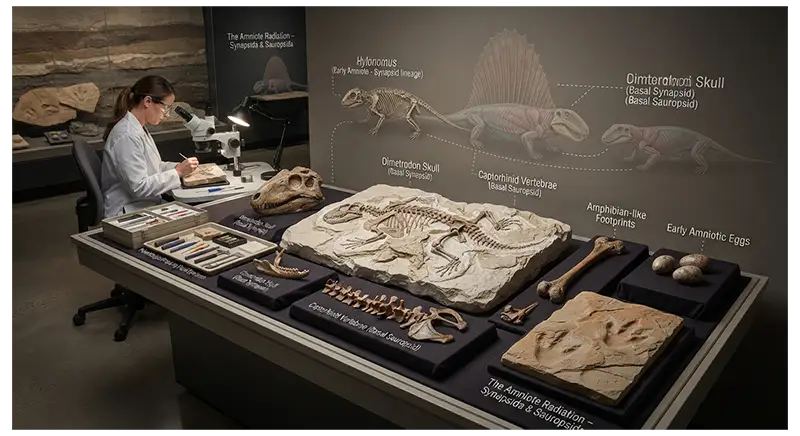
Fossils provide important evidence about the origin and diversification of Amniota. Scientists study bones, skulls, teeth, footprints, eggs, nests, skin impressions, feathers, and other preserved structures to reconstruct the history of these animals.
Early amniote fossils can help identify changes in the skull, jaws, limbs, vertebral column, and other parts of the skeleton. Fossil eggs and nests provide additional information about reproduction and parental behavior. Some dinosaur nesting sites, for example, preserve evidence about where eggs were laid and how adults interacted with their young.
Fossilized footprints can show how ancient amniotes moved and whether they walked, ran, climbed, or lived in particular environments. The fossil record also reveals the enormous diversity of extinct amniotes. Dinosaurs, pterosaurs, early synapsids, marine reptiles, and many other groups represent branches that appeared and disappeared throughout geological time.
By comparing fossil forms with living animals, scientists can reconstruct evolutionary relationships and identify major changes that occurred within the group.
How Did Amniotes Diversify Into Reptiles, Birds, and Mammals?
After early amniotes appeared, their descendants split into different evolutionary branches. One major branch led to synapsids, eventually producing mammals. Another major branch led to sauropsids, which includes reptiles and birds.
The diversification did not happen as a simple straight line. Instead, many branches appeared, and numerous lineages later became extinct.
Synapsid Evolution
Early synapsids included several groups that looked very different from modern mammals. Over time, the mammalian lineage developed important changes in the skull, jaws, teeth, limbs, hearing structures, and other parts of the body. Eventually, true mammals appeared.
Sauropsid Evolution
Sauropsids also diversified extensively. Different lineages produced turtles, crocodilians, lizards, snakes, dinosaurs, pterosaurs, and many other groups. One dinosaur branch eventually produced birds. Modern birds therefore represent a surviving branch of the dinosaur lineage.
Major Evolutionary Changes
Amniote diversification involved changes in:
- Body size
- Skull structure
- Teeth
- Limbs
- Feeding strategies
- Body coverings
- Reproduction
- Breathing systems
- Movement
- Habitat use
This long history explains why modern amniotes occupy such a wide range of ecological roles.
What Living Animals Are Amniotes Today?
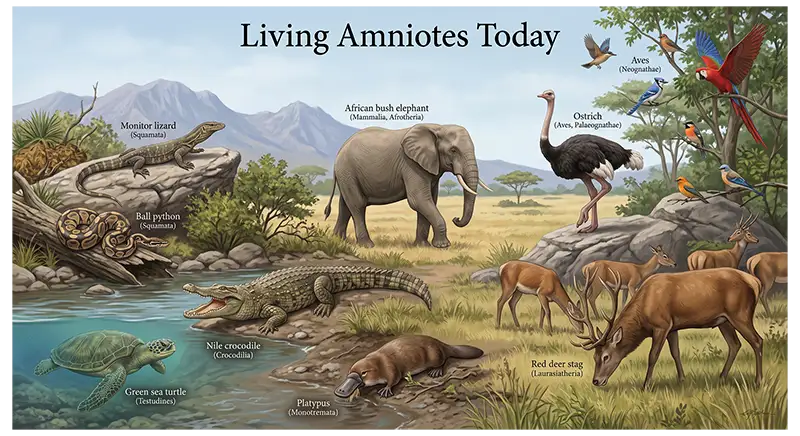
Amniotes are represented by many familiar animals today.
Mammals
All living mammals are amniotes. This includes humans, elephants, bats, whales, dogs, cats, rodents, and thousands of other species. Most mammals give birth to live young, but monotremes such as the platypus and echidnas lay eggs.
Reptiles
Living reptiles are also amniotes. They include turtles, lizards, snakes, crocodilians, and several other groups. Their body coverings, reproductive systems, and lifestyles vary considerably.
Birds
Birds are also amniotes and belong to the sauropsid branch. Modern birds lay amniotic eggs with specialized membranes. Their feathers, lightweight skeletons, wings, and highly efficient respiratory systems are later adaptations that evolved within the bird lineage.
The diversity of living amniotes shows how successful this major vertebrate group has been. From a small mammal to a giant whale, from a tiny bird to a large crocodilian, living amniotes occupy environments ranging from deserts and forests to oceans and polar regions.
Why Is Amniota Important to Vertebrate Evolution?
Amniota is important because it represents one of the major transitions in vertebrate evolutionary history. The evolution of the amniotic condition allowed reproduction to become less dependent on open water. This opened new opportunities for vertebrates living in terrestrial environments. The success of amniotes eventually led to enormous diversification.
Their descendants include:
- Reptiles
- Birds
- Mammals
- Dinosaurs
- Pterosaurs
- Numerous extinct synapsids
- Many other extinct terrestrial and aquatic groups
The group also demonstrates how a single major evolutionary innovation can be modified in different ways. Reptiles developed various forms of scales and terrestrial reproduction. Birds evolved feathers, flight, and specialized respiratory systems. Mammals developed hair, complex milk production, and many different reproductive strategies.
The amniotic condition therefore forms an important foundation for understanding the evolution of modern terrestrial vertebrates. Studying Amniota also connects several areas of science, including biology, paleontology, anatomy, embryology, ecology, and evolutionary science.
Conclusion
Amniota is one of the most important groups in vertebrate evolution. It includes mammals, reptiles, birds, and many extinct lineages that have shaped life on Earth for hundreds of millions of years.
The development of the amniotic condition allowed embryos to develop with greater protection and reduced the dependence on open water for reproduction. This helped early amniotes expand into terrestrial environments. Over geological time, amniotes diversified into two major living branches, synapsids and sauropsids.
These branches eventually produced mammals, reptiles, birds, dinosaurs, and many other forms of life. Fossils, living animals, eggs, and embryological evidence together reveal the long evolutionary history of Amniota and show how one major developmental innovation contributed to the remarkable diversity of vertebrates living today.
They are called amniotes because their embryos develop with an amnion, a membrane that surrounds and protects the developing embryo.
No. Many reptiles and birds lay eggs, but most mammals give birth to live young. Mammals are still amniotes because their embryos develop with the characteristic amniotic membranes.
The two major evolutionary branches are Sauropsida, which includes reptiles and birds, and Synapsida, which includes mammals and their extinct relatives.
The earliest amniotes appeared during the Carboniferous Period, more than 300 million years ago.
Yes. Birds are sauropsid amniotes and are part of the dinosaur lineage.