
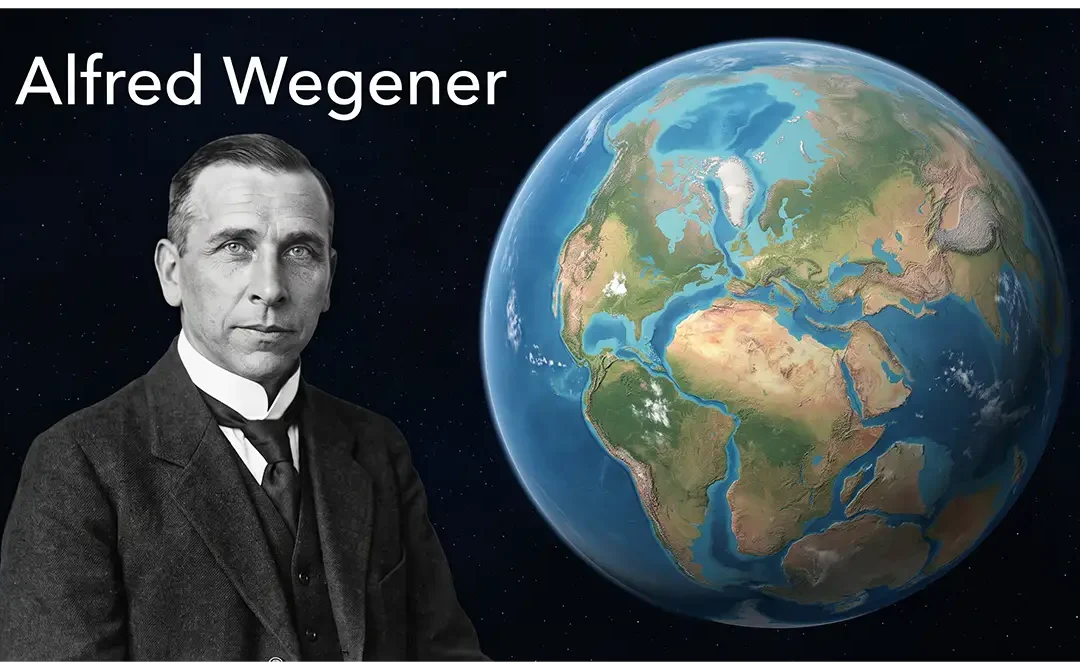
Alfred Wegener was a German meteorologist and geophysicist best known for developing the scientific theory of continental drift. He argued that the continents were not permanently fixed in their present positions but had moved over geological time. His ideas were based on several lines of evidence, including matching fossils, similar rocks and mountain structures, the fit of continental margins, and evidence of ancient climates.
Wegener's ideas were controversial during his lifetime because he could not provide a convincing physical mechanism that explained how continents could move across the ocean floor. Decades later, discoveries about the ocean floor, seafloor spreading, paleomagnetism, earthquakes, and volcanic activity helped establish the modern theory of plate tectonics, which incorporated the central idea that continents move as parts of larger tectonic plates.
Who Was Alfred Wegener?

Alfred Lothar Wegener was a German meteorologist, geophysicist, and polar researcher best known for developing the theory of continental drift. He was born on 1 November 1880 in Berlin, Germany, and died in November 1930 during a scientific expedition in Greenland.
Wegener studied astronomy and received his doctorate in 1905. He later became interested in meteorology, geophysics, and the history of Earth's continents. His scientific career included several expeditions to Greenland, where he studied atmospheric conditions and carried out research in the challenging polar environment.
Wegener became especially interested in the similarities between continents. He noticed that fossils, rock formations, mountain structures, and ancient climate evidence on continents now separated by oceans could be better explained if those landmasses had once been connected.
In 1912, he presented his ideas about continental movement, and in 1915 he published them in his book The Origin of Continents and Oceans. He proposed that the continents had once formed a large supercontinent called Pangaea and had gradually moved apart over geological time.
His continental drift theory was controversial because he could not explain a convincing physical mechanism for moving continents. Later discoveries about seafloor spreading, paleomagnetism, ocean-floor geology, and plate tectonics provided the mechanism and evidence that helped establish the modern understanding of moving tectonic plates.
Wegener died at the age of 50 during his 1930 Greenland expedition. Although he did not live to see the development of modern plate tectonics, his continental drift hypothesis became an important foundation for understanding Earth's dynamic surface.
What Did Alfred Wegener Discover?
Wegener is best known for developing and defending the theory of continental drift. He did not discover that continents might have moved from one position to another entirely on his own. Earlier scientists had noticed similarities between continental coastlines and had proposed ideas about continental movement. Wegener's major contribution was to collect and connect evidence from several different scientific fields into a much more developed hypothesis.
His work brought together several important observations:
- The shapes of some continents appear to fit together.
- Similar fossils occur on continents now separated by large oceans.
- Similar rock formations and mountain belts occur on continents that are now far apart.
- Evidence of ancient glaciers occurs in places that are warm today.
- Fossils of plants associated with warmer climates occur in regions that are now extremely cold.
- The distribution of ancient organisms made more sense if some continents had once been connected.
Wegener used these observations to argue that the continents had once been joined and later moved apart. His work was important because it encouraged scientists to view Earth as a changing planet rather than a world whose continents and ocean basins had always remained in their present positions.
What Was Wegener’s Continental Drift Theory?
Continental drift was Wegener's hypothesis that continents had moved significantly over geological time. He proposed that the continents were once assembled into a large supercontinent that he called Pangaea. According to his reconstruction, Pangaea later broke apart, and its continental pieces gradually moved toward their present positions.
Wegener's basic idea can be understood in three stages:
- Large continental landmasses were once joined.
- The supercontinent later broke apart.
- The separated continents moved over geological time.
This idea helped explain several otherwise difficult observations. For example, the coastlines of South America and Africa appear to fit together particularly well. More importantly, fossils and geological structures on opposite sides of the Atlantic also showed similarities.
Wegener argued that these similarities were difficult to explain if the continents had always been separated. His continental drift hypothesis was therefore based on multiple types of evidence, not simply the visual appearance of continental coastlines.
However, Wegener's model was different from modern plate tectonics. He did not correctly explain the mechanism that moves continents. Modern geology shows that continents are parts of rigid tectonic plates, and these plates move over the Earth's interior.
What Evidence Did Wegener Use for Continental Drift?
Wegener used several independent lines of evidence to support continental drift. This was one of the strongest aspects of his work because different types of evidence pointed toward the same general conclusion.
Matching Continental Margins
The coastlines of South America and Africa attracted particular attention. When reconstructed, their continental margins show a strong geometric relationship. Wegener recognized that the apparent fit was more meaningful when combined with other evidence rather than treated as a simple puzzle of modern coastlines.
Matching Rock Formations
Similar rocks and geological structures occur on continents that are now separated by oceans. When the continents are reconstructed into earlier positions, some of these geological features line up more naturally. This suggested that rocks now found on opposite sides of an ocean could have formed as part of the same ancient geological system.
Matching Fossils
The same fossil species were found on continents that are now separated by large oceans. Wegener argued that many of these organisms could not reasonably have crossed such wide oceans. Their distribution therefore made more sense if the continents had once been connected.
Ancient Climate Evidence
Wegener also studied evidence of past climates. For example, glacial deposits occur in regions that are warm today, while evidence of ancient tropical vegetation has been found in Antarctica. These observations suggested that continents had occupied very different positions in the past. Together, these observations created a much stronger case than any single piece of evidence could provide.
How Did Fossils Support Wegener’s Continental Drift Theory?
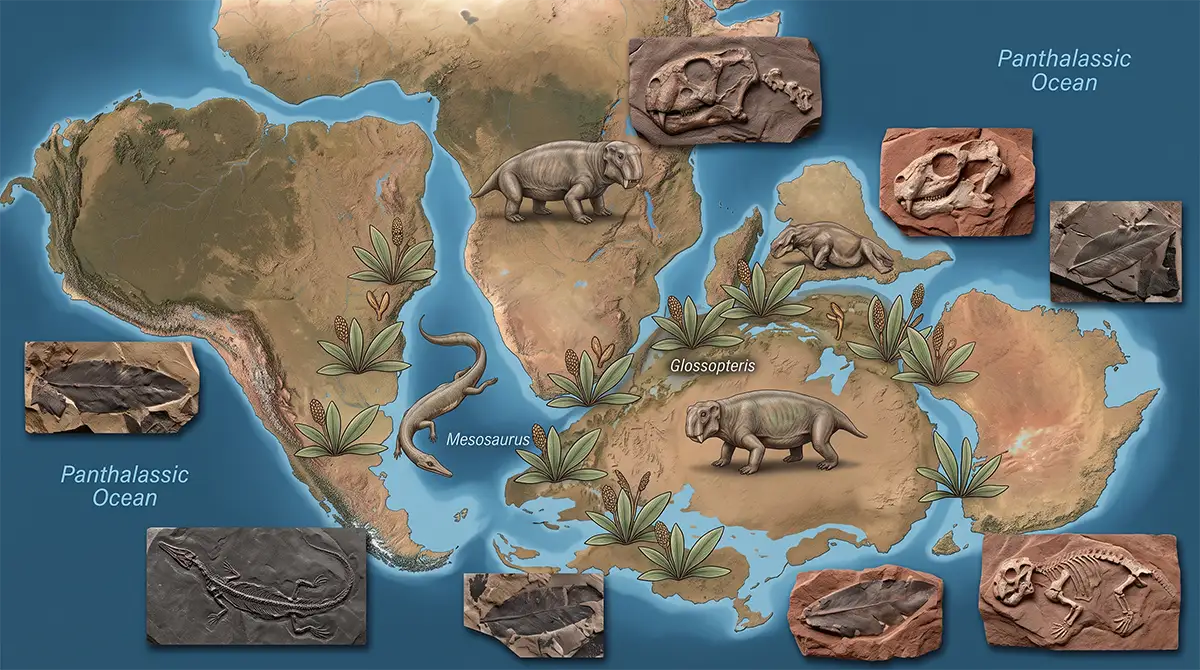
Fossils played an especially important role in Wegener's argument. Several fossil organisms were found on continents that are now separated by oceans. If these organisms had lived in freshwater environments or on land, it was difficult to explain how the same species could have reached widely separated continents without a land connection.
One well-known example involved Mesosaurus, a freshwater reptile whose fossils occur in parts of South America and southern Africa. Another important example was Glossopteris, an extinct seed fern whose fossils were found across several southern continents. Fossils of Lystrosaurus, a land-dwelling vertebrate, also occurred across regions that are now widely separated. USGS educational materials use these fossil distributions to demonstrate how Wegener reconstructed ancient continental positions.
Wegener argued that these organisms had lived when the continents were connected. After the landmasses separated, the fossils remained in rocks on the different continents. This explanation became especially powerful when fossil evidence was combined with matching rocks and ancient climate indicators.
The fossil evidence did not by itself prove every detail of continental movement, but it provided an important clue about the former connections between continents.
How Did Paleoclimate Evidence Support Continental Drift?
Paleoclimate is the study of ancient climates. Wegener recognized that rocks and fossils could preserve evidence of climates that were very different from those experienced in the same regions today.
One striking example was evidence of ancient glaciation in parts of Africa and other southern continents. Some of these areas are now located in relatively warm climates. If the continents had always remained in their present positions, these ancient glacial deposits would be difficult to explain.
Wegener also considered evidence from ancient vegetation. Coal deposits in Antarctica, for example, indicate that vegetation once grew there under conditions very different from the continent's present cold environment. The distribution of Glossopteris was also important because this plant occurred across several southern continents and was associated with ancient environments that differed greatly from the climates of some of those regions today.
Wegener's explanation was that the continents had changed latitude over geological time. A continent that is now close to a polar region could have occupied a much warmer latitude in the past. Similarly, a region that is now tropical could once have been located at a higher latitude. This provided another line of evidence for continental movement.
What Was Pangaea According to Wegener?
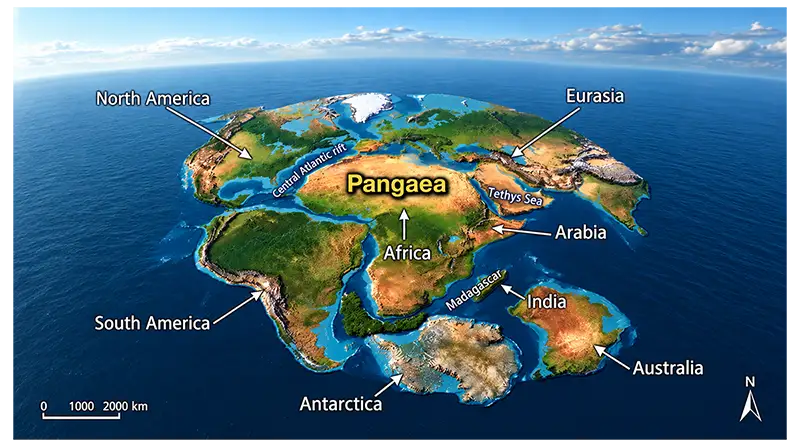
Pangaea was the supercontinent that Wegener proposed had existed before the present continents separated. The name comes from Greek roots meaning approximately “all Earth.” Wegener used Pangaea to describe a time when most of the world's continental landmass was joined into one enormous supercontinent.
In Wegener's reconstruction, Pangaea later began to break apart. The separated continental pieces gradually moved away from one another. Over millions of years, this produced the broad arrangement of continents that we recognize today. Wegener's Pangaea reconstruction was not identical to modern reconstructions. Scientists now have much more information from seafloor rocks, magnetic patterns, radiometric dating, seismic data, and other geological evidence.
Nevertheless, the basic idea that the continents were once assembled into a supercontinent and later separated remains an important part of modern Earth science. Pangaea also helps explain why matching fossils, rock formations, and ancient climate indicators occur across continents that are now far apart.
Why Was Wegener’s Continental Drift Theory Rejected?
Wegener's theory attracted considerable criticism when it was introduced. The main problem was not simply a lack of evidence. Wegener had gathered a substantial collection of geological, fossil, and climate evidence. The major weakness was his explanation of how the continents could move.
Scientists wanted to know what force could move enormous continental masses through solid oceanic material. Wegener proposed mechanisms involving forces related to Earth's rotation and other processes, but these explanations were not sufficient to satisfy many geophysicists. One major criticism was that continents could not simply plow through the solid ocean floor as if they were ships moving through water. The physical forces required would be far too great.
As a result, many scientists rejected continental drift during Wegener's lifetime, even though some researchers supported parts of his idea. This distinction is important: Wegener's evidence for continental movement and his proposed mechanism for movement were separate issues. His evidence later proved valuable, while his proposed mechanism was not the explanation used by modern plate tectonics.
How Did Plate Tectonics Support Wegener’s Ideas?
Wegener died before the modern theory of plate tectonics was developed. Beginning particularly in the 1950s and 1960s, new technology and geological discoveries produced evidence that changed scientists' understanding of Earth's surface.
Scientists mapped the ocean floor and discovered features such as mid-ocean ridges and deep ocean trenches. They also found evidence that oceanic crust is relatively young near mid-ocean ridges and becomes older farther away. The discovery of seafloor spreading provided a mechanism for producing new oceanic crust and moving tectonic plates.
Paleomagnetic research provided another important line of evidence. Scientists discovered patterns of magnetic reversals preserved in oceanic rocks on both sides of mid-ocean ridges. The global distribution of earthquakes and volcanoes also showed that Earth's surface is divided into large moving plates with active boundaries.
These discoveries helped establish modern plate tectonics. Modern plate tectonics differs from Wegener's original model because continents do not simply move independently through oceanic crust. Instead, continents are embedded within larger lithospheric plates. Those plates interact at boundaries and move over the Earth's deeper, hotter interior. In this sense, later discoveries supplied the physical framework that Wegener's continental drift hypothesis lacked.
What Was Alfred Wegener’s Contribution to Earth Science?
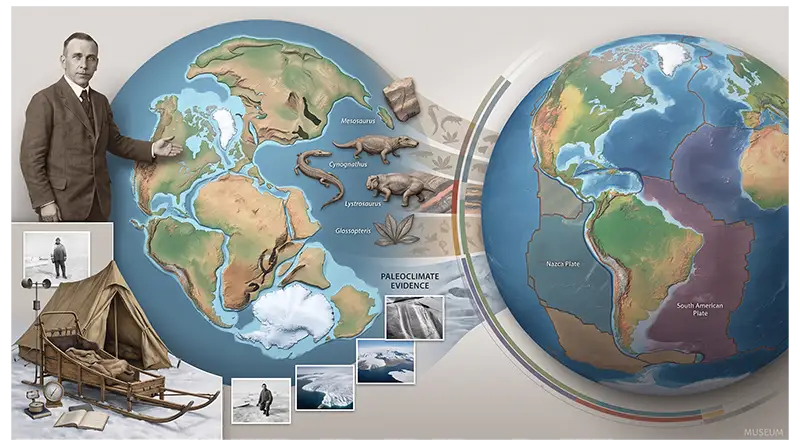
Wegener's most important contribution was changing the way scientists thought about the history of Earth's continents. He showed the value of combining evidence from different branches of Earth science. His continental drift hypothesis brought together:
- Geology
- Paleontology
- Paleoclimatology
- Geography
- Meteorology
- Geophysics
This interdisciplinary approach was particularly important because no single type of evidence could explain the distribution of continents on its own. His reconstructions of ancient continental positions were also valuable. Later research showed that many of his broad ideas about past continental arrangements were much closer to modern understanding than scientists of his time generally accepted.
Wegener also contributed to meteorology and polar research through his work and expeditions in Greenland. His legacy is therefore broader than the phrase “continental drift.” He demonstrated how fossils, rocks, climate indicators, and geographic patterns could be combined to investigate Earth's deep history.
Modern plate tectonics developed decades after his death, but his continental-drift hypothesis provided an important foundation for that scientific revolution.
How Did Alfred Wegener Die?
Alfred Wegener died during his 1930 Greenland expedition. He had traveled to Greenland as part of a scientific expedition involving meteorological research and the study of the Greenland ice sheet. During the expedition, Wegener and his companions faced extremely difficult conditions, including severe cold. Wegener reached a remote station and later began the journey back toward the expedition's main camp.
He died during the return journey in November 1930, at the age of 50. His body was found the following year. His death occurred before the later discoveries that would transform continental drift into the modern theory of plate tectonics. He therefore never saw the full scientific development of the idea he had spent much of his career defending.
Conclusion
Alfred Wegener changed Earth science by developing the theory of continental drift and showing how evidence from fossils, rocks, geography, and ancient climates could reveal the past movement of continents.
His proposal that the continents had once been joined as Pangaea was controversial because he could not explain the physical mechanism responsible for continental movement. For many years, this weakness prevented widespread acceptance of his theory.
Later discoveries transformed the situation. Ocean-floor mapping, seafloor spreading, paleomagnetism, and the global patterns of earthquakes and volcanoes provided the evidence and mechanisms needed for modern plate tectonics.
Wegener therefore occupies an important place in the history of geology. His original theory was incomplete, but his approach to combining different kinds of evidence helped open the way toward the modern understanding of Earth's moving continents and dynamic crust.
He is famous for arguing that Earth's continents had moved over geological time and were once joined as part of the supercontinent Pangaea.
Wegener did not discover the physical remains of Pangaea in the modern sense. He proposed the idea of Pangaea as part of his continental drift theory and used geological, fossil, and paleoclimate evidence to reconstruct its former arrangement.
He used the fit of continental margins, matching fossils, similar geological structures and rocks, and evidence of ancient climates.
The main problem was that Wegener could not provide a convincing mechanism capable of moving continents over geological distances.
His central idea that continents have moved over geological time was incorporated into modern plate tectonics. However, his proposed mechanism for continental movement was not the mechanism accepted by modern geology.