
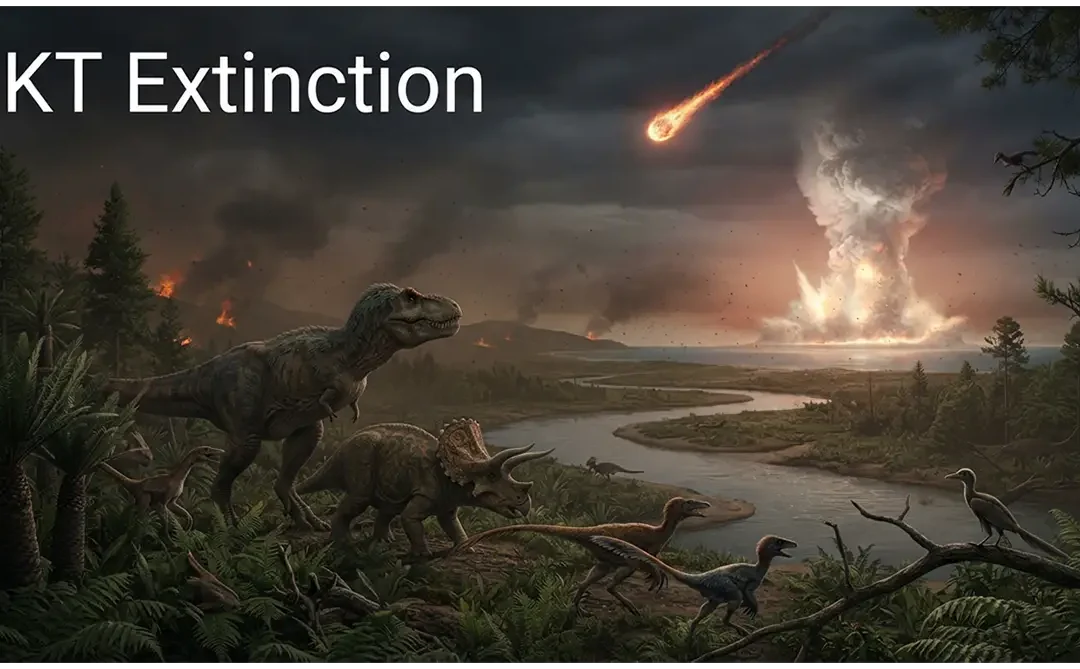
KT Extinction was one of the most important mass extinction events in Earth's history, occurring about 66 million years ago at the boundary between the Cretaceous and Paleogene periods. It ended the age of non-avian dinosaurs and caused major losses in marine and terrestrial ecosystems. Today, scientists generally call it the Cretaceous–Paleogene (K–Pg) extinction, while “KT” or “K–T” remains a commonly used older term.
The event is strongly associated with the impact of a large asteroid near present-day Chicxulub, Mexico. The collision released enormous energy and triggered environmental changes that disrupted food webs around the world. Volcanic activity in India's Deccan Traps also occurred around this time and may have added environmental stress, although the asteroid impact has the strongest evidence as the primary trigger.
What Was the KT Extinction?
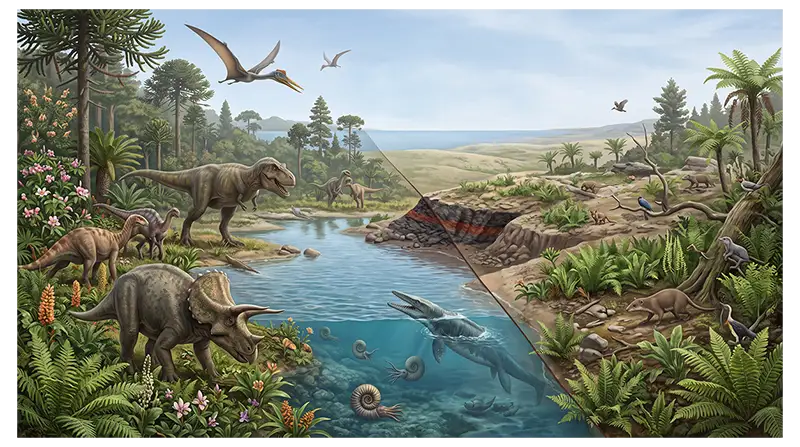
The KT Extinction was a global mass extinction that occurred at the end of the Cretaceous Period, approximately 66 million years ago. It marks the boundary between the Cretaceous and Paleogene periods and therefore also separates the Mesozoic Era from the Cenozoic Era.
The extinction is most famous because it eliminated all non-avian dinosaurs. However, dinosaurs were only one part of a much larger biological crisis.
Several other groups experienced major losses, including:
- Ammonites
- Pterosaurs
- Marine reptiles such as mosasaurs and plesiosaurs
- Several groups of marine plankton
- Various terrestrial and marine organisms
Not every species disappeared. Mammals, crocodilians, turtles, amphibians, fish, insects, plants, and birds all included surviving lineages.
Modern birds are actually surviving members of the dinosaur lineage. Therefore, saying that “the dinosaurs went extinct” is scientifically incomplete. Non-avian dinosaurs disappeared, while avian dinosaurs survived and eventually diversified into modern birds.
The name K–T extinction comes from the German spelling of Cretaceous, Kreide, combined with T for Tertiary. Because “Tertiary” is no longer the preferred formal geological term, scientists now generally use K–Pg for the boundary and extinction event.
What Was Earth Like Before the KT Extinction?
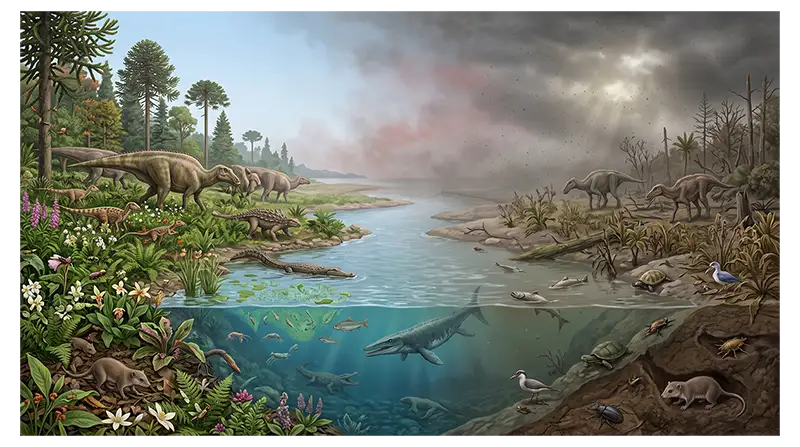
Earth looked very different shortly before the extinction. The continents were moving toward their modern positions, although their arrangement was still substantially different from today. The planet supported extensive oceans, coastal environments, forests, wetlands, inland waterways, and other habitats. The climate was generally warmer than the present global climate, and large ice sheets like those found during later Ice Ages were absent.
Dinosaurs occupied many terrestrial ecosystems. Different species filled roles ranging from plant-eating herbivores to large predators and small feathered animals. The Late Cretaceous also contained highly diverse marine ecosystems. Ammonites, marine reptiles, fish, sharks, microscopic plankton, and other organisms lived in oceans and shallow seas.
Plants were also important parts of these ecosystems. Flowering plants had become widespread, while conifers, ferns, cycads, and other plant groups remained important. This was not an empty world waiting for the extinction event. It contained complex ecosystems with interconnected food webs. That complexity became important when environmental conditions changed rapidly.
What Caused the KT Extinction?
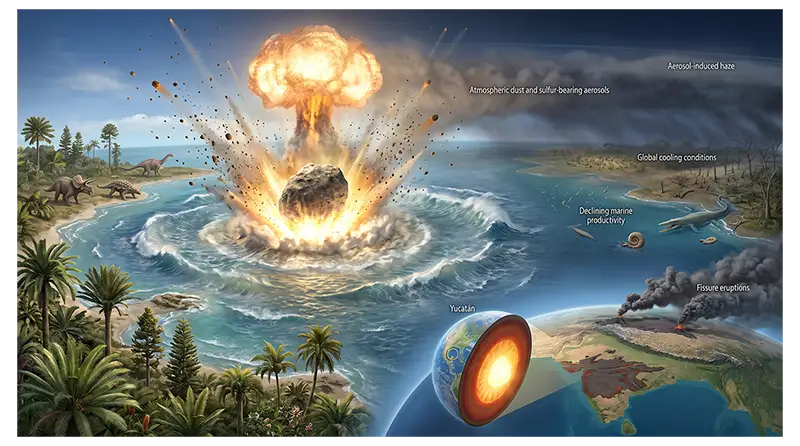
The strongest evidence indicates that a large asteroid impact was the primary trigger of the KT Extinction. The asteroid struck near what is now the Yucatán Peninsula of Mexico, creating the enormous Chicxulub crater. The impact released tremendous amounts of energy and sent dust, rock fragments, sulfur-bearing material, and other substances into the atmosphere. These changes affected the environment far beyond the impact site.
The main consequences likely included:
- Enormous shock waves and heat near the impact.
- Tsunamis across nearby and distant ocean regions.
- Large amounts of material thrown into the atmosphere.
- Reduced sunlight reaching Earth's surface.
- Cooling and other short-term climate disturbances.
- Reduced photosynthesis in plants and marine microorganisms.
- Major disruption of food webs.
- Long-term ecological changes as surviving organisms adapted and ecosystems recovered.
Another important factor was the Deccan Traps, a massive volcanic province in what is now India. Large eruptions occurred around the end of the Cretaceous and released gases that could influence climate and atmospheric chemistry.
Scientists continue to study the exact contribution of Deccan volcanism. The evidence for the Chicxulub impact, however, is exceptionally strong and connects the impact directly with the extinction boundary.
What Happened When the Chicxulub Asteroid Hit Earth?
The Chicxulub impact was an extraordinary geological event. A large asteroid entered Earth's atmosphere at extremely high speed and struck a shallow marine region near the present-day Yucatán Peninsula. The collision excavated an enormous crater that is now buried beneath younger sediments.
The immediate impact generated intense heat and pressure. Close to the impact zone, rocks were fractured, melted, and vaporized. A massive ejecta plume carried material high into the atmosphere, while powerful shock waves traveled outward from the impact. The ocean was also strongly disturbed. The collision generated enormous waves and redistributed sediments across surrounding regions.
Material thrown into the atmosphere eventually spread over much of the planet. Fine particles and other atmospheric components reduced the amount of sunlight reaching Earth's surface. This was especially important because ecosystems depend heavily on sunlight.
Plants and microscopic photosynthetic organisms use sunlight to produce organic matter. When their productivity declined, organisms that depended on them for food were affected as well. The impact therefore created both immediate physical destruction and a much wider ecological crisis.
How Did the Impact Change Earth's Environment?
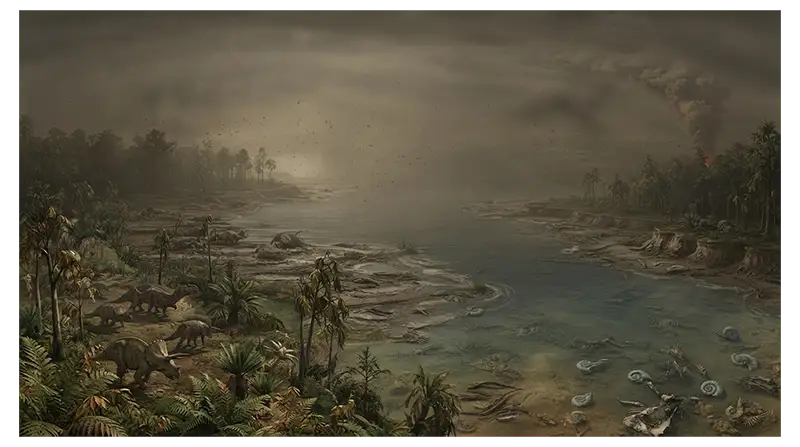
The most important global effects occurred after the initial collision. Large quantities of dust, soot, sulfate aerosols, and impact-related material entered the atmosphere. These particles interfered with sunlight and contributed to a period of unusual darkness and cooling.
The reduction in sunlight had serious consequences for photosynthesis. Plants on land had difficulty producing energy, while marine phytoplankton and other photosynthetic organisms were also affected. These organisms form the foundation of many food chains, so their decline could spread rapidly through ecosystems. The environmental changes were not limited to temperature.
The impact also affected:
- Atmospheric chemistry
- Ocean conditions
- Plant productivity
- Marine productivity
- Water and nutrient cycles
- Terrestrial vegetation
- Food availability
The combination of these effects created severe ecological stress. Some organisms may have experienced direct effects from the impact, but many others were affected indirectly because their habitats or food sources changed.
This distinction is important. The extinction was not simply a case of animals being killed by the asteroid's initial blast. The impact initiated environmental changes that continued to affect ecosystems after the collision.
How Did the Extinction Affect Food Webs?
Food-web disruption was one of the main ways the environmental crisis spread through ecosystems. At the base of many terrestrial food webs were plants. In marine environments, microscopic organisms such as phytoplankton played a similar foundational role. When sunlight decreased, photosynthetic productivity declined.
The basic pattern can be simplified as:
Reduced sunlight → lower photosynthesis → less food production → herbivore decline → predator decline
On land, plants and other producers supported herbivorous dinosaurs and many smaller animals. When plant productivity fell, large herbivores faced a serious shortage of food. Predators were then affected because their prey became less abundant.
Marine ecosystems experienced a similar problem. Declines in microscopic producers affected organisms that fed on them, followed by organisms higher in the food chain. This helps explain why some large animals were particularly vulnerable. Large-bodied species often require substantial amounts of food and energy to survive.
Smaller organisms with flexible diets, underground shelter, aquatic habitats, dormant stages, seeds, or other survival strategies could have had different opportunities during the environmental crisis. The extinction therefore spread through ecosystems rather than affecting every organism in exactly the same way.
What Evidence Shows That an Asteroid Caused the KT Extinction?
Scientists have several independent lines of evidence connecting the extinction to the Chicxulub impact.
Iridium at the K–Pg Boundary
A thin layer associated with the extinction boundary contains unusually high concentrations of iridium, an element that is rare in Earth's surface rocks but relatively abundant in many extraterrestrial materials. The worldwide distribution of this anomaly became an important clue pointing toward an extraterrestrial impact.
Shocked Quartz
Some boundary rocks contain shocked quartz. This mineral has microscopic structural features produced by extremely high pressures, such as those generated during major impacts. Its presence provides geological evidence for an exceptionally energetic event.
Impact Spherules
Scientists have also identified tiny glassy particles called impact spherules in boundary deposits. These formed from molten material produced during the impact and later cooled as they traveled through the atmosphere.
Chicxulub Crater
Geophysical studies revealed a huge buried crater beneath the Yucatán region. Its age and characteristics match the timing of the K–Pg extinction. The crater provides a physical location for the impact responsible for the global geological signals.
Boundary Sediments
Rocks from around the world preserve a distinctive geological layer marking the K–Pg boundary. Chemical and physical evidence within these sediments links the layer to a major impact event. Together, these lines of evidence provide a much stronger explanation than relying on a single discovery.
Which Animals Became Extinct?
The KT Extinction caused major losses across both land and sea. The most famous victims were the non-avian dinosaurs, including groups such as tyrannosaurs, hadrosaurs, ceratopsians, ankylosaurs, and many other dinosaur lineages.
Other important losses included:
- Pterosaurs, the flying reptiles of the Mesozoic
- Ammonites, abundant marine cephalopods
- Mosasaurs, large marine reptiles
- Many marine plankton groups
- Several other marine and terrestrial organisms
However, extinction was selective rather than universal. Birds survived. So did many mammals, crocodilians, turtles, amphibians, fish, insects, and plant lineages. The difference between extinction and survival depended on many factors, including habitat, diet, body size, reproductive biology, ecological flexibility, and the ability to withstand prolonged shortages of food.
The event therefore removed many established ecological groups while leaving enough surviving organisms for ecosystems to rebuild.
Why Did Some Animals Survive and How Did Life Recover?
Survival was probably influenced by several characteristics rather than one universal advantage. Some organisms could survive periods of environmental instability because they had flexible diets, small body sizes, aquatic or sheltered habitats, dormant life stages, or access to food resources that remained available.
Seeds and underground plant structures, for example, could provide opportunities for some plants to persist through difficult conditions. Some freshwater ecosystems may also have provided refuges for certain organisms because their food webs could function differently from highly productive terrestrial and marine systems.
Bird survival is especially important because birds represent the only dinosaur lineage that continued beyond the extinction. After the extinction, surviving ecosystems gradually began to recover. During the early Paleogene, mammals and birds diversified into ecological roles that had previously been occupied by many extinct groups.
Plants also recovered, while marine ecosystems slowly rebuilt their communities. The extinction therefore became an evolutionary turning point. It removed many dominant Mesozoic lineages and opened ecological opportunities for surviving groups. Over millions of years, these opportunities contributed to the development of the Cenozoic ecosystems that eventually produced many of the major animal groups familiar today.
Why Is the KT Extinction Important?
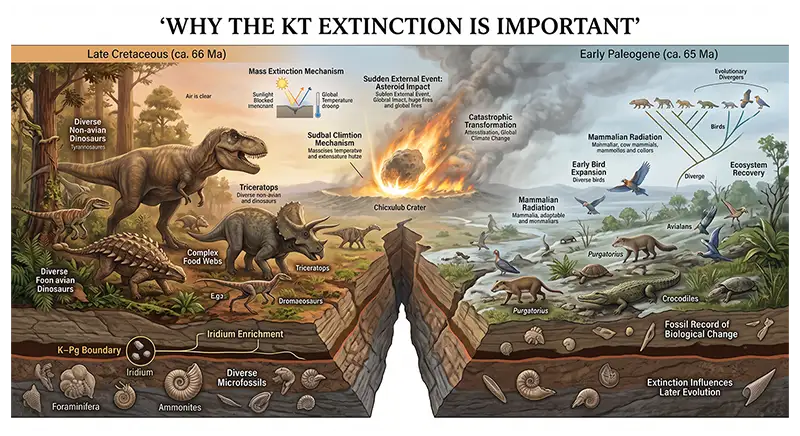
The KT Extinction is important because it provides one of Earth's clearest examples of how a sudden external event can transform the biosphere.
It helps scientists investigate several major questions in Earth science and biology:
- How mass extinctions occur
- How asteroid impacts affect planets
- How climate changes influence ecosystems
- How food webs respond to environmental stress
- Why some species survive while others disappear
- How ecosystems recover after major disturbances
- How fossils record biological change
- How extinction can influence later evolution
The event also demonstrates the connection between geology and life. A geological event created atmospheric and climatic changes, those changes disrupted ecosystems, and the biological consequences were preserved in rocks and fossils.
For paleontologists, the K–Pg boundary provides a remarkably important marker in Earth's history. Fossils below and above the boundary show a major change in the composition of life.
The extinction also changed the evolutionary history of the planet. The disappearance of many dominant Mesozoic groups created opportunities for surviving mammals, birds, and other organisms to expand into new ecological roles.
Conclusion
The KT Extinction was a global biological crisis that occurred about 66 million years ago and transformed life on Earth. The Chicxulub asteroid impact produced immediate destruction and widespread atmospheric and environmental changes that disrupted photosynthesis and food webs.
The event eliminated non-avian dinosaurs along with many marine and terrestrial organisms, while birds and numerous other groups survived. Deccan volcanism may have added environmental stress, but the asteroid impact provides the strongest explanation for the timing and worldwide geological evidence.
The extinction also marked a major transition in Earth's history. As ecosystems recovered, surviving mammals, birds, plants, and other organisms expanded into changing environments, beginning a new phase of Cenozoic life.
The extinction occurred approximately 66 million years ago, at the boundary between the Cretaceous and Paleogene periods.
The modern geological term is the Cretaceous–Paleogene (K–Pg) extinction. KT or K–T is an older terminology still commonly encountered.
The geological evidence strongly supports the Chicxulub asteroid impact as the primary cause of the end-Cretaceous mass extinction, including the disappearance of non-avian dinosaurs.
It struck near the present-day Yucatán Peninsula in Mexico, creating the Chicxulub crater.
No. Non-avian dinosaurs became extinct, but birds survived. Modern birds are living members of the dinosaur lineage.