
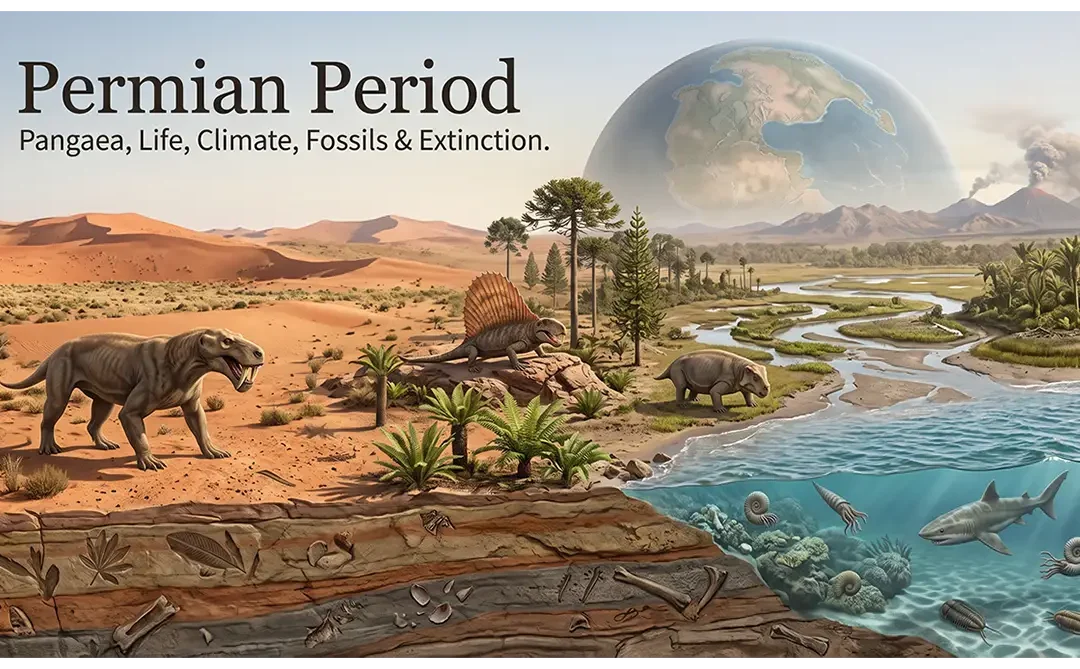
Permian Period was the final period of the Paleozoic Era and a time of major changes in Earth's climate, geography, and life. It lasted from about 298.9 million to 251.9 million years ago.
During the Permian, most of Earth's major landmasses were joined into the supercontinent Pangaea. Huge dry regions developed across its interior, while forests, wetlands, deserts, and shallow seas supported a wide variety of organisms.
The period is also important for the evolution of synapsids, a group that eventually gave rise to mammals. Reptiles, amphibians, insects, marine animals, and seed plants also became important parts of Permian ecosystems.
The Permian ended with the Permian–Triassic mass extinction, the largest known mass extinction in Earth's history. This event removed a very large proportion of marine and terrestrial species and opened the way for major evolutionary changes during the Triassic.
What Was the Permian Period?
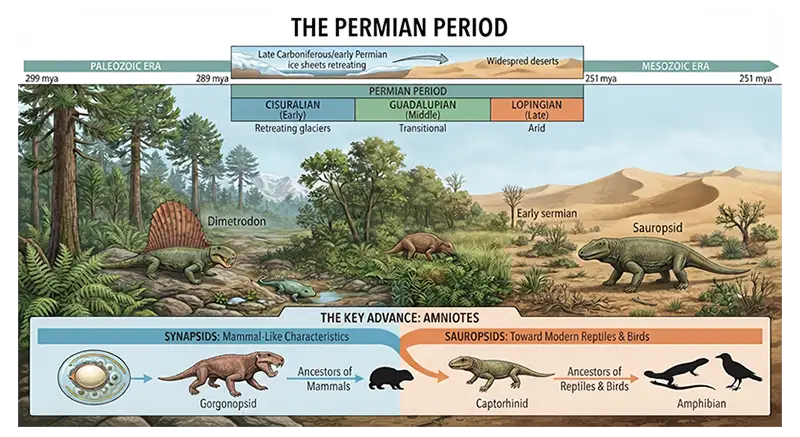
The Permian was the sixth and final geological period of the Paleozoic Era. It followed the Carboniferous Period and came before the Triassic Period of the Mesozoic Era. It began when large ice sheets that had affected the late Carboniferous and early Permian started to retreat. Over millions of years, the planet became generally warmer and drier in many regions.
The Permian is divided into three main epochs:
- Cisuralian — the early Permian
- Guadalupian — the middle Permian
- Lopingian — the late Permian
Each part had different environmental conditions and biological communities. One of the most important developments was the increasing success of amniotes. Unlike amphibians, amniotes could reproduce away from water because their eggs or reproductive systems provided better protection for developing embryos.
Two major amniote branches became especially important:
Synapsids included many forms with increasingly mammal-like characteristics. Some later members of this lineage became the ancestors of mammals.
Sauropsids included the lineage leading toward modern reptiles and birds.
The Permian therefore represents an important stage in the long evolutionary history of land vertebrates.
When Was the Permian Period?
The Permian lasted from approximately 298.9 million years ago to 251.9 million years ago, covering nearly 47 million years.
| Geological period | Approximate age |
|---|---|
| Carboniferous | 358.9–298.9 million years ago |
| Permian | 298.9–251.9 million years ago |
| Triassic | 251.9–201.4 million years ago |
The boundary between the Permian and Triassic is especially important because it coincides with the end-Permian mass extinction. Geologists divide the Permian into three epochs and several stages. These divisions are based on changes in fossils, rocks, sediments, and other evidence.
The period's long duration allowed major environmental and evolutionary changes to occur. Early Permian ecosystems were not identical to those found near the end of the period.
What Was Pangaea Like During the Permian?
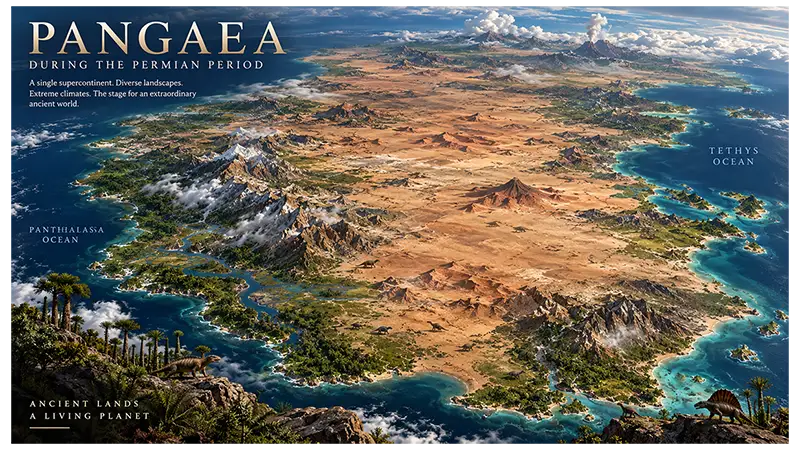
One of the defining features of the Permian was Pangaea, a huge supercontinent that brought most of Earth's major landmasses together. Pangaea stretched across a large portion of the planet. Because its interior was far from the oceans, many inland areas received relatively little moisture.
This helped create extensive dry and desert environments. The supercontinent had several different climatic regions. Coastal areas could receive more moisture from nearby seas, while the interior was often much drier. Mountain ranges also affected wind and rainfall patterns. High terrain could force moist air upward, producing wetter conditions on one side and drier environments beyond the mountains.
The surrounding ocean was known as Panthalassa, while another major oceanic region, Tethys, developed along parts of the eastern side of Pangaea.
The arrangement of land and water influenced:
- Temperature
- Rainfall
- Ocean circulation
- Seasonal conditions
- Plant distribution
- Animal habitats
Pangaea also created opportunities for organisms to move across large connected areas. At the same time, its enormous size produced strong differences between coastal and inland environments. The geography of the Permian was therefore closely connected to its climate and ecosystems.
What Was the Permian Climate Like?
The Permian climate changed considerably over its nearly 47-million-year history. Early in the period, parts of the southern supercontinent Gondwana still experienced substantial glaciation. As the Permian progressed, these ice sheets declined.
Many regions later became warmer and more seasonally dry. The enormous size of Pangaea played an important role. Its interior was far from moisture sources, which encouraged the development of large arid and semi-arid regions.
However, the Permian was not uniformly hot or dry. Forests, wetlands, rivers, coastal environments, and other habitats existed alongside deserts. Seasonal rainfall could also create temporary wet conditions in otherwise dry landscapes.
By the late Permian, Earth's climate and ecosystems were under increasing environmental stress. Large volcanic eruptions associated with the Siberian Traps released enormous amounts of gases into the atmosphere and are strongly linked to major environmental changes near the end of the period. These changes included warming, ocean chemistry changes, and disruption of ecosystems.
What Animals Lived During the Permian?
Permian ecosystems contained a remarkable mixture of land and marine animals. On land, synapsids became particularly important. Some were predators, while others were herbivores or omnivores. One famous example is Dimetrodon.
Although it is often shown alongside dinosaurs, Dimetrodon was not a dinosaur. It was a synapsid and was more closely related to the lineage that eventually produced mammals.
Other important Permian land animals included:
- Dinocephalians
- Dicynodonts
- Gorgonopsians
- Therapsids
- Captorhinids
- Pareiasaurs
- Various amphibians
Dimetrodon
Dimetrodon had a large sail-like structure along its back, supported by elongated vertebral spines. Its exact function is still discussed, although researchers have proposed roles involving temperature regulation, display, and species recognition.
Therapsids
Therapsids were an important group of synapsids that became increasingly diverse during the Permian. Some had features that later became characteristic of mammals, including changes in the skull and jaw.
Marine Animals
The seas contained many different organisms, including:
- Brachiopods
- Mollusks
- Ammonoid relatives
- Trilobites
- Crinoids
- Corals
- Fish
- Sponges
Shallow marine environments supported complex food webs, while reefs and other habitats provided shelter and feeding areas. The Permian was therefore a period of significant diversification among both terrestrial and marine animals.
What Plants Grew During the Permian?
Permian vegetation differed from the lush swamp forests commonly associated with earlier parts of the Carboniferous. As many regions became drier, plants that could tolerate seasonal water shortages became increasingly important.
Important plant groups included:
- Conifers
- Seed ferns
- Glossopterids
- Ginkgophyte relatives
- Ferns
- Horsetails
- Other seed-producing plants
Conifers were particularly successful in many dry environments because some had adaptations that helped them survive conditions with limited water. The Glossopteris plant group was widespread across Gondwana. Fossils of its leaves and other remains have been found across areas that are now South America, Africa, India, Australia, and Antarctica.
These fossils later became important evidence supporting the idea that these continents were once connected. Plant distribution also influenced animals. Herbivores depended on available vegetation, while predators followed populations of plant-eating animals. Plants were therefore central to the structure of Permian terrestrial ecosystems.
How Did Life Change During the Permian?
Life changed considerably between the beginning and end of the Permian. Early in the period, many ecosystems were still recovering from environmental changes associated with the late Carboniferous and early Permian. As conditions became warmer and drier in many areas, organisms adapted to different habitats.
Amniotes became increasingly successful on land. Their reproductive adaptations allowed them to live farther from permanent water than many amphibians. Synapsids developed a wide range of body forms and feeding strategies. Some were large predators, while others became specialized plant eaters.
Plants also changed as forests and wetter habitats declined in some areas. Seed-producing plants became increasingly important across drier landscapes. Marine ecosystems changed as well. New groups appeared and diversified, while older groups declined or disappeared.
The Permian was not a simple story of continuous progress. Some groups flourished for millions of years before becoming extinct, while others survived environmental changes and continued into the Mesozoic. This constant replacement of species and ecosystems helped shape the biological world that followed.
What Happened at the End of the Permian?
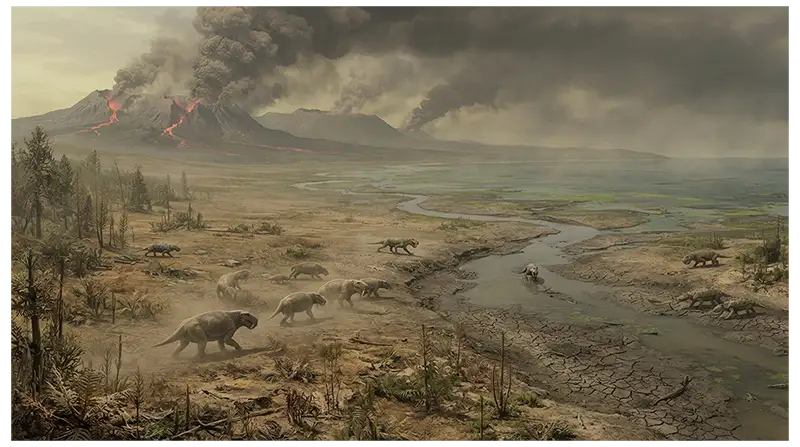
The Permian ended with the Permian–Triassic mass extinction, which occurred about 251.9 million years ago. It was the most severe known mass extinction in Earth's history. A major factor associated with this event was the enormous volcanic activity of the Siberian Traps in what is now northern Asia. The eruptions released large amounts of volcanic gases and other materials over an extended period.
These emissions contributed to major environmental changes.
Possible effects included:
- Rapid global warming
- Ocean warming
- Ocean acidification
- Reduced oxygen in parts of the oceans
- Changes in rainfall
- Ecosystem disruption
- Increased weathering
- Stress on marine and terrestrial organisms
Marine ecosystems were especially heavily affected. Many brachiopods, corals, trilobites, and other groups suffered severe losses. Land ecosystems were also transformed. The extinction did not happen because of one simple factor acting alone. Scientists continue to investigate how volcanic activity, climate change, ocean chemistry, and other environmental processes interacted.
After the extinction, ecosystems gradually recovered during the early Triassic. New groups expanded into habitats left vacant by the organisms that had disappeared.
What Do Permian Fossils Tell Us?
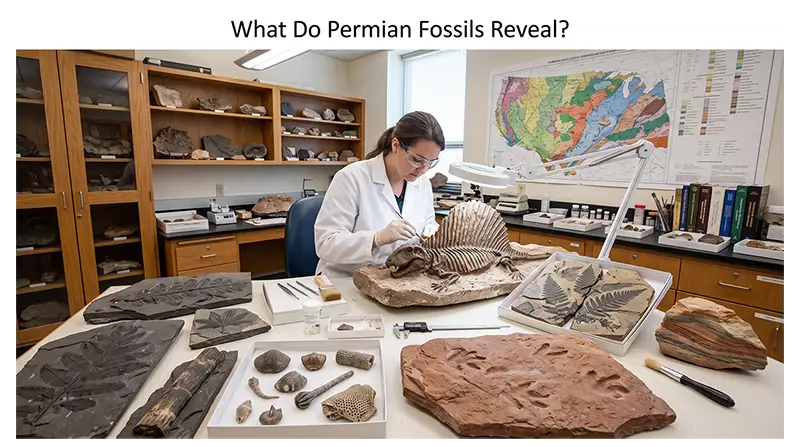
Permian fossils provide evidence about ancient environments, animal evolution, plant distribution, and climate. Fossil bones and teeth help scientists identify extinct animals and study their anatomy. They can also reveal feeding habits, growth patterns, and relationships between different groups.
Plant fossils provide information about ancient vegetation and climate. The distribution of Glossopteris fossils is especially significant. Similar plant fossils occurring on several southern continents provide evidence that these landmasses were once connected as part of Gondwana.
Fossil Footprints
Trace fossils such as footprints can reveal how animals moved across ancient landscapes.
Trackways may provide clues about:
- Walking speed
- Movement direction
- Group behavior
- Habitat conditions
- Body posture
Marine Fossils
Permian marine rocks preserve brachiopods, mollusks, corals, crinoids, fish, and other organisms. These remains help scientists reconstruct ancient seas and track changes in marine biodiversity.
Rock Layers
Sedimentary rocks are equally important. Layers of sandstone, mudstone, limestone, and other deposits preserve evidence of deserts, rivers, lakes, coastal areas, and shallow seas. By combining fossils with rock evidence, researchers can reconstruct how Permian environments changed through time.
Why Is the Permian Period Important?
The Permian is important because it records major changes in geography, climate, ecosystems, and vertebrate evolution. It was a key period in the development of land vertebrates. Synapsids became diverse, and some of their descendants eventually gave rise to mammals.
The formation and development of Pangaea also influenced climate, habitats, and the movement of organisms. Permian fossils provide evidence for ancient environments and helped scientists understand the former connection between continents. The end-Permian extinction is another major reason the period matters.
Studying this event helps researchers examine how rapid environmental changes can affect ecosystems on a global scale. The recovery that followed also demonstrates how life can reorganize after a major extinction. For paleontology and geology, the Permian is therefore an important window into both evolutionary change and Earth-system change.
Conclusion
The Permian Period was a time of major geological and biological change. Pangaea dominated the geography, large dry regions developed across its interior, and changing climate conditions influenced forests, deserts, wetlands, and marine environments.
On land, synapsids and other vertebrates became increasingly diverse, while conifers, seed ferns, glossopterids, and other plants formed important ecosystems. The oceans supported many groups of marine animals, including brachiopods, corals, mollusks, and fish.
The period ended with the Permian–Triassic mass extinction, which dramatically changed life on Earth. Although the event caused enormous biological losses, surviving groups later became part of the new ecosystems of the Triassic.
Because of its rich fossil record, unusual animals, changing environments, development of Pangaea, and extraordinary extinction event, the Permian remains one of the most important periods for understanding Earth's deep history.
The Permian lasted for about 47 million years, from approximately 298.9 million to 251.9 million years ago.
No. Dimetrodon was a synapsid, not a dinosaur. Its lineage was closer to the evolutionary line that eventually produced mammals.
No. Dinosaurs evolved later, during the Triassic Period. Permian ecosystems were dominated by other reptiles, synapsids, amphibians, and marine organisms.
Pangaea was largely assembled by the beginning of the Permian, although its configuration continued to change during the period.
The extinction is strongly associated with the enormous volcanic activity of the Siberian Traps. Resulting climate and ocean changes likely played major roles, although the event involved several interacting environmental processes.