
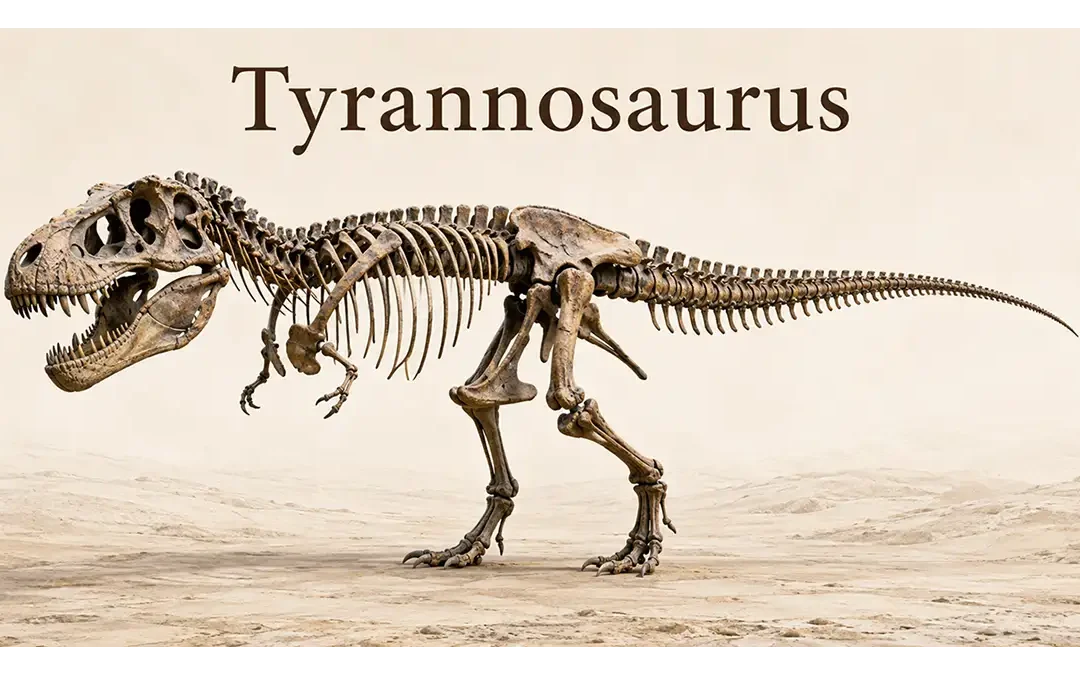
Tyrannosaurus was one of the last giant predatory dinosaurs to live before the end-Cretaceous mass extinction. Its huge head, powerful jaws, two-fingered hands, muscular legs, and heavy tail gave it a body plan unlike that of most familiar land predators today.
The best-known species, Tyrannosaurus rex, has become a symbol of prehistoric life, but its scientific importance goes far beyond its intimidating appearance. Fossils preserve clues about how the animal grew, fed, moved, suffered injuries, and interacted with its surroundings. The sedimentary rocks containing those remains also reveal details about the landscapes and ecosystems it inhabited.
More than a century of discoveries has steadily changed our picture of T. rex. Paleontologists now study everything from microscopic bone structure to tooth marks and fossilized skin to reconstruct its biology.
This article explores Tyrannosaurus from several angles, including its anatomy, habitat, diet, growth, behavior, fossil record, evolutionary history, and extinction.
What Is Tyrannosaurus?
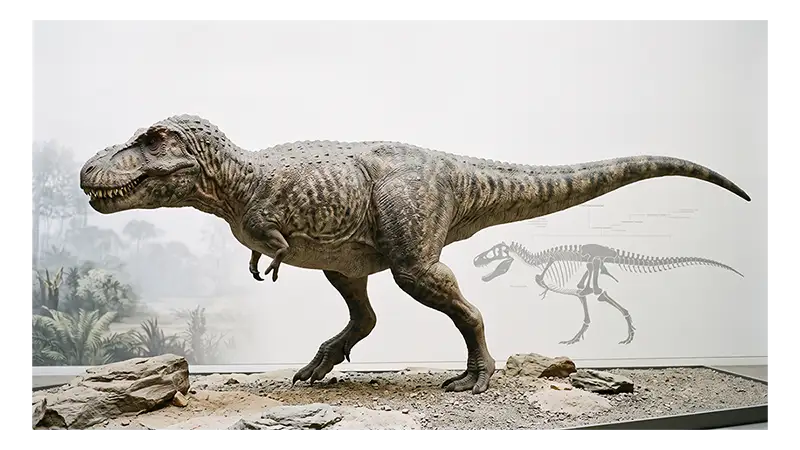
Tyrannosaurus is a genus of large theropod dinosaur belonging to the family Tyrannosauridae. Its best-known species is Tyrannosaurus rex, usually shortened to T. rex.
Theropods were primarily two-legged dinosaurs, and the group included predators ranging from small, lightly built species to enormous carnivores. Tyrannosaurus represents one of the most massive forms produced by this evolutionary branch.
The name Tyrannosaurus combines Greek words commonly interpreted as “tyrant lizard.” The species name rex is Latin for “king,” giving Tyrannosaurus rex the familiar translation “tyrant lizard king.”
T. rex appeared very late in the Mesozoic Era. Its fossils come from rocks dating to approximately 68–66 million years ago, placing the animal near the close of the Cretaceous Period.
Tyrannosaurus Quick Facts
| Feature | Information |
|---|---|
| Scientific name | Tyrannosaurus rex |
| Common abbreviation | T. rex |
| Name meaning | “Tyrant lizard king” |
| Dinosaur group | Theropoda |
| Family | Tyrannosauridae |
| Period | Late Cretaceous |
| Age | About 68–66 million years ago |
| Diet | Carnivorous |
| Movement | Bipedal |
| Known fossil region | Western North America |
The combination of an enormous skull, specialized teeth, strong hindquarters, and a highly developed feeding system made Tyrannosaurus an unusual predator even among other giant theropods.
Tyrannosaurus Size, Appearance and Anatomy
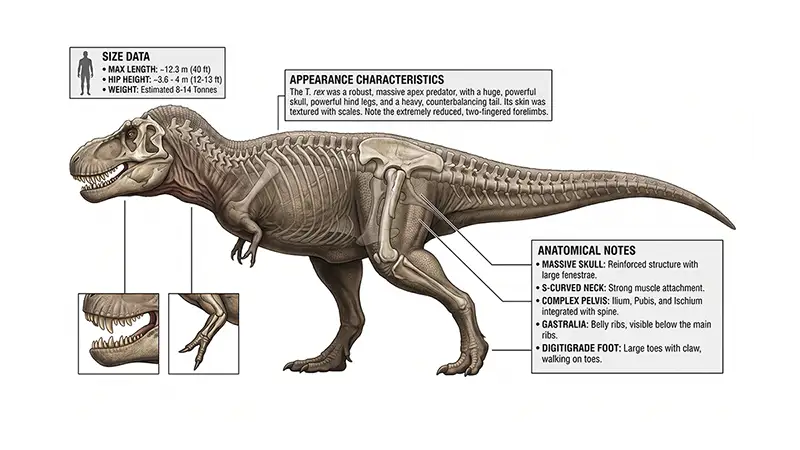
The body of Tyrannosaurus was strongly adapted to supporting a large head while moving on two legs. Its torso was carried roughly horizontally, while a long tail extended backward to counterbalance the weight in front of the hips.
This posture differs from older reconstructions that showed T. rex standing almost upright with its tail resting on the ground.
Size and Weight
Large adult specimens commonly reached around 12 meters (39 feet) in length. A few exceptionally large individuals approached 13 meters. Estimating weight is more difficult because muscles, fat, organs, and other soft tissues rarely fossilize. Researchers therefore build body models around preserved skeletons and compare the results with living animals.
Current reconstructions indicate that very large adults could exceed 8 metric tonnes, although estimates differ among specimens and methods. Tyrannosaurus was therefore not simply long; it was an exceptionally heavy and robust theropod.
Its proportions also changed throughout life, meaning that measurements from a mature specimen should not be used to describe younger individuals.
Skull, Jaws and Teeth
The head was disproportionately large compared with much of the body. In the biggest adults, the skull could measure roughly 1.5 meters long. Large openings within the skull reduced unnecessary weight, while reinforced areas helped withstand forces produced during feeding.
T. rex teeth were thick and deeply rooted rather than thin blades. Their shape allowed them to tolerate substantial stress while penetrating flesh and contacting bone. Teeth were also replaced during life. When one was lost or badly damaged, another could eventually take its place.
This replacement system was valuable for an animal whose feeding style placed enormous mechanical demands on its teeth.
Arms, Legs and Tail
Perhaps no feature of T. rex attracts more curiosity than its short arms. Each hand carried two functional fingers. Although the forelimbs looked tiny beside the rest of the animal, their bones were sturdy and supported substantial muscles.
Their exact purpose remains unresolved. Various functions have been proposed, but the fossil record has not produced a definitive answer. The hind limbs performed the much more obvious job of supporting and propelling the animal. Large thigh and lower-leg muscles helped carry several tonnes of body mass.
Behind the hips, the tail acted as a counterweight. It also provided attachment areas for muscles involved in locomotion. Together, the legs, pelvis, and tail formed the mechanical foundation of the animal's bipedal body.
Skin, Scales and Feathers
Fossilized skin impressions provide rare evidence of what the outside of Tyrannosaurus looked like. Known impressions indicate scaly skin on several parts of the body. They do not, however, preserve every region of an individual from head to tail.
The feather question remains interesting because some earlier tyrannosauroids are known to have possessed feather-like coverings. This demonstrates that such structures existed within the broader evolutionary lineage. No direct fossil currently shows an adult T. rex covered extensively in feathers.
For that reason, reconstructions should distinguish between preserved evidence and possibility. Scales are directly supported for known skin areas, while the presence or extent of feathers elsewhere remains less certain.
Where and When Did Tyrannosaurus Live?
Tyrannosaurus rex inhabited western North America during the closing stages of the Late Cretaceous. Its geographic setting was very different from modern North America. Coastlines occupied different positions, temperatures were generally warmer, and extensive lowlands developed around rivers and coastal plains.
Geographic Range
T. rex remains are known from several geological formations in the United States and Canada. The Hell Creek Formation is particularly famous. Exposures occur across parts of Montana, North Dakota, South Dakota, and Wyoming and preserve an exceptional record of the final part of the Cretaceous. Other rock units have also produced Tyrannosaurus material, allowing paleontologists to examine its distribution across a broad region.
These discoveries show why geological context matters in paleontology. A fossil without information about its rock layer loses much of its scientific value because the surrounding strata help establish its age and environmental setting.
Habitat and Environment
The landscapes occupied by T. rex included river channels, floodplains, wooded areas, wetlands, and coastal lowlands. Rivers repeatedly deposited layers of sand, silt, and mud across these environments. Under suitable conditions, buried animal remains became incorporated into sediments that eventually hardened into sedimentary rock.
Plant fossils and pollen indicate diverse vegetation. Flowering plants were already widespread, while conifers, ferns, and other plant groups contributed to the landscape.
Rather than imagining T. rex against a barren rocky background, it is more accurate to picture a biologically productive environment shaped by water, vegetation, seasonal change, and sediment deposition.
Animals That Shared Its Ecosystem
Tyrannosaurus lived among many other dinosaur species. Triceratops was one of the largest herbivores in the same ecosystems. The hadrosaur Edmontosaurus was another abundant large-bodied dinosaur. Other inhabitants included armored dinosaurs, smaller theropods, turtles, fish, mammals, and crocodilian relatives.
These animals formed interconnected food webs. Herbivores depended on vegetation, carnivores depended directly or indirectly on other animals, and decomposers recycled organic material back into the ecosystem.
Understanding this community provides a more realistic picture of Tyrannosaurus than studying the predator in isolation.
What Did Tyrannosaurus Eat?
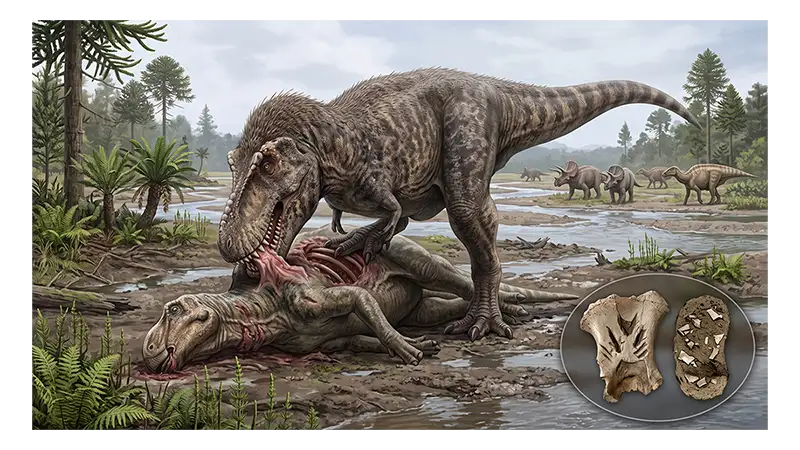
Tyrannosaurus was a meat-eating dinosaur equipped to process large animal carcasses. Paleontologists can investigate its feeding habits using several independent forms of evidence rather than relying only on the shape of its teeth.
Tooth marks, damaged prey bones, jaw anatomy, and fossilized digestive material all contribute pieces of the dietary puzzle.
Tyrannosaurus Diet and Prey
Large herbivorous dinosaurs provided potential food for an adult T. rex. Fossils show Tyrannosaurus-type tooth marks on bones from dinosaurs such as Triceratops and Edmontosaurus. The location and condition of those marks can sometimes reveal how a carcass was processed.
Especially valuable examples involve wounds that later healed. Healing proves that the injured animal remained alive after being bitten. Such fossils provide stronger evidence of attempted predation than marks produced on an animal that was already dead.
Fossilized feces, called coprolites, add another source of information. Large carnivore coprolites containing broken bone fragments demonstrate that some large theropods swallowed skeletal material instead of stripping away only soft tissue.
Was T. rex a Hunter or Scavenger?
The idea that T. rex had to be either a dedicated hunter or a dedicated scavenger creates an unnecessary distinction. Food is expensive to obtain in terms of energy. An animal capable of killing prey would still benefit from an unguarded carcass, while an animal willing to scavenge could also attack vulnerable prey when conditions were favorable.
This flexible strategy occurs among many living carnivores. Fossil evidence is consistent with Tyrannosaurus taking advantage of both living prey and carrion. Its ecological role is therefore better understood as that of an opportunistic large carnivore rather than an animal restricted to a single feeding strategy.
Bite Force and Feeding Adaptations
T. rex had a feeding system capable of generating extreme forces. Researchers have produced different numerical bite-force estimates depending on their models, assumptions, and reconstruction methods. The exact figure is less important than the physical evidence preserved in fossils.
Deep punctures and other tooth damage on dinosaur bones demonstrate that its jaws could subject skeletal tissue to tremendous pressure. Its thick teeth were well suited to these loads. Instead of functioning only as cutting blades, they could penetrate deeply and withstand contact with hard material.
Breaking bone may also have provided access to marrow and other nutritious tissues unavailable to animals that could not process a carcass as aggressively.
Growth and Life Cycle of Tyrannosaurus
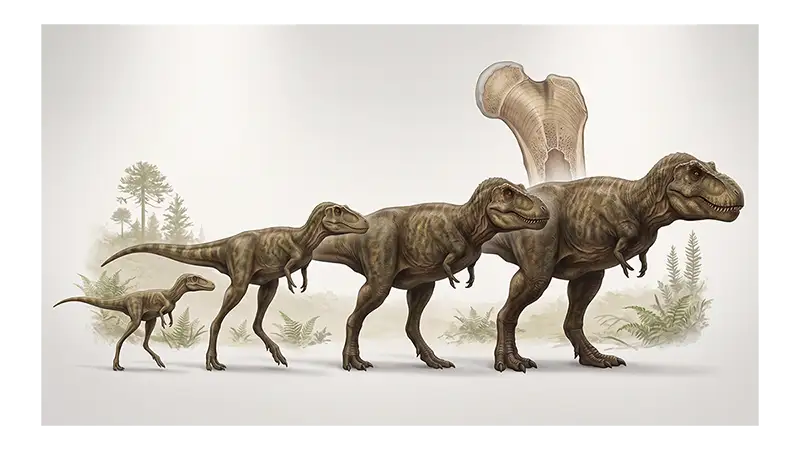
Tyrannosaurus changed substantially as it matured. Juveniles were more lightly constructed than old adults, and the differences involved more than simple overall size. Skull shape, limb proportions, body mass, and feeding capabilities shifted during development. Scientists call these age-related biological changes ontogeny.
Juvenile Tyrannosaurus
Young individuals appear to have possessed relatively slender bodies and proportionally longer legs. Their skulls were also less massive than those of mature adults. As growth continued, the head became deeper and more robust, eventually developing the heavy architecture associated with large T. rex specimens.
These changing proportions may have affected feeding ecology. A lightly built juvenile could potentially pursue different animals from those targeted by a multi-tonne adult. If so, young and mature Tyrannosaurus individuals may have occupied somewhat different ecological roles despite belonging to the same species.
This idea remains an active area of paleontological research.
Growth Into Adulthood
Dinosaur bones contain microscopic records of development. By examining bone tissue and growth lines, paleontologists can estimate an individual's age and determine when growth accelerated or slowed.
T. rex experienced a period of rapid growth during adolescence. Large amounts of body mass were added over a relatively small number of years before the rate decreased near maturity. Such rapid development would have demanded substantial energy.
A growing Tyrannosaurus needed enough food not only to maintain its existing body but also to build large quantities of new muscle, bone, and other tissue.
Lifespan
Evidence from growth lines suggests that some well-studied T. rex individuals survived into their late twenties. That estimate provides an important perspective on the animal's development. An individual could progress from a relatively slender juvenile to an enormous adult within a lifespan considerably shorter than that of humans.
Age estimates are not perfectly precise, however. Fossil preservation, bone remodeling, and sampling methods can influence interpretation. Additional specimens may therefore refine our understanding of Tyrannosaurus longevity.
Tyrannosaurus Speed, Senses and Behavior
Behavior leaves a weaker fossil record than bones and teeth, so paleontologists must approach this subject cautiously. Researchers combine skeletal anatomy, reconstructed muscles, braincase structure, footprints, injuries, and comparisons with living animals to identify what T. rex was physically capable of doing. Some conclusions are well supported; others remain hypotheses.
Speed and Movement
Tyrannosaurus moved on its hind limbs with its body balanced over the hips. Determining its maximum speed is challenging. Computer simulations produce different results depending on estimated muscle mass, body weight, joint forces, and assumptions about gait.
Very high running speeds portrayed in popular entertainment are difficult to reconcile with the mechanical limits imposed by such a massive body. That does not mean T. rex was incapable of effective pursuit. Predatory success depends on more than maximum speed. Acceleration, endurance, turning ability, prey choice, surprise, and positioning can all matter during an encounter.
For this reason, assigning a single dramatic speed figure gives a misleading impression of what scientists actually know.
Vision, Smell and Hearing
The skull and braincase provide important clues about the sensory world of T. rex. Its eye orientation offered a degree of overlapping vision, which would have aided depth perception when judging distance. Structures associated with the olfactory system indicate a well-developed ability to detect odors. Smell could have helped locate food or recognize biological signals from other animals.
The anatomy of the inner ear also provides clues about hearing and balance. These features suggest that Tyrannosaurus relied on several sensory systems rather than simply overpowering everything through size.
Social and Fighting Behavior
Fossil injuries offer rare glimpses of interactions between individual tyrannosaurs. Some skulls preserve scars or bite damage consistent with attacks from another large tyrannosaur. Such wounds could have resulted from competition over food, territory, mates, dominance, or other conflicts.
What they do not automatically demonstrate is organized social living. Scientists continue to investigate whether tyrannosaurs sometimes gathered or cooperated, but evidence for routine pack hunting by T. rex remains uncertain.
The distinction matters. Paleontology can identify plausible behavior, but plausible should not be presented as proven.
Tyrannosaurus Fossils, Discovery and Famous Specimens
Our understanding of T. rex is built from a fossil record assembled over more than a century. Some discoveries consist of only a tooth or individual bone. Others preserve enough of the skeleton to reveal body proportions, pathology, growth history, and variation between individuals.
A small number of unusually complete specimens have become especially influential.
Discovery and Naming of T. rex
Fossil hunter Barnum Brown discovered important Tyrannosaurus material in the American West during the early twentieth century. A specimen collected in Montana in 1902 became central to the scientific recognition of the dinosaur. In 1905, paleontologist Henry Fairfield Osborn formally introduced the name Tyrannosaurus rex.
The first scientific reconstructions reflected the ideas and anatomical knowledge available at the time. Early displays often placed the animal in an upright, tail-dragging pose.
Later research showed that the spine and tail were better interpreted in a more horizontal orientation. This change is a useful example of how scientific reconstructions evolve when new evidence is tested against old assumptions.
Famous Tyrannosaurus Specimens
Sue is among the most celebrated T. rex fossils ever discovered. Found in South Dakota in 1990, the skeleton is notable for both its size and completeness. Its bones preserve evidence useful for studying anatomy, age, injuries, and disease.
Scotty, from Saskatchewan, Canada, represents another exceptionally large adult. Researchers have used its skeletal dimensions to investigate the upper limits of Tyrannosaurus body size. The Wankel T. rex, discovered in Montana, is also remarkably important. The specimen later became known as the Smithsonian's Nation's T. rex.
These fossils are valuable not because they are famous, but because each preserves a different sample of biological information.
What Fossils Tell Scientists
A skeleton can reveal far more than an animal's shape. Muscle attachment scars indicate where major muscles connected to bones. Abnormal growth may record disease or injury. Microscopic bone structure can provide evidence about age and development.
Teeth and feeding traces contribute dietary information, while rare skin impressions offer clues about external covering. The geological setting expands the investigation further. Sediment grain size can indicate the energy of an ancient river or flood. Fossil pollen identifies vegetation. Associated animal remains reveal the wider community, and stratigraphic position establishes when organisms existed relative to one another.
Tyrannosaurus research is therefore not based on a single spectacular skeleton. It emerges from combining anatomical, biological, geological, and ecological evidence.
Tyrannosaurus Evolution, Relatives and Extinction
T. rex appeared near the end of a much longer tyrannosaur evolutionary history. Its distant ancestors were not all enormous apex predators. Earlier tyrannosauroids included comparatively small species with body plans quite different from the giant forms that later dominated parts of Asia and North America. Tracing those changes helps explain how the distinctive T. rex body evolved.
Evolution of Tyrannosaurus
Tyrannosaurus belongs to the broader group Tyrannosauroidea and the more specialized family Tyrannosauridae. Early representatives of the lineage appeared long before T. rex. Over evolutionary time, some branches developed increasingly massive skulls and powerful feeding systems.
Late Cretaceous tyrannosaurids eventually occupied large-predator roles in several northern ecosystems. T. rex was one of the final members of this radiation.
Its enormous size should therefore be viewed as the outcome of a long sequence of evolutionary changes rather than a feature shared by all tyrannosaurs.
Tyrannosaurus Relatives
Several other tyrannosaurids help scientists reconstruct this family tree. Tarbosaurus lived in Asia and possessed many anatomical similarities to Tyrannosaurus. Daspletosaurus is known from older North American rocks and provides useful information about tyrannosaurid evolution before the appearance of T. rex.
Albertosaurus had a lighter body build and represents another branch of the North American family. Comparisons among skulls, teeth, limbs, vertebrae, and other bones allow researchers to test competing ideas about how these dinosaurs were related.
New discoveries can alter those evolutionary trees, making tyrannosaur classification an active field rather than a finished story.
Extinction of Tyrannosaurus
The fossil record of T. rex ends at approximately 66 million years ago, at the boundary between the Cretaceous and Paleogene periods. This boundary records one of Earth's major mass extinctions.
A large asteroid struck near the present-day Yucatán Peninsula and produced the Chicxulub impact structure. Material thrown into the atmosphere triggered severe global environmental disruption. Reduced sunlight interfered with photosynthesis. Changes at the base of food webs then affected organisms at higher trophic levels.
The crisis eliminated the non-avian dinosaurs along with many other forms of life. Tyrannosaurus therefore vanished not because it had become an unsuccessful predator, but during a rapid planetary-scale ecological catastrophe that transformed terrestrial and marine ecosystems.
Conclusion
Tyrannosaurus rex was one of the most remarkable predators in Earth's history. Its enormous body, powerful jaws, robust teeth, advanced senses, and specialized anatomy made it exceptionally well adapted to the Late Cretaceous ecosystems of western North America.
Yet much of what makes Tyrannosaurus scientifically important comes from what its fossils continue to reveal. Bones record growth and injuries, teeth and bite marks provide evidence of feeding, and the surrounding rocks preserve clues about the environments in which it lived.
Our picture of T. rex has changed dramatically as new fossils and research methods have appeared. Rather than the simple prehistoric monster of early reconstructions, Tyrannosaurus was a complex animal shaped by millions of years of evolution.
Tyrannosaurus is the genus name, while Tyrannosaurus rex is its best-known and generally accepted species. T. rex is simply the shortened form of Tyrannosaurus rex.
Skin impressions show that at least several parts of T. rex were covered with scales. Some of its evolutionary relatives had feather-like coverings, but there is currently no direct fossil evidence demonstrating that adult T. rex had an extensive coat of feathers.
An adult T. rex had about 50 to 60 large teeth, with new teeth replacing damaged or lost ones.
Its large skull provided space for strong jaw muscles and helped support its powerful feeding system.
Yes. Fossils from the same Late Cretaceous formations show that Tyrannosaurus and Triceratops lived in the same regions of western North America.