
Minerals are not always stable under every geological condition. As temperature, pressure, or chemical composition changes, minerals may transform into new crystal structures while often retaining the same chemical composition. These transformations are known as mineral phase changes or phase transitions.
Phase changes play a crucial role in shaping Earth's interior. They influence mantle convection, mountain building, earthquakes, volcanic activity, and the formation of metamorphic rocks. Some of the most important discoveries in Earth science, such as the existence of mantle transition zones, are based on mineral phase changes.
Understanding mineral phase changes is essential for mineralogy, petrology, geophysics, crystallography, and Earth science.
This topic should be studied together with Crystal Structure of Minerals, Mineral Polymorphism, and Metamorphism and Minerals.
What Are Mineral Phase Changes?
Mineral phase changes are transformations in which a mineral changes from one crystal structure or physical state to another because of changes in environmental conditions.
These transformations are commonly triggered by changes in:
- Temperature
- Pressure
- Chemical environment
- Water content
- Stress
During many phase changes, the mineral's chemical composition remains the same while its atomic arrangement changes.
Why Do Mineral Phase Changes Occur?
Every mineral is stable only within a specific range of pressure and temperature. When environmental conditions move beyond this stability range, atoms rearrange themselves into a new crystal structure that is more stable.
This process minimizes the mineral's internal energy.
Phase Change vs Chemical Weathering
| Mineral Phase Change | Chemical Weathering |
|---|---|
| Crystal structure changes | Chemical composition changes |
| Often composition remains the same | New minerals are produced through chemical reactions |
| Usually caused by pressure and temperature | Usually caused by water and atmospheric reactions |
| Common deep inside Earth | Common near Earth's surface |
Types of Mineral Phase Changes
Polymorphic Phase Changes
The chemical composition stays the same, but the crystal structure changes.
Examples:
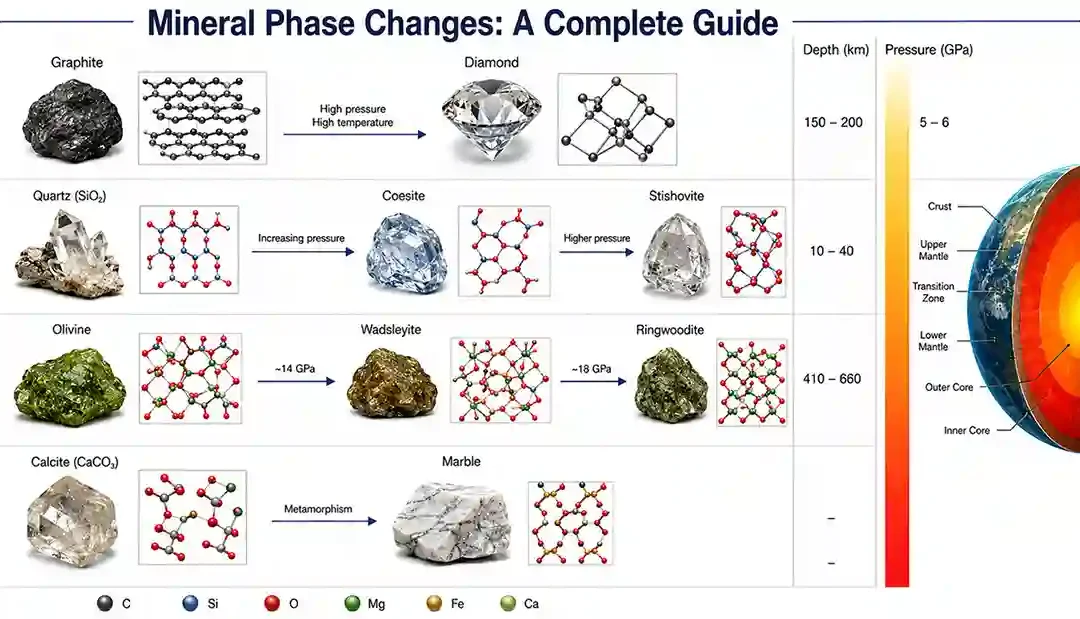
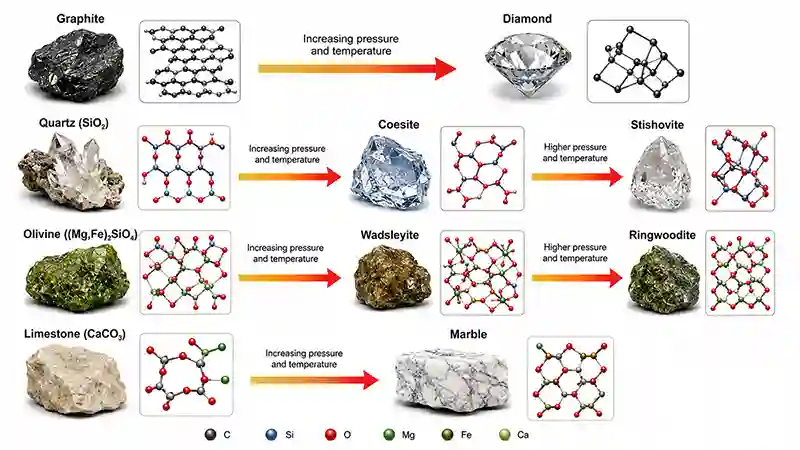
- Graphite → Diamond
- Quartz → Coesite
- Quartz → Stishovite
Reconstructive Phase Changes
Atoms completely reorganize into a new crystal structure.
Characteristics:
- Slow transformation
- Requires breaking chemical bonds
- Large structural changes
Examples:
- Graphite → Diamond
Displacive Phase Changes
Small atomic movements produce a new crystal structure.
Characteristics:
- Rapid transformation
- Minimal bond breaking
- Often reversible
Example:
- High quartz ↔ Low quartz
Order–Disorder Phase Changes
Atoms rearrange into more ordered or disordered positions.
Common in:
- Feldspars
- Pyroxenes
Solid-State Phase Changes
Minerals transform without melting.
Common during:
- Metamorphism
- Mantle processes
Major Factors Affecting Phase Changes
Temperature
Higher temperatures increase atomic movement and promote structural changes.
Pressure
Pressure is one of the most important controls. Increasing pressure produces denser mineral structures.
Chemical Composition
Impurities may stabilize or delay phase transitions.
Water Content
Water lowers activation energy and speeds many mineral transformations.
Time
Some phase changes require millions of years to reach equilibrium in nature.
Examples of Mineral Phase Changes
Graphite → Diamond
- Same chemical formula (C)
- Diamond forms under extremely high pressure
- Common deep within Earth's mantle
Quartz → Coesite
Occurs during:
- Meteorite impacts
- Ultra-high-pressure metamorphism
Quartz → Stishovite
Forms under even greater pressure than coesite.
Common in:
- Impact craters
- Deep mantle environments
Olivine → Wadsleyite
Occurs at approximately 410 km depth. Marks the beginning of Earth's mantle transition zone.
Wadsleyite → Ringwoodite
Occurs near 520 km depth. Ringwoodite can store significant amounts of water in Earth's mantle.
Ringwoodite → Bridgmanite
Occurs near 660 km depth. Marks the boundary between the upper and lower mantle.
Calcite → Marble
During metamorphism, calcite crystals recrystallize into larger interlocking grains, forming marble.
Phase Changes in Earth’s Interior
Earth's mantle contains several important mineral transformations.
| Approximate Depth | Phase Change |
| ~410 km | Olivine → Wadsleyite |
| ~520 km | Wadsleyite → Ringwoodite |
| ~660 km | Ringwoodite → Bridgmanite + Ferropericlase |
These phase transitions influence seismic wave velocities and mantle convection.
Geological Importance
Mineral phase changes help scientists:
- Understand mantle structure
- Explain seismic discontinuities
- Interpret metamorphic conditions
- Study tectonic plate movement
- Investigate Earth's thermal evolution
Laboratory Investigation
Scientists study mineral phase changes using:
- Diamond Anvil Cells
- High-Pressure Multi-Anvil Presses
- X-Ray Diffraction (XRD)
- Raman Spectroscopy
- Electron Microprobe Analysis
- Transmission Electron Microscopy (TEM)
These methods simulate Earth's interior and reveal structural transformations.
Applications
Understanding mineral phase changes is important in:
- Mineralogy
- Petrology
- Geophysics
- Earthquake Science
- Materials Science
- Planetary Geology
- High-Pressure Physics
- Engineering Materials
Advantages of Studying Mineral Phase Changes
Studying mineral phase changes helps scientists:
- Understand Earth's deep interior
- Predict mineral stability
- Interpret metamorphic rocks
- Explain mantle dynamics
- Improve synthetic material development
- Model planetary evolution
Limitations
Although mineral phase changes provide valuable geological information, several limitations exist:
- Many phase transitions occur at pressures and temperatures that are difficult to reproduce.
- Some transformations happen extremely slowly in nature.
- Metastable minerals may persist outside their stability fields.
- Laboratory experiments may not perfectly replicate natural geological conditions.
For a complete understanding, study this topic together with:
- Mineral Polymorphism
- Mineral Stability
- Crystal Structure of Minerals
- Metamorphism and Minerals
- Crystal Chemistry
- High-Pressure Mineralogy
- Petrology
- Earth's Interior
Comparison Table
| Phase Change Type | Main Characteristic | Example |
| Polymorphic | Same composition, different structure | Graphite → Diamond |
| Reconstructive | Complete atomic rearrangement | Quartz → Coesite |
| Displacive | Small atomic movement | High Quartz ↔ Low Quartz |
| Order–Disorder | Atomic ordering changes | Feldspars |
| Solid-State | No melting involved | Calcite → Marble |
Summary Table
| Feature | Mineral Phase Changes |
| Definition | Transformation Between Stable Mineral Phases |
| Main Controls | Temperature, Pressure, Chemistry |
| Common Types | Polymorphic, Reconstructive, Displacive, Order–Disorder |
| Study Methods | XRD, Diamond Anvil Cell, Raman, TEM |
| Geological Importance | Mantle Structure, Metamorphism, Seismic Boundaries |
Mineral phase changes are transformations in which minerals adopt a different crystal structure or physical phase because of changes in pressure, temperature, or other environmental conditions.
No. Many phase changes, such as graphite transforming into diamond, involve the same chemical composition but a different atomic arrangement.
They help explain metamorphism, mantle structure, seismic discontinuities, and the stability of minerals under different geological conditions.
Many occur deep within Earth's crust and mantle, although some also happen during metamorphism closer to the surface.
Researchers use high-pressure laboratory equipment, X-ray diffraction, Raman spectroscopy, electron microscopy, and computer modeling to observe and analyze these transformations.
Final Thoughts
Mineral phase changes reveal how Earth's materials respond to changing pressure and temperature over geological time. From graphite transforming into diamond to olivine evolving through multiple mantle minerals, these transitions shape the structure of Earth's interior and influence processes such as plate tectonics, metamorphism, and volcanic activity. By studying mineral phase changes, scientists gain a deeper understanding of crystal structures, mineral stability, and the dynamic nature of our planet.
Continue Learning
Continue exploring mineral transformations with these related guides: