
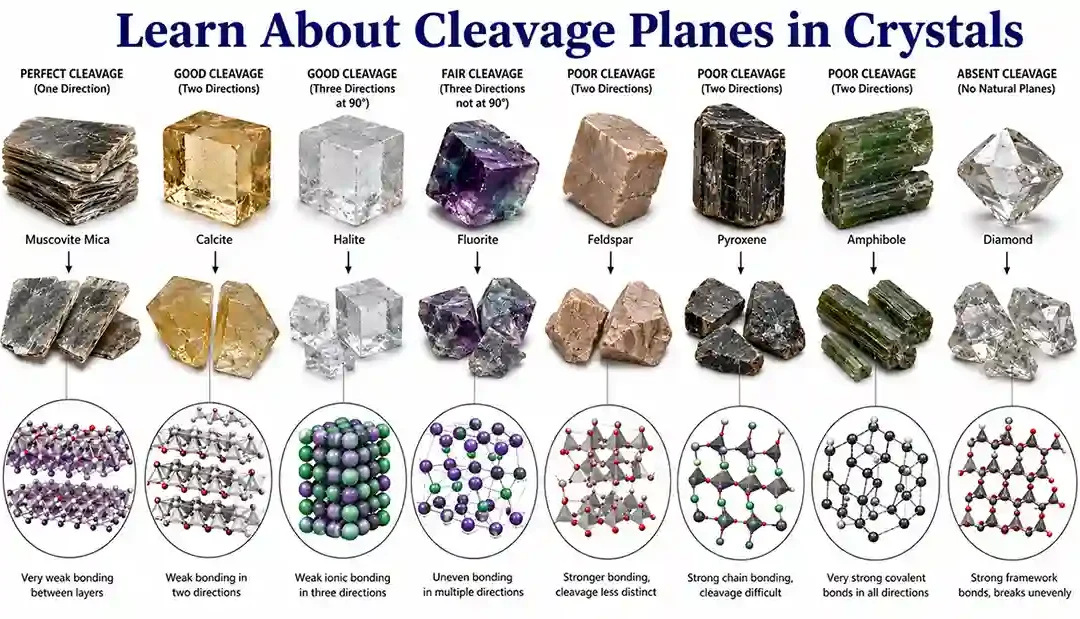
Cleavage is one of the most important physical properties used to identify minerals. It describes a mineral's tendency to break along flat, smooth, parallel surfaces called cleavage planes. These planes form because atomic bonds are weaker in certain directions within the crystal structure.
When a mineral is struck, it does not always break randomly. Instead, many minerals split cleanly along their weakest bonding directions, producing smooth surfaces that reflect their internal atomic arrangement. The number, quality, and angles of cleavage planes vary among different minerals and provide valuable clues for mineral identification.
Understanding cleavage planes is essential in mineralogy, crystallography, petrology, geology, and materials science.
This topic should be studied together with Crystal Habits Explained and Mineralogy Explained.
What Are Cleavage Planes?
Cleavage planes are flat surfaces along which a crystal naturally splits because of weaker atomic bonds.
Cleavage depends on:
- Atomic arrangement
- Bond strength
- Crystal structure
- Crystal symmetry
A mineral may have one, two, three, four, or several cleavage directions.
Why Do Cleavage Planes Form?
Atoms inside crystals are connected by chemical bonds.
Some bonds are:
- Very strong
- Moderately strong
- Relatively weak
When force is applied, the crystal breaks along the weakest bonding directions rather than through the strongest bonds.
This produces smooth cleavage surfaces.
Cleavage vs Fracture
Although both describe how minerals break, they are different.
| Cleavage | Fracture |
|---|---|
| Breaks along weak atomic planes | Breaks irregularly |
| Smooth, flat surfaces | Uneven surfaces |
| Controlled by crystal structure | Not controlled by crystal structure |
| Predictable | Random |
For example:
- Mica shows excellent cleavage.
- Quartz usually fractures instead of cleaving.
Types of Cleavage
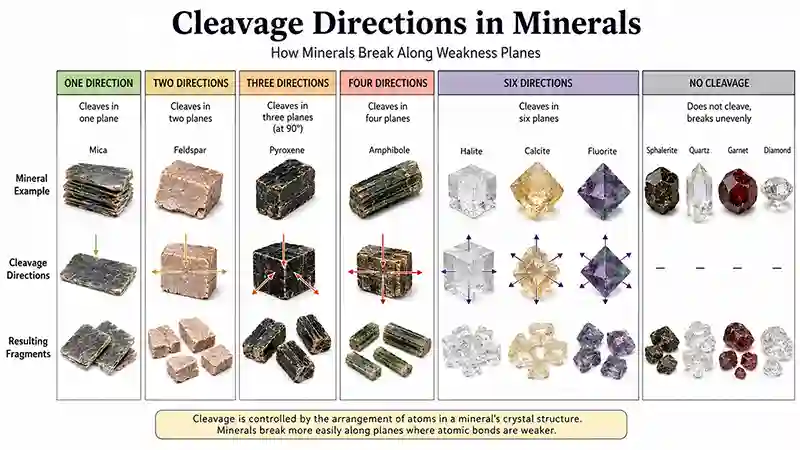
One Direction (Basal Cleavage)
Minerals split into thin sheets.
Examples:
- Muscovite
- Biotite
Two Directions
Crystals break along two intersecting planes.
Examples:
- Feldspar
- Pyroxene
- Amphibole
Pyroxene and amphibole are distinguished by their cleavage angles.
Three Directions
Minerals split along three planes.
Examples:
Cubic Cleavage
Three directions at 90°.
Example:
- Halite
Rhombohedral Cleavage
Three directions not at 90°.
Example:
- Calcite
Four Directions
Example:
- Fluorite
Produces octahedral fragments.
Six Directions
Rare.
Example:
- Sphalerite
No Cleavage
Some minerals lack cleavage because bonding is equally strong in all directions.
Examples:
- Quartz
- Garnet
- Diamond
These minerals usually fracture instead.
Quality of Cleavage
Not all cleavage is equally well developed.
Perfect Cleavage
Minerals split easily into smooth surfaces.
Examples:
- Muscovite
- Biotite
Good Cleavage
Cleavage surfaces are obvious but less perfect.
Example:
- Feldspar
Fair Cleavage
Cleavage is visible but difficult to produce.
Example:
- Olivine (poor to fair in some directions)
Poor Cleavage
Cleavage is weak and rarely observed.
Examples:
- Apatite
No Cleavage
Minerals fracture rather than cleave.
Examples:
- Quartz
- Garnet
Cleavage in Common Minerals
Muscovite
- One perfect cleavage
- Splits into thin sheets
Biotite
- One perfect cleavage
- Flexible layers
Feldspar
- Two cleavage directions
- Nearly 90°
Pyroxene
- Two cleavage directions
- Approximately 90°
Amphibole
- Two cleavage directions
- Approximately 56° and 124°
Calcite
- Three perfect rhombohedral cleavages
- Not at right angles
Halite
- Three perfect cubic cleavages
- 90° intersections
Fluorite
- Four perfect cleavage directions
Quartz
- No cleavage
- Conchoidal fracture
Garnet
- No cleavage
- Uneven fracture
Diamond
- Four perfect octahedral cleavage directions
- Extremely hard but can split along cleavage planes
Factors Affecting Cleavage
Cleavage depends on:
- Crystal structure
- Bond strength
- Mineral composition
- Crystal defects
- Weathering
- Deformation
Crystal structure is the primary controlling factor.
Geological Importance
Cleavage helps geologists:
- Identify minerals
- Distinguish similar species
- Interpret crystal structure
- Understand deformation
- Evaluate industrial uses
It is one of the first properties examined during mineral identification.
Laboratory Investigation
Cleavage is studied using:
- Hand specimen examination
- Petrographic Microscopy
- Universal Stage Microscopy
- Scanning Electron Microscopy (SEM)
- X-Ray Diffraction (XRD)
- Electron Backscatter Diffraction (EBSD)
These techniques relate cleavage to crystal structure and atomic bonding.
Applications
Understanding cleavage is important in:
- Mineralogy
- Crystallography
- Gemology
- Mining
- Petrology
- Engineering Geology
- Materials Science
- Industrial Mineral Processing
Advantages of Studying Cleavage
Studying cleavage helps scientists:
- Identify minerals accurately
- Understand crystal structures
- Predict mineral behavior
- Improve gemstone cutting
- Evaluate industrial minerals
- Interpret geological processes
Limitations
Cleavage should not be used as the only identification feature.
Some limitations include:
- Weathered specimens may hide cleavage surfaces.
- Fine-grained minerals may not display cleavage clearly.
- Several minerals share similar cleavage directions.
- Cleavage is best interpreted together with hardness, luster, crystal habit, and other physical properties.
For comprehensive understanding, combine this topic with:
- Physical Properties of Minerals Explained
- Fracture in Minerals Explained
- Crystal Chemistry Explained
- Optical Mineralogy Explained
- Petrographic Microscopy
Comparison Table
| Cleavage Type | Directions | Example Minerals |
| Basal | One | Muscovite, Biotite |
| Prismatic | Two | Feldspar, Pyroxene, Amphibole |
| Cubic | Three (90°) | Halite |
| Rhombohedral | Three (Not 90°) | Calcite |
| Octahedral | Four | Fluorite, Diamond |
| None | No Cleavage | Quartz, Garnet |
Summary Table
| Feature | Cleavage Planes in Crystals |
| Definition | Preferred Planes of Crystal Breakage |
| Controlled By | Weak Atomic Bonding |
| Main Types | One, Two, Three, Four, Six, None |
| Common Study Methods | Hand Sample, SEM, XRD, Petrography |
| Geological Importance | Mineral Identification and Crystal Structure |
Cleavage planes are natural planes of weakness within a crystal where minerals break smoothly because atomic bonds are weaker in those directions.
Cleavage develops because atoms are not bonded equally in every direction. When stress is applied, the crystal separates along its weakest bonding planes.
Cleavage produces smooth, flat surfaces along weak atomic planes, while fracture creates irregular breakage that is not controlled by crystal structure.
Muscovite, biotite, calcite, halite, fluorite, and diamond are well-known examples of minerals with well-developed cleavage.
Quartz, garnet, and many varieties of olivine lack well-developed cleavage and usually break by fracture instead.
Final Thoughts
Cleavage planes provide a direct link between a mineral's internal atomic structure and its external physical behavior. Because crystals break along their weakest bonding directions, cleavage offers valuable information about crystal chemistry, crystal structure, and mineral identification. From the perfect basal cleavage of mica to the cubic cleavage of halite and the rhombohedral cleavage of calcite, each mineral displays a unique pattern that reflects its atomic arrangement.
By combining cleavage observations with crystal habits, hardness, luster, fracture, and advanced analytical methods, geologists can accurately identify minerals and interpret the geological conditions under which they formed. Cleavage remains one of the most fundamental and useful physical properties in mineralogy and crystallography.
Continue Learning
Continue exploring crystal properties with these related guides:
- Fracture in Minerals Explained
- Crystal Chemistry Explained
- Petrographic Microscopy