
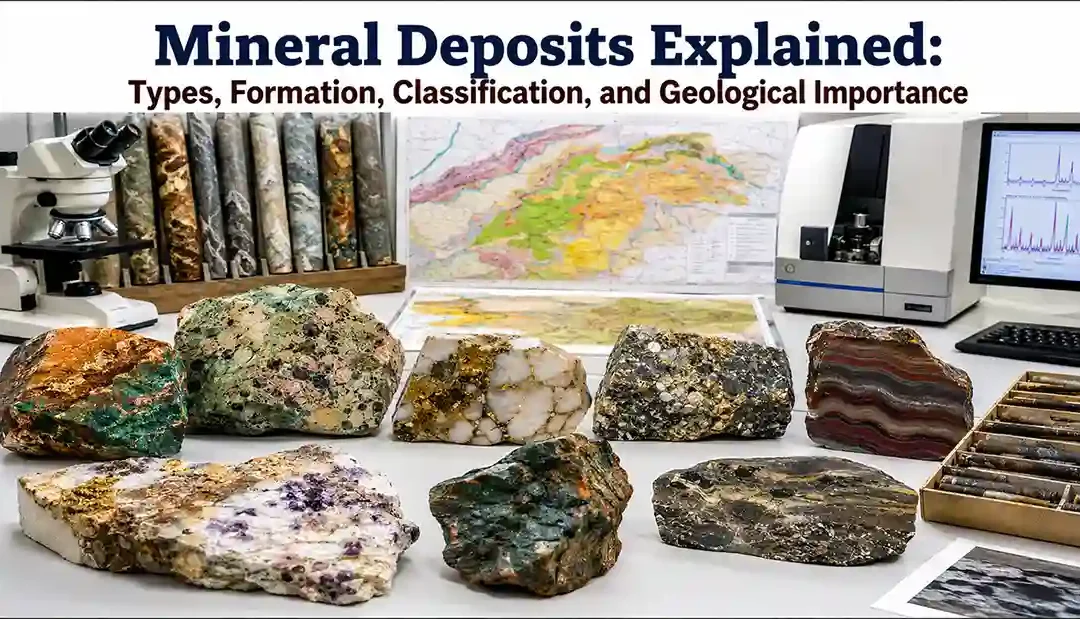
Mineral deposits are naturally occurring concentrations of valuable minerals or metals within Earth's crust that can potentially be extracted economically. They form through a wide variety of geological processes including magmatic crystallization, hydrothermal activity, sedimentary deposition, weathering, metamorphism, and surface erosion. Some deposits are rich in industrial minerals such as limestone and gypsum, while others contain economically important metals including gold, silver, copper, iron, nickel, lithium, uranium, and rare earth elements.
Most modern mining operations are based on the discovery and development of mineral deposits. Understanding how these deposits form allows geologists to predict where valuable resources may occur and supports sustainable exploration and extraction.
This topic should be studied together with Economic Geology, Hydrothermal Minerals, Mineral Veins Explained, and Pegmatite Minerals.
What Are Mineral Deposits?
A mineral deposit is a naturally concentrated accumulation of minerals that has the potential to become an economically viable resource.
A deposit typically contains:
- Valuable ore minerals
- Gangue minerals
- Host rocks
- Alteration zones
- Structural controls
Not every mineral occurrence is an ore deposit. A deposit becomes an ore deposit only when extraction is technically and economically feasible.
How Mineral Deposits Form
Mineral deposits form through multiple geological processes.
Major mechanisms include:
- Magmatic crystallization
- Hydrothermal fluid circulation
- Sedimentary deposition
- Chemical precipitation
- Metamorphism
- Weathering and supergene enrichment
- Mechanical concentration
Each process produces characteristic mineral assemblages and ore bodies.
Components of a Mineral Deposit
Most deposits contain several important components.
Ore Minerals
Economically valuable minerals such as:
- Chalcopyrite
- Galena
- Sphalerite
- Magnetite
- Native Gold
Gangue Minerals
Non-economic minerals commonly associated with ore minerals.
Examples:
- Quartz
- Calcite
- Fluorite
- Barite
Host Rock
The rock surrounding the mineral deposit.
Common host rocks include:
- Granite
- Limestone
- Basalt
- Schist
- Sandstone
Major Types of Mineral Deposits
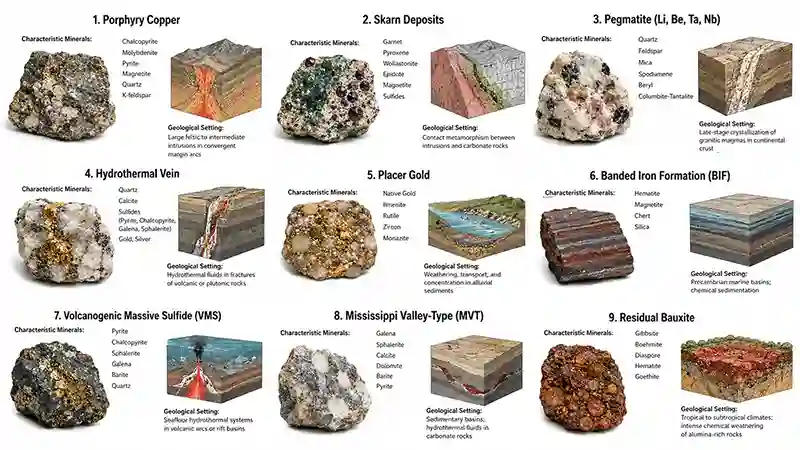
Magmatic Deposits
These form directly from cooling magma.
Common minerals:
- Chromite
- Magnetite
- Ilmenite
- Platinum Group Minerals
- Nickel Sulfides
Examples:
- Bushveld Complex (South Africa)
- Stillwater Complex (USA)
Hydrothermal Deposits
Hot mineral-rich fluids deposit minerals in fractures and faults.
Common minerals:
- Quartz
- Gold
- Chalcopyrite
- Galena
- Sphalerite
- Fluorite
Examples:
- Epithermal gold deposits
- Mesothermal gold deposits
Porphyry Deposits
Large hydrothermal systems surrounding intrusive bodies.
Common commodities:
- Copper
- Molybdenum
- Gold
- Silver
These are among the world's largest copper deposits.
Skarn Deposits
Form where magma reacts with carbonate rocks.
Common minerals:
- Garnet
- Pyroxene
- Magnetite
- Scheelite
- Chalcopyrite
Pegmatite Deposits
Late-stage granitic intrusions rich in rare elements.
Common minerals:
- Spodumene
- Lepidolite
- Beryl
- Columbite-Tantalite
Major source of lithium and tantalum.
Sedimentary Deposits
Form through sedimentary processes.
Examples:
- Banded Iron Formation (BIF)
- Phosphate deposits
- Evaporites
- Coal
Placer Deposits
Heavy minerals become concentrated by rivers, beaches, or waves.
Common minerals:
- Gold
- Diamond
- Cassiterite
- Ilmenite
- Rutile
- Zircon
Residual Deposits
Produced by intense weathering.
Examples:
- Bauxite
- Nickel Laterite
- Kaolin
Volcanogenic Massive Sulfide (VMS) Deposits
Form on ancient seafloors by hydrothermal vents.
Common minerals:
- Chalcopyrite
- Sphalerite
- Galena
- Pyrite
Mississippi Valley-Type (MVT) Deposits
Form in carbonate rocks.
Main commodities:
- Lead
- Zinc
Accessory Deposit Types
Other important mineral deposits include:
- IOCG (Iron Oxide Copper Gold)
- SEDEX (Sedimentary Exhalative)
- Orogenic Gold Deposits
- Carbonatite Rare Earth Deposits
- Kimberlite Diamond Deposits
- Greisen Tin Deposits
Ore-Forming Minerals
Common ore minerals include:
- Chalcopyrite (Copper)
- Galena (Lead)
- Sphalerite (Zinc)
- Magnetite (Iron)
- Hematite (Iron)
- Native Gold
- Native Silver
- Uraninite
- Cassiterite
- Chromite
These minerals are the primary targets of mining.
Factors Controlling Mineral Deposits
Several geological factors influence deposit formation.
Major controls include:
- Plate tectonics
- Magmatism
- Structural geology
- Faults and fractures
- Fluid chemistry
- Temperature
- Pressure
- Host rock composition
Understanding these controls is essential for mineral exploration.
Geological Importance
Mineral deposits help geologists:
- Understand crustal evolution
- Interpret tectonic environments
- Reconstruct hydrothermal systems
- Study ore-forming processes
- Evaluate mineral resources
- Understand fluid-rock interaction
They record some of Earth's most important geological events.
Economic Importance
Mineral deposits provide materials used in:
- Construction
- Electronics
- Renewable energy
- Transportation
- Steel production
- Batteries
- Telecommunications
- Aerospace
- Medicine
Critical minerals are increasingly important for the global energy transition.
Laboratory Identification
Mineral deposits are studied using:
- Petrographic Microscopy
- X-Ray Diffraction (XRD)
- Electron Microprobe Analysis (EPMA)
- Scanning Electron Microscopy (SEM)
- X-Ray Fluorescence (XRF)
- ICP-MS Geochemistry
- Fluid Inclusion Analysis
- Stable Isotope Geochemistry
These techniques determine mineral composition, alteration, and ore-forming conditions.
Applications
Mineral deposit studies are important in:
- Economic Geology
- Mining Geology
- Mineral Exploration
- Geochemistry
- Structural Geology
- Environmental Geology
- Resource Evaluation
- Engineering Geology
Advantages of Studying Mineral Deposits
Studying mineral deposits helps scientists:
- Discover new mineral resources
- Improve exploration success
- Understand ore-forming processes
- Support sustainable mining
- Evaluate critical mineral supplies
- Interpret Earth's geological evolution
Limitations
Studying mineral deposits may be challenging because:
- Ore bodies are often buried beneath younger rocks.
- Multiple mineralization events may overprint earlier deposits.
- Weathering can modify original mineral assemblages.
- Accurate resource evaluation requires extensive drilling, sampling, and laboratory analyses.
For comprehensive interpretation, combine mineral deposit studies with:
- Economic Geology
- Hydrothermal Minerals
- Mineral Veins Explained
- Pegmatite Minerals
- Metasomatism
- Petrographic Microscopy
- Mineral Chemistry Analysis
- X-Ray Diffraction in Mineralogy
Comparison Table
| Deposit Type | Formation Process | Common Commodities |
|---|---|---|
| Magmatic | Magma Crystallization | Chromite, Nickel, Platinum |
| Hydrothermal | Hot Fluids | Gold, Copper, Silver |
| Porphyry | Intrusion-Related Hydrothermal | Copper, Molybdenum |
| Skarn | Magma-Carbonate Interaction | Iron, Tungsten, Copper |
| Pegmatite | Late-Stage Magma | Lithium, Tantalum |
| Sedimentary | Deposition & Chemical Precipitation | Iron, Phosphate, Salt |
| Placer | Mechanical Concentration | Gold, Diamond |
| Residual | Weathering | Bauxite, Nickel |
| VMS | Seafloor Hydrothermal Activity | Copper, Zinc, Lead |
| MVT | Basin Fluid Circulation | Lead, Zinc |
Summary Table
| Feature | Mineral Deposits |
| Main Formation Processes | Magmatic, Hydrothermal, Sedimentary, Weathering, Metamorphic |
| Common Ore Minerals | Chalcopyrite, Galena, Sphalerite, Magnetite, Gold |
| Main Study Methods | Petrography, XRD, SEM, EPMA, Geochemistry |
| Economic Importance | Metal, Industrial Mineral, and Critical Mineral Resources |
| Geological Importance | Ore Formation and Resource Exploration |
A mineral deposit is a naturally concentrated accumulation of valuable minerals or metals within Earth's crust that has the potential to be mined economically.
A mineral deposit is any natural concentration of minerals. An ore deposit is a mineral deposit that can be extracted profitably using current technology and economic conditions.
Mineral deposits form through processes such as magmatic crystallization, hydrothermal fluid activity, sedimentary deposition, metamorphism, weathering, and mechanical concentration.
Porphyry copper, hydrothermal gold, skarn, pegmatite lithium, banded iron formation, placer gold, VMS, and bauxite deposits are among the world's most economically significant mineral deposits.
Geologists investigate mineral deposits using field mapping, drilling, petrographic microscopy, X-ray diffraction (XRD), electron microprobe analysis (EPMA), scanning electron microscopy (SEM), geochemical analysis, fluid inclusion studies, and isotope geochemistry.
Final Thoughts
Mineral deposits are the foundation of modern civilization, supplying the metals and industrial minerals needed for infrastructure, manufacturing, renewable energy, electronics, transportation, and advanced technologies. Their formation reflects a wide range of geological processes, from magma crystallization and hydrothermal activity to sedimentation, weathering, and metamorphism.
By combining field observations with petrographic microscopy, geochemistry, X-ray diffraction, electron microprobe analysis, fluid inclusion studies, and structural geology, geologists can understand ore-forming systems and discover new mineral resources. The study of mineral deposits remains one of the most important branches of economic geology, mineral exploration, and sustainable resource development.
Continue Learning
Continue exploring economic geology with these related guides: