
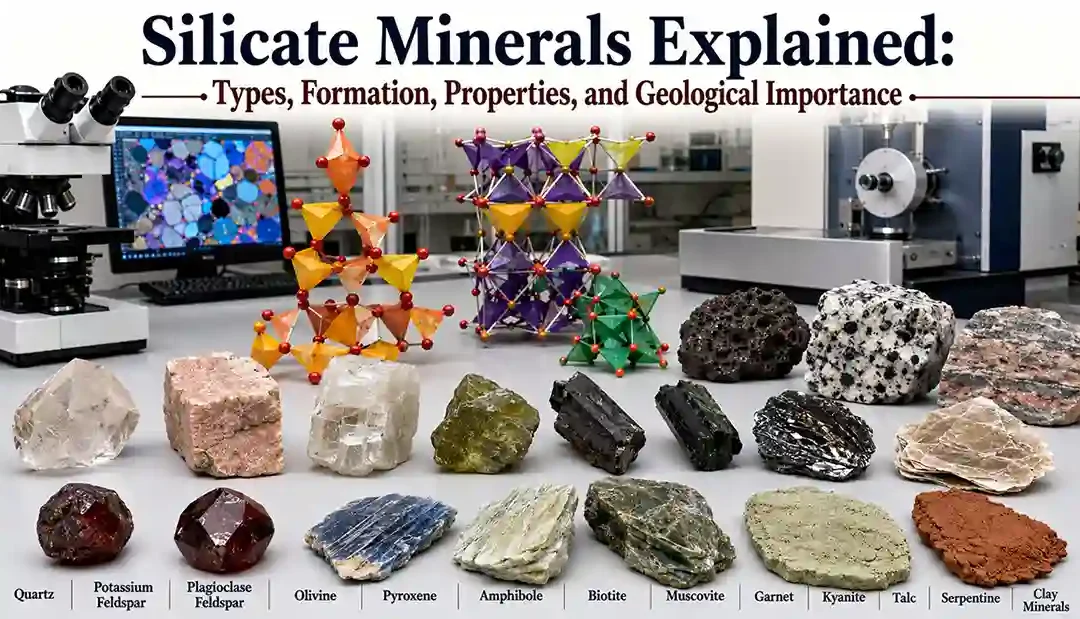
Silicate minerals are the most abundant mineral group on Earth, making up approximately 90% of Earth's crust and a large portion of the mantle. They are the fundamental building blocks of most igneous, metamorphic, and many sedimentary rocks. Nearly every major rock-forming mineral belongs to the silicate group, including quartz, feldspar, olivine, pyroxene, amphibole, mica, garnet, and numerous clay minerals.
All silicate minerals are built from the silicon-oxygen tetrahedron (SiO₄⁴⁻), one of the most important structural units in mineralogy. The way these tetrahedra connect produces a wide variety of crystal structures, physical properties, and mineral groups.
Understanding silicate minerals is fundamental to mineralogy, petrology, geochemistry, plate tectonics, and Earth science because they control the composition, evolution, and behavior of Earth's crust and mantle.
This topic should be studied together with Minerals and Earth's Crust, Mantle Minerals, and Volcanic Minerals.
What Are Silicate Minerals?
Silicate minerals are minerals composed primarily of silicon (Si) and oxygen (O) combined with metals such as:
- Aluminum (Al)
- Magnesium (Mg)
- Iron (Fe)
- Calcium (Ca)
- Sodium (Na)
- Potassium (K)
Their basic structural unit is the silicon-oxygen tetrahedron, consisting of one silicon atom surrounded by four oxygen atoms.
The Silicon-Oxygen Tetrahedron
The silicon-oxygen tetrahedron is the fundamental building block of all silicate minerals.
Chemical unit:
SiO₄⁴⁻
Each tetrahedron may exist independently or share oxygen atoms with neighboring tetrahedra to produce different crystal structures.
The arrangement of tetrahedra determines:
- Mineral classification
- Crystal habit
- Cleavage
- Hardness
- Density
- Chemical behavior
How Silicate Minerals Form
Silicate minerals form through several geological processes.
Major formation mechanisms include:
- Crystallization from magma
- Metamorphic recrystallization
- Weathering and alteration
- Hydrothermal activity
- Sedimentary diagenesis
Each environment produces distinctive silicate mineral assemblages.
Classification of Silicate Minerals
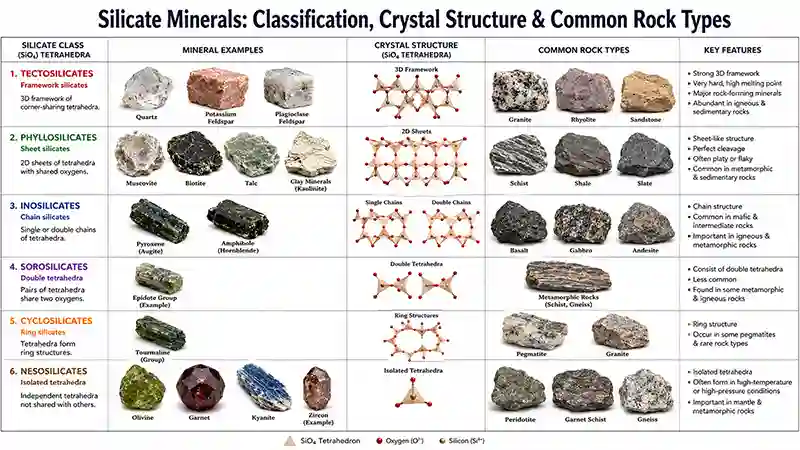
Silicate minerals are classified according to how silicon-oxygen tetrahedra are connected.
Nesosilicates (Isolated Tetrahedra)
Each tetrahedron is independent.
Common minerals:
- Olivine
- Garnet
- Zircon
Characteristics:
- High density
- High crystallization temperature
Sorosilicates (Double Tetrahedra)
Two tetrahedra share one oxygen atom.
Common minerals:
- Epidote
- Vesuvianite
These minerals commonly occur in metamorphic rocks.
Cyclosilicates (Ring Silicates)
Tetrahedra form ring structures.
Common minerals:
- Beryl
- Tourmaline
- Cordierite
Many gemstones belong to this group.
Inosilicates (Chain Silicates)
Single-Chain Silicates
Common minerals:
- Pyroxene
Common rocks:
- Basalt
- Gabbro
Double-Chain Silicates
Common minerals:
- Amphibole
Common rocks:
- Diorite
- Amphibolite
Phyllosilicates (Sheet Silicates)
Tetrahedra form sheets.
Common minerals:
- Muscovite
- Biotite
- Chlorite
- Talc
- Serpentine
- Clay Minerals
These minerals commonly display perfect basal cleavage.
Tectosilicates (Framework Silicates)
All oxygen atoms are shared to form three-dimensional frameworks.
Common minerals:
- Quartz
- Potassium Feldspar
- Plagioclase Feldspar
These minerals dominate Earth's continental crust.
Major Silicate Minerals
Quartz
Chemical Formula:SiO₂
Characteristics:
- Hardness 7
- No cleavage
- Highly resistant to weathering
Feldspar Group
Includes:
- Potassium Feldspar
- Plagioclase Feldspar
Together they make up more than half of Earth's crust.
Olivine
High-temperature magnesium-iron silicate.
Common in:
- Mantle rocks
- Basalt
Pyroxene
Dark-colored chain silicate.
Common in:
- Basalt
- Gabbro
Amphibole
Hydrous chain silicate.
Common in:
- Andesite
- Amphibolite
Mica Group
Includes:
- Muscovite
- Biotite
Known for perfect sheet cleavage.
Garnet
Common metamorphic silicate mineral.
Widely used as:
- Index mineral
- Industrial abrasive
- Gemstone
Clay Minerals
Weathering products including:
- Kaolinite
- Illite
- Smectite
- Vermiculite
These dominate soils and weathered rocks.
Accessory Silicate Minerals
Other important silicate minerals include:
- Kyanite
- Andalusite
- Sillimanite
- Staurolite
- Topaz
- Zircon
- Beryl
- Tourmaline
Although less abundant, they are valuable indicators of geological environments and are widely used in geochronology and gemology.
Physical Properties of Silicate Minerals
Silicate minerals exhibit a wide range of physical properties.
Common characteristics include:
- Hardness ranging from 1 (talc) to 7 (quartz)
- Variable cleavage
- Diverse crystal habits
- Generally low to moderate density
- Glassy to earthy luster
- Wide color variation
Their crystal structure strongly influences these properties.
Silicate Minerals in Different Rock Types
| Rock Type | Dominant Silicate Minerals |
|---|---|
| Granite | Quartz, Feldspar, Biotite |
| Basalt | Plagioclase, Pyroxene, Olivine |
| Gabbro | Plagioclase, Pyroxene |
| Peridotite | Olivine, Pyroxene |
| Gneiss | Quartz, Feldspar, Garnet |
| Schist | Mica, Garnet |
| Sandstone | Quartz |
Silicate minerals dominate igneous and metamorphic rocks and are also abundant in sedimentary rocks.
Silicate Minerals and the Rock Cycle
Silicate minerals participate in every stage of the rock cycle.
They:
- Crystallize from magma
- Recrystallize during metamorphism
- Weather into clay minerals
- Become sediments
- Form new sedimentary rocks
- Melt to produce new magma
This continuous recycling drives Earth's geological evolution.
Economic Importance
Silicate minerals are essential natural resources.
Major uses include:
- Glass manufacturing
- Ceramics
- Cement
- Building stone
- Electronics
- Abrasives
- Gemstones
- Refractories
- Industrial fillers
Quartz, feldspar, mica, talc, and clay minerals are among the world's most important industrial minerals.
Laboratory Identification
Silicate minerals are identified using:
- Hand specimen examination
- Petrographic Microscopy
- X-Ray Diffraction (XRD)
- Electron Microprobe Analysis (EPMA)
- Scanning Electron Microscopy (SEM)
- Raman Spectroscopy
- X-Ray Fluorescence (XRF)
These methods determine crystal structure, mineral chemistry, and geological origin.
Importance of Silicate Minerals
Studying silicate minerals helps geologists:
- Classify rocks
- Understand magma evolution
- Interpret metamorphism
- Reconstruct tectonic history
- Evaluate mineral resources
- Study weathering processes
Silicate minerals are the foundation of Earth's geology.
Applications
Silicate mineral studies are important in:
- Mineralogy
- Petrology
- Geochemistry
- Economic Geology
- Engineering Geology
- Environmental Geology
- Planetary Science
- Materials Science
Advantages of Studying Silicate Minerals
Studying silicate minerals allows scientists to:
- Understand Earth's crust and mantle
- Reconstruct geological history
- Explore mineral resources
- Improve industrial material production
- Interpret tectonic environments
- Investigate planetary evolution
Limitations
Studying silicate minerals may be challenging because:
- Many silicate minerals have similar appearances.
- Weathering may alter original mineral compositions.
- Fine-grained silicates often require advanced laboratory techniques.
- Some minerals can only be distinguished through detailed chemical analysis.
For comprehensive interpretation, combine silicate mineral studies with:
- Minerals and Earth's Crust
- Mantle Minerals
- Volcanic Minerals
- Weathering and Mineral Formation
- Clay Minerals
- Petrographic Microscopy
- X-Ray Diffraction in Mineralogy
- Mineral Chemistry Analysis
Comparison Table
| Silicate Group | Tetrahedral Structure | Common Minerals | Typical Environment |
| Nesosilicates | Isolated | Olivine, Garnet | Mantle, Igneous Rocks |
| Sorosilicates | Double | Epidote | Metamorphic Rocks |
| Cyclosilicates | Ring | Beryl, Tourmaline | Pegmatites |
| Inosilicates | Chain | Pyroxene, Amphibole | Igneous & Metamorphic Rocks |
| Phyllosilicates | Sheet | Mica, Talc, Clay Minerals | Weathered & Metamorphic Rocks |
| Tectosilicates | Framework | Quartz, Feldspar | Continental Crust |
Summary Table
| Feature | Silicate Minerals |
| Main Chemical Group | Silicon-Oxygen (SiO₄) Minerals |
| Dominant Structural Unit | Silicon-Oxygen Tetrahedron |
| Major Mineral Groups | Nesosilicates, Inosilicates, Phyllosilicates, Tectosilicates |
| Main Identification Methods | Petrography, XRD, EPMA, SEM |
| Geological Importance | Earth's Crust, Mantle, Rock Formation |
Silicate minerals are minerals composed primarily of silicon and oxygen arranged as silicon-oxygen tetrahedra. They make up about 90% of Earth's crust and are the dominant rock-forming minerals.
Silicon and oxygen are the two most abundant elements in Earth's crust. Their strong chemical bonding produces stable silicate structures that dominate Earth's rocks.
Feldspar is the most abundant silicate mineral group in Earth's crust, followed by quartz, pyroxene, amphibole, mica, and olivine.
The silicon-oxygen tetrahedron (SiO₄⁴⁻) is the fundamental structural unit of all silicate minerals. Different ways of linking these tetrahedra produce the six major silicate mineral groups.
Geologists identify silicate minerals using hand specimens, petrographic microscopy, X-ray diffraction (XRD), electron microprobe analysis (EPMA), scanning electron microscopy (SEM), Raman spectroscopy, and X-ray fluorescence (XRF).
Final Thoughts
Silicate minerals form the structural foundation of Earth's crust and mantle, controlling the composition of nearly all igneous, metamorphic, and many sedimentary rocks. From isolated olivine crystals in the mantle to the framework structure of quartz and feldspar in continental crust, silicate minerals record the processes of magma crystallization, metamorphism, weathering, and plate tectonics.
By combining field observations with petrographic microscopy, X-ray diffraction, mineral chemistry, electron microprobe analysis, and geochemical investigations, geologists can classify rocks, reconstruct Earth's geological history, and locate valuable mineral resources. The study of silicate minerals remains one of the most fundamental topics in mineralogy, petrology, geochemistry, and Earth system science.
Continue Learning
Continue exploring mineralogy and Earth's composition with these related guides: