
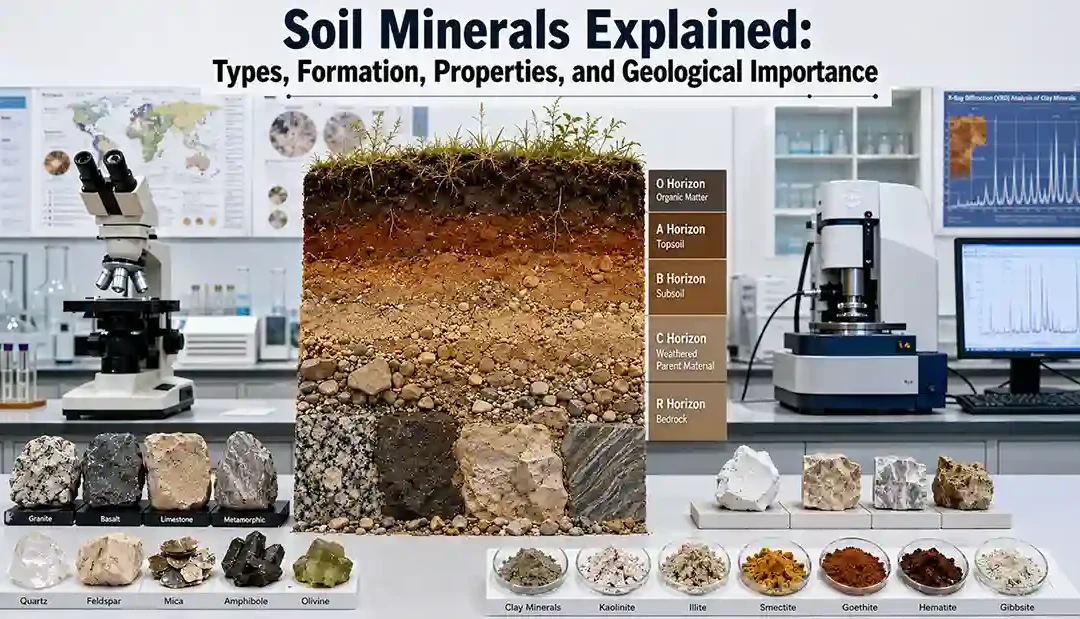
Soil minerals are the inorganic components of soil formed through the weathering of rocks and minerals over thousands to millions of years. They provide the structural framework of soils, influence nutrient availability, control water retention, regulate soil chemistry, and support plant growth. Although organic matter and living organisms are important components of soil, minerals usually make up about 45% of a typical mineral soil, making them the dominant solid component.
Soil minerals originate from both primary minerals, inherited from the parent rock, and secondary minerals, formed during weathering. Primary minerals such as quartz and feldspar gradually break down into clay minerals, iron oxides, and aluminum hydroxides that dominate mature soils.
Understanding soil minerals is essential in mineralogy, soil science, agriculture, environmental geology, engineering geology, and hydrology.
This topic should be studied together with Weathering and Mineral Formation, Mineral Weathering, Mineral Stability, and Sedimentary Rocks Explained.
What Are Soil Minerals?
Soil minerals are naturally occurring inorganic crystalline materials found within soil.
They originate from:
- Igneous rocks
- Sedimentary rocks
- Metamorphic rocks
- Volcanic ash
- Wind-blown sediments
- Glacial deposits
Their abundance depends on climate, parent material, weathering intensity, and time.
How Soil Minerals Form
Soil minerals develop through long-term weathering of rocks.
The general process includes:
- Rock exposure
- Physical weathering
- Chemical weathering
- Biological activity
- Mineral alteration
- Secondary mineral formation
- Soil profile development
Over time, unstable minerals transform into stable soil minerals.
Primary Soil Minerals
Primary minerals are inherited directly from the parent rock.
They generally remain unchanged during the early stages of soil formation.
Common primary minerals include:
- Quartz
- Feldspar
- Muscovite
- Biotite
- Amphibole
- Pyroxene
- Olivine
- Magnetite
Quartz is the most resistant primary soil mineral.
Secondary Soil Minerals
Secondary minerals form during chemical weathering.
Common examples include:
- Kaolinite
- Illite
- Smectite
- Chlorite
- Vermiculite
- Goethite
- Hematite
- Gibbsite
These minerals dominate mature soils in many climates.
Major Soil Minerals
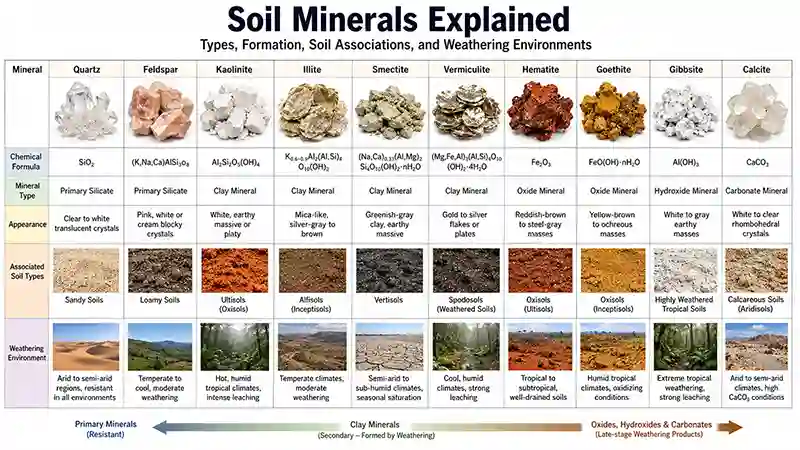
Quartz
Quartz is the most abundant resistant mineral in many soils.
Characteristics:
- Hardness 7
- Chemically stable
- Poor nutrient source
Quartz contributes mainly to soil texture.
Feldspar
Feldspar gradually weathers into clay minerals.
Characteristics:
- Rich in potassium, sodium, or calcium
- Important nutrient source
- Common in young soils
Clay Minerals
Clay minerals are the most important secondary soil minerals.
Major types include:
Kaolinite
- Stable in tropical climates
- Low nutrient retention
- Low shrink-swell behavior
Illite
- Potassium-rich clay
- Moderate nutrient retention
- Common in temperate soils
Smectite
- High shrink-swell capacity
- Excellent nutrient retention
- Common in volcanic and arid soils
Vermiculite
- High cation exchange capacity
- Excellent water retention
Iron Oxides
Iron oxides give soils their red, yellow, and brown colors.
Common minerals:
- Hematite
- Goethite
These minerals indicate strong chemical weathering.
Aluminum Hydroxides
Gibbsite forms during intense tropical weathering.
It commonly occurs in:
- Lateritic soils
- Highly weathered tropical profiles
Carbonate Minerals
Calcite and dolomite occur in dry climates where rainfall is insufficient to remove dissolved calcium and magnesium.
These minerals help buffer soil acidity.
Accessory Soil Minerals
Minor soil minerals include:
- Zircon
- Apatite
- Tourmaline
- Rutile
- Magnetite
- Ilmenite
Although present in small amounts, they provide valuable information about parent material and soil origin.
Factors Affecting Soil Mineral Formation
Several environmental factors influence soil mineralogy.
Parent Material
The composition of the original rock strongly controls mineral availability.
Climate
Warm, humid climates promote rapid chemical weathering and clay mineral formation. Cold or dry climates preserve more primary minerals.
Organisms
Plants, fungi, bacteria, and roots accelerate weathering through biological activity.
Topography
Slope affects drainage, erosion, and soil development.
Time
Older soils generally contain more secondary minerals because weathering has progressed further.
Soil Horizons and Mineral Distribution
Different minerals dominate different soil horizons.
| Soil Horizon | Dominant Minerals |
|---|---|
| O Horizon | Organic Matter |
| A Horizon | Quartz, Clay Minerals |
| E Horizon | Quartz, Resistant Minerals |
| B Horizon | Clay Minerals, Iron Oxides |
| C Horizon | Weathered Parent Rock |
Mineral composition changes gradually with depth.
Importance of Clay Minerals
Clay minerals strongly influence soil properties.
They control:
- Water retention
- Nutrient storage
- Soil fertility
- Plasticity
- Shrink-swell behavior
- Cation exchange capacity
They are among the most important minerals in agriculture.
Soil Minerals and Agriculture
Soil minerals influence:
- Nutrient availability
- Root growth
- Soil pH
- Water holding capacity
- Fertilizer efficiency
- Crop productivity
Healthy soils require balanced mineral composition.
Economic Importance
Soil minerals have many industrial applications.
Examples include:
- Kaolin for ceramics and paper
- Bentonite (smectite) for drilling mud
- Laterite for nickel mining
- Bauxite (gibbsite-rich) for aluminum production
Many important industrial minerals originate through soil-forming processes.
Laboratory Identification
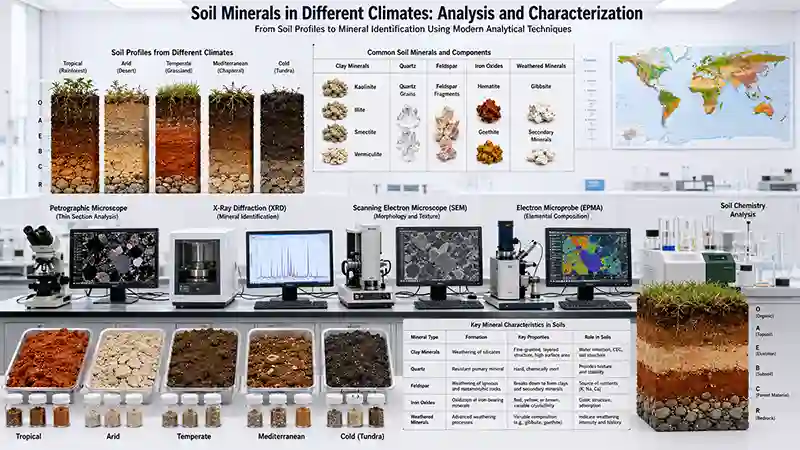
Soil minerals are commonly studied using:
- Petrographic Microscopy
- X-Ray Diffraction (XRD)
- Electron Microprobe Analysis (EPMA)
- Scanning Electron Microscopy (SEM)
- X-Ray Fluorescence (XRF)
- Raman Spectroscopy
- Grain-size analysis
These techniques identify mineral composition and weathering products.
Importance of Soil Minerals
Studying soil minerals helps scientists:
- Understand soil formation
- Evaluate soil fertility
- Interpret weathering history
- Improve agricultural management
- Assess environmental quality
- Explore weathering-related mineral deposits
Soil minerals connect geology with ecosystems and agriculture.
Applications
Soil mineral studies are important in:
- Soil Science
- Mineralogy
- Agriculture
- Environmental Geology
- Engineering Geology
- Hydrology
- Geochemistry
- Land Management
Advantages of Studying Soil Minerals
Studying soil minerals allows scientists to:
- Improve crop production
- Understand weathering processes
- Evaluate soil health
- Interpret past climates
- Manage land sustainably
- Explore industrial mineral resources
Limitations
Interpreting soil mineralogy may be challenging because:
- Multiple weathering processes often occur simultaneously.
- Soil profiles vary significantly over short distances.
- Human activities can modify natural soil composition.
- Fine-grained clay minerals often require advanced laboratory analysis.
For comprehensive interpretation, combine soil mineral studies with:
- Weathering and Mineral Formation
- Mineral Weathering
- Mineral Stability
- Sedimentary Rocks Explained
- Mineral Chemistry Analysis
- Petrographic Microscopy
- X-Ray Diffraction in Mineralogy
Comparison Table
| Mineral Type | Common Examples | Main Role in Soil |
| Primary Minerals | Quartz, Feldspar, Mica | Parent Material |
| Clay Minerals | Kaolinite, Illite, Smectite | Nutrient & Water Retention |
| Iron Oxides | Hematite, Goethite | Soil Color & Weathering Indicator |
| Carbonates | Calcite, Dolomite | Soil pH Buffering |
Summary Table
| Feature | Soil Minerals |
| Main Origin | Weathering of Rocks |
| Primary Minerals | Quartz, Feldspar, Mica |
| Secondary Minerals | Clay Minerals, Iron Oxides |
| Common Study Methods | XRD, SEM, EPMA, Petrography |
| Geological Importance | Soil Formation and Nutrient Cycling |
Soil minerals are the inorganic crystalline components of soil that originate from weathered rocks or form during soil development through chemical weathering.
Primary minerals are inherited directly from parent rocks, while secondary minerals form through weathering reactions. Quartz and feldspar are common primary minerals, whereas kaolinite, illite, smectite, and goethite are common secondary minerals.
Clay minerals regulate nutrient availability, water retention, cation exchange capacity, soil fertility, and many physical properties that influence plant growth.
Quartz is the most resistant common soil mineral because of its strong silicon-oxygen crystal structure and high chemical stability.
Scientists identify soil minerals using petrographic microscopy, X-ray diffraction (XRD), scanning electron microscopy (SEM), electron microprobe analysis (EPMA), Raman spectroscopy, X-ray fluorescence (XRF), and soil chemistry analyses.
Final Thoughts
Soil minerals are the foundation of healthy soils and play a vital role in Earth's surface systems. Through millions of years of weathering, primary minerals gradually transform into secondary minerals such as clay minerals and iron oxides that control soil fertility, water retention, nutrient cycling, and ecosystem productivity.
By combining field observations with petrographic microscopy, X-ray diffraction, mineral chemistry, and advanced laboratory techniques, scientists can better understand soil formation, improve agricultural practices, manage natural resources, and interpret Earth's environmental history. The study of soil minerals remains essential for mineralogy, soil science, agriculture, environmental geology, and sustainable land management.
Continue Learning
Continue exploring weathering and Earth surface processes with these related guides: