
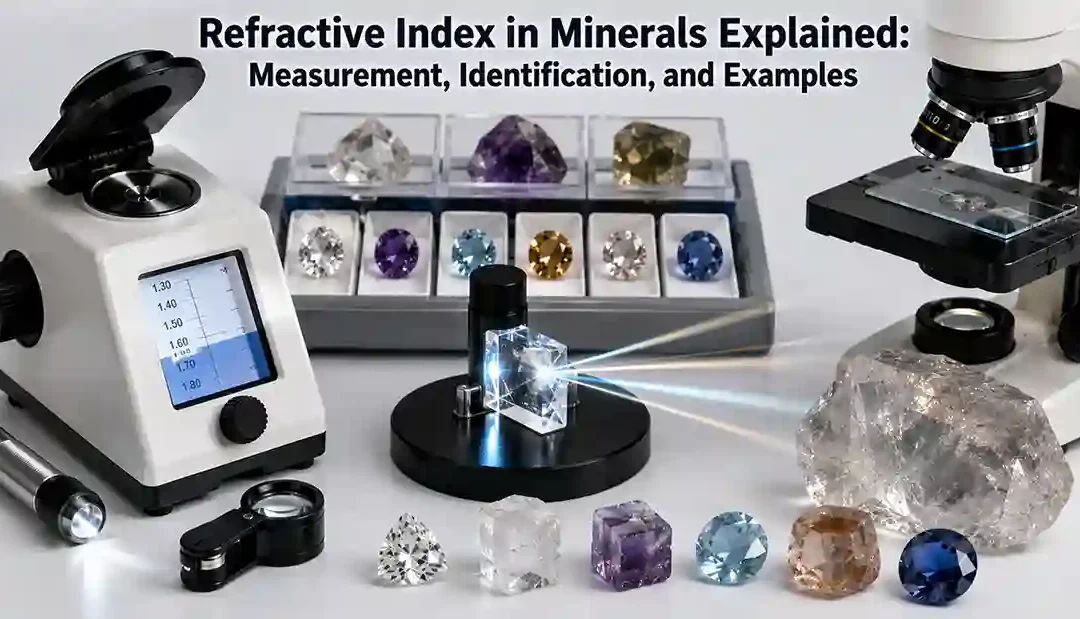
Refractive index (RI) is one of the most important optical properties used in mineralogy and gemology. It measures how much light slows down and bends as it passes from air into a mineral. Every transparent or translucent mineral has a characteristic refractive index based on its chemical composition and crystal structure, making it an essential property for mineral identification.
Minerals with high refractive indices, such as diamond and zircon, appear brighter and more brilliant because they bend light strongly. Minerals with lower refractive indices, such as quartz and fluorite, bend light less and generally display lower brilliance.
Geologists and gemologists routinely measure refractive index using a refractometer, often alongside other optical and physical properties such as birefringence, pleochroism, hardness, density, and crystal habit.
If you are learning mineral identification, this topic should be studied together with Optical Properties of Minerals, Mineral Density Test, and How to Identify Minerals.
What Is Refractive Index?
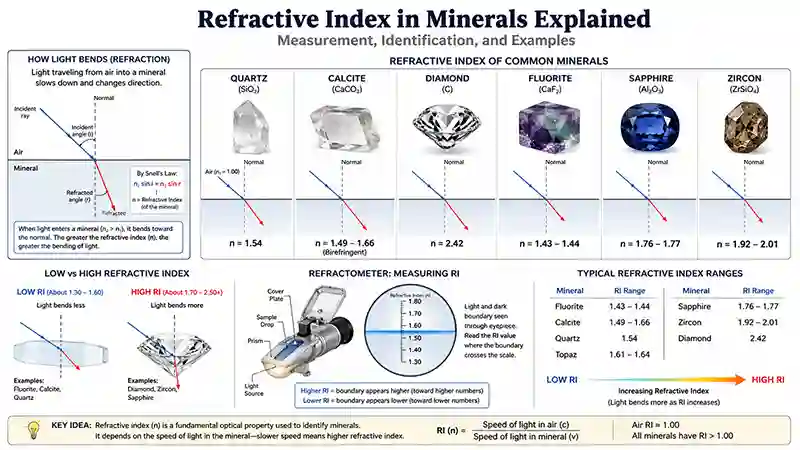
Refractive index is a numerical value that describes how much light bends when it enters a mineral from another medium, usually air.
A higher refractive index means:
- Light travels more slowly inside the mineral.
- Light bends more strongly.
- The mineral often appears brighter and more brilliant.
Every mineral has a characteristic refractive index range that helps identify it.
What Causes Refraction?
When light moves from air into a mineral, its speed changes because minerals are optically denser than air.
As a result:
- The light changes direction.
- The amount of bending depends on the mineral's refractive index.
- Different minerals bend light by different amounts.
This principle forms the basis of refractometer measurements.
Why Is Refractive Index Important?
Refractive index helps geologists and gemologists:
- Identify transparent minerals
- Distinguish similar-looking gemstones
- Evaluate gemstone quality
- Measure optical properties
- Study crystal structure
Many gemstones that appear similar in color can be easily separated by their refractive indices.
How Is Refractive Index Measured?
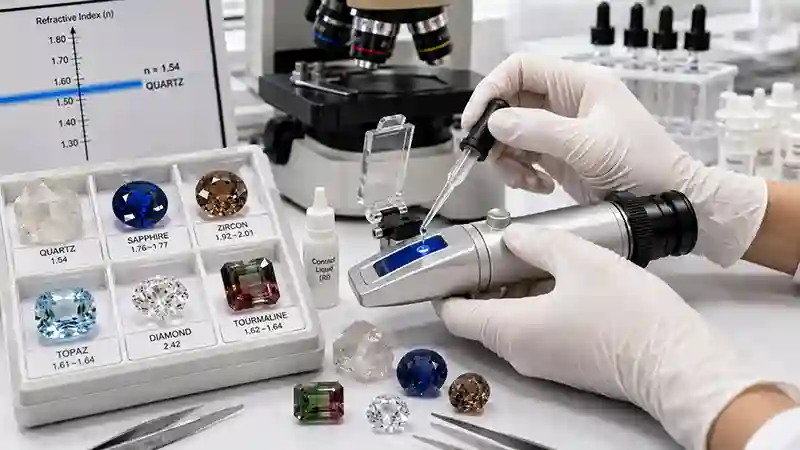
The most common instrument is a gem refractometer.
Step 1
Clean the polished mineral surface.
Step 2
Apply refractive index contact liquid.
Step 3
Place the specimen on the refractometer prism.
Step 4
Illuminate the instrument.
Step 5
Read the refractive index value from the scale.
For accurate measurements, a polished and transparent surface is required.
Equipment Used
Common instruments include:
- Gem refractometer
- Polarized light source
- Contact liquid
- Polariscope
- Microscope
- Dichroscope
Professional gemological laboratories often use several optical instruments together.
Refractive Index of Common Minerals
| Mineral | Refractive Index |
|---|---|
| Fluorite | 1.43 |
| Quartz | 1.54–1.55 |
| Beryl | 1.57–1.60 |
| Tourmaline | 1.61–1.66 |
| Topaz | 1.61–1.64 |
| Sapphire (Corundum) | 1.76–1.77 |
| Zircon | 1.92–1.98 |
| Diamond | 2.42 |
Diamond has one of the highest refractive indices among naturally occurring gemstones.
High vs Low Refractive Index
| Low RI Minerals | High RI Minerals |
| Fluorite | Diamond |
| Quartz | Zircon |
| Calcite | Corundum |
| Feldspar | Rutile |
High-RI minerals generally appear more brilliant because they bend light more strongly.
Refractive Index and Brilliance
Brilliance refers to the amount of light returned from a gemstone.
Generally:
- Higher refractive index → greater brilliance.
- Lower refractive index → softer appearance.
This is one reason why diamonds appear exceptionally bright.
Refractive Index vs Birefringence
Refractive index and birefringence are related but different.
| Refractive Index | Birefringence |
| Measures light bending | Measures double refraction |
| Single value or range | Difference between two RI values |
| Used for all transparent minerals | Only anisotropic minerals |
Calcite has relatively low refractive indices but extremely high birefringence.
Read more in Optical Properties of Minerals.
Isotropic vs Anisotropic Minerals
Isotropic Minerals
- Single refractive index
- Light behaves the same in every direction
Example:
- Diamond
- Garnet
Anisotropic Minerals
- Two or more refractive indices
- Light travels at different speeds
Examples:
- Quartz
- Calcite
- Tourmaline
- Sapphire
This difference is fundamental in optical mineralogy.
Factors Affecting Refractive Index
Several factors influence refractive index.
Chemical Composition
Heavy elements usually increase RI.
Crystal Structure
Atomic arrangement affects light propagation.
Wavelength
Different wavelengths may produce slight RI variations.
Temperature
Temperature causes very small RI changes.
Applications in Geology and Gemology
Refractive index is widely used in:
- Mineral identification
- Gemstone grading
- Petrography
- Museum collections
- Research laboratories
- Gem testing laboratories
It is one of the most reliable optical tests for transparent minerals.
Advantages
Refractive index testing is:
- Non-destructive
- Highly accurate
- Fast
- Repeatable
- Reliable
It provides one of the most diagnostic optical properties for transparent minerals.
Limitations
Refractive index alone cannot identify every mineral because:
- Opaque minerals cannot usually be tested.
- Different minerals may have overlapping RI ranges.
- Proper surface preparation is required.
For reliable identification, combine refractive index with:
- Optical Properties of Minerals
- Mineral Density Test
- Specific Gravity Test Explained
- Mineral Hardness Test
- Fluorescent Minerals
- Cleavage Test Explained
- Fracture in Minerals
Comparison Table
| Test | Measures |
| Refractive Index | Light Bending |
| Birefringence | Double Refraction |
| Fluorescence | UV Response |
| Density Test | Mass per Unit Volume |
| Hardness Test | Scratch Resistance |
Summary Table
| Feature | Refractive Index Test |
| Main Purpose | Measure Light Refraction |
| Equipment | Refractometer |
| Best For | Transparent Minerals |
| Accuracy | Very High |
| Identification Value | Excellent |
Refractive index measures how much light slows down and bends when it enters a mineral.
Diamond has one of the highest refractive indices among naturally occurring gemstones, approximately 2.42.
It helps identify minerals and gemstones because each species has a characteristic refractive index range.
It is measured using a refractometer with a polished mineral surface and a special contact liquid.
No. It is most effective for transparent and translucent minerals and should be used together with other identification tests.
Final Thoughts
Refractive index is one of the most valuable optical properties in mineralogy and gemology because it provides a precise and repeatable method for identifying transparent minerals. From the modest light bending of quartz to the exceptional brilliance of diamond, refractive index reveals important information about a mineral's chemistry and crystal structure.
When combined with birefringence, fluorescence, density, hardness, cleavage, fracture, and other optical properties, refractive index becomes an indispensable tool for geologists, gemologists, and mineral collectors.
Continue Learning
Expand your knowledge with these related guides: