
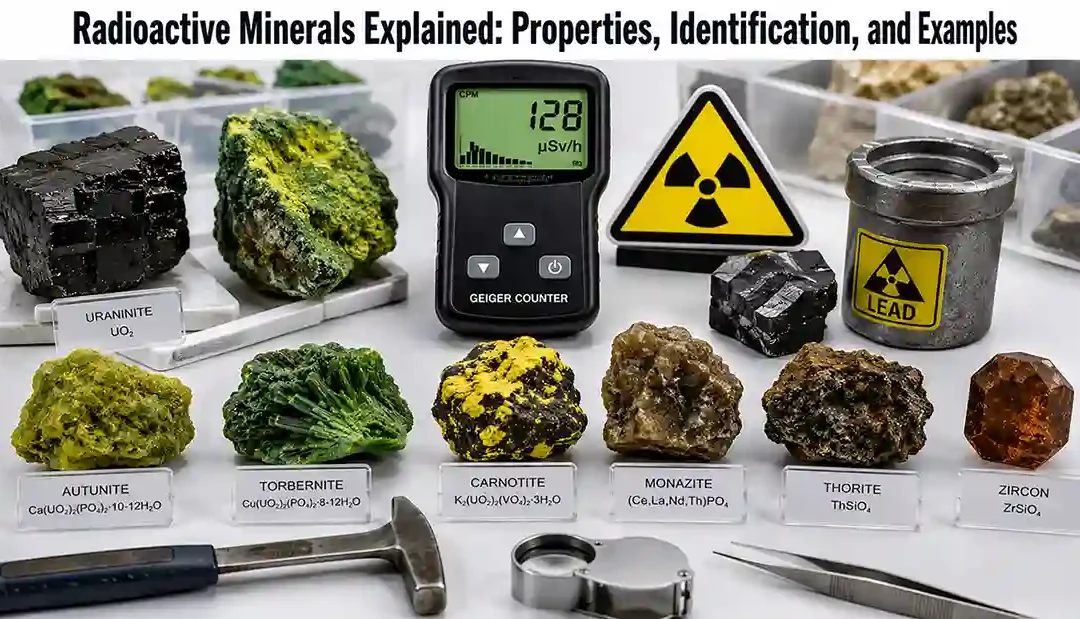
Radioactive minerals are naturally occurring minerals that contain unstable radioactive elements such as uranium (U), thorium (Th), or, less commonly, potassium (K). As these elements decay over time, they release radiation in the form of alpha particles, beta particles, and gamma rays. This natural radioactivity plays an important role in geology, mineral exploration, nuclear energy, and geochronology.
Although radioactive minerals are often associated with uranium mining, they are also valuable for scientific research because their radioactive decay allows geologists to determine the ages of rocks and minerals. Radioactivity alone should never be used to identify a mineral, but when combined with color, hardness, density, fluorescence, crystal habit, and other physical properties, it becomes a powerful identification tool.
If you are learning mineral identification, study radioactivity together with the Fluorescent Minerals, Mineral Density Test, and How to Identify Minerals guides.

What Are Radioactive Minerals?
Radioactive minerals are minerals that naturally emit ionizing radiation because they contain radioactive isotopes.
The most common radioactive elements found in minerals are:
- Uranium (U)
- Thorium (Th)
- Potassium-40 (⁴⁰K)
The amount of radiation varies greatly from one mineral to another.
Why Are Some Minerals Radioactive?
Certain atomic nuclei are unstable. Over time, they decay naturally and release energy as radiation. This process is called radioactive decay.
The decay continues until a stable element is produced. Many uranium minerals eventually decay into stable lead.
Types of Radiation
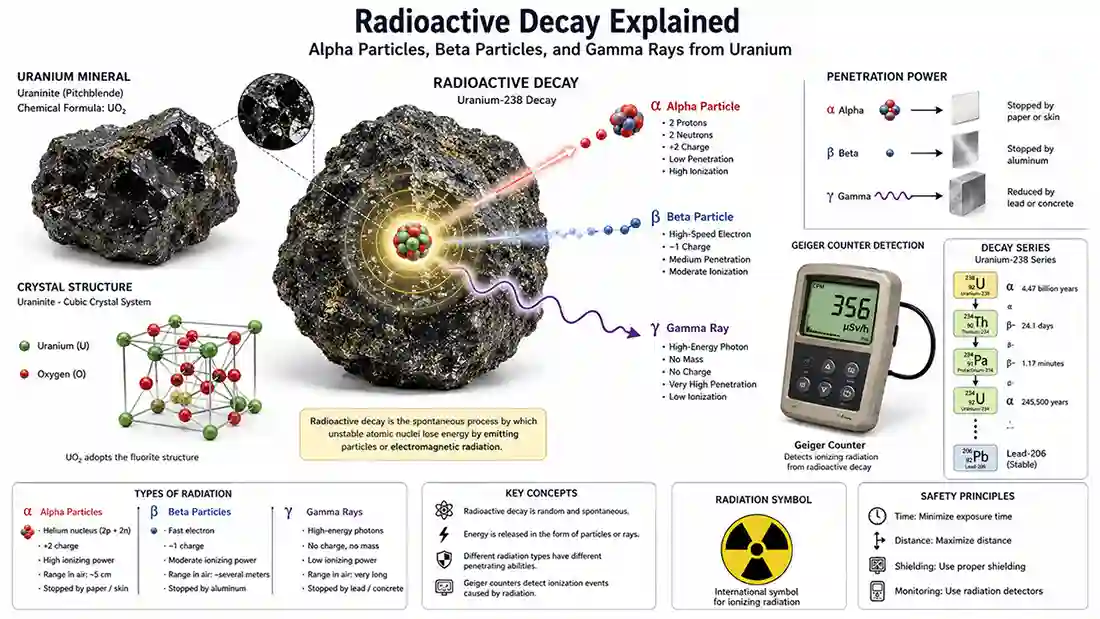
Radioactive minerals may emit three main types of radiation.
Alpha Radiation
- Heavy particles
- Low penetration
- Easily stopped by paper or skin
Beta Radiation
- Fast-moving electrons
- Moderate penetration
- Blocked by thin aluminum
Gamma Radiation
- High-energy electromagnetic waves
- Very penetrating
- Requires dense shielding such as lead or concrete
Gamma radiation is the easiest type to detect with portable instruments.
Common Radioactive Minerals
Several minerals naturally contain uranium or thorium.
| Mineral | Formula | Main Radioactive Element |
|---|---|---|
| Uraninite | UO₂ | Uranium |
| Pitchblende | UO₂-rich | Uranium |
| Autunite | Ca(UO₂)₂(PO₄)₂·10–12H₂O | Uranium |
| Torbernite | Cu(UO₂)₂(PO₄)₂·8–12H₂O | Uranium |
| Carnotite | K₂(UO₂)₂(VO₄)₂·3H₂O | Uranium |
| Monazite | (Ce,La,Nd,Th)PO₄ | Thorium |
| Thorite | ThSiO₄ | Thorium |
| Zircon | ZrSiO₄ | May contain Uranium & Thorium |
Uraninite is the world's most important uranium ore mineral.
Physical Properties
Radioactive minerals vary widely in appearance.
| Property | Typical Range |
| Color | Black, Green, Yellow, Brown |
| Hardness | 2–7.5 |
| Luster | Metallic, Vitreous, Resinous |
| Density | 3–11 g/cm³ |
| Crystal System | Varies |
Many uranium minerals are unusually dense because uranium atoms are very heavy.
Where Are Radioactive Minerals Found?
Radioactive minerals occur in several geological environments.
Common settings include:
- Granite pegmatites
- Hydrothermal veins
- Sandstone-hosted uranium deposits
- Unconformity-related deposits
- Placer deposits
- Metamorphic rocks
These environments concentrate uranium and thorium through geological processes.
How Are Radioactive Minerals Identified?
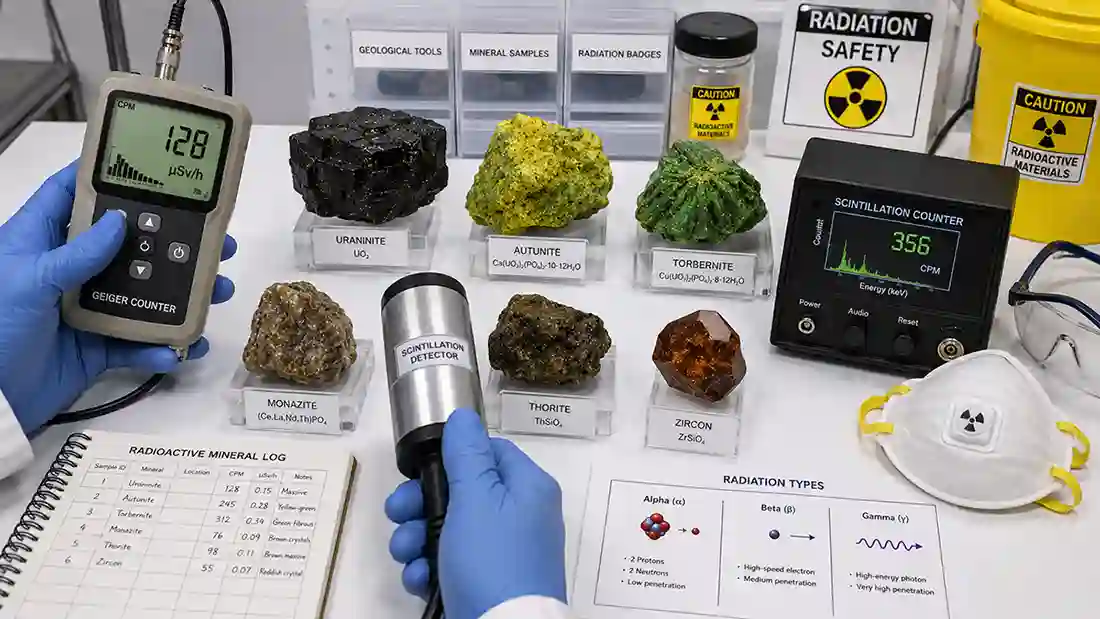
Geologists use several methods.
Visual Identification
Color and crystal habit provide initial clues.
Geiger Counter
Measures radiation emitted by the specimen.
Scintillation Counter
More sensitive than a Geiger counter.
Laboratory Analysis
Confirms mineral composition using X-ray diffraction or spectroscopy.
Radioactivity should always be confirmed using proper instruments.
Fluorescent Radioactive Minerals
Some radioactive minerals also fluoresce under ultraviolet light.
Examples include:
- Autunite
- Torbernite
- Carnotite
This combination of fluorescence and radioactivity makes them easier to recognize.
Learn more in Fluorescent Minerals Explained.
Major Uranium-Producing Countries
Leading uranium producers include:
- Kazakhstan
- Canada
- Namibia
- Australia
- Uzbekistan
- Niger
These countries contain some of the world's largest uranium deposits.
Uses of Radioactive Minerals
Radioactive minerals are important for:
- Nuclear fuel production
- Geological dating
- Scientific research
- Medical isotope production
- Radiation monitoring
- Mineral exploration
Uranium extracted from these minerals is used to produce fuel for nuclear power plants.
Radioactive Minerals in Geochronology
Radioactive decay allows geologists to determine the age of rocks.
Common dating methods include:
- Uranium–Lead (U–Pb)
- Uranium–Thorium (U–Th)
- Potassium–Argon (K–Ar)
These techniques are fundamental to understanding Earth's geological history.
Radiation Safety
When handling radioactive minerals:
- Avoid unnecessary prolonged contact.
- Wash hands after handling specimens.
- Store samples in appropriate containers.
- Keep specimens away from food preparation areas.
- Use radiation monitoring equipment when necessary.
Most small mineral specimens owned by collectors emit relatively low levels of radiation, but sensible handling practices are still recommended.
Advantages of Radioactivity Testing
Radioactivity measurements help geologists:
- Locate uranium deposits
- Identify radioactive minerals
- Study geological processes
- Determine rock ages
- Support mineral exploration
Limitations
Radioactivity alone cannot identify a mineral because:
- Different minerals may have similar radiation levels.
- Weathering alters mineral appearance.
- Some radioactive minerals emit only weak radiation.
For reliable identification, combine radioactivity with:
- Fluorescent Minerals
- Mineral Density Test
- Magnetism in Minerals
- Acid Test for Minerals
- Cleavage Test Explained
- Fracture in Minerals
- Mineral Hardness Test
Comparison Table
| Test | Measures |
| Radioactivity Test | Natural Radiation |
| Fluorescence Test | UV Response |
| Density Test | Mass per Unit Volume |
| Magnetism Test | Magnetic Properties |
| Acid Test | Carbonate Reaction |
| Hardness Test | Scratch Resistance |
Summary Table
| Feature | Radioactive Minerals |
| Main Elements | Uranium, Thorium |
| Main Detection Tool | Geiger Counter |
| Main Uses | Nuclear Fuel, Dating, Exploration |
| Common Minerals | Uraninite, Autunite, Monazite |
| Identification Value | High (with other tests) |
Radioactive minerals are naturally occurring minerals that contain unstable elements such as uranium or thorium and emit ionizing radiation.
Uraninite (UO₂) is the world's most important uranium ore mineral.
Not necessarily. Many mineral specimens emit only low levels of radiation, but they should still be handled responsibly using basic safety precautions.
They commonly use Geiger counters and scintillation counters to measure natural radiation emitted by the minerals.
They are valuable sources of uranium for nuclear energy and are essential for radiometric dating methods that determine the ages of rocks and minerals.
Final Thoughts
Radioactive minerals are among the most scientifically significant minerals on Earth. Beyond their role as uranium and thorium ores, they provide the foundation for radiometric dating, helping geologists reconstruct Earth's 4.5-billion-year history. Minerals such as uraninite, autunite, monazite, and thorite also play important roles in nuclear energy, mineral exploration, and geological research.
Although radioactivity is a distinctive property, it should always be used alongside density, hardness, fluorescence, magnetism, cleavage, fracture, and other identification techniques for reliable mineral identification.
Continue Learning
Build your mineral identification knowledge with these related guides: