
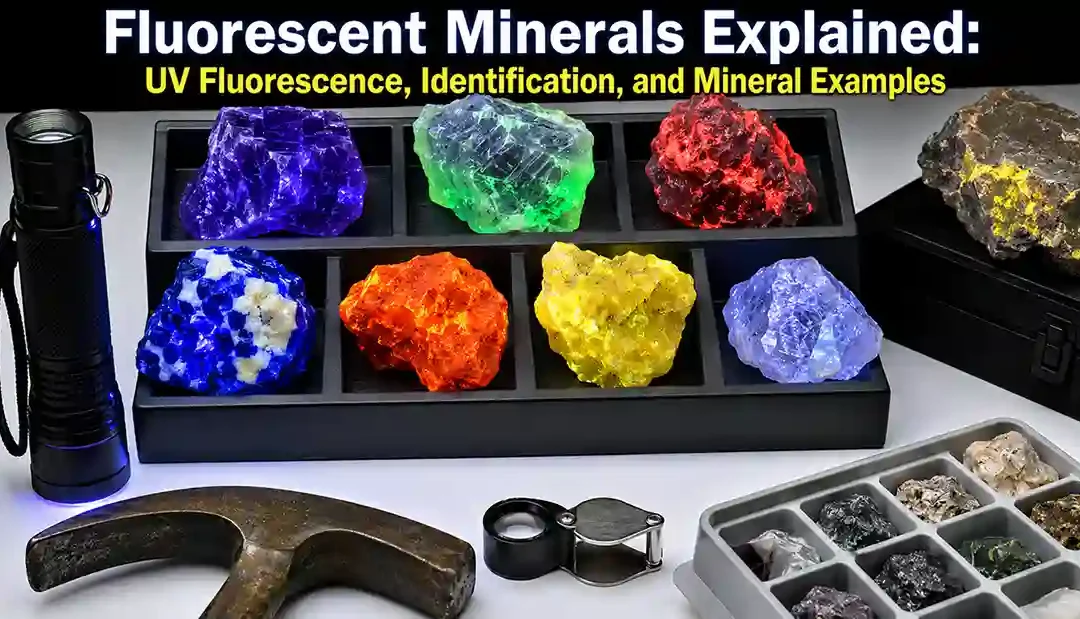
Fluorescence is one of the most fascinating optical properties observed in minerals. Some minerals appear ordinary under visible light but produce brilliant blue, green, red, yellow, orange, or white colors when exposed to ultraviolet (UV) light. This phenomenon, known as mineral fluorescence, occurs because certain impurities or structural defects absorb ultraviolet radiation and immediately re-emit it as visible light.
Geologists, mineral collectors, and gemologists use fluorescence as an important identification tool. Although only a small percentage of minerals fluoresce, this property can quickly distinguish minerals that otherwise look very similar. Fluorescence is most effective when combined with hardness, streak, cleavage, fracture, density, magnetism, and acid testing.
If you are learning mineral identification, this test should be studied alongside the Mineral Density Test, Magnetism in Minerals, and How to Identify Minerals.
What Are Fluorescent Minerals?
Fluorescent minerals are minerals that emit visible light when exposed to ultraviolet (UV) radiation. Unlike reflected light, fluorescence is produced when minerals absorb invisible ultraviolet energy and instantly release part of that energy as visible light.
The glow disappears almost immediately after the UV source is removed.
Why Do Minerals Fluoresce?
Fluorescence occurs because certain atoms or impurities inside the crystal absorb ultraviolet energy. These are called activators.
Common activator elements include:
- Manganese (Mn)
- Uranium (U)
- Europium (Eu)
- Lead (Pb)
- Rare Earth Elements (REEs)
Crystal defects may also contribute to fluorescence. Not every specimen of the same mineral fluoresces because impurity concentrations vary.
How Fluorescence Works
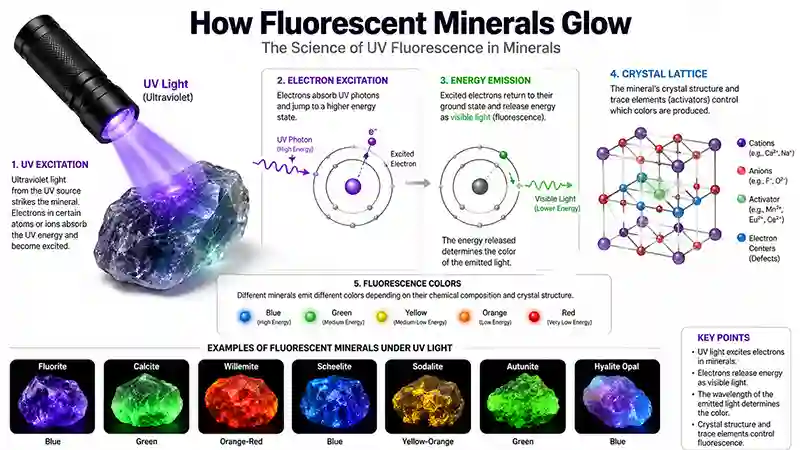
The process occurs in three simple steps:
- Ultraviolet light strikes the mineral.
- Electrons absorb UV energy and move to higher energy levels.
- Electrons immediately return to lower energy levels, releasing visible light.
The emitted light may appear blue, green, red, orange, yellow, purple, or white depending on the mineral.
Types of Ultraviolet Light
Geologists commonly use three types of UV light.
Long-Wave UV (LWUV)
- Wavelength: 365 nm
- Most common for hobbyists and collectors
- Safer for routine mineral observation
Short-Wave UV (SWUV)
- Wavelength: 254 nm
- Produces stronger fluorescence in many minerals
- Requires additional eye protection
Medium-Wave UV
- Less commonly used
- Mainly used for specialized laboratory work
Common Fluorescent Minerals
Many minerals fluoresce under ultraviolet light.
| Mineral | Common Fluorescent Color |
|---|---|
| Fluorite | Blue, Purple |
| Calcite | Red, Orange, Pink |
| Willemite | Bright Green |
| Scheelite | Blue-White |
| Sodalite | Orange |
| Autunite | Bright Green |
| Hyalite Opal | Green |
| Scapolite | Yellow |
| Hackmanite | Pink |
| Apatite | Yellow |
Fluorite is one of the most famous fluorescent minerals, although many specimens do not fluoresce.
Minerals That Usually Do Not Fluoresce
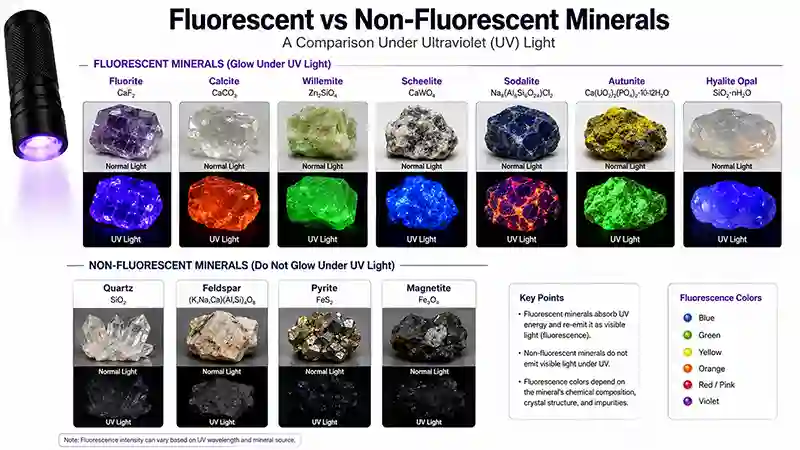
Many common minerals show little or no fluorescence.
Examples include:
- Quartz
- Feldspar
- Muscovite
- Biotite
- Garnet
- Magnetite
- Pyrite
A lack of fluorescence can also help eliminate possible mineral identities.
How to Perform a Fluorescence Test
A fluorescence test is simple but should be performed in a dark room.
Step 1
Darken the room completely.
Step 2
Place the mineral on a clean surface.
Step 3
Illuminate the specimen with a UV lamp.
Step 4
Observe the emitted color.
Step 5
Compare the fluorescence with known mineral properties.
The observed color should always be confirmed using additional identification tests.
Equipment Required
Common equipment includes:
- Long-wave UV lamp
- Short-wave UV lamp
- UV safety glasses
- Dark viewing box
- Mineral identification tray
- Hand lens
Professional laboratories often use both long-wave and short-wave UV sources.
Fluorescence vs Phosphorescence
Although related, they are different phenomena.
| Fluorescence | Phosphorescence |
| Stops immediately | Continues after UV light is removed |
| More common | Less common |
| Instant response | Delayed fading |
Some minerals display both behaviors.
Applications in Geology
Fluorescence is widely used for:
- Mineral identification
- Gemstone identification
- Ore exploration
- Museum displays
- Geological education
- Mineral collecting
Some tungsten ores, such as scheelite, are commonly located using UV lamps.
Fluorescent Minerals in Mining
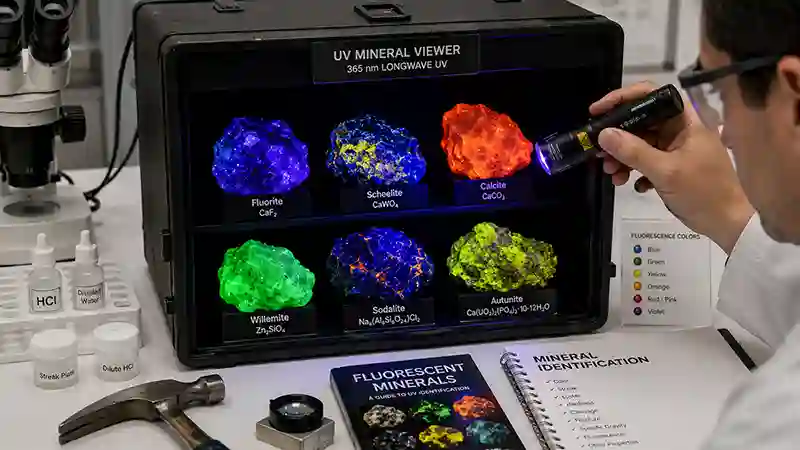
Mining companies use UV light to locate certain ore minerals.
Examples include:
- Scheelite (tungsten)
- Autunite (uranium)
- Fluorite
- Calcite in some deposits
Fluorescence can help identify ore-bearing rocks during exploration.
Advantages of the Fluorescence Test
The fluorescence test is:
- Fast
- Non-destructive
- Highly visual
- Easy to perform
- Useful for many minerals
It provides valuable identification clues that are not visible under ordinary light.
Limitations
Fluorescence should not be used alone because:
- Not all specimens fluoresce.
- Color intensity varies.
- Weathering may reduce fluorescence.
- Artificial treatments can affect fluorescence.
For reliable identification, combine fluorescence with:
- Mineral Density Test
- Specific Gravity Test Explained
- Mineral Hardness Test
- Magnetism in Minerals
- Cleavage Test Explained
- Fracture in Minerals
- Acid Test for Minerals
Comparison Table
| Test | Measures |
| Fluorescence Test | UV Light Response |
| Density Test | Mass per Unit Volume |
| Hardness Test | Scratch Resistance |
| Magnetism Test | Magnetic Properties |
| Acid Test | Carbonate Reaction |
| Streak Test | Powder Color |
Summary Table
| Feature | Fluorescence Test |
| Main Purpose | Identify Fluorescent Minerals |
| Light Source | Ultraviolet Lamp |
| Best Environment | Dark Room |
| Common Colors | Blue, Green, Red, Yellow |
| Identification Value | High |
A fluorescent mineral emits visible light after absorbing ultraviolet radiation.
Fluorescence is caused by activator elements, impurities, or crystal defects that absorb UV energy and emit visible light.
Fluorite is one of the best-known fluorescent minerals, although calcite and willemite are also widely recognized.
No. Only a small percentage of minerals exhibit noticeable fluorescence under ultraviolet light.
Long-wave UV lamps are generally safer than short-wave UV lamps, but UV-protective eyewear should always be worn during testing.
Final Thoughts
Fluorescent minerals reveal one of the most striking optical properties found in nature. Their ability to glow in vivid colors under ultraviolet light provides geologists, collectors, and gemologists with an effective tool for mineral identification and exploration.
Although fluorescence alone cannot identify every mineral, it offers valuable diagnostic information when combined with density, hardness, streak, cleavage, fracture, magnetism, and acid testing. Understanding how and why minerals fluoresce opens a fascinating window into crystal chemistry and mineralogy.
Continue Learning
Expand your mineral identification skills with these related guides: