
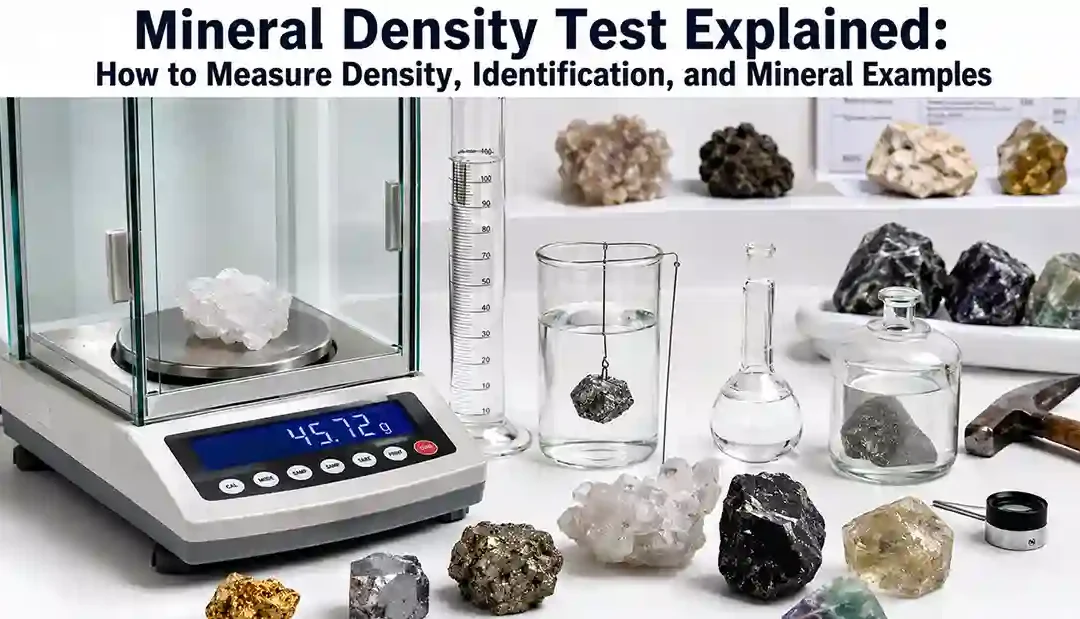
The mineral density test is one of the most reliable methods used to identify minerals because every mineral has a characteristic density determined by its chemical composition and crystal structure. Dense minerals such as gold and galena feel noticeably heavier than common minerals like quartz or calcite, even when they are similar in size.
Geologists use density measurements in laboratories and field investigations to distinguish visually similar minerals, evaluate ore minerals, and understand mineral composition. Density testing is especially valuable when combined with hardness, streak, cleavage, fracture, luster, magnetism, and acid testing to achieve accurate mineral identification.
If you are learning mineral identification, the density test should be studied alongside the Mineral Hardness Test, and How to Identify Minerals.
What Is Mineral Density?
Mineral density is the amount of mass contained within a given volume of a mineral. It describes how tightly atoms are packed inside the crystal structure.
The standard unit of density is:
- grams per cubic centimeter (g/cm³)
- kilograms per cubic meter (kg/m³)
Minerals with tightly packed heavy elements generally have higher densities.
Density vs Specific Gravity
Although the terms are often used interchangeably, they are different.
| Density | Specific Gravity |
|---|---|
| Measured in g/cm³ | No units |
| Absolute value | Relative to water |
| Laboratory measurement | Comparison measurement |
For most minerals at room temperature, the numerical values of density and specific gravity are nearly identical.
Learn more in Specific Gravity Test Explained.
Density Formula
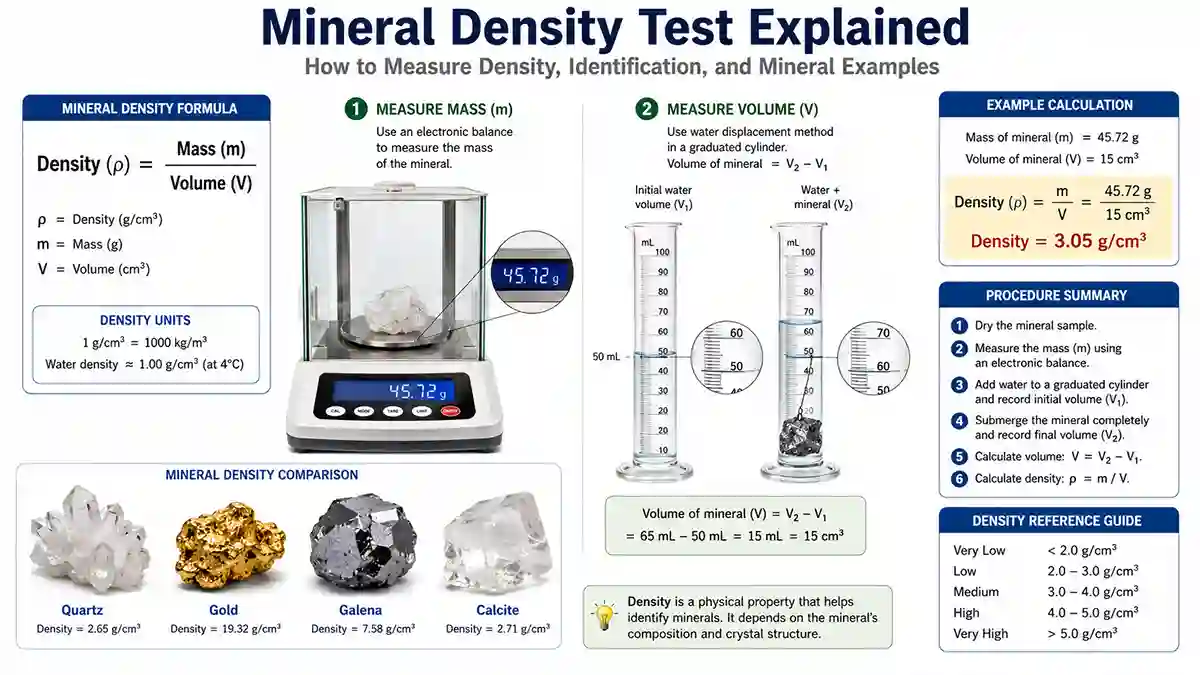
The formula for density is:
Where:
- ρ (rho) = density
- m = mass
- V = volume
You can also rearrange the formula:
- Mass = Density × Volume → m=ρV
- Volume = Mass ÷ Density → V=ρm
Common units:
- kg/m³ (SI unit)
- g/cm³ or g/mL (commonly used in chemistry)
Why Is Density Important?
Density provides valuable information about a mineral's:
- Chemical composition
- Crystal structure
- Economic value
- Identification
Heavy metallic minerals usually contain elements such as:
- Gold
- Lead
- Iron
- Tungsten
These minerals have much higher densities than common silicate minerals.
How to Perform a Mineral Density Test
Step 1 – Measure the Mass
Use an electronic laboratory balance to measure the mineral's mass.
Record the value in grams.
Step 2 – Measure the Volume
For irregular minerals, use the water displacement method.
- Fill a graduated cylinder with water.
- Record the initial volume.
- Place the mineral into the water.
- Record the new water level.
- Calculate the displaced volume.
Step 3 – Calculate Density
Divide the mineral's mass by its volume.
The result is the mineral's density.
Equipment Required
Common laboratory equipment includes:
- Electronic balance
- Graduated cylinder
- Beaker
- Distilled water
- Pycnometer
- Tweezers
- Calculator
Advanced laboratories may use digital density analyzers.
Water Displacement Method
The water displacement method is the most common way to determine the volume of irregular mineral specimens.
Advantages include:
- Accurate
- Simple
- Inexpensive
- Suitable for most minerals
Porous minerals should be dried before testing to improve accuracy.
Density of Common Minerals
| Mineral | Density (g/cm³) |
| Quartz | 2.65 |
| Feldspar | 2.55–2.76 |
| Calcite | 2.71 |
| Fluorite | 3.18 |
| Magnetite | 5.17 |
| Hematite | 5.26 |
| Pyrite | 5.02 |
| Galena | 7.40–7.60 |
| Native Copper | 8.96 |
| Native Silver | 10.49 |
| Native Gold | 19.30 |
Notice how metallic ore minerals are significantly denser than common rock-forming minerals.
Density of Ore Minerals
Ore minerals generally have high densities because they contain heavy metallic elements.
Examples include:
- Gold
- Galena
- Magnetite
- Hematite
- Cassiterite
- Wolframite
These minerals often feel much heavier than similarly sized non-metallic minerals.
Factors Affecting Mineral Density
Several factors influence density:
Chemical Composition
Heavy elements increase density.
Crystal Structure
Tightly packed crystal lattices produce higher density.
Porosity
Fractures and pores reduce measured density.
Impurities
Foreign minerals can slightly alter density values.
Density vs Weight
Weight depends on gravity.
Density depends only on:
- Mass
- Volume
A mineral's density remains constant regardless of where it is measured.
Applications of Density Testing
Geologists use density measurements in:
- Mineral identification
- Ore evaluation
- Mining exploration
- Gemology
- Museum collections
- University laboratories
- Geological research
Density is particularly useful for distinguishing minerals with similar appearance.
Advantages of the Density Test
The mineral density test is:
- Accurate
- Quantitative
- Easy to perform
- Highly reliable
- Useful for ore minerals
When combined with other physical properties, density significantly improves identification accuracy.
Limitations
Density should not be used alone.
Errors may result from:
- Air bubbles
- Porous specimens
- Incorrect volume measurements
- Weathered minerals
- Mixed mineral samples
For best results, combine density with:
- Mineral Hardness Test
- Cleavage Test Explained
- Fracture in Minerals
- Magnetism in Minerals
- Acid Test for Minerals
- Streak Test Explained
- Luster Test Explained
Comparison Table
| Test | Measures |
| Density Test | Mass per Unit Volume |
| Hardness Test | Scratch Resistance |
| Streak Test | Powder Color |
| Cleavage Test | Planes of Weakness |
| Magnetism Test | Magnetic Response |
| Acid Test | Carbonate Reaction |
Summary Table
| Feature | Mineral Density Test |
| Main Purpose | Measure Density |
| Unit | g/cm³ |
| Equipment | Balance & Graduated Cylinder |
| Accuracy | High |
| Best For | Mineral Identification |
Mineral density is the mass of a mineral divided by its volume and is usually expressed in grams per cubic centimeter (g/cm³).
Different minerals have characteristic densities, making density an important property for distinguishing similar-looking minerals.
Among common naturally occurring minerals, native gold has one of the highest densities at approximately 19.3 g/cm³.
Density has units (g/cm³), while specific gravity is a unitless ratio comparing a mineral's density with the density of water.
Density is measured by determining the mineral's mass with a balance and its volume using the water displacement method or a pycnometer.
Final Thoughts
The mineral density test is one of the most dependable quantitative methods used in mineral identification. Because every mineral has a characteristic density based on its chemical composition and crystal structure, measuring density provides valuable information that complements visual observations and other physical tests.
From lightweight quartz to exceptionally dense gold and galena, density variations reveal important clues about mineral composition and economic significance. When combined with hardness, streak, cleavage, fracture, luster, magnetism, and acid testing, the density test becomes an essential tool for geologists, students, collectors, and mining professionals.
Continue Learning
Expand your mineral identification skills with these related guides: