
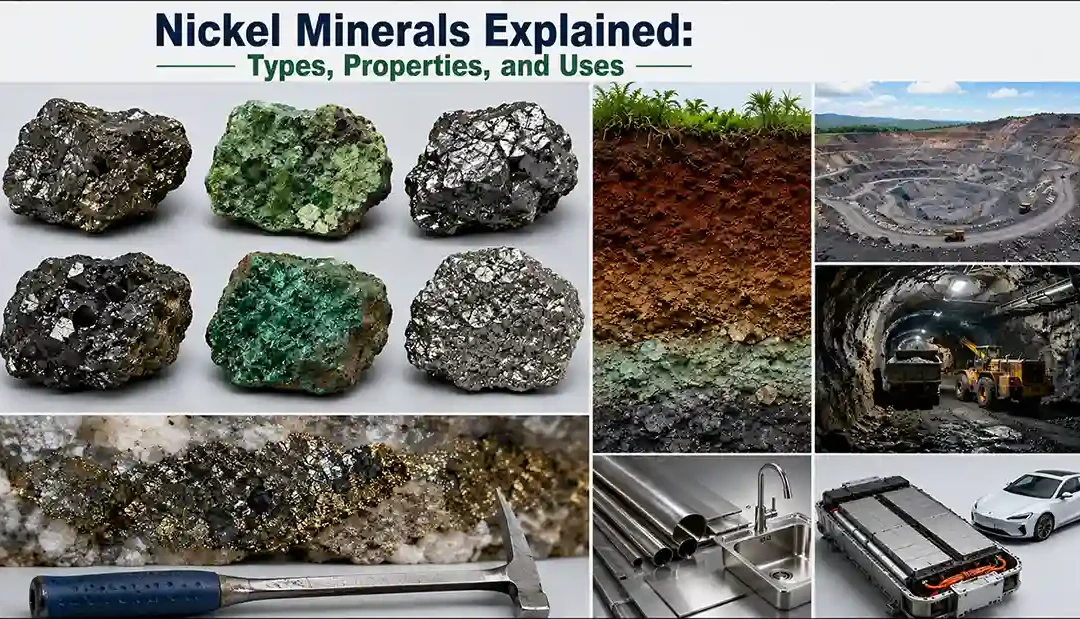
Nickel minerals are among the world's most strategically important mineral resources because they supply nickel, a metal essential for stainless steel production, rechargeable batteries, aerospace alloys, renewable energy technologies, and electric vehicles.
Nickel occurs in both sulfide and laterite deposits. Although more than 80 minerals contain nickel, only a small number are economically important. The principal nickel ore minerals include pentlandite, garnierite, millerite, niccolite, violarite, and awaruite.
What Are Nickel Minerals?
Nickel minerals are naturally occurring minerals that contain economically recoverable nickel.
Nickel is used to manufacture:
- stainless steel
- rechargeable batteries
- superalloys
- electric vehicles
- aerospace components
- coins
- corrosion-resistant alloys
Nickel is classified as a critical mineral for the global energy transition.
Major Nickel Minerals
Pentlandite
The world's most important nickel ore mineral.
Chemical formula:
Nickel content:
Typically 22–35% Ni
Color:
- bronze yellow
- pale brass
Garnierite
Nickel-rich hydrous silicate mixture.
Approximate formula:
Color:
- apple green
- pale green
Occurs mainly in laterite deposits.
Millerite
Nickel sulfide mineral.
Chemical formula:
Color:
- brass yellow
Niccolite (Nickeline)
Nickel arsenide mineral.
Chemical formula:
Color:
- copper red
- bronze
Violarite
Nickel iron sulfide.
Chemical formula:
Color:
- bronze
- gray
Often forms through alteration of pentlandite.
Awaruite
Natural nickel-iron alloy.
Chemical formula:
Color:
- silver white
- metallic
Nickel Mineral Comparison
| Mineral | Formula | Deposit Type | Importance |
|---|---|---|---|
| Pentlandite | (Fe,Ni)₉S₈ | Sulfide | Excellent |
| Garnierite | (Ni,Mg)₃Si₂O₅(OH)₄ | Laterite | High |
| Millerite | NiS | Sulfide | Moderate |
| Niccolite | NiAs | Hydrothermal | Moderate |
| Violarite | FeNi₂S₄ | Secondary Sulfide | Moderate |
| Awaruite | Ni₃Fe | Serpentinized Rocks | Local |
Formation of Nickel Deposits
Nickel deposits form through several geological processes.
Magmatic Sulfide Deposits
The world's richest nickel sulfide ores.
Laterite Deposits
Formed by tropical weathering of ultramafic rocks.
Hydrothermal Veins
Nickel-bearing fluids deposit minerals in fractures.
Serpentinization
Produces awaruite in altered ultramafic rocks.
Laterite and sulfide deposits account for nearly all global nickel production.
Nickel Laterite Deposits
Laterite deposits develop through prolonged weathering of ultramafic rocks.
Characteristics include:
- garnierite-rich zones
- iron-rich limonite
- saprolite horizons
- high nickel enrichment
These deposits supply a significant share of the world's nickel.
Magmatic Sulfide Deposits
Nickel sulfides crystallize from magma together with:
- copper
- cobalt
- platinum-group elements
Pentlandite is the dominant ore mineral in these deposits.
Physical Properties
| Property | Typical Value |
|---|---|
| Hardness | 3–5.5 |
| Luster | Metallic |
| Streak | Gray to Black |
| Specific Gravity | 3–5 |
| Crystal System | Varies |
Major Nickel-Producing Countries
Leading nickel producers include:
- Indonesia
- Philippines
- Russia
- Canada
- Australia
- New Caledonia
- Brazil
Famous Nickel Mines
Major nickel operations include:
- Sudbury Basin
- Norilsk
- Sorowako Mine
- Voisey's Bay
Nickel Mining Methods
Nickel is extracted using:
- open-pit mining
- underground mining
- drilling
- blasting
- crushing
- flotation (sulfide ores)
- high-pressure acid leaching (laterite ores)
The mining method depends on deposit type.
Nickel Processing
After mining, nickel ores are processed by:
- Crushing
- Grinding
- Flotation (sulfides)
- High-pressure acid leaching (laterites)
- Smelting
- Refining
Battery-grade nickel requires additional purification to achieve very high purity.
Nickel Extraction
One simplified reduction reaction for nickel oxide is commercial nickel production, which involves more complex roasting, smelting, hydrometallurgical, or refining processes depending on the ore.
Uses of Nickel
Nickel is widely used in:
- stainless steel
- lithium-ion batteries
- electric vehicles
- aerospace superalloys
- chemical processing equipment
- coins
- plating
- wind turbines
- renewable energy infrastructure
Over two-thirds of global nickel production is used to manufacture stainless steel.
Nickel and Electric Vehicles
Nickel is a key component in many modern lithium-ion battery chemistries, including:
- NMC (Nickel-Manganese-Cobalt)
- NCA (Nickel-Cobalt-Aluminum)
Higher nickel content can increase battery energy density and driving range.
Environmental Considerations
Nickel mining may affect:
- tropical forests
- water quality
- tailings storage
- biodiversity
Responsible mining includes:
- mine rehabilitation
- water recycling
- waste management
- emissions reduction
Nickel Minerals Summary
Nickel has become one of the world's most strategically important metals because of its essential role in stainless steel manufacturing and the rapidly growing electric vehicle industry.
| Feature | Nickel Minerals |
|---|---|
| Main Minerals | Pentlandite, Garnierite, Millerite, Niccolite |
| Main Metal | Nickel (Ni) |
| Main Deposit Types | Laterite, Magmatic Sulfide |
| Main Processing | Flotation, HPAL, Smelting |
| Major Uses | Stainless Steel, Batteries, Superalloys |
Pentlandite ((Fe,Ni)₉S₈) is the world's most important nickel ore mineral.
The two main deposit types are laterite deposits formed by tropical weathering and magmatic sulfide deposits formed from cooling magma.
Nickel is primarily used in stainless steel, lithium-ion batteries, electric vehicles, superalloys, and corrosion-resistant alloys.
Indonesia is currently the world's largest nickel producer, followed by the Philippines, Russia, Canada, and Australia.
Nickel is essential for battery technology, renewable energy, and electric vehicles, making it a key material for the global clean energy transition.
Final Thoughts
Nickel minerals are among the most important resources supporting modern industry and the transition to cleaner energy. From pentlandite in magmatic sulfide deposits to garnierite in tropical laterite profiles, nickel ores occur in diverse geological settings that reflect complex Earth processes.
As demand for stainless steel, electric vehicles, and advanced battery technologies continues to grow, nickel will remain a cornerstone of economic geology and one of the world's most strategically important critical minerals.
Continue learning with → /cobalt-minerals-explained/, /lithium-minerals-explained/, /critical-minerals-for-technology/, /economic-geology-explained/, and /mineral-processing-basics/.