
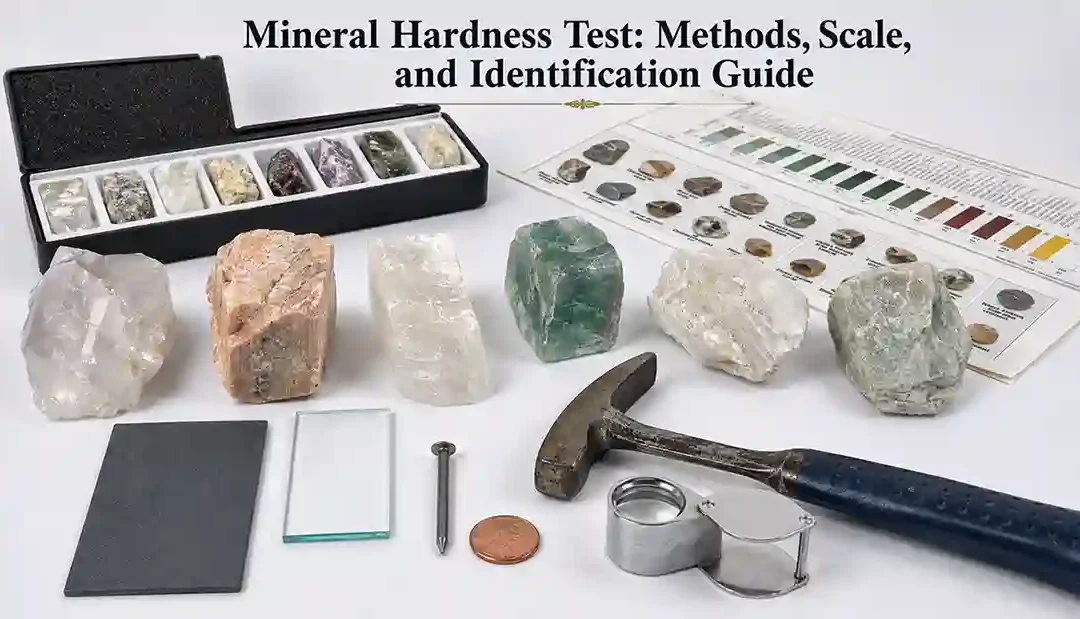
One of the most important methods used in mineral identification is the mineral hardness test. Hardness helps geologists determine a mineral's resistance to scratching and is often one of the first tests performed when identifying unknown specimens.
The hardness test is simple, inexpensive, and highly effective. By comparing a mineral against objects or minerals of known hardness, geologists can quickly narrow down possible identifications.
Hardness remains one of the most reliable physical properties used in mineralogy.
What Is Mineral Hardness?
Mineral hardness is a mineral's resistance to scratching.
It measures how difficult it is to scratch a mineral's surface using another material.
Hardness is not the same as:
- strength
- toughness
- durability
For example:
- Diamond is extremely hard.
- Diamond can still break if struck with enough force.
Hardness specifically refers to scratch resistance.
Why Hardness Is Important
Hardness helps geologists:
Identify Minerals
One of the most useful diagnostic properties.
Compare Minerals
Provides consistent measurements.
Understand Mineral Structure
Hardness relates to atomic bonding strength.
Evaluate Industrial Uses
Harder minerals often have specialized applications.
The Mohs Hardness Scale
In 1812, German mineralogist Friedrich Mohs developed the Mohs Hardness Scale.
The scale ranks minerals from:
Where:
- 1 = Softest mineral
- 10 = Hardest mineral
Complete Mohs Hardness Scale
| Hardness | Mineral |
|---|---|
| 1 | Talc |
| 2 | Gypsum |
| 3 | Calcite |
| 4 | Fluorite |
| 5 | Apatite |
| 6 | Feldspar |
| 7 | Quartz |
| 8 | Topaz |
| 9 | Corundum |
| 10 | Diamond |
Understanding the Scale
The Mohs scale is relative rather than linear.
For example:
- Quartz (7) is much harder than Feldspar (6).
- Diamond (10) is dramatically harder than Corundum (9).
The difference between values increases significantly toward the top of the scale.
How a Hardness Test Works
A harder material scratches a softer material.
If Mineral A scratches Mineral B:
- Mineral A is harder than Mineral B.
If Mineral B scratches Mineral A:
- Mineral B is harder than Mineral A.
This simple principle forms the basis of all hardness testing.
Common Hardness Testing Tools
Geologists often use everyday objects.
| Object | Approximate Hardness |
|---|---|
| Fingernail | 2.5 |
| Copper Coin | 3 |
| Knife Blade | 5–5.5 |
| Glass Plate | 5.5 |
| Steel Nail | 5.5–6 |
| Quartz | 7 |
These tools help estimate mineral hardness in the field.
Performing a Mineral Hardness Test
Step 1
Choose a fresh, clean mineral surface.
Step 2
Attempt to scratch the mineral using a known object.
Step 3
Observe whether a visible scratch is produced.
Step 4
Repeat using harder or softer materials.
Step 5
Determine the hardness range.
Hardness Test Reference Table
| Material | Hardness |
|---|---|
| Talc | 1 |
| Fingernail | 2.5 |
| Gypsum | 2 |
| Copper Coin | 3 |
| Calcite | 3 |
| Fluorite | 4 |
| Steel Nail | 5.5 |
| Feldspar | 6 |
| Quartz | 7 |
| Topaz | 8 |
| Corundum | 9 |
| Diamond | 10 |
Hardness and Mineral Identification
Hardness is especially useful because:
- it is easy to measure
- it is consistent
- it rarely changes
Hardness vs Toughness
Hardness and toughness are different properties.
Hardness
Resistance to scratching.
Toughness
Resistance to breaking.
Example:
- Diamond is extremely hard.
- Jade is tougher than diamond.
A mineral may be hard but still fragile.
Factors Affecting Hardness Tests
Weathering
Altered surfaces may give inaccurate results.
Impurities
Can slightly affect hardness.
Crystal Orientation
Some minerals show directional hardness differences.
Surface Quality
Fresh surfaces provide the best results.
Minerals Commonly Identified by Hardness
| Mineral | Hardness |
|---|---|
| Talc | 1 |
| Gypsum | 2 |
| Calcite | 3 |
| Fluorite | 4 |
| Apatite | 5 |
| Feldspar | 6 |
| Quartz | 7 |
| Topaz | 8 |
| Corundum | 9 |
| Diamond | 10 |
Hardness Testing Equipment
Professional hardness kits typically include:
- Mohs reference minerals
- streak plates
- magnifiers
- scratch tools
- identification guides
These kits are commonly used by geology students and mineral collectors.
Advantages of the Hardness Test
Fast
Results obtained quickly.
Simple
No complex equipment required.
Reliable
Consistent identification property.
Portable
Can be performed in the field.
Limitations of Hardness Testing
Surface Damage
Scratches may damage specimens.
Similar Hardness Values
Some minerals have overlapping ranges.
Requires Experience
Proper interpretation improves accuracy.
Therefore, hardness should be combined with:
- luster
- streak
- cleavage
- crystal habit
for accurate mineral identification.
Hardness and Common Field Objects
| Field Object | Hardness |
|---|---|
| Fingernail | 2.5 |
| Copper Coin | 3 |
| Pocket Knife | 5–5.5 |
| Glass | 5.5 |
| Steel File | 6.5 |
| Quartz | 7 |
A mineral hardness test measures a mineral's resistance to scratching using materials of known hardness.
The Mohs Scale ranks minerals from 1 (talc) to 10 (diamond) based on scratch resistance.
Quartz has a hardness of 7 and can scratch glass.
A fingernail has a hardness of about 2.5 and can scratch minerals softer than that.
No. Hardness should be used together with luster, streak, cleavage, and crystal form.
Final Thoughts
The mineral hardness test is one of the most important and widely used tools in mineral identification. By measuring scratch resistance using the Mohs Hardness Scale, geologists can quickly distinguish between minerals and better understand their properties.
Whether identifying quartz, calcite, gypsum, or diamond, hardness testing provides a simple, reliable, and effective method for studying Earth's minerals. Combined with other identification techniques, it forms a cornerstone of mineralogy and geology.
Continue learning with → /how-to-identify-minerals/, /mohs-hardness-scale/, and /mineral-classification-system/.