
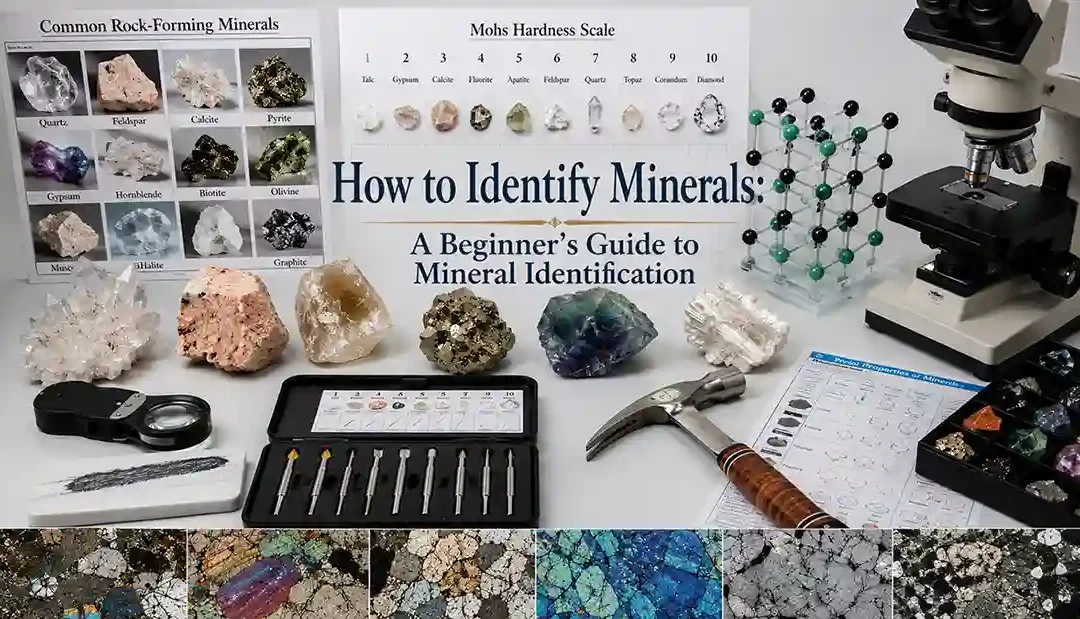
Minerals are the building blocks of rocks and one of the most important subjects in geology. While thousands of minerals exist, geologists identify them using a set of physical and chemical properties rather than appearance alone.
Learning how to identify minerals is an essential skill for:
- geology students
- rock collectors
- prospectors
- mineral enthusiasts
- earth science teachers
With a few simple tests, many common minerals can be identified accurately.
What Is Mineral Identification?
Mineral identification is the process of determining the identity of a mineral by examining its physical and chemical properties.
Geologists compare observed characteristics with known mineral properties until a match is found. No single property is usually enough for identification.
Instead, multiple properties are evaluated together.
Why Color Alone Is Not Reliable
Many beginners identify minerals based on color.
This often leads to mistakes because:
- impurities change color
- weathering alters appearance
- different minerals can have similar colors
For example:
Quartz
May be:
- clear
- white
- pink
- purple
- smoky brown
Therefore, geologists rely on several properties rather than color alone.
Most Important Mineral Identification Properties
| Property | Reliability |
|---|---|
| Hardness | High |
| Streak | High |
| Cleavage | High |
| Crystal Form | High |
| Luster | Moderate |
| Color | Low to Moderate |
| Density | High |
Step 1: Observe Color
Color is usually the first characteristic noticed.
Examples:
| Mineral | Common Color |
|---|---|
| Quartz | Clear to White |
| Pyrite | Brass Yellow |
| Malachite | Green |
| Sulfur | Yellow |
| Graphite | Gray to Black |
Although useful, color should never be used alone.
Step 2: Examine Luster
Luster describes how light reflects from a mineral surface.
Common types include:
Metallic
Looks like polished metal.
Examples:
- pyrite
- galena
- magnetite
Non-Metallic
Does not resemble metal.
Examples:
- quartz
- calcite
- gypsum
Types of Luster
| Luster Type | Example |
|---|---|
| Metallic | Pyrite |
| Vitreous | Quartz |
| Pearly | Muscovite |
| Silky | Gypsum |
| Resinous | Sphalerite |
| Earthy | Kaolinite |
Step 3: Test Hardness
Mohs Hardness Scale Hardness measures resistance to scratching.
The Mohs Scale ranges from:
Mohs Hardness Scale
| Mineral | Hardness |
|---|---|
| Talc | 1 |
| Gypsum | 2 |
| Calcite | 3 |
| Fluorite | 4 |
| Apatite | 5 |
| Feldspar | 6 |
| Quartz | 7 |
| Topaz | 8 |
| Corundum | 9 |
| Diamond | 10 |
Common Hardness Tests
| Object | Hardness |
|---|---|
| Fingernail | ~2.5 |
| Copper Coin | ~3 |
| Steel Nail | ~5.5 |
| Glass Plate | ~5.5 |
| Quartz | 7 |
Example:
- Gypsum can be scratched by a fingernail.
- Quartz cannot scratch a diamond but easily scratches glass.
Step 4: Check Streak
Streak is the color of a mineral's powdered form. It is tested by rubbing a mineral against an unglazed porcelain streak plate.
Examples:
| Mineral | Streak |
|---|---|
| Hematite | Reddish Brown |
| Pyrite | Greenish Black |
| Magnetite | Black |
| Calcite | White |
Streak is often more reliable than color.
Step 5: Examine Cleavage and Fracture
Cleavage
The tendency to break along flat planes.
Examples:
- mica (perfect cleavage)
- calcite (rhombohedral cleavage)
- feldspar (two cleavages)
Fracture
Irregular breakage.
Examples:
- quartz (conchoidal fracture)
- obsidian
Cleavage vs Fracture
| Property | Description |
|---|---|
| Cleavage | Flat Breaks |
| Fracture | Irregular Breaks |
Step 6: Observe Crystal Shape
Crystal habit describes the typical external shape.
Examples:
Cubic
- halite
- pyrite
Hexagonal
- quartz
Tabular
- feldspar
Prismatic
- tourmaline
Crystal shape can provide valuable identification clues.
Step 7: Determine Density
Density or specific gravity measures how heavy a mineral feels compared to its size.
Examples:
| Mineral | Specific Gravity |
|---|---|
| Quartz | 2.65 |
| Calcite | 2.71 |
| Galena | 7.5 |
| Gold | 19.3 |
Heavy minerals often stand out immediately.
Step 8: Special Mineral Tests
Some minerals require additional tests.
Magnetism
Strong in magnetite.
Acid Reaction
Calcite reacts with dilute hydrochloric acid.
Fluorescence
Fluorite may glow under UV light.
Taste
Halite tastes salty (not generally recommended in fieldwork).
Common Minerals and Their Key Features
| Mineral | Key Identification Feature |
|---|---|
| Quartz | Hardness 7, No Cleavage |
| Feldspar | Hardness 6, Two Cleavages |
| Calcite | Acid Reaction |
| Pyrite | Metallic Gold Color |
| Gypsum | Very Soft |
| Halite | Cubic Cleavage |
| Magnetite | Strong Magnetism |
| Fluorite | Four Cleavage Directions |
Mineral Identification Workflow
A typical identification sequence:
- Observe color
- Examine luster
- Test hardness
- Check streak
- Observe cleavage
- Examine crystal form
- Determine density
- Use special tests if needed
Combining these observations usually leads to accurate identification.
Tools Used for Mineral Identification
Common tools include:
- hand lens
- streak plate
- hardness kit
- geological hammer
- magnet
- dilute acid bottle
- UV lamp
- field notebook
Professional geologists often carry these tools during fieldwork.
Common Identification Mistakes
Using Color Alone
Most common mistake.
Ignoring Cleavage
Important diagnostic property.
Incorrect Hardness Testing
Can lead to misidentification.
Weathered Samples
May not display original mineral characteristics.
Always use multiple tests.
Quick Mineral Identification Guide
| Mineral | Hardness | Cleavage | Streak |
|---|---|---|---|
| Quartz | 7 | None | White |
| Calcite | 3 | Perfect | White |
| Gypsum | 2 | Good | White |
| Pyrite | 6–6.5 | Poor | Dark |
| Fluorite | 4 | Perfect | White |
Hardness, cleavage, streak, and crystal form are generally more reliable than color.
Many minerals occur in multiple colors due to impurities and weathering.
A scale from 1 to 10 used to measure a mineral's resistance to scratching.
Streak is the color of a mineral's powdered form when rubbed on a streak plate.
Magnetite is often easy to identify because of its strong magnetic properties.
Final Thoughts
Mineral identification is a fundamental skill in geology that combines observation, testing, and comparison. By examining properties such as hardness, luster, streak, cleavage, crystal shape, and density, geologists can accurately distinguish one mineral from another.
With practice and the right tools, identifying minerals becomes easier and provides valuable insight into Earth's materials, geological processes, and natural resources.
Continue learning with → /what-is-a-mineral/, /mohs-hardness-scale/, and /mineral-classification-system/.