
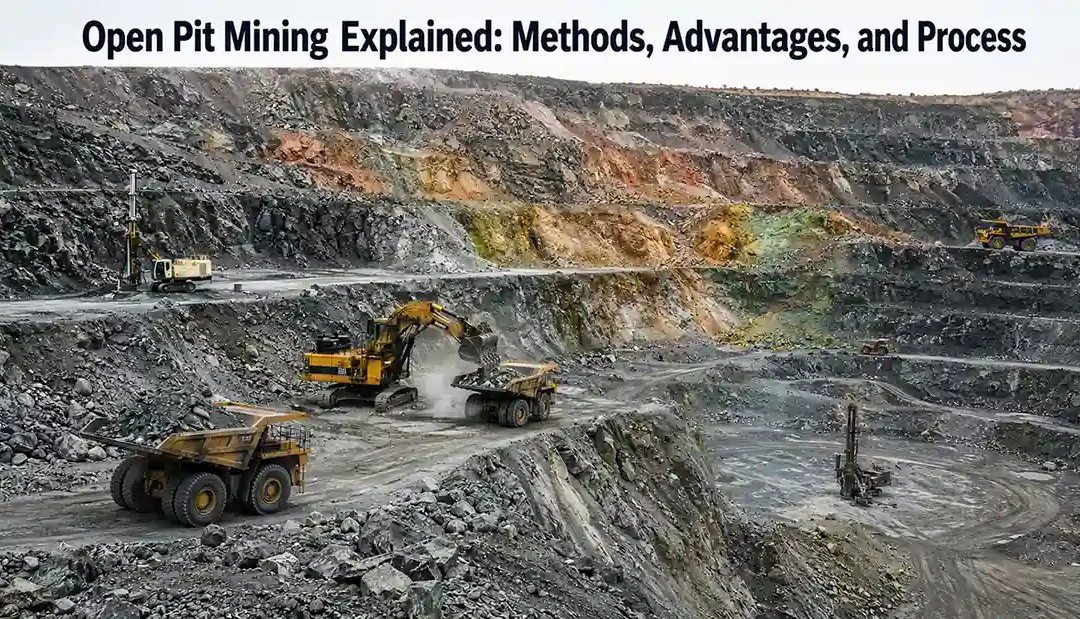
Open pit mining is the most widely used mining method in the world for extracting near-surface mineral deposits. It involves removing rock and ore from a large open excavation that expands downward and outward as mining progresses.
Many of the world's largest mines use open pit mining to extract:
- copper
- gold
- iron ore
- diamonds
- uranium
- phosphate
Because of its high production rates and relatively low operating costs, open pit mining remains one of the most important methods of mineral extraction.
What Is Open-Pit Mining?
Open pit mining is a surface mining method used to extract minerals and ore bodies located close to Earth's surface.
The mine is developed by excavating:
- rock
- soil
- overburden
- ore
in a series of stepped levels called benches.
As mining continues, the pit gradually becomes deeper and wider.
Open Pit Mining at a Glance
| Feature | Description |
|---|---|
| Mining Type | Surface Mining |
| Typical Depth | Up to 1,000+ meters |
| Production Rate | Very High |
| Cost per Ton | Relatively Low |
| Main Resources | Copper, Gold, Iron, Coal |
How Open Pit Mining Works
The process generally follows these stages:
1. Exploration
Geologists locate and evaluate the deposit.
2. Mine Design
Engineers design the pit shape and bench geometry.
3. Overburden Removal
Waste material covering the ore is removed.
4. Drilling and Blasting
Rock is fractured using explosives.
5. Loading and Hauling
Excavators load ore into haul trucks.
6. Processing
Ore is transported to processing facilities.
7. Reclamation
The site is restored after mining ends.
Main Components of an Open Pit Mine
Benches
Stepped levels cut into the pit walls.
Haul Roads
Roads used by mining trucks.
Waste Dumps
Areas where waste rock is stored.
Ore Stockpiles
Temporary storage for mined ore.
Processing Plant
Facility where ore is processed.
What Are Mining Benches?
Benches are horizontal working levels created during excavation.
Benefits include:
- improved safety
- slope stability
- easier equipment operation
- controlled mining
Large mines may contain dozens of benches.
Open Pit Mine Geometry
Important design parameters include:
Bench Height
Vertical height of each bench.
Bench Width
Working area available for equipment.
Slope Angle
Angle of pit walls.
Ultimate Pit Limit
Maximum planned pit boundary.
These factors directly affect safety and profitability.
Key Open Pit Design Elements
| Element | Purpose |
|---|---|
| Bench Height | Safe excavation |
| Bench Width | Equipment access |
| Slope Angle | Stability |
| Haul Road | Material transport |
| Pit Limit | Resource optimization |
Equipment Used in Open Pit Mining
Modern open pit mines use large-scale machinery.
Hydraulic Excavators
Load ore and waste rock.
Electric Shovels
Used in large mines.
Haul Trucks
Transport ore and waste.
Drilling Rigs
Create blast holes.
Bulldozers
Maintain roads and benches.
Wheel Loaders
Material handling.
Drilling and Blasting
Most hard-rock open pit mines use:
Drilling
Creates holes in rock.
Blasting
Breaks rock into manageable fragments.
Benefits include:
- improved excavation
- reduced loading costs
- increased productivity
Ore and Waste Rock
Mining operations separate:
Ore
Rock containing valuable minerals.
Waste Rock
Rock with little or no economic value.
Efficient separation improves mine profitability.
Stripping Ratio
The stripping ratio compares lower stripping ratios generally improve mine economics. As pits deepen, stripping ratios often increase.
Advantages of Open Pit Mining
High Production Rates
Large amounts of ore can be mined quickly.
Lower Costs
Cheaper than underground mining.
Better Safety
Fewer underground hazards.
Large Equipment
Allows efficient mining operations.
Easier Access
Direct access to ore bodies.
Disadvantages of Open Pit Mining
Environmental Impact
Large land disturbance.
Visual Effects
Significant landscape changes.
Waste Rock Generation
Large waste volumes.
Limited Depth
Eventually becomes uneconomic at great depths.
Open Pit vs Underground Mining
| Feature | Open Pit | Underground |
|---|---|---|
| Cost | Lower | Higher |
| Production | Higher | Lower |
| Safety | Generally Safer | More Complex |
| Depth | Shallow Deposits | Deep Deposits |
| Equipment Size | Very Large | Smaller |
Major Minerals Mined by Open Pit Methods
Common resources include:
Copper
Porphyry copper deposits.
Gold
Large disseminated deposits.
Iron Ore
Banded iron formations.
Uranium
Near-surface ore bodies.
Phosphate
Sedimentary deposits.
Diamonds
Kimberlite pipes.
Famous Open Pit Mines
Some of the world's most famous open pit mines include:
- Bingham Canyon Mine
- Chuquicamata Mine
- Mirny Mine
- Fimiston Open Pit
These operations demonstrate the enormous scale of modern surface mining.
Environmental Management
Modern mines implement:
Dust Control
Water spraying and suppression systems.
Water Management
Collection and treatment systems.
Waste Rock Management
Controlled storage facilities.
Reclamation
Land restoration after closure.
Responsible mining practices help reduce environmental impacts.
Future of Open Pit Mining
Modern open pit mines increasingly use:
- automation
- autonomous haul trucks
- drones
- artificial intelligence
- real-time monitoring
- advanced mine planning software
These technologies improve safety, productivity, and sustainability.
Applications of Open Pit Mining
| Commodity | Typical Deposit Type |
|---|---|
| Copper | Porphyry |
| Gold | Disseminated |
| Iron Ore | Sedimentary |
| Uranium | Near-Surface |
| Phosphate | Sedimentary |
| Diamonds | Kimberlite |
Open pit mining is a surface mining method used to extract mineral deposits located near Earth's surface through a large open excavation.
It is cost-effective, highly productive, and safer than many underground mining methods.
Benches are stepped working levels cut into the pit walls that improve safety and operational efficiency.
Copper, gold, iron ore, uranium, phosphate, and diamonds are commonly mined using open pit techniques.
The stripping ratio is the amount of waste rock removed compared to the amount of ore extracted.
Final Thoughts
Open pit mining is one of the most important mineral extraction methods used worldwide. By providing efficient access to large ore deposits, it supplies the raw materials needed for infrastructure, technology, transportation, and renewable energy systems.
From giant copper mines to iron ore operations and gold pits, open pit mining remains a cornerstone of modern resource development and economic geology.
Continue learning with → mining-and-mineral-extraction, ore-deposits-explained, and economic-geology-explained.