
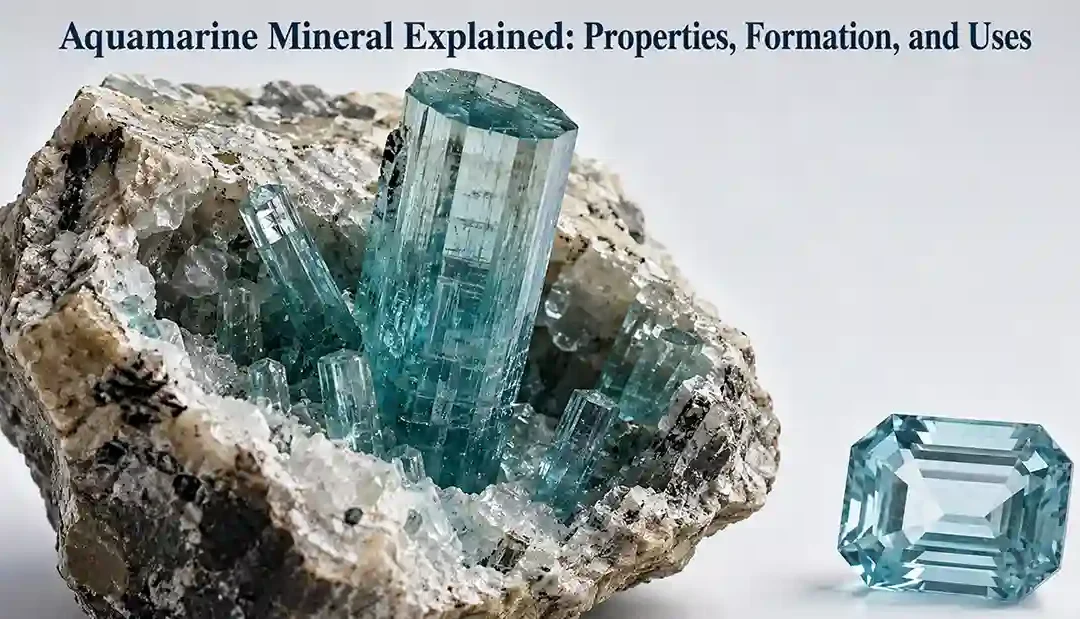
Aquamarine is the blue to blue-green variety of the mineral beryl and one of the world's most popular gemstones. Its name comes from the Latin words aqua marina, meaning "seawater," reflecting its beautiful ocean-like color.
Aquamarine is valued for its:
- crystal clarity
- blue color
- durability
- large crystal size
Unlike emerald, which often contains many inclusions, aquamarine crystals are commonly transparent and highly gem-quality, making them especially desirable for jewelry.
Learn more → emerald mineral explained
What Is Aquamarine?
Aquamarine is the blue variety of beryl. Its chemical formula is:
Aquamarine contains:
- beryllium
- aluminum
- silicon
- oxygen
Its blue color is produced primarily by Iron (Fe) within the crystal structure.
Basic Properties of Aquamarine
| Property | Value |
|---|---|
| Chemical Formula | Be₃Al₂Si₆O₁₈ |
| Mineral Group | Cyclosilicate |
| Crystal System | Hexagonal |
| Hardness | 7.5–8 |
| Streak | White |
| Luster | Vitreous |
Why Is Aquamarine Blue?
Pure beryl is colorless.
Small amounts of iron incorporated into the crystal structure create colors ranging from:
- pale blue
- sky blue
- blue-green
- deep ocean blue
The most desirable gemstones often display a rich pure blue color.
Crystal Structure of Aquamarine
Aquamarine belongs to the beryl family.
Its structure consists of:
- rings of silicate tetrahedra
- aluminum atoms
- beryllium atoms
This arrangement creates:
- hexagonal crystal shapes
- exceptional transparency
- gemstone-quality clarity
Learn more → crystal structure in minerals
Crystal System of Aquamarine
Aquamarine belongs to the hexagonal crystal system. Its crystallographic relationship is:
Common crystal habits include:
- hexagonal prisms
- elongated crystals
- columnar crystals
Large well-formed crystals are common.
Learn more → hexagonal crystal system
Physical Properties of Aquamarine
| Property | Description |
|---|---|
| Color | Blue to blue-green |
| Streak | White |
| Luster | Vitreous |
| Hardness | 7.5–8 |
| Cleavage | Poor |
| Transparency | Transparent |
| Specific Gravity | 2.7–2.9 |
Aquamarine and the Mohs Hardness Scale
Aquamarine ranks hardness 7.5–8 on the Mohs Hardness Scale.
This hardness makes aquamarine suitable for:
- rings
- necklaces
- bracelets
- everyday jewelry
Learn more → mohs hardness scale
How Aquamarine Forms
Granite Pegmatites
The most common formation environment.
Hydrothermal Veins
Mineral-rich fluids deposit crystals.
Metamorphic Rocks
Some deposits occur in metamorphic settings.
Late-Stage Magmatic Processes
Forms from mineral-rich residual fluids.
Aquamarine in Pegmatites
Aquamarine commonly occurs with:
- quartz
- feldspar
- mica
- tourmaline
- topaz
Pegmatites provide the space and fluids necessary for large crystal growth.
Learn more → topaz mineral explained
Some of the Largest Gem Crystals on Earth
Aquamarine is famous for producing:
- giant crystals
- museum-quality specimens
- exceptionally clear gemstones
Some crystals have reached several meters in length and weighed hundreds of kilograms.
Aquamarine vs Emerald
Both gemstones belong to the beryl family.
| Property | Aquamarine | Emerald |
|---|---|---|
| Formula | Be₃Al₂Si₆O₁₈ | Be₃Al₂Si₆O₁₈ |
| Color | Blue | Green |
| Color Source | Iron | Chromium/Vanadium |
| Clarity | Usually High | Often Included |
Learn more → emerald mineral explained
Major Aquamarine-Producing Countries
Important aquamarine sources include:
- Brazil
- Pakistan
- Afghanistan
- Nigeria
- Madagascar
- Mozambique
Brazil is particularly famous for producing large gem-quality aquamarine crystals.
Uses of Aquamarine
Jewelry
The primary commercial use.
Gemstone Collections
Highly sought by collectors.
Museum Displays
Large crystals are famous exhibit specimens.
Scientific Research
Used to study pegmatite formation and crystal growth.
Major Uses of Aquamarine
| Industry | Application |
|---|---|
| Jewelry | Gemstones |
| Museums | Displays |
| Collecting | Mineral specimens |
| Research | Geological studies |
Aquamarine in Mineral Identification
Geologists identify aquamarine using:
- blue color
- hexagonal crystal habit
- hardness of 7.5–8
- vitreous luster
- high transparency
Its crystal clarity and blue coloration make it one of the easiest beryl varieties to recognize.
Learn more → mineral identification guide
Aquamarine Identification Summary
| Property | Aquamarine |
|---|---|
| Formula | Be₃Al₂Si₆O₁₈ |
| Hardness | 7.5–8 |
| Crystal System | Hexagonal |
| Color | Blue |
| Luster | Vitreous |
| Mineral Group | Cyclosilicate |
Aquamarine is the blue variety of beryl with the formula Be₃Al₂Si₆O₁₈.
Its blue color is caused primarily by trace amounts of iron within the crystal structure.
Aquamarine belongs to the hexagonal crystal system.
Yes. Both aquamarine and emerald are varieties of the mineral beryl.
Aquamarine commonly forms in granite pegmatites, hydrothermal veins, and some metamorphic rocks.
Final Thoughts
Aquamarine is one of the most beautiful members of the beryl family and is admired for its ocean-blue color, remarkable transparency, and large crystal size. Its formation in pegmatites and hydrothermal environments provides important insights into late-stage magmatic processes and gemstone formation.
From giant museum specimens to elegant gemstones used in jewelry worldwide, aquamarine remains one of the most important and visually striking minerals in both geology and gemology.