
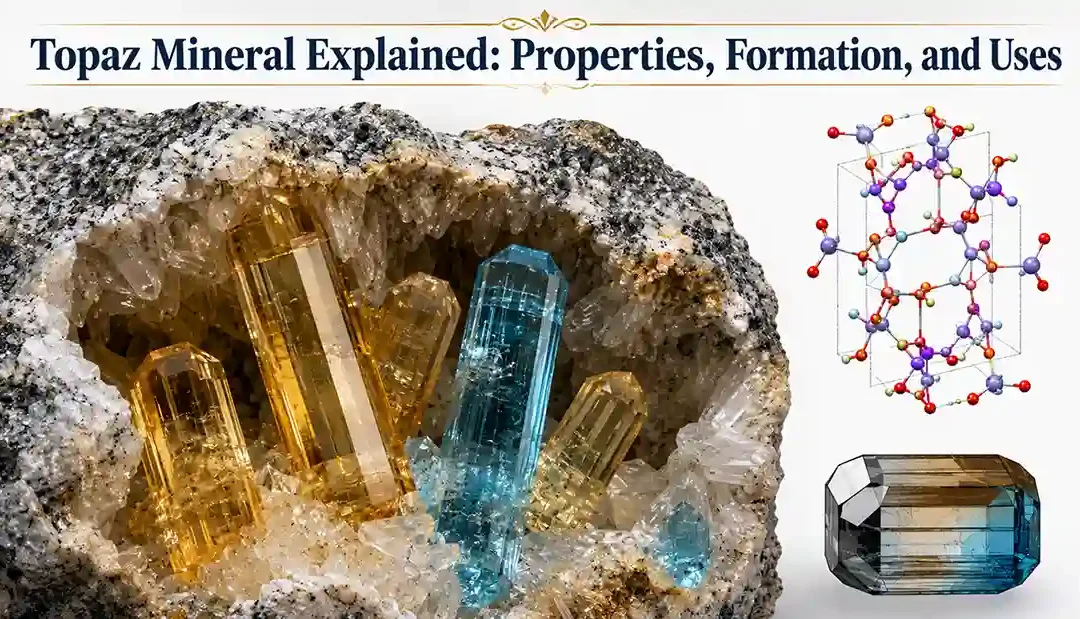
Topaz is one of the world's most popular gemstones and is valued for its clarity, durability, and wide range of colors. It occurs naturally in igneous rocks, especially pegmatites and rhyolites, where large, well-formed crystals can develop.
Topaz is famous for its:
- exceptional transparency
- gemstone quality
- variety of colors
- high hardness
Because of its beauty and durability, topaz has been used in jewelry for centuries and remains one of the most important gemstone minerals today.
Learn more → what is a mineral
What Is Topaz?
Topaz is an aluminum fluorine silicate mineral. Its chemical formula is:
Topaz contains:
- aluminum
- silicon
- oxygen
- fluorine
- hydroxyl groups
It belongs to the nesosilicate mineral group.
Basic Properties of Topaz
| Property | Value |
|---|---|
| Chemical Formula | Al₂SiO₄(F,OH)₂ |
| Mineral Group | Nesosilicate |
| Crystal System | Orthorhombic |
| Hardness | 8 |
| Streak | White |
| Luster | Vitreous |
Why Is Topaz So Popular?
Exceptional Gemstone Quality
Topaz combines several desirable properties:
- high hardness
- excellent transparency
- attractive colors
- large crystal size
Many topaz crystals are naturally transparent and can be cut into large gemstones.
Crystal Structure of Topaz
Topaz contains:
- isolated silica tetrahedra
- aluminum octahedra
- fluorine and hydroxyl ions
Its tightly bonded crystal structure contributes to:
- high hardness
- crystal clarity
- chemical stability
Learn more → crystal structure in minerals
Crystal System of Topaz
Topaz belongs to the orthorhombic crystal system. Its crystallographic relationship is:
Common crystal habits include:
- elongated prisms
- columnar crystals
- striated crystal faces
Learn more → orthorhombic crystal system
Physical Properties of Topaz
| Property | Description |
|---|---|
| Color | Colorless, blue, yellow, orange, pink |
| Streak | White |
| Luster | Vitreous |
| Hardness | 8 |
| Cleavage | Perfect |
| Transparency | Transparent to translucent |
| Specific Gravity | 3.4–3.6 |
Topaz on the Mohs Hardness Scale
Topaz ranks hardness 8 on the Mohs Hardness Scale.
This means topaz is harder than:
- quartz
- feldspar
- garnet
but softer than:
- corundum
- diamond
Learn more → mohs hardness scale
Colors of Topaz
Topaz occurs in many colors.
Blue Topaz
The most common gemstone variety.
Imperial Topaz
Golden-orange to reddish-orange color.
Pink Topaz
Rare and highly valued.
Colorless Topaz
Naturally transparent variety.
Major Topaz Varieties
| Variety | Color |
|---|---|
| Blue Topaz | Blue |
| Imperial Topaz | Orange-Gold |
| Pink Topaz | Pink |
| White Topaz | Colorless |
How Topaz Forms
Pegmatitic Crystallization
Forms in granite pegmatites.
Hydrothermal Activity
Mineral-rich fluids create crystals.
Volcanic Environments
Occurs in cavities within rhyolite.
Pneumatolytic Processes
Forms from fluorine-rich gases during magma cooling.
Topaz in Pegmatites
Topaz is commonly associated with:
- quartz
- feldspar
- mica
- beryl
- tourmaline
Large crystals may reach several meters in length under favorable conditions.
Famous Topaz-Producing Countries
Major topaz sources include:
- Brazil
- Pakistan
- Russia
- Nigeria
- Sri Lanka
- Afghanistan
Brazil is particularly famous for producing Imperial Topaz.
Imperial Topaz
The Most Valuable Variety
Imperial Topaz is prized for:
- golden orange color
- reddish-orange tones
- rarity
- gemstone quality
It is generally considered the most valuable variety of topaz.
Topaz vs Quartz
| Property | Topaz | Quartz |
|---|---|---|
| Hardness | 8 | 7 |
| Cleavage | Perfect | None |
| Crystal System | Orthorhombic | Hexagonal |
| Specific Gravity | Higher | Lower |
Topaz is commonly distinguished from quartz by its higher hardness and perfect cleavage.
Learn more → quartz mineral explained
Industrial and Gemstone Uses
Jewelry
The most important use.
Mineral Collections
Popular collector specimens.
Museum Displays
Large crystals attract significant interest.
Scientific Research
Used in geological studies.
Major Uses of Topaz
| Industry | Application |
|---|---|
| Jewelry | Gemstones |
| Collecting | Mineral specimens |
| Museums | Displays |
| Research | Geological studies |
Topaz in Mineral Identification
Geologists identify topaz using:
- hardness of 8
- perfect cleavage
- vitreous luster
- orthorhombic crystals
- transparent appearance
Its combination of hardness and cleavage is highly diagnostic.
Learn more → mineral identification guide
Topaz Identification Summary
| Property | Topaz |
|---|---|
| Formula | Al₂SiO₄(F,OH)₂ |
| Hardness | 8 |
| Crystal System | Orthorhombic |
| Cleavage | Perfect |
| Color | Various |
| Mineral Group | Nesosilicate |
Topaz is an aluminum fluorine silicate mineral with the formula Al₂SiO₄(F,OH)₂.
Topaz has a hardness of 8 on the Mohs scale.
Topaz belongs to the orthorhombic crystal system.
Imperial Topaz is a rare orange to reddish-orange variety considered the most valuable type of topaz.
Topaz commonly occurs in granite pegmatites, hydrothermal veins, and volcanic cavities.
Final Thoughts
Topaz is one of the world's most important gemstone minerals and is prized for its beauty, durability, and crystal clarity. Its occurrence in pegmatites and volcanic environments provides valuable insights into late-stage magmatic processes and mineral formation.
From Brazil's famous Imperial Topaz deposits to stunning blue gemstones used in jewelry worldwide, topaz remains one of the most admired and scientifically interesting minerals in geology.