
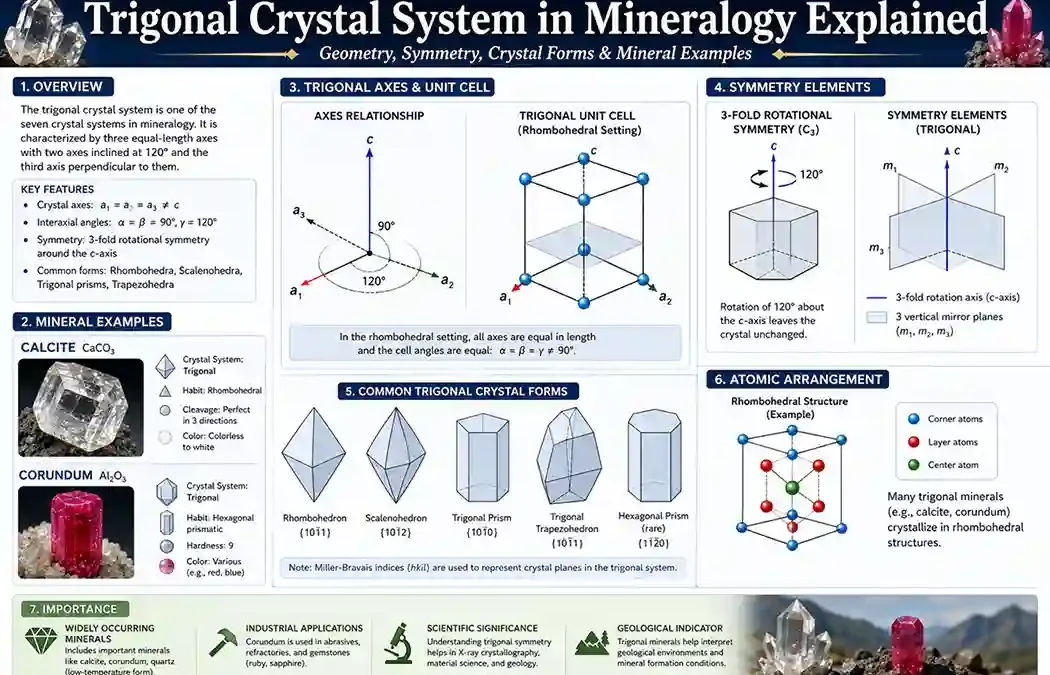
The Trigonal Crystal System is one of the seven crystal systems used in mineralogy and crystallography. It is closely related to the hexagonal crystal system but differs because it has three-fold rotational symmetry instead of six-fold symmetry.
Many important minerals crystallize in the trigonal system, including:
- Calcite
- Corundum
- Hematite
- Quartz (structurally classified in the trigonal crystal class)
- Tourmaline
The trigonal system is especially important because it includes major rock-forming minerals, valuable gemstones, and economically important ore minerals.
Learn more → crystal systems explained
What Is the Trigonal Crystal System?
The trigonal crystal system is a crystal system characterized by three-fold rotational symmetry
Its symmetry can be represented as:
Rotation Symmetry=120∘
Key Characteristics
- Three-fold rotational symmetry
- Often grouped with the hexagonal family
- Commonly forms rhombohedral crystals
- Moderate to high symmetry
- Distinct crystal habits
Trigonal Crystal System Properties
| Property | Value |
|---|---|
| Crystal Family | Hexagonal Family |
| Rotational Symmetry | 3-fold |
| Common Crystal Form | Rhombohedron |
| Symmetry Level | Moderate to High |
| Typical Habit | Rhombohedral and prismatic |
Trigonal vs Hexagonal Crystal System
The trigonal and hexagonal systems are closely related.
Hexagonal System
- Six-fold symmetry
- Quartz often shows hexagonal crystal shapes
Trigonal System
- Three-fold symmetry
- Rhombohedral crystal forms are common
Although they belong to the same crystal family, their symmetry differs significantly.
Learn more → hexagonal crystal system
Common Crystal Forms
Rhombohedron
The most characteristic trigonal crystal form.
Features:
- Six faces
- Angled surfaces
- Similar to a distorted cube
Trigonal Prism
Elongated crystals with three-fold symmetry.
Scalenohedron
Complex crystal form often called a "dog-tooth spar" shape.
Common Trigonal Crystal Forms
| Crystal Form | Appearance |
|---|---|
| Rhombohedron | Angled cube-like shape |
| Prism | Elongated crystal |
| Scalenohedron | Pointed dog-tooth shape |
Calcite: The Classic Trigonal Mineral
Calcite is one of the most important trigonal minerals.
Characteristics
- Rhombohedral cleavage
- Hardness of 3
- Reacts with acid
Importance
- Main mineral in limestone
- Important in sedimentary geology
- Common worldwide
Calcite crystals frequently show excellent trigonal symmetry.
Learn more → chemical properties of minerals
Corundum and the Trigonal System
Corundum is one of the hardest natural minerals.
Characteristics
- Hardness of 9
- Trigonal crystal symmetry
- High durability
Gemstone Varieties
- Ruby
- Sapphire
Corundum is widely used in both jewelry and industrial abrasives.
Hematite Crystals
Hematite is an important iron ore mineral that belongs to the trigonal system.
Characteristics
- Metallic to earthy luster
- Reddish-brown streak
- Major source of iron
Hematite commonly forms:
- tabular crystals
- rhombohedral crystals
- massive aggregates
Common Minerals of the Trigonal System
| Mineral | Typical Crystal Form |
|---|---|
| Calcite | Rhombohedron |
| Corundum | Prism |
| Hematite | Tabular |
| Tourmaline | Prism |
| Quartz* | Prism |
*Quartz belongs to the trigonal crystal class within the hexagonal crystal family.
Crystal Structure and Trigonal Symmetry
The trigonal system is controlled by crystal structure
Atomic arrangement determines:
- crystal symmetry
- crystal faces
- cleavage directions
- crystal habit
The internal structure creates the characteristic three-fold symmetry seen in trigonal minerals.
Learn more → crystal structure in minerals
Symmetry Comparison
| Crystal System | Rotational Symmetry |
|---|---|
| Isometric | Multiple high-order axes |
| Hexagonal | 6-fold |
| Trigonal | 3-fold |
| Tetragonal | 4-fold |
| Orthorhombic | 2-fold |
The trigonal system occupies an important middle position among crystal systems.
Importance of the Trigonal Crystal System
The trigonal system is important in:
- mineral identification
- gemstone studies
- ore geology
- crystallography
- petrology
Many economically valuable minerals belong to this system.
Trigonal Minerals in Geology
Geologists study trigonal minerals to understand:
- sedimentary environments
- metamorphic processes
- ore formation
- gemstone deposits
Minerals such as calcite, hematite, and corundum provide important clues about Earth's geological history.
Learn more → mineral classification system
It is a crystal system characterized by three-fold rotational symmetry.
Calcite, corundum, hematite, and tourmaline are common examples.
The trigonal system has three-fold symmetry, while the hexagonal system has six-fold symmetry.
Yes. Calcite is one of the most famous minerals in the trigonal crystal system.
Ruby and sapphire, both varieties of corundum, belong to the trigonal crystal system.
Final Thoughts
The Trigonal Crystal System is a fascinating crystal system distinguished by its three-fold rotational symmetry and characteristic rhombohedral crystal forms. It includes some of the most important minerals in geology, such as calcite, corundum, and hematite.
Understanding trigonal crystals helps geologists identify minerals, interpret crystal growth patterns, and better understand the geological processes that shape Earth's crust.
Continue learning with → hexagonal crystal system and crystal structure in minerals.