
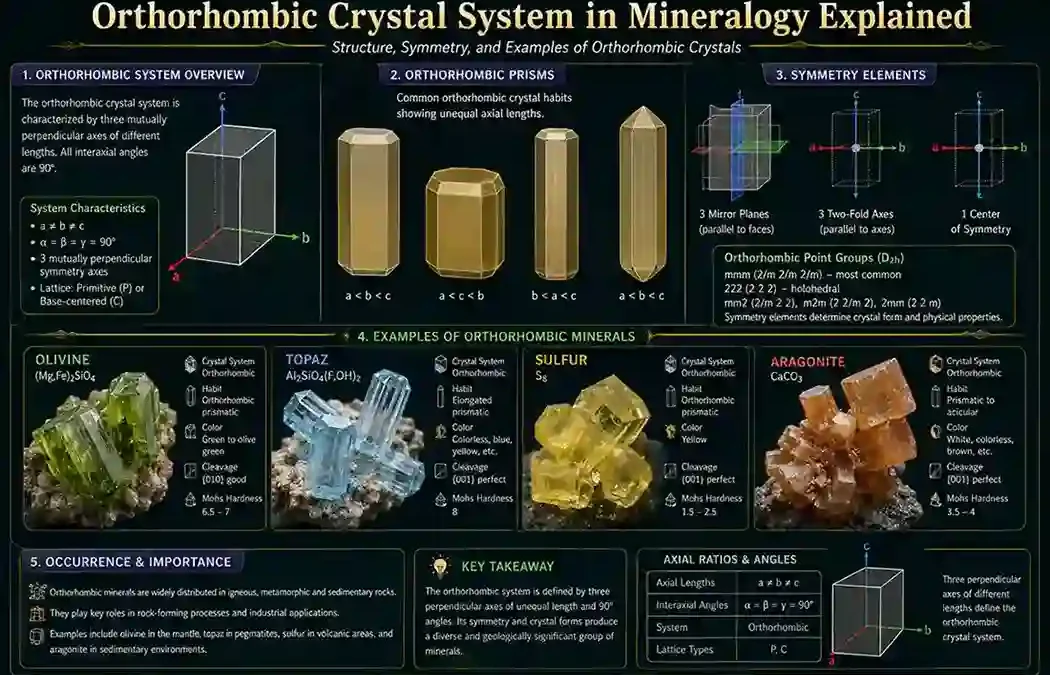
The Orthorhombic Crystal System is one of the seven crystal systems used in mineralogy to classify crystals based on their symmetry and geometry.
Minerals in this system have three crystal axes of unequal lengths, but unlike some lower-symmetry systems, all axes intersect at right angles.
Many important rock-forming and gemstone minerals belong to the orthorhombic system, including:
- Olivine
- Topaz
- Sulfur
- Andalusite
Understanding the orthorhombic crystal system helps geologists identify minerals, interpret crystal growth, and study geological processes.
Learn more → crystal systems explained
What Is the Orthorhombic Crystal System?
The orthorhombic crystal system is a crystal system with three unequal crystal axes intersecting at 90°
The crystallographic relationship is:
a=b=c,α=β=γ=90∘
Key Characteristics
- Three crystal axes
- All axes different lengths
- All angles 90°
- Moderate crystal symmetry
- Common prism-shaped crystals
Orthorhombic Crystal System Properties
| Property | Value |
|---|---|
| Crystal Axes | 3 |
| Axis Lengths | All unequal |
| Axis Angles | 90° |
| Symmetry | Moderate |
| Common Forms | Prisms and dipyramids |
Crystal Shape in the Orthorhombic System
Because all three axes differ in length crystals often appear elongated, blocky, or rectangular.
Common crystal forms include:
- orthorhombic prisms
- dipyramids
- tabular crystals
These crystals usually lack the perfect symmetry seen in cubic minerals.
Common Crystal Forms
Orthorhombic Prism
A crystal with:
- rectangular cross-sections
- elongated growth pattern
Orthorhombic Dipyramid
A crystal form with:
- pointed ends
- symmetrical faces
These forms are frequently seen in topaz and sulfur crystals.
Common Orthorhombic Crystal Forms
| Crystal Form | Appearance |
|---|---|
| Prism | Elongated rectangular crystal |
| Dipyramid | Double pointed crystal |
| Tabular | Flat rectangular crystal |
Olivine: A Major Orthorhombic Mineral
Olivine is one of the most important orthorhombic minerals.
Characteristics
- Olive-green color
- Common in mantle rocks
- Major component of basalt
Olivine plays a key role in understanding:
- Earth's mantle
- volcanic rocks
- plate tectonics
Topaz and the Orthorhombic System
Topaz is a well-known gemstone mineral that crystallizes in the orthorhombic system.
Characteristics
- High hardness (8)
- Excellent crystal form
- Popular gemstone
Topaz crystals commonly occur as elongated prisms.
Sulfur Crystals
Sulfur is another classic orthorhombic mineral.
Characteristics
- Bright yellow color
- Low hardness
- Forms near volcanic regions
Sulfur often develops beautiful orthorhombic crystal shapes.
Common Minerals of the Orthorhombic System
| Mineral | Typical Crystal Form |
|---|---|
| Olivine | Granular crystals |
| Topaz | Prism |
| Sulfur | Dipyramid |
| Andalusite | Prism |
| Barite | Tabular |
Orthorhombic vs Tetragonal Crystal System
| Property | Orthorhombic | Tetragonal |
|---|---|---|
| Equal Axes | None | Two |
| Unequal Axes | Three | One |
| Angles | 90° | 90° |
| Symmetry | Moderate | Higher |
The orthorhombic system has lower symmetry because all three axes differ in length.
Learn more → tetragonal crystal system
Crystal Structure and Orthorhombic Symmetry
The orthorhombic system is controlled by Crystal Structure
Atomic arrangement determines:
- crystal symmetry
- growth direction
- crystal habit
These atomic patterns produce the characteristic orthorhombic geometry seen in minerals.
Learn more → crystal structure in minerals
Symmetry Comparison
SymmetryIsometric>SymmetryTetragonal>SymmetryOrthorhombic>SymmetryMonoclinic
The orthorhombic system occupies an intermediate position among the seven crystal systems.
Importance of the Orthorhombic Crystal System
The orthorhombic system is important in:
- mineral identification
- gemstone studies
- petrology
- volcanology
- crystallography
Many important rock-forming minerals and gemstones belong to this system.
Orthorhombic Minerals in Geology
Geologists use orthorhombic minerals to study:
- mantle composition
- volcanic processes
- metamorphic environments
- ore deposits
Minerals such as olivine provide valuable information about Earth's interior.
Learn more → mineral classification system
It is a crystal system with three unequal crystal axes intersecting at right angles.
Olivine, topaz, sulfur, and andalusite are common examples.
The orthorhombic system has three unequal axes, while the tetragonal system has two equal axes.
Yes. Olivine is one of the most important orthorhombic minerals in geology.
It has moderate symmetry, lower than the tetragonal and isometric systems.
Final Thoughts
The Orthorhombic Crystal System is an important crystal system characterized by three unequal axes that intersect at right angles. It includes many significant minerals such as olivine, topaz, and sulfur, making it essential in mineralogy and geology.
Understanding orthorhombic crystals helps geologists identify minerals, interpret crystal growth patterns, and better understand Earth's geological processes.
Continue learning with → tetragonal crystal system and crystal structure in minerals