
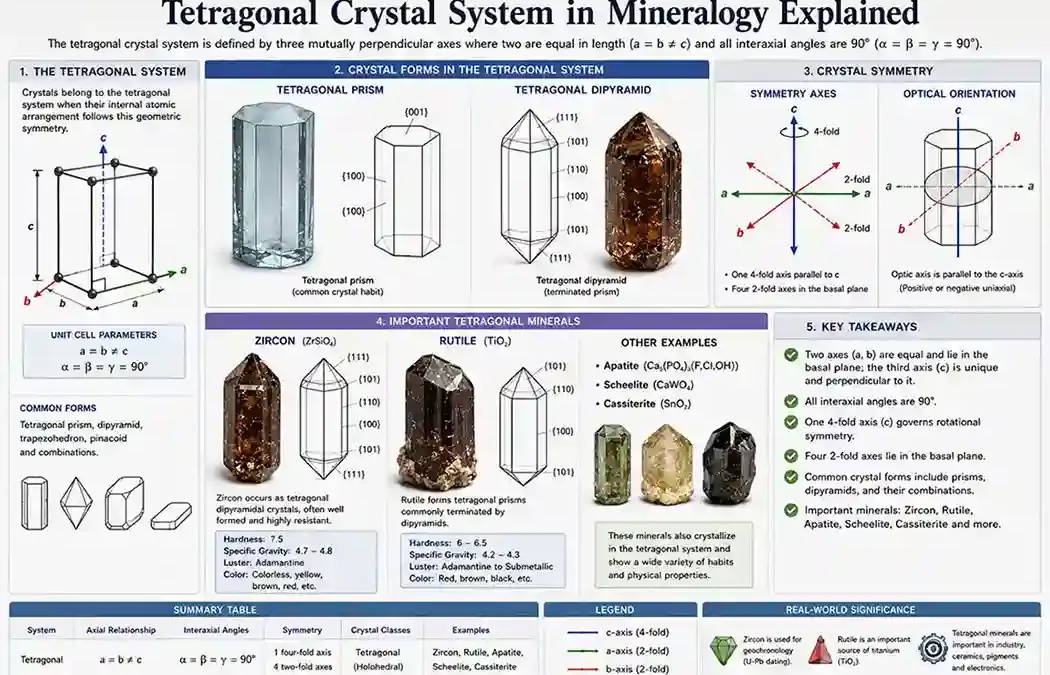
The Tetragonal Crystal System is one of the seven crystal systems used in mineralogy to classify minerals based on crystal symmetry and geometry.
It resembles the cubic (isometric) system but differs because one crystal axis is longer or shorter than the other two. This subtle difference creates elongated crystal forms while maintaining high symmetry.
Several important minerals crystallize in the tetragonal system, including:
- Zircon
- Rutile
- Cassiterite
- Apophyllite
Understanding the tetragonal system helps geologists identify minerals and better understand crystal growth processes.
Learn more → crystal systems explained
What Is the Tetragonal Crystal System?
The tetragonal crystal system is a crystal system with three axes where two are equal and one is different
The crystallographic relationship is:
a=b=c,α=β=γ=90∘
Key Characteristics
- Three crystal axes
- Two equal axes
- One unequal axis
- All angles equal 90°
- High crystal symmetry
Tetragonal Crystal System Properties
| Property | Value |
|---|---|
| Crystal Axes | 3 |
| Equal Axes | 2 |
| Unequal Axes | 1 |
| Axis Angles | 90° |
| Symmetry | High |
Crystal Shape in the Tetragonal System
Because one axis differs in length, crystals often appear stretched or elongated.
Common crystal forms include:
- tetragonal prisms
- bipyramids
- elongated columnar crystals
Many tetragonal minerals have square cross-sections when viewed from above.
Common Crystal Forms
Tetragonal Prism
A long crystal with:
- four rectangular faces
- square cross-section
Tetragonal Bipyramid
A crystal with:
- symmetrical pointed ends
- pyramid-like faces
These forms are common in zircon and rutile crystals.
Common Tetragonal Crystal Forms
| Crystal Form | Appearance |
|---|---|
| Prism | Elongated column |
| Bipyramid | Double pyramid |
| Prism + Bipyramid | Combined crystal shape |
Zircon: The Best-Known Tetragonal Mineral
Zircon is one of the most famous tetragonal minerals.
Characteristics
- Tetragonal crystal symmetry
- High hardness
- Resistant to weathering
Zircon is extremely important in geology because it is used for:
- radiometric dating
- determining rock ages
- studying Earth's history
Rutile and the Tetragonal System
Rutile commonly forms:
- elongated crystals
- needle-like crystals
- tetragonal prisms
Rutile is composed mainly of titanium dioxide (TiO₂). It is an important source of titanium.
Cassiterite: Tin Ore Mineral
Cassiterite is another important tetragonal mineral.
Importance
- Major ore of tin
- Common in hydrothermal deposits
- High specific gravity
Cassiterite crystals often show excellent tetragonal symmetry.
Learn more → specific gravity of minerals
Common Minerals of the Tetragonal System
| Mineral | Typical Crystal Form |
|---|---|
| Zircon | Prism + Bipyramid |
| Rutile | Prism |
| Cassiterite | Prism |
| Apophyllite | Prism |
| Wulfenite | Tabular |
Tetragonal vs Isometric Crystal System
| Property | Tetragonal | Isometric |
|---|---|---|
| Equal Axes | 2 | 3 |
| Unequal Axis | 1 | None |
| Symmetry | High | Highest |
| Common Shape | Elongated Prism | Cube |
The tetragonal system is often viewed as a stretched version of the cubic system.
Learn more → isometric crystal system
Crystal Structure and Tetragonal Symmetry
The tetragonal system is controlled by the crystal structure
Atomic arrangement determines:
- crystal symmetry
- crystal faces
- growth directions
This relationship explains why tetragonal minerals consistently form similar crystal shapes.
Learn more → crystal structure in minerals
Symmetry Comparison
SymmetryIsometric>SymmetryTetragonal>SymmetryOrthorhombic
The tetragonal system has high symmetry but less than the isometric system.
Importance of the Tetragonal Crystal System
The tetragonal system is important in:
- mineral identification
- crystallography
- economic geology
- gemstone studies
- geochronology
Minerals such as zircon provide critical information about Earth's oldest rocks and geological history.
Tetragonal Minerals in Geology
Geologists use tetragonal minerals to:
- date rocks
- identify mineral deposits
- understand magma evolution
- study metamorphic processes
Some tetragonal minerals are valuable industrial resources.
It is a crystal system with three axes where two are equal in length and one is different, all intersecting at 90°.
Zircon, rutile, cassiterite, and apophyllite are common examples.
The tetragonal system has one axis of different length, while the cubic system has three equal axes.
Zircon is especially important because it is widely used for radiometric dating.
Yes, it has high symmetry, although less than the isometric system.
Final Thoughts
The Tetragonal Crystal System is an important crystal system that bridges the highly symmetrical cubic system and the lower-symmetry crystal systems. Its characteristic elongated crystals, high symmetry, and economically important minerals make it a key topic in mineralogy and geology.
Understanding tetragonal crystals helps geologists identify minerals, interpret crystal growth patterns, and study Earth's geological history through minerals such as zircon and cassiterite.