
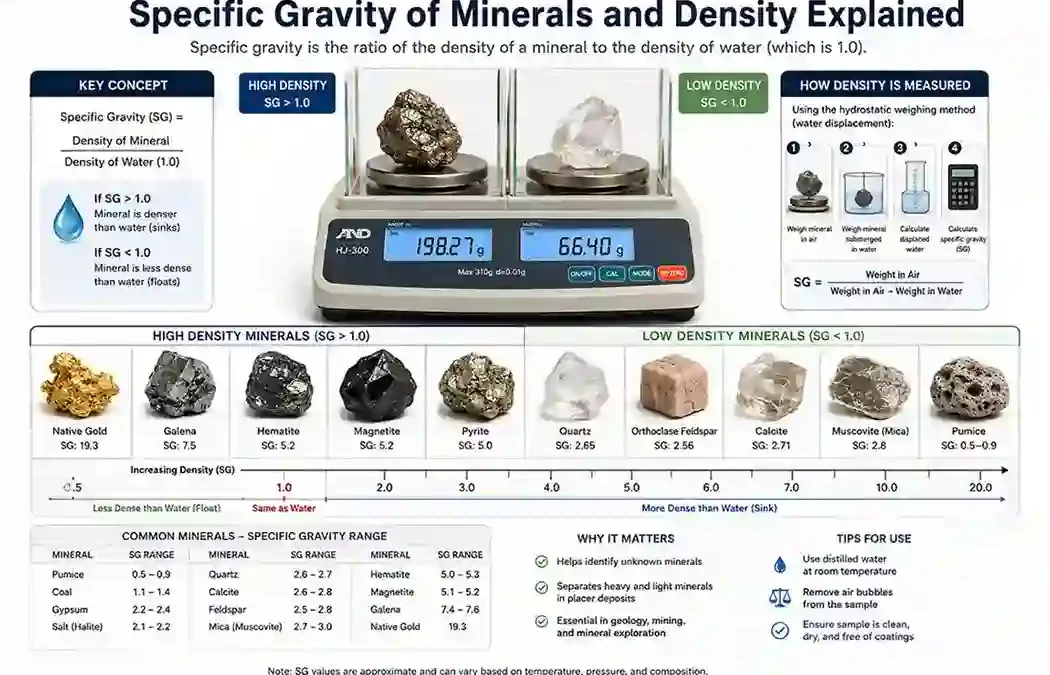
Some minerals feel surprisingly heavy, while others seem unusually light for their size. This difference is related to a property called specific gravity.
Specific gravity measures how dense a mineral is compared to water. It helps geologists identify minerals, distinguish similar-looking specimens, and understand mineral composition.
Many ore minerals have high specific gravity because they contain heavy elements such as iron, lead, or copper. In contrast, common silicate minerals tend to have lower values.
Specific gravity is one of the most useful physical properties used in mineral identification and economic geology.
Learn more → characteristics of minerals
Specific Gravity of Common Minerals
| Mineral | Specific Gravity |
|---|---|
| Quartz | 2.65 |
| Feldspar | 2.55–2.75 |
| Calcite | 2.71 |
| Pyrite | 5.0 |
| Galena | 7.4–7.6 |
| Gold | 19.3 |
What Is Specific Gravity?
Specific gravity is the ratio of a mineral's density compared to water. Water has a specific gravity of 1.0. If a mineral has a specific gravity of 3.0, it is three times denser than water.
Unlike weight, specific gravity remains the same regardless of sample size.
Why Specific Gravity Matters
Specific gravity helps geologists:
- identify minerals
- separate ore minerals
- study mineral composition
- distinguish similar specimens
Many minerals look alike but have very different densities.
Example
Quartz and galena may appear similar in some hand samples, but galena feels much heavier.
How Specific Gravity Is Measured
Scientists measure specific gravity by:
- Weighing the mineral in air
- Weighing it in water
- Comparing the two measurements
This method determines the mineral's relative density.
Modern laboratories may also use:
- digital balances
- density meters
- hydrostatic weighing systems
General Specific Gravity Ranges
| Specific Gravity | Density Category |
|---|---|
| Less than 2.5 | Light minerals |
| 2.5–3.5 | Average minerals |
| 3.5–5.0 | Dense minerals |
| Above 5.0 | Very heavy minerals |
Low Specific Gravity Minerals
Many common rock-forming minerals have relatively low specific gravity.
Examples
| Mineral | Specific Gravity |
|---|---|
| Quartz | 2.65 |
| Orthoclase Feldspar | 2.56 |
| Muscovite | 2.8 |
| Gypsum | 2.3 |
These minerals dominate much of Earth's crust.
Learn more → mineral classification system
High Specific Gravity Minerals
Heavy minerals usually contain metallic elements.
Examples
| Mineral | Specific Gravity |
|---|---|
| Magnetite | 5.2 |
| Pyrite | 5.0 |
| Galena | 7.5 |
| Native Gold | 19.3 |
These minerals often feel much heavier than expected.
Why Some Minerals Are Heavier Than Others
A mineral's specific gravity depends mainly on:
- atomic weight
- chemical composition
- crystal structure
- packing efficiency of atoms
Minerals containing:
- lead
- iron
- copper
- gold
generally have higher specific gravity values than silicate minerals.
Learn more → chemical properties of minerals
Specific Gravity and Mineral Identification
Specific gravity is especially useful when minerals share similar:
- colors
- crystal habits
- luster
Density can quickly help eliminate incorrect identifications.
For example:
Gold vs Pyrite
Both may appear golden-yellow.
However:
- Gold = 19.3
- Pyrite = 5.0
The difference is immediately noticeable by weight.
Density Comparison of Common Minerals
SGGold=19.3>SGGalena=7.5>SGPyrite=5.0>SGQuartz=2.65
This comparison shows why some minerals feel dramatically heavier than others.
Specific Gravity in Mining
Mining companies often use density differences to:
- concentrate ore minerals
- separate waste material
- recover heavy metals
- improve processing efficiency
Gold panning is a classic example of density-based separation.
Heavy gold particles settle faster than lighter sediment.
Specific Gravity and Economic Minerals
Specific gravity plays a major role in:
- mineral exploration
- ore evaluation
- resource assessment
- industrial mineral processing
Many valuable ore minerals are identified partly through their high density.
Learn more → mineral identification guide
Specific Gravity vs Weight
| Property | Specific Gravity | Weight |
|---|---|---|
| Constant for mineral | Yes | No |
| Depends on sample size | No | Yes |
| Used for identification | Yes | Limited |
| Scientific comparison | Excellent | Poor |
Specific gravity is the density of a mineral compared to the density of water.
It helps geologists identify minerals and distinguish similar-looking specimens.
Native gold has one of the highest values, around 19.3.
No. Specific gravity compares density, while weight depends on sample size.
Final Thoughts
Specific gravity is one of the most valuable mineral identification properties because it reveals how dense a mineral is relative to water. From lightweight silicates such as quartz to extremely dense minerals like gold and galena, specific gravity provides important clues about mineral composition, economic value, and geological origin.
Understanding mineral density helps geologists identify minerals more accurately and better interpret Earth's natural resources.