
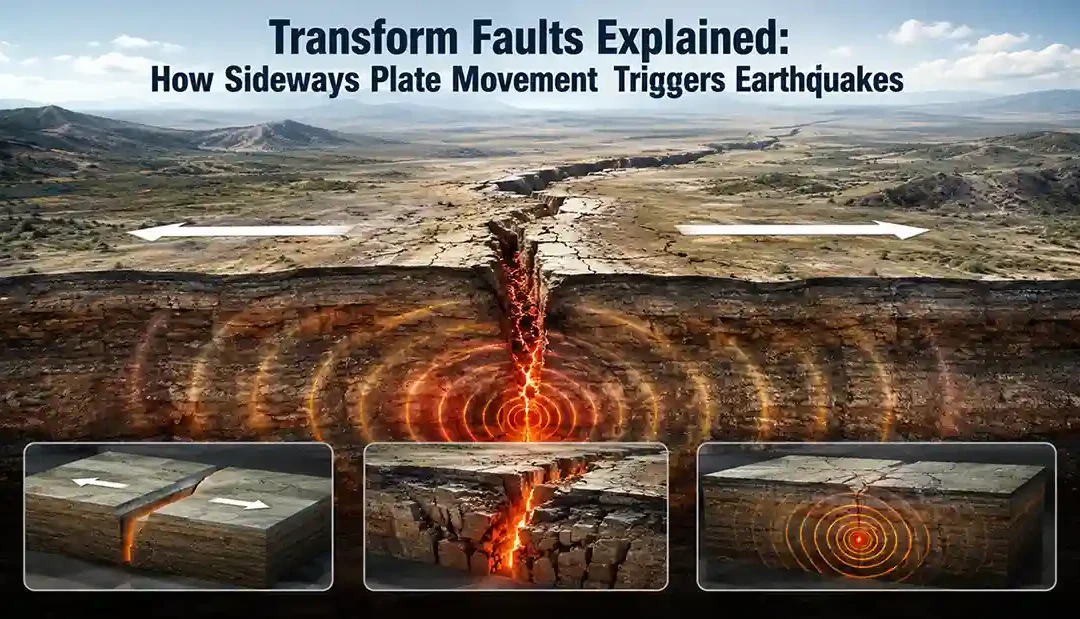
Earth’s outer shell is broken into gigantic, rigid slabs of rock known as tectonic plates. Where these plates collide, they build towering mountain ranges; where they pull apart, they tear open new ocean basins. However, along many boundaries, plates do neither—they slide horizontally past one another in a grinding, side-by-side motion. In geology and plate tectonics, this dynamic boundary is known as a transform fault.
A transform fault (or transform plate boundary) is a specialized type of strike-slip fault that connects other plate boundaries—such as mid-ocean ridges or subduction zones—where tectonic plates slide horizontally past each other. Geologists refer to transform faults as conservative plate boundaries because lithospheric crust is neither created (as it is at divergent spreading ridges) nor destroyed (as it is at convergent subduction zones). Despite this lack of crustal destruction, transform faults are among the most seismically active zones on Earth, producing intense, shallow-focus earthquakes that threaten millions of people worldwide.
If you’re new to earthquakes, begin here → what is an earthquake
What Is a Transform Fault?
In plate tectonics, a transform fault is a plate boundary characterized by horizontal, lateral motion where two plates slide past one another along vertical or near-vertical fracture planes.
The concept was introduced to geology in 1965 by Canadian geophysicist J. Tuzo Wilson. Before Wilson's breakthrough, geologists struggled to understand why linear mid-ocean spreading ridges were continuously offset and broken into zigzagging, stepped segments across the ocean floor. Wilson demonstrated that these fractures were not ordinary faults cutting across old crust, but active plate boundaries that "transformed" one type of plate motion into another (such as connecting two spreading ridges or linking a ridge to a trench).
How Do Transform Faults Form?
Transform faults are a geometric necessity resulting from the mechanics of plate movement across the surface of a spherical planet.
Accommodating Spreading Centers on a Sphere
When two tectonic plates pull apart at a mid-ocean ridge, new crust cannot spread out uniformly in a straight, continuous line. Because the Earth is a sphere, tectonic plates rotate around an axis of rotation rather than moving in flat, straight lines. As a result, the spreading rate varies along the length of a ridge: rock near the rotational pole moves slower, while rock farther away moves faster.
To relieve this differential strain, the spreading ridge breaks into multiple offset segments connected by transverse fractures. The active segment connecting the two offset ridge axes is the transform fault.
Active Transform Fault vs. Inactive Fracture Zone
One of the most important concepts in marine geophysics is the difference between an active transform fault and an inactive fracture zone:
- Active Transform Fault (Between Ridge Offsets): The active fault exists only in the narrow strip between the two offset ridge crests. Here, the two plates on either side of the fault are moving in opposite directions, generating friction, crustal grinding, and frequent earthquakes.
- Inactive Fracture Zone (Beyond the Ridge Offsets): Beyond the offset ridge crests, the fracture continues across the ocean floor as a deep trench or scar. However, on either side of this fracture zone, the crust belongs to the same plate and travels in the same direction at the same speed. Consequently, fracture zones are seismically inactive fossil scars.
How Transform Fault Movement Works
Although plates move slowly
- friction locks sections of the fault
- stress builds underground
- rocks deform over time
Eventually, the fault suddenly slips.
This releases seismic energy as:
- earthquakes
- seismic waves
- ground shaking
Learn more → earthquake energy release explained
Transform Faults Create Strike-Slip Earthquakes
Transform faults usually produce strike-slip earthquakes. These earthquakes involve horizontal movement along the fault.
Movement Types
- right-lateral motion
- left-lateral motion
The ground on opposite sides of the fault moves in opposite directions.
Strike-Slip Fault Motion
Stress Build-Up Along Transform Faults
Stress increases gradually until sudden rupture creates an earthquake.
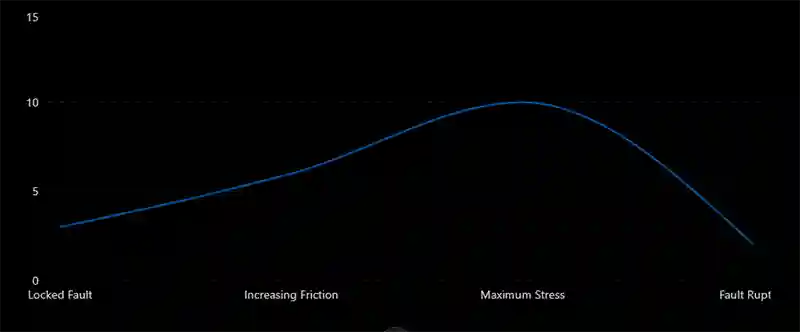
Earthquakes release years or centuries of stored tectonic stress within seconds.
Why Transform Fault Earthquakes Are Often Shallow
Most transform fault earthquakes happen close to Earth’s surface.
Why This Matters
Shallow earthquakes often produce:
- stronger surface shaking
- greater local damage
- visible fault rupture
Even moderate transform earthquakes can be destructive.
The Two Main Types of Transform Faults
Geologists divide transform faults into two broad categories based on whether they cut through oceanic or continental lithosphere:
Oceanic Transform Faults
The vast majority of transform faults on Earth are located underwater along mid-ocean ridge systems.
- Characteristics: They cut through thin (5 to 10 km), dense, basaltic oceanic crust.
- Morphology: They form deep, steep-sided submarine troughs that can plunge several kilometers below the surrounding seafloor. Because oceanic lithosphere is relatively young, hot, and thin near ridges, earthquakes on oceanic transform faults are generally small to moderate in magnitude.
- Example: The Romanche Fracture Zone in the equatorial Atlantic Ocean, which offsets the Mid-Atlantic Ridge by over 900 km (560 miles).
Continental Transform Faults
Much rarer—but far more dangerous to human populations—are transform boundaries that slice directly through thick ($30\text{ to }70\text{ km}$), buoyant continental crust.
- Characteristics: Continental rock is brittle, heterogeneous, and structurally complex. As a result, continental transform boundaries rarely consist of a single clean fracture; instead, they develop into broad, complex fault zones spanning tens of kilometers wide with dozens of branching subsidiary faults.
- Morphology: The immense friction between continental plates locks the fault for decades or centuries, accumulating enormous elastic strain that periodically releases in catastrophic, shallow earthquakes.
- Example: The San Andreas Fault Zone in California and the North Anatolian Fault in Turkey.
Transform Faults vs Other Plate Boundaries
| Boundary Type | Plate Movement | Common Result |
|---|---|---|
| Transform | Slide sideways | Shallow earthquakes |
| Subduction | One plate sinks | Giant earthquakes & tsunamis |
| Divergent | Plates move apart | Volcanic activity |
| Collision | Plates crash together | Mountain building |
Transform faults mainly generate horizontal fault movement.
Surface Features Along Transform Faults
Transform faults may create:
- linear valleys
- offset rivers
- fractured roads
- fault scarps
Visible Ground Movement
Large earthquakes can shift landscapes by several meters within seconds.
Famous Transform Fault Earthquakes
| Earthquake | Location |
|---|---|
| 1906 San Francisco | USA |
| 1999 İzmit Earthquake | Turkey |
| 2010 Haiti Earthquake | Caribbean |
| 2016 Kaikōura Earthquake | New Zealand |
Many destructive urban earthquakes occur along transform systems.
Transform Faults and Urban Risk
Many transform faults pass near large cities.
This creates major earthquake risk for:
- transportation systems
- utilities
- buildings
- dense populations
High-Risk Urban Areas
- California
- Istanbul
- New Zealand fault zones
Learn more → earthquake risk zones worldwide
Can Transform Faults Produce Tsunamis?
Usually, tsunami risk is lower than at subduction zones.
However:
- underwater transform earthquakes
- submarine landslides
can occasionally generate local tsunamis.
How Scientists Monitor Transform Faults
Scientists study transform faults using:
- GPS systems
- seismic sensors
- satellite imaging
- fault creep measurements
These tools help track:
- plate movement
- stress buildup
- earthquake probability
Learn more → earthquake monitoring technology
Why Transform Faults Matter
Transform faults:
- release tectonic stress
- reshape Earth’s crust
- generate destructive earthquakes
- reveal plate motion patterns
They are one of the key parts of plate tectonics.
Could Future Large Transform Earthquakes Happen?
Yes.
Major transform faults continue storing tectonic stress.
Future large earthquakes are expected along:
- San Andreas Fault
- North Anatolian Fault
- Alpine Fault (New Zealand)
Preparedness remains extremely important in these regions.
A tectonic boundary where plates slide sideways past each other.
Mostly shallow strike-slip earthquakes.
The San Andreas Fault in California.
Usually, no — they mainly produce earthquakes.
Final Thoughts
Transform faults are tectonic boundaries where plates slide sideways past each other, building stress that eventually releases as earthquakes. Although transform faults do not usually create giant tsunamis or volcanoes, they can still produce destructive shallow earthquakes near populated regions.
Understanding transform faults helps explain why some of the world’s most famous earthquake zones experience sudden horizontal ground movement and powerful seismic shaking.