
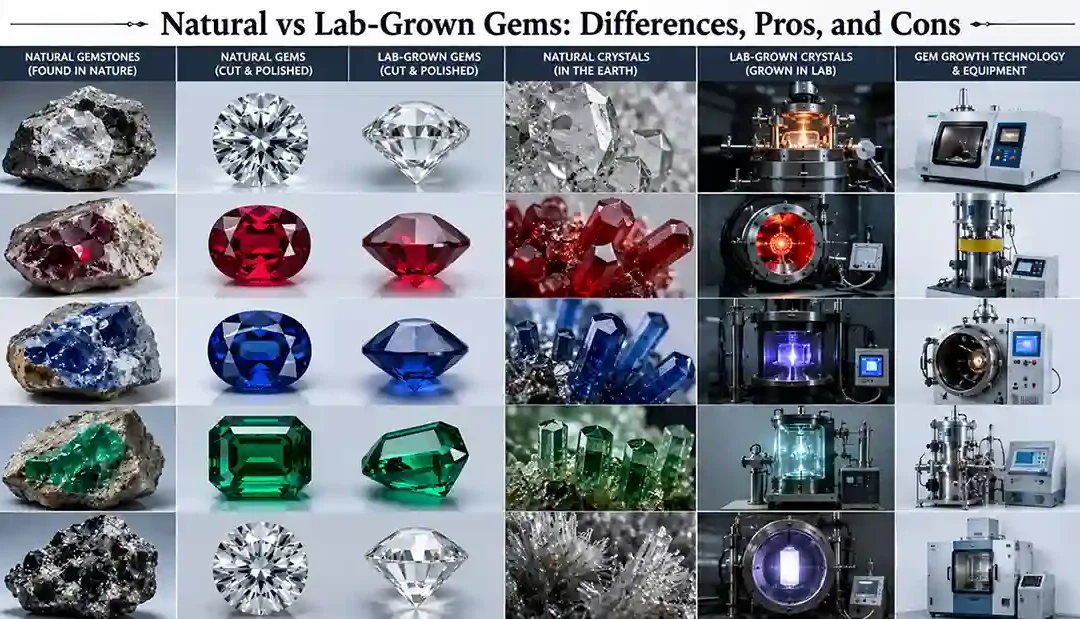
Natural and lab-grown gemstones may appear nearly identical, but they have very different origins. Natural gemstones form deep within the Earth over millions of years through geological processes, while lab-grown gemstones are created in controlled laboratories using advanced crystal-growth technologies that reproduce natural conditions.
Both types of gemstones possess exceptional beauty, but they differ in origin, rarity, market value, and collector appeal. Understanding these differences helps buyers make informed decisions when purchasing gemstone jewelry.
What Are Natural Gemstones?
Natural gemstones are minerals or mineraloids formed entirely through geological processes without human intervention.
They develop through:
- volcanic activity
- metamorphism
- hydrothermal fluids
- sedimentary processes
- extreme pressure and temperature
Most natural gemstones require millions of years to form.
What Are Lab-Grown Gemstones?
Lab-grown gemstones are created by scientists using methods that replicate natural crystal growth.
They possess:
- identical chemical composition
- identical crystal structure
- nearly identical physical properties
- nearly identical optical properties
Unlike imitation stones, lab-grown gems are genuine gemstones.
Natural vs Lab-Grown Comparison
| Feature | Natural Gems | Lab-Grown Gems |
|---|---|---|
| Formation | Geological | Laboratory |
| Growth Time | Millions of Years | Weeks to Months |
| Chemical Composition | Natural | Same |
| Crystal Structure | Natural | Same |
| Physical Properties | Natural | Same |
| Optical Properties | Same | Same |
How Natural Gems Form
Natural gemstones develop through several geological processes.
Igneous Activity
Crystallization from magma.
Metamorphism
Heat and pressure transform minerals.
Hydrothermal Systems
Mineral-rich fluids grow crystals.
Sedimentary Processes
Minerals precipitate from groundwater.
Each environment produces different gemstone varieties.
How Lab-Grown Gems Are Made
Common manufacturing methods include:
- Flame Fusion
- Hydrothermal Growth
- Flux Growth
- HPHT (High Pressure High Temperature)
- CVD (Chemical Vapor Deposition)
Each method is designed for specific gemstone species.
Are They Chemically Different?
No
For true synthetic gemstones:
- chemical composition is identical
- crystal structure is identical
- hardness is nearly identical
- optical properties are nearly identical
Example:
Natural Diamond, Lab-Grown Diamond.
The difference is origin, not chemistry.
Appearance Comparison
To the naked eye:
- both appear almost identical
- both display similar brilliance
- both exhibit similar color
Professional testing is usually required to determine origin.
How Gemologists Tell Them Apart
Professional laboratories examine:
- growth structures
- inclusion patterns
- fluorescence
- spectroscopy
- phosphorescence
- advanced microscopy
These tests reveal whether a gemstone formed naturally or in a laboratory.
Natural Inclusions vs Laboratory Features
| Natural Gems | Lab-Grown Gems |
|---|---|
| Mineral inclusions | Metallic flux inclusions |
| Fluid inclusions | Curved growth lines |
| Irregular zoning | Regular growth zoning |
| Geological fractures | Laboratory growth patterns |
These microscopic features help identify origin.
Popular Natural and Lab-Grown Gemstones
Today, laboratories successfully produce:
- diamond
- ruby
- sapphire
- emerald
- spinel
- alexandrite
- quartz
Most of these have natural equivalents.
Advantages of Natural Gemstones
Natural gemstones offer:
- geological history
- rarity
- collector appeal
- investment potential
- uniqueness
Every natural gemstone has its own growth history and inclusions.
Advantages of Lab-Grown Gemstones
Lab-grown gems provide:
- excellent clarity
- lower prices
- larger sizes
- consistent color
- fewer visible inclusions
They are often an attractive option for buyers seeking high visual quality.
Cost Comparison
| Feature | Natural | Lab-Grown |
|---|---|---|
| Purchase Price | Higher | Lower |
| Rarity | Higher | Lower |
| Availability | Limited | Greater |
| Collector Value | Higher | Lower |
Lab-grown gemstones generally cost less because they can be produced under controlled conditions.
Which Is More Valuable?
Generally:
Natural Gemstones
retain higher market and collector value because of their rarity and natural origin.
Lab-Grown Gemstones
typically sell for less, even though they have similar physical and chemical properties.
Value depends on:
- rarity
- quality
- demand
- treatment
- certification
Environmental Considerations
Some buyers choose lab-grown gems because they may reduce the need for new mining.
However, environmental impact varies depending on:
- energy source
- manufacturing process
- mining practices
- transportation
The overall sustainability of either option depends on how it is produced or sourced.
Which Should You Choose?
Choose natural gemstones if you value:
- rarity
- geological history
- collecting
- investment potential
Choose lab-grown gemstones if you prioritize:
- appearance
- affordability
- larger sizes
- fewer inclusions
Neither choice is universally better—it depends on your priorities.
Identification Methods
Professional laboratories use:
- spectroscopy
- Raman analysis
- photoluminescence
- UV fluorescence
- microscopy
These advanced methods can reliably determine gemstone origin.
Natural vs Lab-Grown Comparison
Modern gemological laboratories use sophisticated equipment to distinguish natural gemstones from laboratory-grown counterparts.
Quick Comparison
| Feature | Natural Gem | Lab-Grown Gem |
|---|---|---|
| Formed by Nature | ✅ | ❌ |
| Laboratory Created | ❌ | ✅ |
| Same Chemistry | ✅ | ✅ |
| Same Crystal Structure | ✅ | ✅ |
| Same Hardness | Nearly | Nearly |
| Lower Cost | ❌ | ✅ |
| Higher Collector Value | ✅ | ❌ |
Yes. Lab-grown gemstones are genuine gemstones with the same chemical composition and crystal structure as natural gemstones.
Usually not. Most natural and lab-grown gemstones appear nearly identical without professional testing.
Yes. They are chemically, physically, and optically the same as natural diamonds, differing primarily in their origin.
Natural gemstones generally have higher market and collector value because of their rarity and geological origin.
Neither is inherently better. Natural gemstones appeal to those who value rarity and geological history, while lab-grown gemstones appeal to buyers seeking similar appearance at a lower price.
Final Thoughts
Natural and lab-grown gemstones each have distinct advantages. Natural gemstones are unique products of Earth's geological history, formed over millions of years and prized for their rarity. Lab-grown gemstones showcase advances in materials science by recreating those same crystals in controlled environments with remarkable precision.
Rather than viewing one as superior to the other, it is more useful to understand their differences in origin, value, and purpose. Whether chosen for their natural heritage or their affordability and consistency, both natural and lab-grown gems have an important place in modern gemology and jewelry.
Continue learning with → /synthetic-gemstones-explained/, /gemstone-clarity-explained/, and /precious-vs-semi-precious-stones/.