
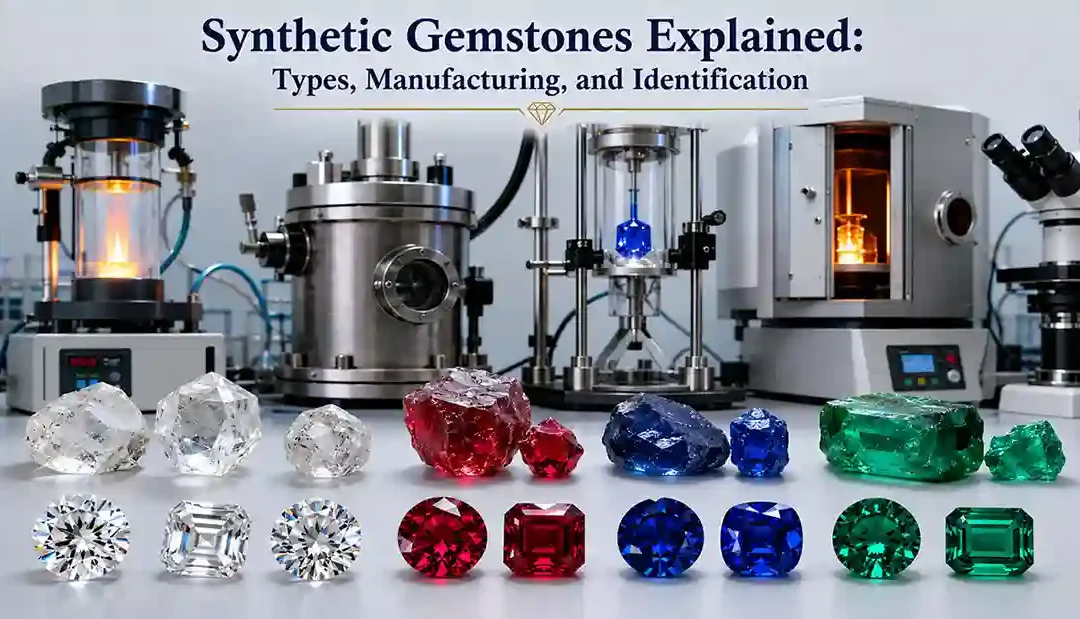
Synthetic gemstones are gemstones created in laboratories using controlled scientific processes that replicate the natural conditions under which gemstones form. Unlike imitation stones, synthetic gemstones have the same chemical composition, crystal structure, and physical properties as their natural counterparts.
Today, synthetic gemstones are widely used in jewelry, scientific research, industrial applications, and gemstone education. Advances in crystal-growth technology have made it possible to produce laboratory-grown diamonds, rubies, sapphires, emeralds, and many other gemstones with exceptional quality.
What Are Synthetic Gemstones?
Synthetic gemstones are laboratory-grown gemstones that possess:
- the same chemical composition
- the same crystal structure
- nearly identical physical properties
- similar optical characteristics
as naturally occurring gemstones.
They are genuine gemstones but are created by humans rather than geological processes.
Synthetic vs Natural Gemstones
| Feature | Natural Gemstone | Synthetic Gemstone |
|---|---|---|
| Formation | Geological Processes | Laboratory Growth |
| Chemical Composition | Natural | Same as Natural |
| Crystal Structure | Natural | Same as Natural |
| Appearance | Similar | Similar |
| Growth Time | Millions of Years | Weeks to Months |
Synthetic vs Imitation Gemstones
Synthetic and imitation gemstones are not the same.
| Synthetic Gemstone | Imitation Gemstone |
|---|---|
| Same chemistry as natural | Different material |
| Same crystal structure | Different crystal structure |
| Genuine gemstone | Simulates appearance only |
Example:
- Laboratory-grown ruby → Synthetic
- Red glass → Imitation
How Synthetic Gemstones Are Made
Modern laboratories grow gemstones using several techniques.
Flame Fusion
Fast and economical method for corundum gemstones.
Flux Growth
Produces high-quality crystals slowly.
Hydrothermal Growth
Simulates natural hot-water environments.
High Pressure High Temperature (HPHT)
Used primarily for laboratory-grown diamonds.
Chemical Vapor Deposition (CVD)
Advanced process for growing synthetic diamonds.
Major Gemstone Growth Methods
| Method | Common Gemstones |
|---|---|
| Flame Fusion | Ruby, Sapphire |
| Flux Growth | Emerald, Ruby |
| Hydrothermal | Emerald, Quartz |
| HPHT | Diamond |
| CVD | Diamond |
Flame Fusion Process
One of the oldest methods.
The process involves:
- melting powdered materials
- crystal growth on a rotating seed
- rapid crystal formation
Commonly used for:
- synthetic ruby
- synthetic sapphire
Hydrothermal Growth
Hydrothermal synthesis uses:
- high pressure
- high temperature
- mineral-rich water
to grow crystals similar to those formed naturally underground.
This method is widely used for:
- emerald
- quartz
- beryl
HPHT Diamonds
HPHT recreates the conditions found deep within Earth's mantle.
Carbon crystallizes into diamond under:
- extreme pressure
- extreme temperature
The resulting laboratory-grown diamond has the same composition as a natural diamond.
CVD Diamonds
Chemical Vapor Deposition (CVD) creates diamonds by:
- introducing carbon-rich gases
- depositing carbon atoms
- growing crystal layers on a seed
CVD allows excellent control over crystal quality.
Common Synthetic Gemstones
Popular laboratory-grown gemstones include:
- diamond
- ruby
- sapphire
- emerald
- spinel
- alexandrite
- quartz
These gemstones are commonly used in both jewelry and industry.
Advantages of Synthetic Gemstones
Benefits
Synthetic gemstones offer:
- high clarity
- consistent color
- fewer inclusions
- lower cost
- predictable quality
They are also widely used for scientific and industrial purposes.
Limitations
Some buyers prefer natural gemstones because of:
- geological origin
- rarity
- collector value
- historical significance
- investment potential
Natural gemstones generally remain more valuable in the collector market.
How Gemologists Identify Synthetic Gemstones
Professional gemologists use:
- gemological microscopes
- spectroscopy
- UV fluorescence
- refractive index testing
- inclusion analysis
Synthetic gemstones often display distinctive growth patterns and inclusions created during laboratory production.
Typical Synthetic Features
Common laboratory indicators include:
- curved growth lines
- gas bubbles (in some materials)
- metallic flux inclusions
- nail-head inclusions (hydrothermal)
- distinctive zoning patterns
These characteristics help distinguish laboratory-grown stones from natural gems.
Natural Inclusions vs Synthetic Growth
| Natural | Synthetic |
|---|---|
| Mineral inclusions | Curved growth lines |
| Fluid inclusions | Flux inclusions |
| Irregular zoning | Regular growth patterns |
| Geological fractures | Laboratory growth features |
Identification usually requires professional examination.
Synthetic Diamonds in Jewelry
Laboratory-grown diamonds have become increasingly popular because they offer:
- excellent brilliance
- lower cost
- high clarity
- identical physical properties to natural diamonds
They must be disclosed as laboratory-grown when sold.
Industrial Uses
Synthetic gemstones are used in:
- laser technology
- electronics
- watch bearings
- cutting tools
- scientific instruments
- medical equipment
Many industrial applications rely on laboratory-grown crystals because of their consistency.
Synthetic Gemstone Manufacturing
Modern crystal-growth laboratories use advanced equipment to produce gemstones with highly controlled quality and consistency.
Are Synthetic Gemstones Real?
Yes.
Synthetic gemstones are real gemstones because they possess the same chemical composition and crystal structure as natural gemstones.
However, they are laboratory-created rather than naturally formed, and this difference should always be disclosed in the marketplace.
Summary of Natural vs Synthetic
| Feature | Natural | Synthetic |
|---|---|---|
| Geological Origin | Yes | No |
| Same Chemistry | Yes | Yes |
| Same Crystal Structure | Yes | Yes |
| Human-Made | No | Yes |
| Collector Value | Generally Higher | Generally Lower |
| Industrial Use | Limited | Extensive |
Synthetic gemstones are laboratory-grown crystals that have the same chemical composition and crystal structure as natural gemstones.
No. They are genuine gemstones, but they are created in laboratories rather than formed naturally.
Synthetic gemstones have the same chemistry as natural gems, while imitation gemstones only resemble their appearance.
Yes. Professional gemologists use microscopes and advanced testing methods to distinguish natural and synthetic gemstones.
Yes. Laboratory-grown diamonds have the same chemical composition, crystal structure, and physical properties as natural diamonds.
Final Thoughts
Synthetic gemstones represent one of the greatest achievements in modern gemology and materials science. By recreating the conditions under which gemstones naturally form, scientists can produce crystals with remarkable clarity, color, and consistency.
Although natural gemstones remain highly prized for their geological history and rarity, laboratory-grown gemstones have become an important part of the jewelry, scientific, and industrial worlds. Understanding the differences between natural, synthetic, and imitation gemstones helps consumers make informed decisions while appreciating the remarkable science behind crystal growth.
Continue learning with → /gemstone-clarity-explained/, and /precious-vs-semi-precious-stones/.