
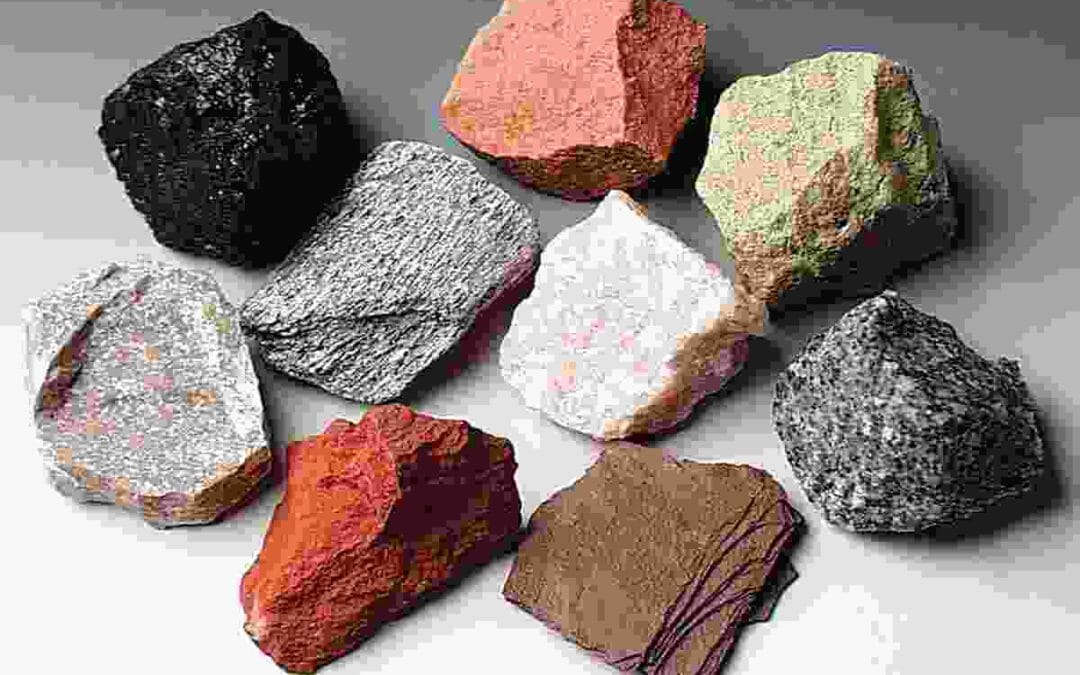
Limestone is one of the most widespread rocks on Earth, known for its diverse uses in various industries and natural landscapes. This sedimentary rock was formed over millions of years by the accumulation and compression of marine organisms, especially shells and coral remains. Its texture and color can vary greatly based on its composition. Throughout history, It has been an important resource for various human activities.
What is Limestone?
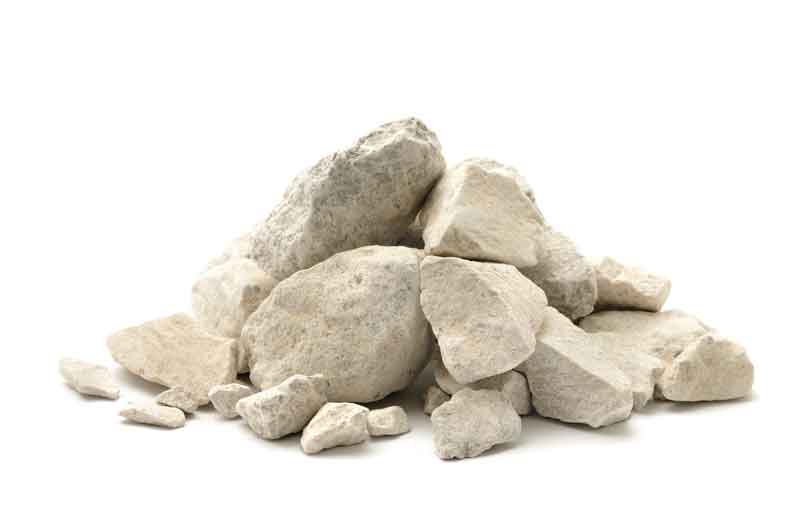
Limestone is a sedimentary rock composed largely of the minerals calcite and aragonite, which are different forms of calcium carbonate (CaCO3). Many limestones are composed of skeletal fragments of marine organisms such as coral or foraminifera.
Key Characteristics
| Property | Description |
|---|---|
| Rock Type | Sedimentary |
| Main Mineral | Calcite |
| Color | White, gray, cream, yellow, brown, black |
| Hardness | About 3 (Mohs Scale) |
| Acid Reaction | Fizzes with dilute hydrochloric acid |
| Common Environment | Oceans, lakes, caves, springs |
How Are Limestone Rocks Classified?
Geologists classify limestone based on several factors:
- Grain size
- Fossil content
- Formation process
- Texture
- Mineral composition
- Depositional environment
This classification helps determine how and where the rock formed.
How does Limestone form?
- Most limestones are simply the cemented remains of marine shells
- Limestone “anatomy”
- Grains: Skeletal particles, ooids, peloids
- Lime mud: Microscopic crystals produced by calcareous algae and through abrasion of larger particles
- Cement: Inorganically precipitated CaCO3 crystals
Where do Limestones form?
Because CaCO3 precipitates most readily in warm, well-lit, agitated water of normal marine salinity. Most limestones form in shallow, tropical depositional environments.
e.g., Bahamas, Central America, Persian Gulf, NW shelf of Australia, Great Barrier Reef, Malaysia, Indonesia, etc.
Different varieties occur in different geological settings:
- Chalk — England, France, Denmark
- Travertine — Italy, Turkey, Yellowstone National Park
- Oolitic limestone — Bahamas, Florida, England
- Coquina — Florida, Caribbean coastlines
- Fossiliferous limestone — Found worldwide in ancient shallow marine deposits
- Tufa — Freshwater lakes and springs across many regions
What are limestone products?
Whole rock
- Crushed limestone
- Dolomitic limestone
Burned lime (calcium oxide)
- High calcium lime
- Dolomitic lime
Hydrated lime (calcium hydroxide)
Types of Limestone:
- Bituminous limestone
- Carboniferous Limestone
- Coquina
- Coral rag
- Chalk
- Fossiliferous
- Lithographic
- Marble
- Oolite
- Rag-stone
- Shelly
- Travertine
- Tufa
learn more about common types of limestone rock
Uses of Limestone:
- It is the raw material for the manufacture of quicklime ( calcium oxide), slaked lime ( calcium hydroxide), cement and mortar.
- Pulverized limestone is used as a soil conditioner to neutralize acidic soils.
- It is crushed for use as aggregate, the solid base for many roads.
- Geological formations of limestone are among the best petroleum reservoirs.
- As a reagent in flue-gas desulfurization, It reacts with sulphur dioxide for air pollution control.
- Glass making in some circumstances uses limestone.
- It is added to toothpaste, plastic, paper, paint, tiles, and other materials as both white pigment and cheap filler.
- It can suppress methane explosions in underground coalmines.
- Purified, It is added to bread and cereals as a source of calcium
- Calcium levels in livestock feed are supplemented with it, such as for poultry ( when ground up)
- It can be used for demineralizing and increasing the alkalinity of purified water to prevent pipe corrosion and to restore essential nutrient levels.
- Used in blast furnaces, limestone extracts iron from its ore.
- It is often found in medicines and cosmetics.
- It is used in sculptures because of its suitability for carving.
Physical and Chemical Properties
- Color: Ranges from white and gray to yellow and brown.
- Texture: Can vary from coarse to fine-grained.
- Hardness: Moderate, making it easy to work with.
- Reactivity: Reacts with acids, producing carbon dioxide gas (effervescence).
Limestone and Sustainability:
While limestone mining supports economic development, it also creates environmental challenges such as habitat destruction and groundwater depletion. Good practices, including mine rehabilitation and good water drainage, are designed to mitigate these impacts.
Limestone in Bangladesh:
- In 1961, the Geological Survey of Pakistan found limestone deposits in Bagalibazar-Takerghat-Bhangerghat area of Sunamganj. The total deposit of around 30 million tons was found in four locations at depths between six meters and 100 meters. At Takerghat, at least 612,371 tons of limestone were mined between 1965 and 1993, according to the Geological Survey of Bangladesh.
- In the '60s, limestone deposits were found in Bogra (nearly 2,000 meters below the surface), in Patnitala of Naogaon (300 meters below the surface), Paharpur of Joypurhat (500 meters below the surface), and Jamalganj of Joypurhat.
- In 1966, Fried Krupp Roshtoff of Germany undertook a feasibility study of limestone mining in Jamalganj and found the mine was economically feasible. In 1969, the government undertook a mining project that had never been launched.
Fossiliferous limestone is among the most widespread because shallow marine environments have supported abundant life throughout Earth's history.
Dense varieties such as oolitic, crystalline, and some fossiliferous limestones are commonly used because of their strength and durability.
Yes. Travertine is a freshwater limestone formed by the precipitation of calcium carbonate from mineral-rich water.
Chalk is a specific type of limestone composed mainly of microscopic marine organisms, making it softer and finer than most other limestone varieties.
No. While many limestones are fossil-rich, others form through chemical precipitation or recrystallization and may contain few or no visible fossils.