
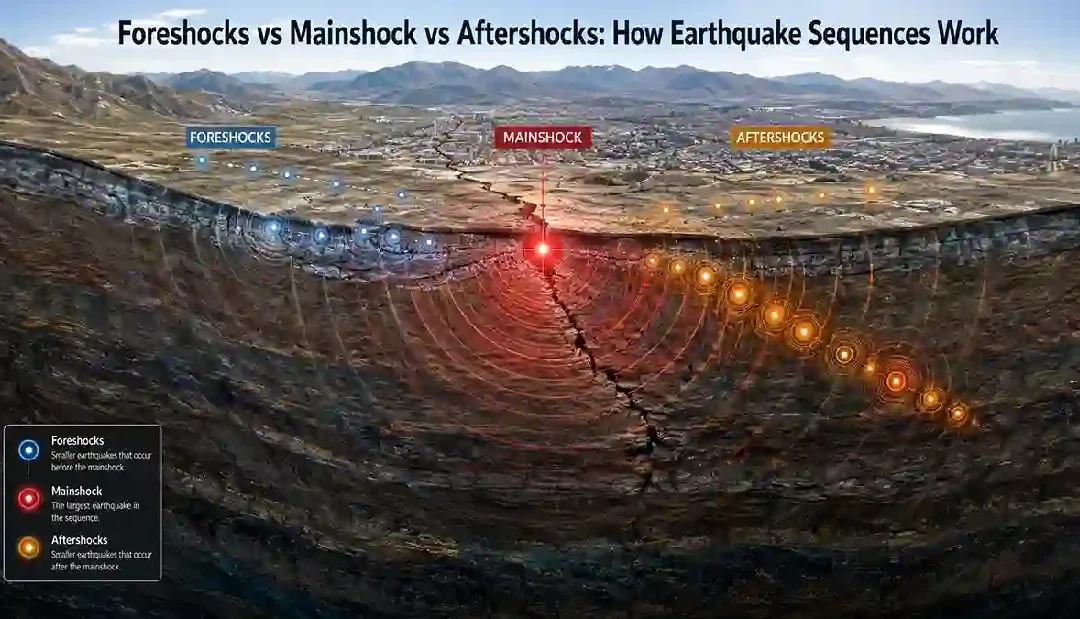
Many earthquakes do not happen alone. Instead, they occur as part of a sequence involving:
- smaller earthquakes before the main event
- one major earthquake
- continued shaking afterward
These stages are called foreshocks, mainshock, and aftershocks.
Understanding these seismic patterns helps scientists study how stress builds and releases inside Earth’s crust.
If you’re new to earthquakes, begin here → what is an earthquake
Earthquake Sequence Overview
Typical Earthquake Sequence
General pattern of foreshocks, mainshock, and aftershock activity over time.
| Stage | Activity |
|---|---|
| Early Foreshocks | 2 |
| Increasing Foreshocks | 4 |
| Mainshock | 10 |
| Strong Aftershocks | 6 |
| Weakening Aftershocks | 3 |
What Are Foreshocks?
Foreshocks are smaller earthquakes that happen before the largest earthquake in a sequence.
Important Fact
Scientists usually cannot identify a foreshock until AFTER the main earthquake occurs.
That means:
- a small earthquake may seem ordinary at first
- later it becomes classified as a foreshock if a larger earthquake follows
Characteristics of Foreshocks
Main Features
- Smaller than the mainshock
- Occur near the same fault region
- Sometimes happen minutes, days, or weeks earlier
Not every earthquake sequence includes clear foreshocks.
What Is the Mainshock?
The mainshock is the largest earthquake in a seismic sequence.
This is the earthquake that releases the greatest amount of tectonic stress.
Mainshock Characteristics
- Strongest shaking
- Largest fault rupture
- Highest energy release
The mainshock is usually the event people remember most.
Mainshock Rupture Process
During the mainshock:
- the fault suddenly slips
- huge seismic waves spread outward
- stress redistributes underground
This redistribution often triggers aftershocks afterward.
Learn more → fault lines
What Are Aftershocks?
Aftershocks are smaller earthquakes that happen after the mainshock.
They occur because Earth’s crust continues adjusting after the major rupture.
Important Facts
- Usually smaller than the mainshock
- Can continue for months or years
- Often cluster near the rupture zone
Aftershock Activity
Aftershocks happen because:
- stress remains uneven underground
- nearby rocks continue shifting
- faults adjust to the new tectonic conditions
Large earthquakes may produce thousands of aftershocks.
Learn more → earthquake aftershocks explained
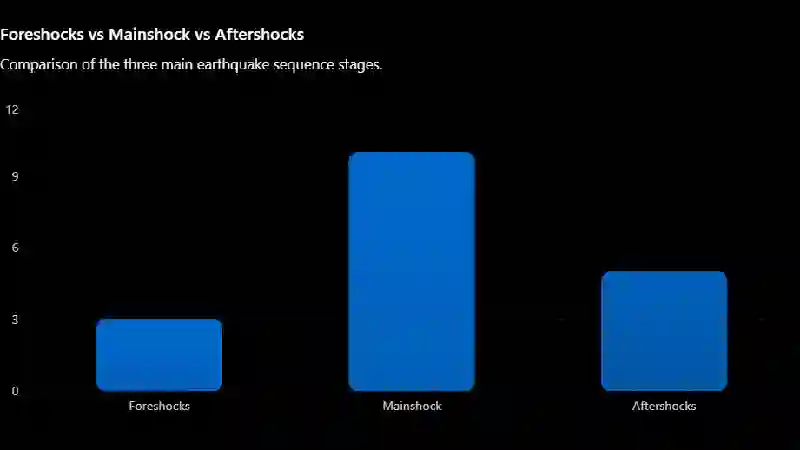
Foreshocks vs Mainshock vs Aftershocks
Foreshocks vs Mainshock vs Aftershocks
Comparison of the three main earthquake sequence stages.
| Stage | Happens When? | Typical Size |
|---|---|---|
| Foreshock | Before main earthquake | Smaller |
| Mainshock | Largest event | Largest |
| Aftershock | After mainshock | Smaller |
The mainshock is almost always the strongest earthquake in the sequence.
Why Earthquake Sequences Happen
Earthquake sequences occur because tectonic stress is rarely released evenly.
When one part of a fault ruptures:
- nearby areas may remain stressed
- pressure redistributes underground
- surrounding faults react
Earth’s crust behaves like a connected stress system.
Famous Earthquake Sequences
1. 2011 Japan Tohoku Sequence
The 2011 Tohoku earthquake sequence included:
- significant foreshocks
- a giant M9 mainshock
- thousands of aftershocks
Explore → earthquakes Tokyo region
2. Christchurch Earthquake Sequence
The Christchurch sequence involved:
- repeated damaging earthquakes
- large aftershock activity
- extended seismic instability
Learn more → earthquakes Christchurch NZ
3. Turkey–Syria Earthquake Sequence
This earthquake sequence included:
- multiple large ruptures
- widespread aftershock activity
- continued regional seismic stress
Explore → Istanbul fault zone
Can Foreshocks Predict a Major Earthquake?
Sometimes foreshocks happen before large earthquakes. But the problem is that most small earthquakes DO NOT become major earthquakes.
Scientists usually cannot know in advance whether:
- a small earthquake is harmless
- or the beginning of a larger sequence
Learn more → earthquake prediction methods
How Scientists Study Earthquake Sequences
Researchers analyze:
- seismic wave patterns
- fault movement
- aftershock distribution
- stress transfer between faults
Modern monitoring systems track earthquake sequences in real time.
Learn more → earthquake monitoring technology
Why Earthquake Sequences Matter
Understanding earthquake sequences helps scientists:
- estimate aftershock hazards
- improve early warnings
- study fault behavior
- map underground stress changes
Earthquake sequences reveal how tectonic systems evolve over time.
Foreshocks happen before the mainshock, while aftershocks happen afterward.
The largest earthquake in a seismic sequence.
Not reliably — most small earthquakes do not lead to major earthquakes.
Days, months, or even years after very large earthquakes.
Final Thoughts
Foreshocks, mainshocks, and aftershocks are all part of how Earth releases tectonic stress during earthquake sequences. These connected seismic events reveal how faults continue adjusting before and after major ruptures deep underground.
Understanding earthquake sequences helps explain why the ground may keep shaking long after the largest earthquake appears to be over.