
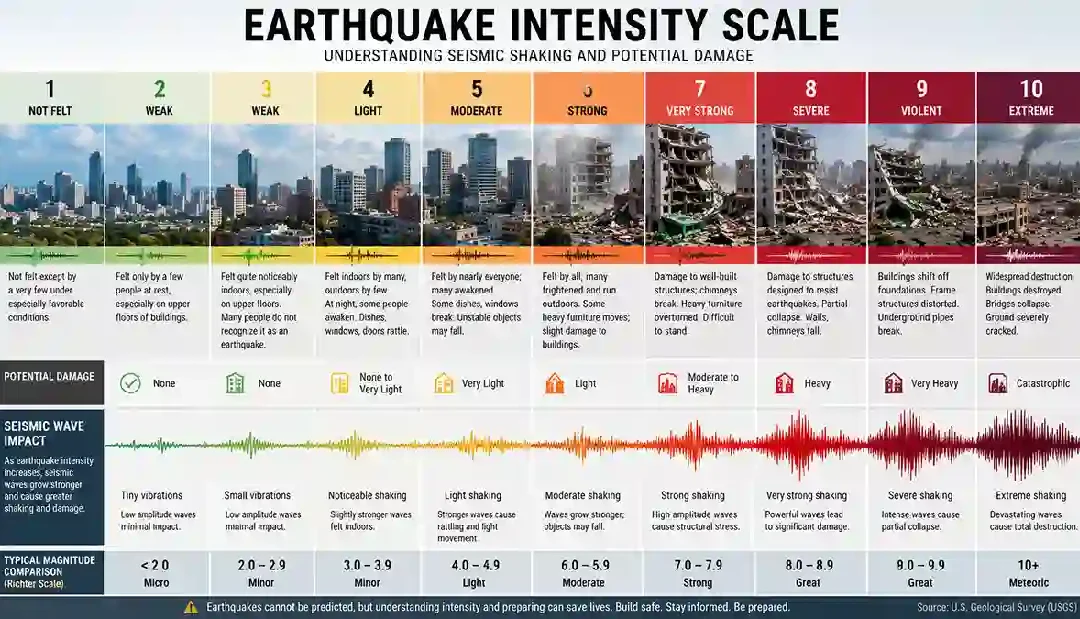
Many people think earthquake magnitude and earthquake intensity mean the same thing. But they are actually very different. Magnitude measures the total energy released by an earthquake. Intensity measures how strongly the earthquake is felt at a specific location.
This means:
- one earthquake has only ONE magnitude
- but it can produce MANY different intensity levels depending on location
Understanding intensity scales helps explain why shaking may feel weak in one city but devastating in another.
If you’re new to earthquakes, begin here → what is an earthquake
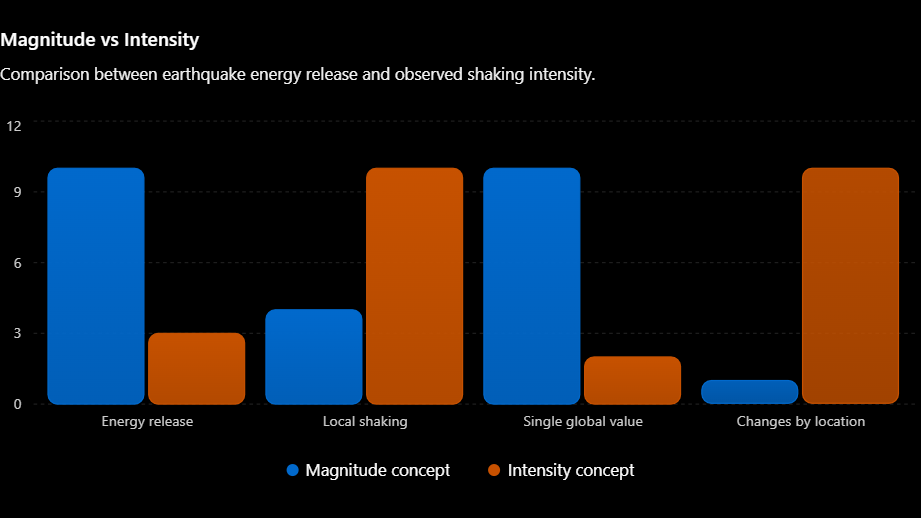
Magnitude vs Intensity
Magnitude vs Intensity
Comparison between earthquake energy release and observed shaking intensity.
| Measurement | What It Measures |
|---|---|
| Magnitude | Total earthquake energy |
| Intensity | Surface shaking & damage |
Learn more → magnitude vs intensity
What Is an Earthquake Intensity Scale?
An earthquake intensity scale measures how strongly shaking is experienced at a specific location.
Intensity depends on:
- distance from the epicenter
- earthquake depth
- local geology
- building strength
- seismic wave amplification
Two nearby cities can experience very different intensities during the same earthquake.
The Modified Mercalli Intensity Scale (MMI)
The most widely used intensity system is the Modified Mercalli Intensity Scale.
Instead of measuring energy directly, it describes:
- human observations
- building damage
- ground effects
The scale uses Roman numerals from:
- I (not felt)
to - XII (total destruction)
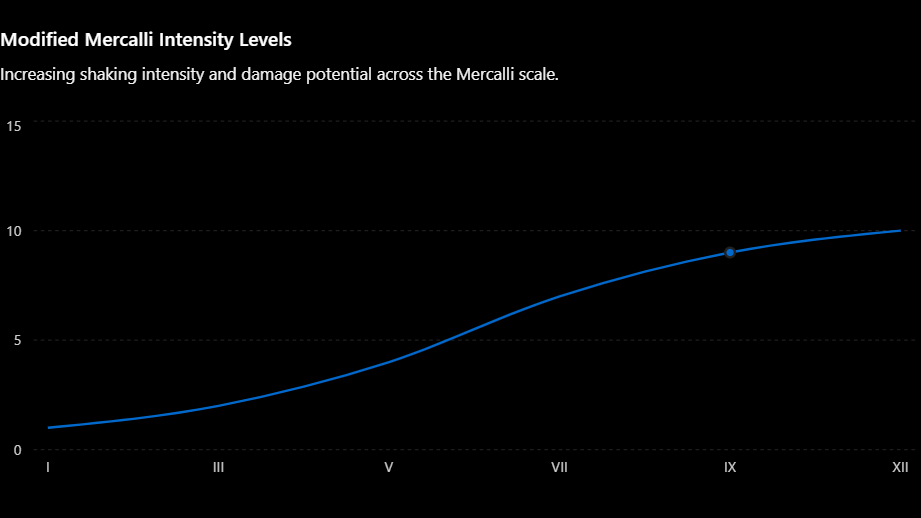
Modified Mercalli Intensity Scale Overview
Modified Mercalli Intensity Levels: Increasing shaking intensity and damage potential across the Mercalli scale.
Understanding Major Intensity Levels
Intensity I–III (Weak Shaking)
Typical Effects
- Often not felt by everyone
- Hanging objects may sway
- Very little or no damage
Small earthquakes commonly produce these intensities.
Intensity IV–VI (Moderate Shaking)
Typical Effects
- Most people feel shaking
- Objects may fall from shelves
- Minor structural damage possible
Many everyday earthquakes fall within this range.
Intensity VII–IX (Strong to Violent Shaking)
Typical Effects
- Significant building damage
- Cracks in roads and ground
- Dangerous shaking
Many destructive earthquakes produce these intensities near the epicenter.
Intensity X–XII (Extreme Destruction)
Typical Effects
- Severe structural collapse
- Ground deformation
- Massive destruction across cities
These intensities occur only in the most extreme earthquakes.
Why Intensity Changes From Place to Place
The same earthquake can produce different intensity levels because of:
| Factor | Effect |
|---|---|
| Distance | Shaking weakens farther away |
| Soft soil | Amplifies seismic waves |
| Bedrock | Reduces amplification |
| Earthquake depth | Shallow quakes shake more strongly |
| Building quality | Changes damage severity |
Local geology strongly affects earthquake intensity. Learn more → earthquake depth explained
Example: One Earthquake, Many Intensities
A major earthquake might produce:
- Intensity IX near the epicenter
- Intensity VI in nearby cities
- Intensity III hundreds of kilometers away
Magnitude stays constant, but intensity changes by location.
Magnitude Scales vs Intensity Scales
| Scale Type | Example |
|---|---|
| Magnitude scale | Moment Magnitude (Mw) |
| Intensity scale | Modified Mercalli Scale |
| Energy measurement | Richter/Mw |
| Human impact measurement | Mercalli |
- Magnitude measures the earthquake itself.
- Intensity measures the earthquake’s effects.
Why Intensity Maps Matter
Scientists create intensity maps after earthquakes to:
- estimate damage zones
- guide emergency response
- study wave amplification
- improve seismic hazard planning
Modern intensity maps combine sensor data with human reports.
Famous Earthquakes With Extreme Intensities
| Earthquake | Maximum Intensity |
|---|---|
| 2010 Haiti | X |
| 2011 Japan Tohoku | IX |
| 1906 San Francisco | XI |
| 2023 Turkey–Syria | XI |
Strong shaking intensity often determines destruction levels more than magnitude alone.
Could Future Intensity Mapping Improve?
Yes.
Scientists are improving intensity mapping using:
- smartphone sensors
- AI analysis
- satellite imaging
- real-time seismic networks
Future systems may estimate shaking almost instantly after earthquakes begin.
Learn more → earthquake monitoring technology
Magnitude measures energy release, while intensity measures local shaking effects.
The Modified Mercalli Intensity Scale.
Yes — intensity changes by location.
Shallow depth, proximity to the epicenter, and local geology.
Final Thoughts
Earthquake intensity scales help explain how earthquakes are experienced differently across regions. While magnitude measures the total energy released underground, intensity describes the actual shaking and damage people experience at the surface.
Understanding intensity scales is essential for understanding why some earthquakes cause catastrophic destruction in one area while producing only mild shaking elsewhere.