
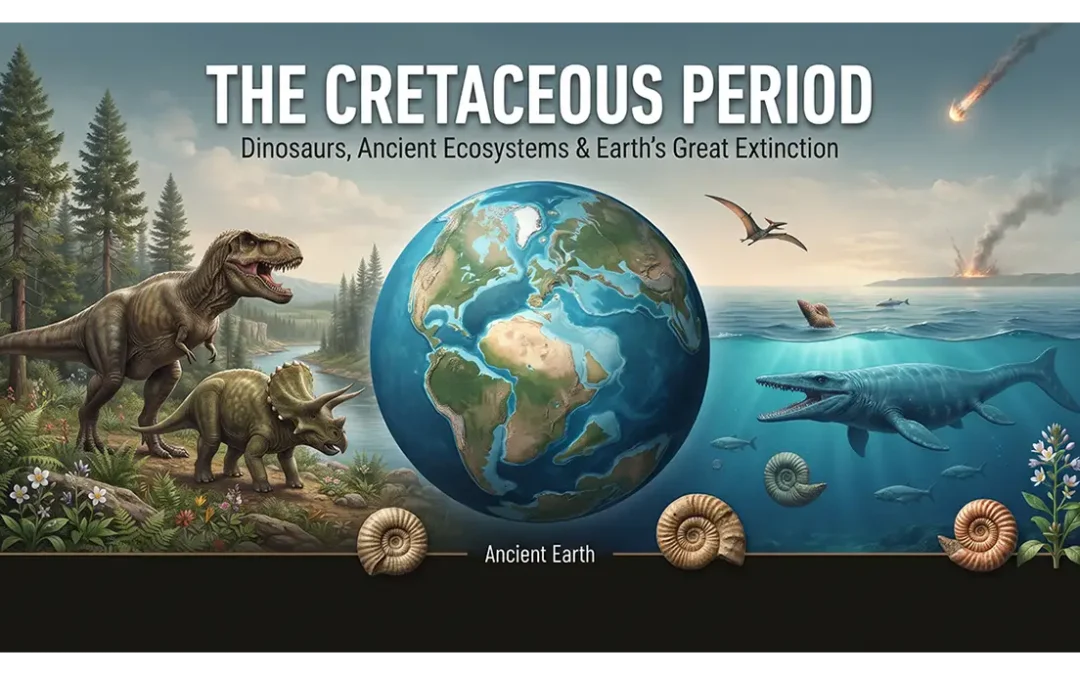
The Cretaceous Period was the final period of the Mesozoic Era, widely known as the Age of Dinosaurs. It began approximately 145 million years ago and ended about 66 million years ago. During this time, dinosaurs diversified, flowering plants spread across the continents, marine ecosystems flourished, and Earth's geography continued to change.
The Cretaceous was also a period of significant evolutionary development. Early birds diversified, mammals occupied different ecological niches, and insects developed increasingly complex relationships with flowering plants. Meanwhile, continental movement, volcanic activity, and changing sea levels reshaped habitats across the planet.
The period ended with a major mass extinction associated with a large asteroid impact near present-day Mexico. This event eliminated non-avian dinosaurs and many other organisms, permanently changing Earth's ecosystems. Studying the Cretaceous helps scientists understand ancient biodiversity, evolutionary relationships, geological processes, and the origins of many features of the modern natural world.
When Did the Cretaceous Period Begin and End?
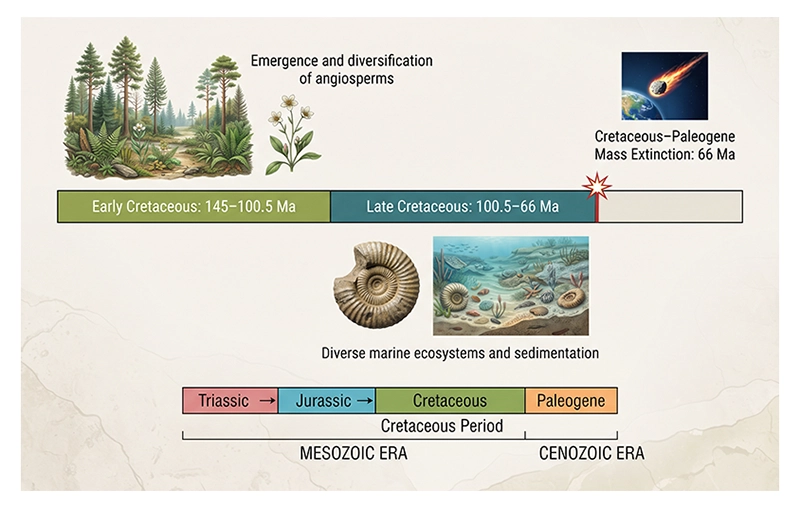
The Cretaceous Period began approximately 145 million years ago and ended 66 million years ago. Lasting around 79 million years, it was the longest period of the Mesozoic Era. It followed the Jurassic Period and preceded the Paleogene Period. The name Cretaceous comes from the Latin word creta, meaning chalk.
Thick chalk deposits formed in ancient marine environments from the accumulated remains of microscopic organisms that produced calcium carbonate. Geologists divide the Cretaceous into two main epochs. The Early Cretaceous lasted from approximately 145 million to 100.5 million years ago, while the Late Cretaceous extended from about 100.5 million to 66 million years ago.
These divisions help researchers organize geological evidence and identify changes in ancient ecosystems. Fossils, sedimentary rock layers, volcanic deposits, and radiometric dating all contribute to establishing the timeline.
The Cretaceous is particularly important because it records major developments in dinosaur evolution, the diversification of flowering plants, and the mass extinction that ended the Mesozoic Era.
Earth's Geography and Climate During the Cretaceous
Earth's geography changed substantially throughout the Cretaceous as tectonic plates moved and continents continued to separate. The Atlantic Ocean widened, and the landmasses inherited from the breakup of Pangaea gradually developed into more recognizable continental arrangements.
India moved northward across the Indian Ocean before colliding with Asia later in the Cenozoic Era. Meanwhile, parts of North America were divided by the Western Interior Seaway, a vast shallow sea that covered areas of the continent during the Late Cretaceous.
The global climate was generally warm, particularly during parts of the middle and Late Cretaceous. Atmospheric carbon dioxide concentrations were often elevated, contributing to greenhouse conditions. However, temperatures and rainfall varied considerably between regions and changed throughout the period.
Forests existed at high latitudes, even in regions that experienced prolonged seasonal darkness. Other areas supported relatively dry environments, river systems, wetlands, and coastal habitats.
Sea levels were high during much of the Cretaceous, although they fluctuated over time. Shallow seas spread across low-lying continental areas, providing habitats for marine organisms and creating conditions for extensive sediment accumulation.
Together, continental drift, changing sea levels, and climate variation influenced the distribution of organisms and the development of distinct ecosystems.
Dinosaurs and Their Adaptations
Dinosaurs were among the most prominent terrestrial animals during the Cretaceous. They occupied diverse ecological roles, ranging from small feathered predators to enormous plant-eating species. Different groups evolved specialized features for feeding, movement, defense, and reproduction.
Tyrannosaurus rex lived in western North America near the end of the Cretaceous. It possessed a massive skull, powerful jaws, sharp teeth, and strong hind limbs adapted for supporting its large body.
Triceratops was a herbivore recognizable by its three facial horns and broad bony frill. These structures may have served functions related to defense, display, or interactions between individuals.
Velociraptor was a relatively small, feathered theropod that lived in Asia during the Late Cretaceous. Its enlarged hind-foot claw, narrow skull, and agile body distinguish it from the much larger predators often shown in popular films.
Hadrosaurs, commonly called duck-billed dinosaurs, possessed numerous teeth adapted for processing vegetation. Ankylosaurs had extensive bony armor, and some species developed a tail club. Titanosaurs were long-necked sauropods that included some of the largest land animals known.
These dinosaurs did not all live at the same time or in the same locations. Their diversity reflects millions of years of evolutionary change as species adapted to different environments and food sources.
Marine Life, Flying Reptiles, and Early Birds
Cretaceous oceans supported complex food webs containing fish, marine reptiles, ammonites, turtles, and microscopic organisms. Shallow seas created productive habitats where abundant food supported a wide range of animals.
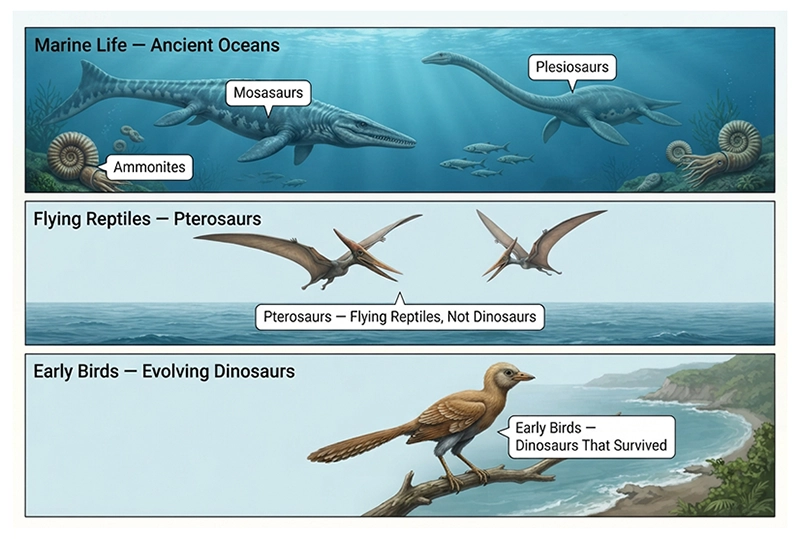
Mosasaurs were large marine reptiles with elongated bodies, paddle-like limbs, and powerful tails. Many were active predators that hunted fish and other marine animals. Plesiosaurs also inhabited ancient seas, with different groups displaying either long necks and relatively small heads or shorter necks and larger skulls.
Ammonites were marine cephalopods related to modern squid, octopuses, and nautiluses. Many possessed coiled shells divided into chambers. Their fossils are especially useful for determining the relative ages of sedimentary rocks.
Pterosaurs occupied the skies. These flying reptiles were not dinosaurs, although both groups belonged to the broader archosaur lineage. Their wings consisted of membranes supported primarily by an elongated fourth finger.
Birds evolved from theropod dinosaurs before the Cretaceous and continued to diversify throughout the period. Some early birds retained teeth or clawed fingers, while others developed more specialized flight adaptations.
The distinction between these groups is important: mosasaurs, plesiosaurs, and pterosaurs were reptiles outside Dinosauria, whereas birds belong to the dinosaur lineage. Birds are the only dinosaur group that survived the end-Cretaceous mass extinction.
Mammals and Other Animals of the Cretaceous
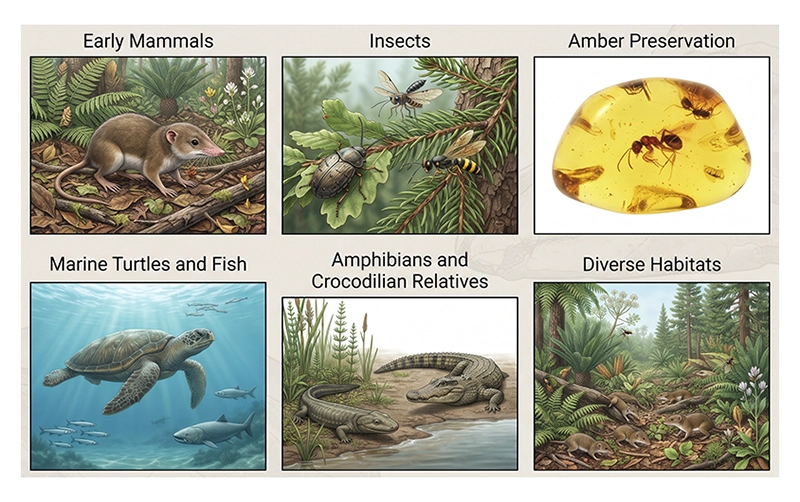
Mammals lived alongside dinosaurs throughout the Cretaceous. Although many were relatively small, they were not ecologically insignificant. Different species occupied habitats on the ground, in trees, and in other specialized environments.
Their diets varied according to their anatomy and lifestyle. Some consumed insects, while others fed on plants or small animals. Fossil teeth, jaws, and limb bones provide clues about how these mammals moved, fed, and adapted to their surroundings.
Insects were also important members of Cretaceous ecosystems. Beetles, flies, wasps, and other groups interacted with plants and contributed to food webs. The diversification of flowering plants created new resources and ecological opportunities for many insects.
Amber, formed from hardened tree resin, sometimes preserves insects in remarkable detail. These fossils allow researchers to examine ancient wings, legs, mouthparts, and other structures.
Marine turtles, fish, amphibians, and crocodilian relatives occupied a range of aquatic and terrestrial habitats. Their survival strategies differed, and the fossil record shows that the end-Cretaceous extinction affected animal groups unevenly.
The diversity of mammals, insects, and other organisms demonstrates that Cretaceous ecosystems were much more complex than a world dominated exclusively by large dinosaurs.
Flowering Plants and Ancient Ecosystems
One of the most significant biological developments of the Cretaceous was the diversification of flowering plants, scientifically known as angiosperms. These plants produce flowers and seeds enclosed within structures that develop into fruits.
Flowering plants appeared in the fossil record by the Early Cretaceous and diversified considerably during the period. Their reproductive strategies included wind pollination and interactions with insects and other animals.
As angiosperms spread, they introduced new sources of food and habitat. Leaves, seeds, pollen, nectar, and fruits supported different organisms, although these resources did not become widespread everywhere at the same time.
Flowering plants did not immediately replace all earlier vegetation. Conifers, cycads, ferns, and ginkgo relatives remained important components of many landscapes. Their relative abundance varied according to climate, soil conditions, and geographical location.
Cretaceous habitats included forests, floodplains, river systems, coastal wetlands, and relatively dry regions. Forests provided vegetation at different heights, while river valleys supported productive plant communities and attracted herbivores.
Coastal environments connected terrestrial and marine food webs, and changing sea levels repeatedly altered shorelines. These varied habitats encouraged different evolutionary adaptations and supported diverse animal communities.
The gradual spread of flowering plants transformed terrestrial ecosystems and helped establish the ecological relationships that became increasingly important in later geological periods.
Fossils and Geological Evidence From the Cretaceous
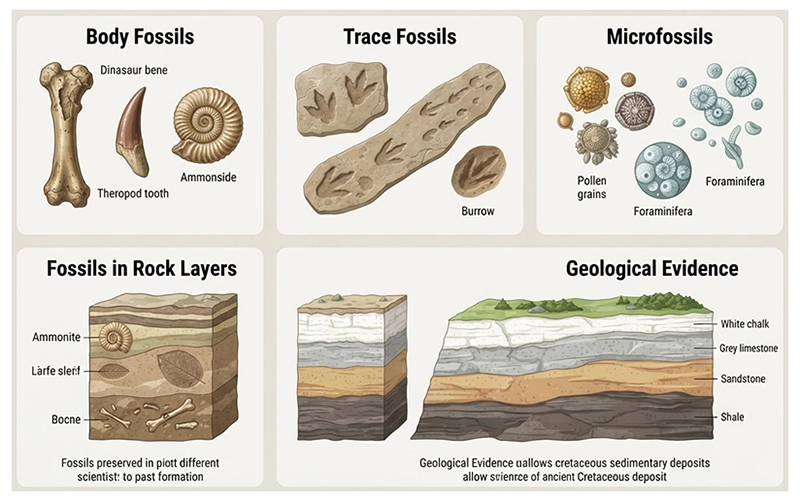
Fossils provide direct evidence of the organisms that lived during the Cretaceous. Scientists study bones, teeth, shells, leaves, pollen, eggs, footprints, and other preserved remains to reconstruct ancient environments.
Body fossils preserve parts of organisms, such as skeletons, teeth, or shells. Dinosaur bones can reveal information about anatomy, growth, and movement, while tooth shapes provide clues about feeding habits.
Trace fossils record activities rather than body structures. Footprints and trackways can indicate the direction of movement and sometimes provide evidence of how animals moved across a surface. Burrows and fossilized droppings also reveal aspects of ancient behavior and ecology.
Microfossils, including pollen, spores, and the remains of marine microorganisms, are valuable for identifying changes in vegetation and reconstructing ancient environments. Their abundance in some sedimentary deposits makes them useful for comparing rock layers across distant regions.
Geologists establish the ages of Cretaceous deposits through relative dating and radiometric dating. Relative dating uses the sequence of rock layers and their fossil content, while radiometric dating estimates numerical ages by measuring radioactive decay in suitable minerals.
Cretaceous chalk deposits provide another important source of geological evidence. The White Cliffs of Dover in England, for example, contain chalk formed largely from microscopic marine organisms.
By combining fossil discoveries with geological and chemical analyses, researchers can reconstruct ancient landscapes and investigate how Earth's environments changed over millions of years.
The End-Cretaceous Mass Extinction
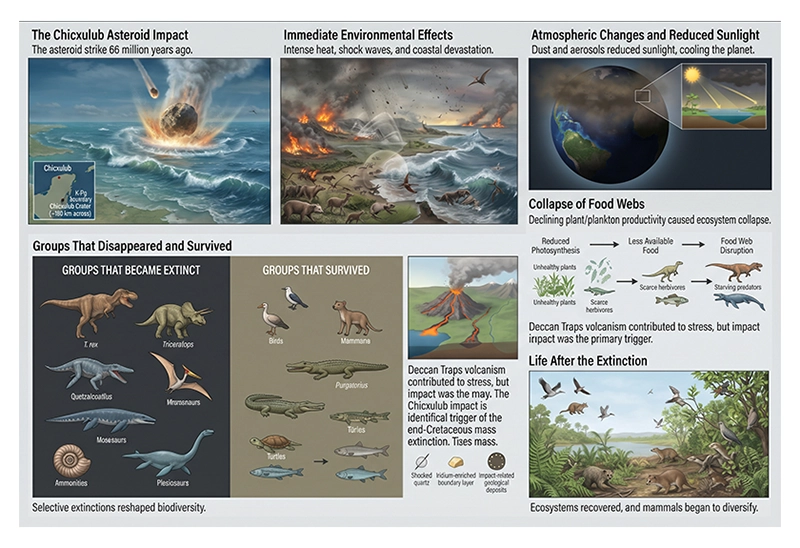
The Cretaceous Period ended approximately 66 million years ago with a major mass extinction known as the Cretaceous–Paleogene, or K–Pg, extinction. It eliminated all non-avian dinosaurs, pterosaurs, ammonites, mosasaurs, and numerous other organisms.
The strongest evidence identifies a large asteroid impact near the present-day Yucatán Peninsula in Mexico as the principal trigger. The collision created the Chicxulub crater, which is approximately 180 kilometers across.
Scientists have found impact-related geological evidence, including shocked quartz, distinctive mineral deposits, and a globally distributed boundary layer enriched in iridium. These findings strongly support the conclusion that a major extraterrestrial impact occurred at the end of the Cretaceous.
The impact released enormous energy and caused severe environmental disruption. Material thrown into the atmosphere reduced the sunlight reaching Earth's surface, interfering with photosynthesis. As plant and plankton productivity declined, food supplies became less reliable, affecting herbivores and the predators that depended on them.
The impact also caused intense heating near the impact region, widespread disturbances, and major changes to marine environments. The exact severity of individual effects varied by location.
Large volcanic eruptions in India produced the Deccan Traps during the Late Cretaceous. These eruptions released gases that influenced climate, and researchers continue to investigate their role in environmental stress around the extinction boundary.
Although volcanic activity may have contributed to the broader environmental conditions, the Chicxulub impact is identified as the principal trigger of the end-Cretaceous mass extinction.
What Happened After the Cretaceous Period?
The Paleogene Period began approximately 66 million years ago, immediately after the Cretaceous ended. This transition marked the beginning of the Cenozoic Era.
The extinction disrupted terrestrial and marine ecosystems, eliminating many species and changing food webs. Recovery took place over different timescales depending on the environment and the organisms involved.
Mammals diversified over the following millions of years as surviving lineages occupied ecological opportunities left by extinct animals. Some groups developed larger bodies, while others specialized in different feeding strategies and habitats.
Birds also diversified, developing adaptations for swimming, running, flying, and feeding on different resources. Their survival provides the direct evolutionary connection between the Cretaceous dinosaurs and modern birds.
Flowering plants persisted through the extinction, although many plant communities experienced substantial disruption. Over time, surviving plant lineages diversified and continued to shape terrestrial ecosystems.
The recovery was not immediate or uniform. It depended on environmental stability, food availability, competition, and the characteristics of surviving organisms.
The transition from the Cretaceous to the Paleogene illustrates how mass extinction can reshape biodiversity while also creating opportunities for surviving groups to diversify over geological time.
How Scientists Study the Cretaceous Today
Modern research combines paleontology, geology, chemistry, biology, and computer science to investigate the Cretaceous Period.
Computed tomography, or CT scanning, allows scientists to examine internal fossil structures without completely removing surrounding rock. Digital reconstruction can reveal hidden bones and provide detailed models for anatomical comparisons.
Chemical analysis of rocks, fossils, and microscopic remains helps researchers investigate ancient climates, diets, and environmental conditions. Isotope measurements can provide information about past temperatures and water conditions, although results depend on the type and preservation of the material.
Computer models allow scientists to test hypotheses about dinosaur movement, ocean circulation, climate change, and the environmental effects of the Chicxulub impact. These models depend on available evidence and assumptions, so their results must be interpreted carefully.
Researchers also compare fossils from different continents to investigate how organisms were distributed and how populations changed as landmasses separated. Similarities may reveal historical connections, while differences can indicate evolutionary isolation or distinct environmental conditions.
By combining these methods, scientists continue to refine the geological timeline and improve our understanding of ancient biodiversity.
Conclusion
The Cretaceous Period was a defining chapter in Earth's history. Over approximately 79 million years, continents moved toward their modern positions, climate and sea levels changed, and ecosystems developed through the evolution of dinosaurs, mammals, insects, birds, and flowering plants.
Marine reptiles and ammonites flourished in ancient oceans, while flowering plants diversified across terrestrial environments. Fossils and geological deposits preserve evidence of these changes, allowing scientists to reconstruct the history of ancient life.
The period ended with the Chicxulub asteroid impact and a mass extinction that eliminated non-avian dinosaurs and many other organisms. Birds survived, mammals later diversified, and flowering plants continued to shape terrestrial ecosystems.
Studying the Cretaceous helps explain not only how prehistoric life evolved but also how geological processes and environmental disruptions influence biodiversity over millions of years.
The Cretaceous was the final period of the Mesozoic Era, lasting approximately 145 million to 66 million years ago. It was marked by diverse dinosaurs, the diversification of flowering plants, changing continental geography, and a major mass extinction.
The Cretaceous lasted approximately 79 million years.
Examples include Tyrannosaurus rex, Triceratops, Velociraptor, hadrosaurs, ankylosaurs, and titanosaurs. These groups lived at different times and in different regions.
The climate was generally warm, with elevated atmospheric carbon dioxide during much of the period. Regional temperatures, rainfall, and seasonal conditions varied significantly.
Yes. Flowering plants appeared in the fossil record by the Early Cretaceous and diversified substantially during the period.