
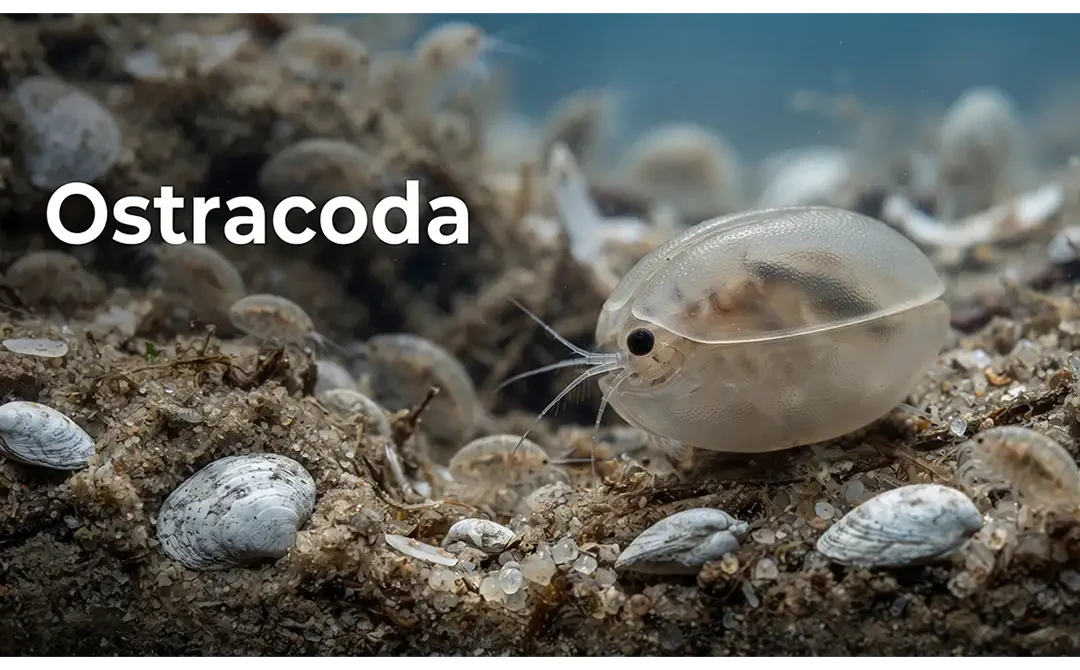
Ostracoda are tiny aquatic crustaceans known for their distinctive two-valved shells, diverse habitats, and remarkable fossil record. Commonly called seed shrimp, these animals live in oceans, rivers, lakes, ponds, and other aquatic environments. Although most are only a few millimeters long, they play important roles in aquatic food webs and help scientists investigate ancient environments.
Ostracods belong to the phylum Arthropoda, which also includes insects, spiders, and other crustaceans. Their bodies are protected by a hard outer covering called a carapace, made of two hinged valves that resemble the halves of a small clam shell. Unlike clams, however, ostracods are crustaceans with jointed appendages.
Scientists study both living ostracods and their fossilized remains. Modern species help researchers understand aquatic ecosystems, while fossil ostracods provide evidence about past climates, water conditions, and geological history. Their small size, widespread distribution, and often well-preserved shells make them valuable subjects in biology, ecology, geology, and paleontology.
What Are Ostracoda?
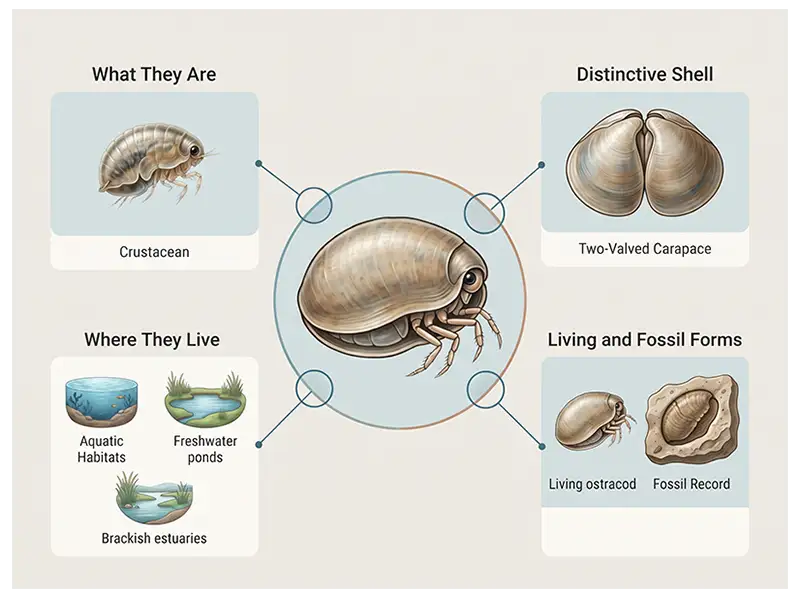
Ostracoda is a group of small crustaceans commonly known as ostracods or seed shrimp. They are members of the subphylum Crustacea within the phylum Arthropoda. Their name is associated with their shell-like outer covering, which protects most of the soft body.
An ostracod's carapace consists of two valves connected along a hinge. When the valves close, they enclose most of the animal, creating a compact shape that often resembles a tiny seed. This appearance explains the common name seed shrimp.
Ostracods occur in a wide range of aquatic environments. Many species live on or within bottom sediments, while others swim or drift in the water column. They can be found in marine waters, freshwater habitats, and brackish environments where freshwater mixes with seawater.
Although ostracods are crustaceans, they differ from familiar animals such as crabs, lobsters, and shrimp. Their bodies are much smaller and are largely enclosed by the carapace. Their jointed limbs extend through openings between the valves and help them move, feed, and sense their surroundings.
Scientists have identified thousands of living and fossil ostracod species. Their wide distribution and long evolutionary history make them important for understanding the development of aquatic life and changes in Earth's environments.
What Are the Main Characteristics of Ostracoda?
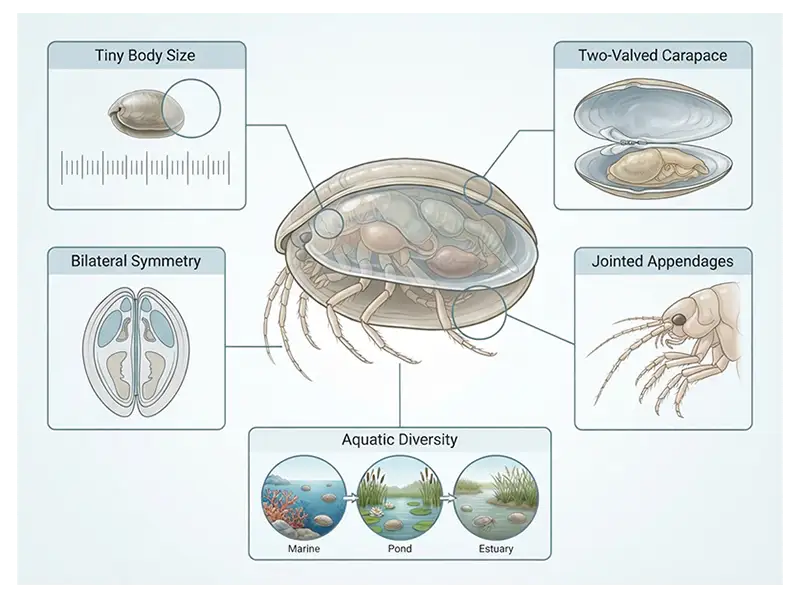
Ostracods share several recognizable characteristics, although their appearance and behavior vary among species. Their small size and protective carapace are among their most distinctive features.
Small body size
Most ostracods are tiny, commonly measuring around 0.1 to 2 millimeters in length. Some species are larger, and a few reach sizes well beyond this usual range. Their small bodies allow many species to occupy spaces between sediment grains or live among aquatic plants.
Two-valved carapace
The most recognizable feature is the carapace, which consists of two valves covering the body. In many species, the valves contain calcium carbonate, making them relatively hard. The shape, surface texture, and ornamentation of these valves differ among groups.
Bilateral symmetry
The body has bilateral organization, meaning its left and right sides broadly correspond. The two valves enclose the animal from either side, although the valves may differ slightly in shape or size.
Jointed appendages
Like other arthropods, ostracods have jointed appendages. These structures perform several functions, including locomotion, feeding, and sensing environmental conditions. Their number and form vary across ostracod lineages.
Aquatic adaptations
Ostracods are primarily aquatic animals. Their structures and behaviors reflect different ways of living in water, from crawling across sediment to swimming among plankton. Some species tolerate a broad range of conditions, while others survive only within narrower environmental limits.
Variable appearance
Ostracod shells may be smooth, rounded, elongated, or decorated with ridges and other surface features. These differences help researchers distinguish species, particularly in fossil material where the hard valves may be preserved even when the soft body is lost. Together, these traits identify ostracods as a diverse group of small crustaceans rather than a single uniform type of aquatic animal.
How Is an Ostracod's Body Structured?
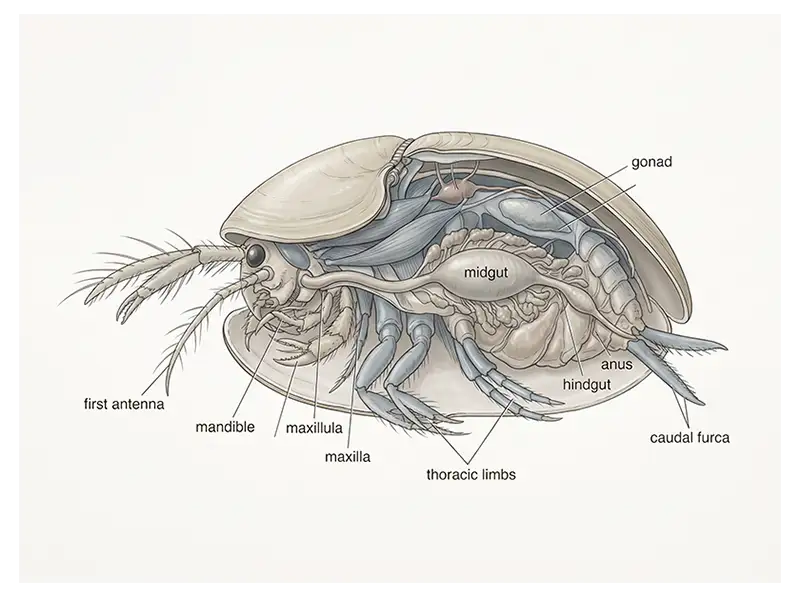
An ostracod's body is compact and largely enclosed within its carapace. Its anatomy differs from that of larger crustaceans because many body regions are shortened or difficult to distinguish externally.
The carapace and valves
The carapace forms the outer protective covering. It consists of two valves joined along a hinge, usually along the dorsal side. The valves can open slightly to allow appendages to extend and close when the animal needs protection.
In many ostracods, the valves contain calcite, a mineral form of calcium carbonate. The outer surface may have growth lines, pores, ridges, or other features. These details can be important for identifying species.
The head and trunk
The head bears several important sensory and feeding structures. The trunk is relatively compact compared with the bodies of many other crustaceans. Because the carapace covers much of the animal, its body segments are not always clearly visible from the outside.
Antennae and sensory structures
Ostracods possess antennae that help them detect their surroundings. Depending on the species, these appendages can contribute to movement as well as sensory functions. Other sensory structures help the animal respond to food, obstacles, and environmental changes.
Feeding appendages
Specialized mouthparts and associated limbs help ostracods collect and process food. Their exact structure depends on their feeding habits. A species that grazes on surface material may use its appendages differently from one that captures animal prey.
Locomotory limbs
Ostracods use their appendages to crawl, swim, or move through sediment. Some swim by extending their limbs beyond the valves, while others spend much of their time moving along surfaces or remaining within the substrate.
Internal organs
Inside the carapace are the digestive tract, reproductive organs, muscles, and other soft tissues. Muscles help operate the valves and move the appendages. The digestive system processes food, while reproductive structures support egg production or sperm transfer, depending on the species.
This arrangement allows ostracods to combine a protected body with flexible appendages that support feeding, movement, and survival in many different aquatic habitats.
What Are the Main Groups of Ostracoda?
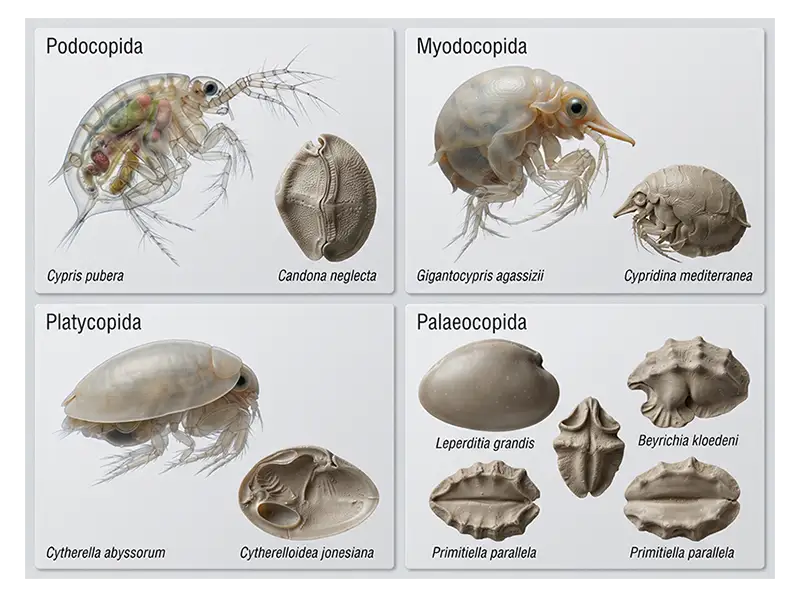
Ostracods include many lineages with differences in shell shape, appendage structure, movement, and lifestyle. Scientists classify them using features of their anatomy, carapace, soft parts, and evolutionary relationships. Classification systems can change as new evidence becomes available, so the names and boundaries of some groups vary among references.
Podocopida
Podocopida is one of the major groups of ostracods. Many members live on or near the bottom of aquatic environments, including marine and freshwater habitats. Their valves often preserve useful details of shape and surface ornamentation, making this group especially important in fossil studies.
Myodocopida
Myodocopida includes ostracods with distinctive appendage structures and varied lifestyles. Many are marine, and some can swim actively rather than remaining close to the bottom. Certain species in this group are bioluminescent, producing light through chemical reactions.
Platycopida
Platycopida is another recognized ostracod group. Its members have distinctive anatomical and shell features used in classification. Researchers examine both living forms and fossil material to understand the group's diversity and evolutionary relationships.
Other ostracod lineages
Ostracod diversity extends beyond these examples. Other recognized groups include Cypridocopina and several additional lineages, depending on the classification system used. Some groups are mainly associated with freshwater, while others are predominantly marine.
These categories describe evolutionary relationships, not a simple ranking from primitive to advanced. Each lineage has its own history, and scientists continue to refine ostracod classification using morphological and molecular evidence.
Where Do Ostracoda Live?
Ostracods occupy nearly every major type of aquatic environment. Their distribution depends on factors such as salinity, temperature, oxygen availability, water movement, food supply, and the nature of the surrounding sediment.
Marine environments
Many ostracods live in the oceans, from shallow coastal waters to deeper marine settings. Coastal species may inhabit tidal flats, seagrass beds, coral reef sediments, and estuaries. Other species occur in deep-sea sediments, where environmental conditions can be very different from those near the surface.
Marine ostracods vary in their lifestyles. Some crawl across the seabed, some live within sediment, and others swim in the water column. The type of habitat influences which species can survive in a particular location.
Freshwater habitats
Numerous ostracod species live in lakes, ponds, streams, rivers, and temporary pools. They may occur among aquatic plants, on submerged surfaces, or between sediment grains. Some freshwater species can colonize newly formed or seasonal bodies of water when conditions are suitable.
Temporary pools present special challenges because they may dry out. Certain ostracods produce resistant eggs or other durable stages that help their populations survive unfavorable periods, although survival strategies differ among species.
Brackish water
Brackish environments contain mixtures of freshwater and seawater. Estuaries, coastal lagoons, and some tidal wetlands provide these conditions. Ostracod species found there vary in their tolerance of changing salinity.
Some species can survive substantial fluctuations in salt concentration, while others are restricted to narrower ranges. For this reason, ostracod communities can change when river flow, evaporation, tides, or marine influence alters the water.
Life on and within sediments
Many ostracods are associated with the bottom of aquatic environments. They may crawl over mud, sand, or plant material, or move through spaces between sediment grains. Their distribution can therefore depend on grain size, organic matter, and the availability of shelter.
Other species spend more time swimming or drifting in open water. This difference in lifestyle affects how they find food, avoid predators, and spread through aquatic systems.
What Do Ostracoda Eat, and How Do They Feed?
Ostracods have varied diets. Their food sources depend on their species, habitat, body structures, and the resources available in the surrounding water or sediment. There is no single diet that applies to every ostracod.
Algae and microorganisms
Many ostracods consume algae, microscopic organisms, and material growing on submerged surfaces. They may graze on thin biological films that develop on plants, rocks, and sediment. These food sources can be especially important in shallow waters where light supports algal growth.
Organic debris
Some species feed on detritus, which consists of decaying plant and animal material. This material may contain bacteria and other microorganisms that contribute to its nutritional value. By processing organic debris, ostracods participate in the movement and recycling of nutrients through aquatic ecosystems.
Suspended food particles
Depending on the species, ostracods may collect small particles from the surrounding water. Appendages and mouthparts help move suitable material toward the mouth. The method used to obtain food varies with anatomy and lifestyle.
Predatory feeding
Some ostracods are predators or consume animal material. They may feed on small invertebrates or other available food items. These species have feeding structures and behaviors suited to obtaining animal prey.
How feeding supports survival
Ostracods must find enough food to support growth, molting, and reproduction. Food availability can influence their distribution and population size. Changes in algae, organic matter, or other food resources may therefore affect which species are common in a particular habitat.
Their varied feeding strategies allow ostracods to occupy different ecological roles, from consumers of microscopic plant material to predators of small aquatic animals.
How Do Ostracoda Reproduce and Develop?
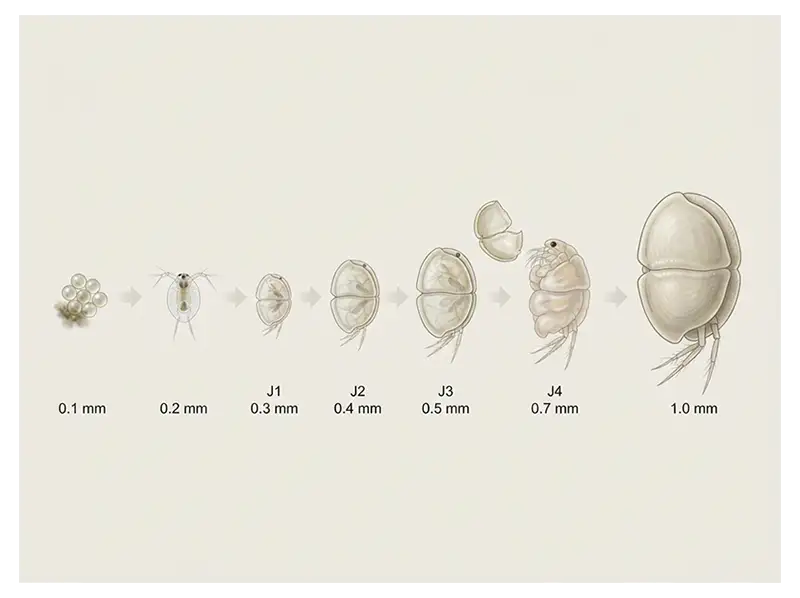
Ostracods reproduce through different strategies. Many species reproduce sexually, while others can produce offspring without fertilization through a process called parthenogenesis. The reproductive method varies across lineages and environmental conditions.
Sexual reproduction
In sexually reproducing species, males and females contribute to the formation of offspring. Males transfer sperm to females, and fertilization occurs according to the reproductive biology of the species. Females produce eggs that may be released into the environment or retained for some period.
The number of eggs, their placement, and the timing of reproduction differ among species. Some reproduce during favorable seasons, while others can reproduce more frequently when conditions allow.
Parthenogenesis
Parthenogenesis is a form of reproduction in which eggs develop without fertilization. This strategy occurs in some ostracods and can allow populations to reproduce even when males are rare or absent.
It does not characterize every ostracod. Some lineages reproduce sexually, some include both sexual and parthenogenetic species, and reproductive patterns can differ among populations.
Juvenile development
Young ostracods generally hatch in an immature form and grow through a series of stages. Like other crustaceans, they undergo molting, shedding the old external covering as they increase in size. A new, larger carapace forms during development.
Because the hard outer covering cannot expand continuously like soft tissue, molting is necessary for growth. The number and timing of juvenile stages vary among species.
Environmental influences
Temperature, food availability, salinity, and the duration of favorable conditions can affect development and reproductive success. In temporary aquatic habitats, resistant eggs or other durable stages help certain species persist when water becomes scarce or conditions become unsuitable.
These different strategies help ostracods maintain populations across environments that may change considerably over time.
What Is the Fossil History of Ostracoda?
Ostracods have a long fossil record extending back at least to the Ordovician Period, more than 450 million years ago. Their fossils occur in sedimentary rocks formed in many different aquatic environments. Over geological time, ostracods diversified into numerous forms, and their remains became part of the fossil record.
Early fossil evidence
Early ostracod fossils are important for understanding the development of small crustaceans in ancient marine ecosystems. Fossil identification can be challenging because early forms may be known mainly from isolated valves, and some very old shell-like fossils have uncertain relationships.
For that reason, the earliest widely accepted record is generally discussed cautiously rather than assuming every ancient bivalved microfossil was an ostracod.
Diversification through geological time
Ostracods persisted through many major changes in Earth's history. Their fossil record includes forms from the Paleozoic, Mesozoic, and Cenozoic eras. Different groups became common in different settings, and their abundance and diversity changed as environments and ecosystems evolved.
Their history is not a simple, uninterrupted rise in diversity. Some lineages disappeared, others expanded, and many modern forms have evolutionary histories that differ from those of earlier groups.
Why their shells fossilize well
The carapace of many ostracods contains calcium carbonate. When an ostracod dies, its valves may settle into sediment and become buried. If conditions favor preservation, the valves can remain in the rock record long after the soft body has decayed.
The two valves may remain together or become separated during transport and burial. Fossil samples often contain numerous isolated valves, so researchers examine their shape, surface features, and abundance to identify the organisms represented.
Ostracods in sedimentary rocks
Ostracod fossils occur in many kinds of sedimentary deposits, including rocks formed in marine, lake, lagoon, and other aquatic settings. Their occurrence depends on the original habitat as well as transport, burial, preservation, and later geological changes.
Because their valves are small, ostracods are often studied with magnification. Even tiny differences in valve form can help scientists distinguish species and compare fossil assemblages from different rock layers.
What Can Ostracod Fossils Reveal About Ancient Environments?
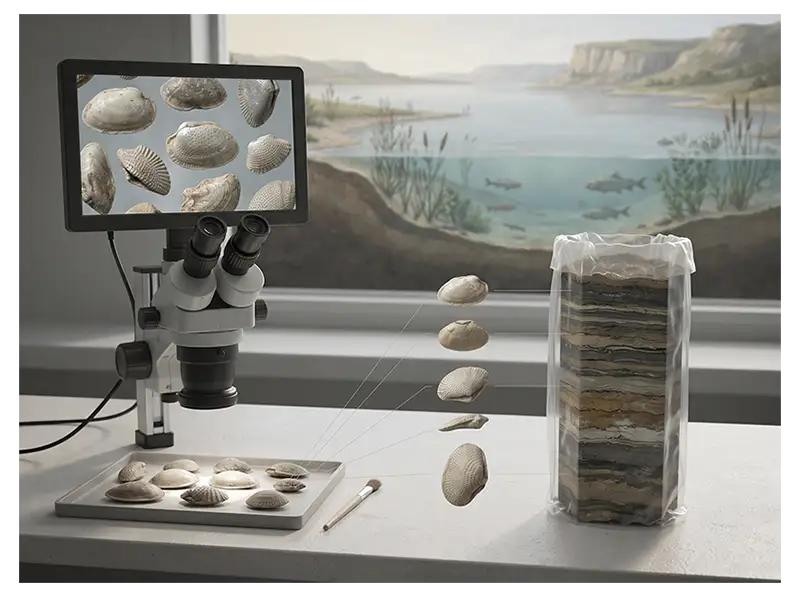
Fossil ostracods can help scientists reconstruct conditions that existed when sediment accumulated. Their value comes from the environmental preferences of living species, differences among fossil assemblages, and information preserved in their shells. However, no single ostracod fossil provides a complete picture of an ancient environment.
Salinity and water conditions
Different ostracod species tolerate different concentrations of dissolved salts. A fossil assemblage dominated by species associated with freshwater may support an interpretation of a lake or river environment, while other assemblages may indicate marine or brackish conditions.
These conclusions require care. Some species tolerate broad salinity ranges, and fossils may have been transported away from where the animals lived. Researchers therefore consider the entire assemblage and the surrounding sediment rather than relying on one species alone.
Water depth and habitat
The species found in a sediment layer can provide clues about whether the original environment was shallow, coastal, offshore, or associated with a lake. Some ostracods are linked to particular bottom conditions, while others occupy a wider range of habitats.
Shell evidence becomes more reliable when it agrees with other indicators, such as sediment grain size, sedimentary structures, and associated fossils. Together, these observations help reconstruct the setting in which the deposit formed.
Temperature and climate
Ostracod assemblages can provide information about past climate when researchers understand the environmental requirements of the species involved. In some cases, chemical measurements from well-preserved shells also help investigate ancient water conditions.
For example, oxygen isotope measurements may contribute to estimates of past temperature or changes in the isotopic composition of water. Yet these values can be affected by several factors, including salinity, water chemistry, species-specific biology, and later alteration of the shell.
Oxygen levels and ecosystem change
The composition of an ostracod community can sometimes help researchers investigate oxygen conditions near the bottom of a water body. Species differ in their environmental tolerances, so changes in the assemblage may indicate changes in habitat quality.
Such interpretations need supporting evidence because oxygen conditions interact with organic matter, water circulation, temperature, and sediment type. Ostracods are most useful when their evidence is evaluated alongside other biological and geological indicators.
Reconstructing change over time
By comparing ostracod assemblages in successive sediment layers, scientists can identify changes in the aquatic environment. A shift in species composition may indicate a change in salinity, water depth, temperature, or other conditions.
These comparisons help researchers investigate the history of lakes, coastal basins, and ancient seas. The strongest interpretations combine fossil evidence, sedimentology, geochemistry, and knowledge of modern ostracod ecology.
Why Are Ostracoda Important to Science and the Environment?
Ostracods are important because they contribute to living ecosystems and provide evidence that scientists can use to study sedimentary rocks and environmental change. Their applications extend across ecology, paleontology, geology, and some areas of petroleum exploration.
Role in aquatic food webs
Ostracods form part of the food supply for various aquatic predators, including small fish and invertebrates. By consuming algae, microorganisms, and organic material, they also transfer energy and nutrients through aquatic food webs.
Their ecological importance varies with their abundance, species, and habitat. In some environments, they are a noticeable component of small-animal communities; in others, their role may be more limited.
Biostratigraphy and geological correlation
Biostratigraphy uses fossils to compare and help determine the relative ages of rock layers. Some ostracod species existed during relatively limited intervals or were associated with particular geological settings. Their fossils can therefore help geologists correlate sedimentary deposits from different locations.
This method is most effective when the species can be identified reliably and its geological distribution is sufficiently well known. Ostracods are often used alongside other fossil groups rather than as the sole basis for dating a rock layer.
Petroleum exploration and sedimentary geology
Ostracod fossils can help researchers interpret the depositional environments of sedimentary rocks. This information may contribute to understanding ancient lakes, marine basins, and other settings in which organic-rich sediments accumulated.
In petroleum exploration, ostracod assemblages can support interpretations of basin history and environmental conditions. They are one source of geological evidence among many, and their presence alone does not establish whether a rock contains commercially recoverable oil or gas.
Monitoring modern environmental change
Living ostracod communities can respond to changes in salinity, temperature, oxygen availability, pollution, and habitat structure. Researchers may examine which species are present and how their populations change across locations or through time.
Ostracods are not universal indicators of every environmental problem. Their usefulness depends on the species involved, local conditions, and the availability of reliable baseline information. Properly interpreted, however, they can contribute to assessments of aquatic ecosystem health.
Paleoclimate research
Fossil assemblages and the chemistry of well-preserved ostracod valves can provide evidence about past water conditions. Researchers use this information to investigate long-term environmental shifts that cannot be observed directly today.
These records are especially valuable when compared with independent evidence, such as other microfossils, sediment layers, and geochemical measurements. Combining different sources helps scientists distinguish genuine environmental signals from preservation effects and other uncertainties.
What Makes Some Ostracods Unusual?
Although ostracods are generally inconspicuous because of their size, some have unusual adaptations and behaviors that make them especially interesting to researchers.
Some ostracods produce light
Certain marine ostracods, including species in the genus Vargula, can produce blue light through bioluminescence. They release light-producing chemicals into the surrounding water, creating a brief glowing display.
Bioluminescence can be involved in behaviors such as communication, mating, or defense, depending on the species. It is not a feature of all ostracods, and many species do not produce visible light.
Their shells vary greatly in shape
Ostracod valves can be rounded, elongated, flattened, or decorated with ridges and other structures. These variations reflect differences among species and can be useful for identification.
Some fossil valves preserve fine surface details even when the rest of the animal is missing. This makes ostracods particularly interesting to paleontologists studying microscopic fossils.
Some species reproduce without males
Parthenogenesis allows certain ostracod species to produce offspring without fertilization. In populations where this strategy occurs, reproduction can continue even when males are absent.
The pattern is not universal, and sexual reproduction remains important in many ostracod lineages. The variety of reproductive systems provides researchers with opportunities to investigate how different strategies persist in changing environments.
They can survive in temporary habitats
Some freshwater ostracods occupy pools and other habitats that dry out periodically. Resistant eggs or dormant stages can help particular species survive unfavorable conditions and resume development when water returns.
This adaptation is especially useful in environments where water availability changes seasonally. The details differ among species, so not every ostracod can survive drying in the same way.
They connect modern biology with ancient geology
Ostracods are both living animals and a well-established group in the fossil record. Researchers can compare modern species with fossil forms to investigate how their anatomy, distribution, and diversity have changed through time.
Their combination of small size, varied lifestyles, and preservable valves makes them a valuable group for linking biological research with the study of Earth's past.
Conclusion
Ostracoda are a diverse group of small crustaceans distinguished by their two-valved carapace, varied lifestyles, and ability to inhabit many types of aquatic environments. Their biology includes different feeding strategies, reproductive systems, and adaptations to conditions ranging from stable marine habitats to temporary freshwater pools.
Their importance extends beyond the living world. Ostracod fossils preserve evidence of ancient aquatic communities and help scientists investigate the conditions under which sedimentary rocks formed. When combined with other fossils, sedimentary evidence, and geochemical data, they can contribute to reconstructions of past environments and geological change.
Despite their tiny size, ostracods offer valuable insights into both modern ecosystems and Earth's long history. Their study demonstrates how small organisms can provide significant evidence for understanding biological diversity, environmental change, and the fossil record.
Ostracods are crustaceans, not insects. They belong to the phylum Arthropoda and have jointed appendages. Their two-valved carapace is one of their most recognizable features.
Most ostracods measure approximately 0.1–2 millimeters long, although some species are considerably larger. Their small size means they often require a microscope or magnifying equipment for detailed examination.
Yes. Many ostracod species live in freshwater habitats such as lakes, ponds, streams, and rivers. Others inhabit marine or brackish environments, and each species has its own environmental tolerances.
Yes. Ostracods are a living and diverse group found in aquatic environments around the world. Scientists study modern species to understand their biology, ecological relationships, and responses to environmental conditions.
Their fossilized valves can help researchers correlate sedimentary rock layers and investigate ancient aquatic environments. Some species are useful in biostratigraphy, while fossil assemblages and shell chemistry can provide clues about past water conditions.