
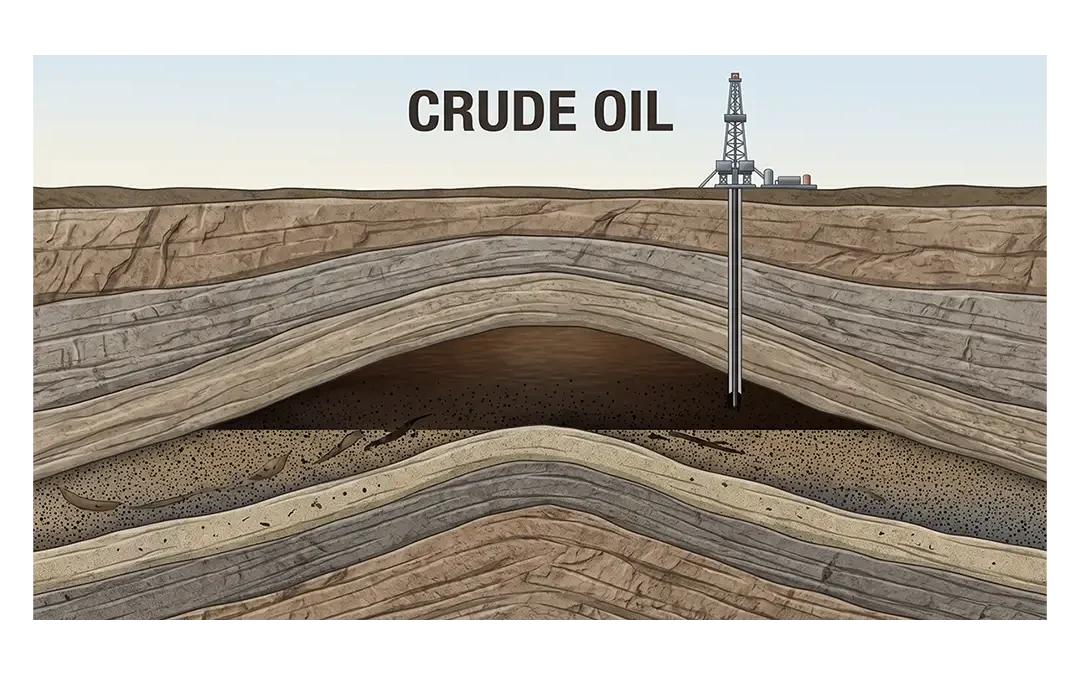
Crude oil is one of the most important natural resources on Earth. It is a naturally occurring liquid made mainly of hydrocarbons. It forms deep beneath Earth's surface from ancient organic matter over millions of years. Today, crude oil provides raw materials for fuels, chemicals, plastics, lubricants, asphalt, and many other products.
Crude oil is also an important subject in geology because its formation depends on sedimentary rocks, organic matter, heat, pressure, migration, and geological traps. After extraction, crude oil is transported to refineries, where it is separated and processed into different useful products.
What Is Crude Oil?
Crude oil is a naturally occurring, unrefined liquid mixture of hydrocarbons found beneath Earth's surface. It is also called crude petroleum. The term "crude" means that the material has not yet been processed or refined.
Crude oil does not have the same composition everywhere. Its color, thickness, density, and chemical composition can vary depending on where it formed and the geological conditions it experienced.
The main components of crude oil are hydrocarbons, which contain mainly carbon and hydrogen. However, crude oil can also contain smaller amounts of sulfur, nitrogen, oxygen, metals, salts, and other compounds.
Crude oil usually occurs within the pores of underground rocks. It is not normally stored in large underground caves or empty lakes. Instead, oil occupies tiny spaces within porous rocks called reservoir rocks.
Once crude oil is extracted from the ground, it is transported to a refinery. Refineries separate and process the different components of crude oil to produce useful fuels and materials.
Crude oil is considered a fossil fuel because most conventional crude oil formed from ancient organic material that was buried and transformed over geological time.
How Does Crude Oil Form?
Crude oil forms through a long geological process that takes millions of years. The process begins with organic matter, especially microscopic organisms such as algae and plankton.
When these organisms die, their remains can settle in environments such as ancient seas, lakes, and other sediment-rich areas. Under suitable conditions, some of this organic material becomes buried before it completely decomposes.
As more sediment accumulates, the organic material becomes buried deeper. Heat and pressure increase with depth, causing physical and chemical changes in the buried material.
Organic Matter Accumulation
The first stage is the accumulation of organic matter. Microscopic organisms live in oceans and lakes and eventually die. Their remains can settle on the bottom and mix with fine sediments.
An environment with limited oxygen can help preserve more organic material. This is especially important for the formation of organic-rich sedimentary rocks.
Burial by Sediments
Over time, layers of sediment build up above the organic-rich material. The increasing weight of these sediments pushes the material deeper into Earth's crust.
As burial continues, temperature and pressure gradually increase.
Formation of Kerogen
During burial, the preserved organic matter undergoes chemical changes and eventually forms kerogen. Kerogen is a complex organic material found in many organic-rich sedimentary rocks. It is an important source material for the formation of petroleum and natural gas.
Hydrocarbon Generation
As the temperature increases with deeper burial, kerogen begins to break down and generate hydrocarbons. Under suitable temperature conditions, commonly associated with the oil window, kerogen can produce liquid petroleum. At still higher temperatures, the organic material can generate more natural gas.
The exact temperature range varies depending on the type of organic matter and geological conditions.
Migration
Once hydrocarbons form, they can move through pores, fractures, and permeable pathways in rocks. This movement is known as hydrocarbon migration.
Oil can move away from its source rock and travel toward a reservoir rock where it may accumulate.
Accumulation in Reservoirs
For a commercial oil accumulation to develop, several geological conditions must work together.
A typical petroleum system includes:
- Source rock: Generates hydrocarbons.
- Reservoir rock: Stores hydrocarbons in its pores.
- Seal or cap rock: Prevents hydrocarbons from escaping.
- Trap: Provides a geological structure where hydrocarbons can accumulate.
When these conditions occur in the right sequence and location, crude oil can accumulate in an underground reservoir.
Where Is Crude Oil Found?
Crude oil is mainly found in sedimentary basins. These are large areas where sediments have accumulated over long periods of geological time.
Oil is stored within porous and permeable rocks. Common reservoir rocks include sandstone and limestone. A reservoir rock needs enough pore space to store oil and enough connected pathways to allow fluids to move through it.
However, finding a reservoir rock alone is not enough. The petroleum system must also contain a source rock, a seal, and a suitable trap.
Source Rocks
Source rocks contain enough organic matter to generate hydrocarbons when exposed to suitable temperatures and pressures.
Many important petroleum source rocks are organic-rich mudstones or shales.
Reservoir Rocks
Reservoir rocks contain pores where oil and natural gas can accumulate.
Sandstone and limestone are common reservoir rocks because they can develop suitable porosity and permeability.
Cap Rocks
A cap rock is a relatively impermeable layer that prevents oil and gas from continuing to migrate upward.
Shale and other low-permeability rocks can act as effective seals.
Geological Traps
A geological trap is a structure or arrangement of rocks that allows migrating hydrocarbons to accumulate.
Common traps include fold traps, fault traps, and stratigraphic traps.
Major Oil-Producing Regions
Crude oil occurs in many parts of the world. Major petroleum-producing regions include:
- The Middle East
- North America
- South America
- Russia and Central Asia
- Africa
- Europe
- Southeast Asia
Oil resources also occur beneath the seabed. Offshore petroleum fields have become an important part of global oil production.
Composition of Crude Oil
Crude oil is a complex mixture of many different chemical compounds. The exact composition varies from one oil field to another. The largest part of crude oil consists of hydrocarbons. These compounds contain carbon and hydrogen atoms arranged in different structures.
Alkanes
Alkanes are hydrocarbons containing mainly single carbon-carbon bonds. They are also known as paraffins. Some alkanes are relatively small molecules and can occur in lighter petroleum fractions, while larger alkanes occur in heavier fractions.
Cycloalkanes
Cycloalkanes are hydrocarbons in which carbon atoms form ring structures. They are also called naphthenes. They are common components of many crude oils.
Aromatic Hydrocarbons
Aromatic hydrocarbons contain one or more special carbon-ring structures. They are naturally present in crude oil in varying amounts.
Some aromatic compounds are useful industrial feedstocks, while certain compounds in this group can be harmful to human health and the environment.
Sulfur Compounds
Crude oil can contain sulfur in different chemical forms. The amount of sulfur is important because sulfur compounds must often be removed during refining to produce fuels that meet modern quality and environmental requirements.
Nitrogen and Oxygen Compounds
Smaller amounts of nitrogen- and oxygen-containing compounds can also occur in crude oil. These substances can affect refinery operations and the properties of petroleum products.
Trace Metals
Some crude oils contain very small amounts of metals such as nickel and vanadium. Although these metals occur in relatively low concentrations, they can affect refinery processes. Because crude oil contains such a wide range of compounds, each crude oil has its own chemical and physical characteristics.
Types of Crude Oil
Crude oil can be classified in several ways. Two common methods are based on density and sulfur content.
Light Crude Oil
Light crude oil has relatively low density and generally flows more easily than heavy crude oil. It often contains a higher proportion of lighter hydrocarbons. Refineries can process these hydrocarbons into valuable products such as gasoline and other light fuels.
Medium Crude Oil
Medium crude oil has properties between light and heavy crude oil. Its exact characteristics depend on its chemical composition and the geological source from which it was produced.
Heavy Crude Oil
Heavy crude oil has higher density and viscosity than light crude oil. Because it is thicker and contains more heavy hydrocarbon molecules, it can require more complex production and refining processes. Some very heavy petroleum resources are extremely viscous and require specialized methods for production and processing.
Sweet Crude Oil
Sweet crude oil contains relatively low amounts of sulfur. It is generally easier to process because less sulfur removal may be required during refining.
Sour Crude Oil
Sour crude oil contains higher amounts of sulfur compounds. Refineries need additional treatment to remove sulfur and produce fuels that meet required specifications. Therefore, crude oil classification is important because its properties affect extraction, transportation, refining, cost, and the types of products that can be produced.
How Is Crude Oil Refined?
Crude oil is not normally used in its natural form for most modern applications. Instead, it is sent to petroleum refineries, where it is separated and processed into useful products.
Refining involves several major steps.
Fractional Distillation
The first major step is usually fractional distillation. In this process, crude oil is heated. Different hydrocarbons have different boiling points, so they separate into groups called fractions.
The heated crude oil enters a distillation column. Lighter hydrocarbons generally move toward the upper part of the column, while heavier materials remain closer to the bottom.
The resulting fractions can then undergo additional processing.
Conversion Processes
Some heavier fractions are not as valuable as lighter fuels. Refineries can use conversion processes to change large hydrocarbon molecules into smaller and more useful molecules.
Important processes include:
- Catalytic cracking
- Hydrocracking
- Coking
- Reforming
These processes help refineries produce fuels and other products that meet market demand.
Treatment
Refineries also remove unwanted compounds and impurities. For example, sulfur can be removed from petroleum fractions to produce cleaner fuels. Treatment also helps improve the quality and performance of refined products.
Blending
Different refined components are blended to produce final products with specific properties. For example, gasoline and diesel must meet particular specifications for performance and environmental standards.
Through these processes, a complex natural mixture becomes a wide range of useful petroleum products.
Major Products Made From Crude Oil
Crude oil is the starting material for many products used in modern life. Transportation fuels are among the most important, but petroleum also provides raw materials for many industrial products.
Gasoline
Gasoline is a major transportation fuel used in many spark-ignition engines.
Diesel Fuel
Diesel fuel is widely used in trucks, buses, heavy machinery, ships, and other applications.
Jet Fuel
Jet fuel is used to power many aircraft. Its properties must meet strict requirements for safe and efficient operation.
Heating Oil
Some petroleum fractions are used as heating fuels and for other energy applications.
Lubricants
Petroleum-based lubricants help reduce friction and wear between moving machine parts.
They are used in vehicles, industrial equipment, engines, and many mechanical systems.
Asphalt
Heavy petroleum materials can be used to produce asphalt. Asphalt is widely used in road construction and roofing applications.
Petrochemical Feedstocks
Crude oil provides important feedstocks for the petrochemical industry.
These materials can be used to produce:
- Plastics
- Synthetic fibers
- Solvents
- Detergents
- Paint-related chemicals
- Industrial chemicals
- Synthetic rubber
Therefore, crude oil is not simply a source of fuel. It is also an important raw material for manufacturing.
Importance of Crude Oil
Crude oil has played a major role in modern economic and industrial development.
Transportation
Petroleum fuels provide energy for many cars, trucks, ships, airplanes, and other transportation systems. This makes crude oil an important part of the global transportation sector.
Industrial Development
Petroleum products and petrochemical feedstocks support many manufacturing industries. Plastics, synthetic materials, chemicals, lubricants, and other products depend partly or completely on petroleum-based raw materials.
Economic Importance
Crude oil is an important global commodity. Oil production, refining, transportation, and trade generate significant economic activity. Countries that produce large quantities of oil can earn substantial revenue from domestic production and exports.
Energy Security
Domestic oil production can help countries meet part of their energy demand. However, international petroleum markets connect oil-producing and oil-consuming countries, so changes in global supply and demand can affect many economies.
Employment
The oil and gas industry supports employment in many fields, including:
- Geology
- Geophysics
- Engineering
- Drilling
- Transportation
- Refining
- Equipment maintenance
- Environmental management
- Research and development
Because of these applications, crude oil remains an important natural resource even as the global energy system changes.
Crude Oil vs. Petroleum
The terms crude oil and petroleum are closely related, but they are not always identical.
Crude oil specifically refers to the naturally occurring liquid hydrocarbon mixture extracted from underground reservoirs. Petroleum is a broader term that can refer to naturally occurring hydrocarbons. Depending on the context, it may include crude oil and related hydrocarbon resources.
A simple way to understand the difference is:
Crude oil is an unrefined liquid hydrocarbon resource, while petroleum is a broader term used for naturally occurring hydrocarbons and, in some contexts, products derived from them.
For example, crude oil can be taken from an underground reservoir and transported to a refinery. The refinery then processes it into petroleum products such as gasoline, diesel, jet fuel, lubricants, and asphalt.
Therefore, crude oil is the raw material, while petroleum is a broader term that can describe the resource and its related products depending on how the term is being used.
Environmental Effects of Crude Oil
Crude oil provides important energy and industrial resources, but its extraction, transportation, refining, and use can affect the environment.
Oil Spills
Oil spills can occur during drilling, transportation, storage, or other petroleum operations. A large spill can contaminate water, soil, beaches, wetlands, and marine ecosystems. It can also harm wildlife and damage habitats.
Air Pollution
Burning petroleum fuels releases several pollutants into the atmosphere. Depending on the fuel and combustion conditions, these emissions can include particulate matter, nitrogen oxides, sulfur compounds, and other air pollutants.
Greenhouse Gas Emissions
The production and use of fossil fuels contribute to greenhouse gas emissions. When petroleum fuels are burned, carbon dioxide is released into the atmosphere. Carbon dioxide is a major greenhouse gas associated with human-caused climate change.
Habitat Disturbance
Oil exploration and production can change natural landscapes. Drilling sites, roads, pipelines, processing facilities, and other infrastructure can disturb habitats and ecosystems.
Soil and Water Contamination
Petroleum leaks and improperly managed waste can introduce hydrocarbons into soil and water. Effective monitoring, waste management, spill prevention, and environmental protection measures can help reduce these risks.
The environmental effects of crude oil are therefore an important reason for improving production practices and developing cleaner energy technologies.
Crude oil consists mainly of hydrocarbons, including alkanes, cycloalkanes, and aromatic hydrocarbons. It can also contain sulfur, nitrogen, oxygen, metals, salts, and other compounds.
Crude oil can be classified by density and sulfur content. Common categories include light, medium, and heavy crude oil, as well as sweet and sour crude oil.
Crude oil is refined into gasoline, diesel, jet fuel, lubricants, asphalt, heating fuels, and petrochemical feedstocks. These materials are used in transportation, manufacturing, construction, and many other industries.
Crude oil is the naturally occurring, unrefined liquid hydrocarbon mixture extracted from underground. Petroleum is a broader term that can refer to naturally occurring hydrocarbons and, depending on the context, related petroleum products.
Yes. Conventional crude oil is considered a fossil fuel because it formed from ancient organic matter through geological processes over millions of years.
Conclusion
Crude oil is a naturally occurring liquid mixture of hydrocarbons that forms through geological processes over millions of years. It develops from ancient organic matter that becomes buried beneath sediments and undergoes chemical changes caused by increasing heat and pressure.
The formation of crude oil requires several geological conditions. Organic-rich source rocks generate hydrocarbons, while migration allows the hydrocarbons to move into reservoir rocks. Geological traps and cap rocks can then allow the oil to accumulate underground.
Crude oil has a complex composition and can be classified into different types based on properties such as density and sulfur content. Light, medium, heavy, sweet, and sour crude oils have different characteristics that influence their production and refining.
After extraction, crude oil is transported to refineries, where processes such as fractional distillation, conversion, treatment, and blending produce useful materials. Gasoline, diesel, jet fuel, lubricants, asphalt, and petrochemical feedstocks are among the major products made from crude oil.
Crude oil has supported transportation, industrial development, international trade, and economic growth. However, oil production and use can also cause environmental problems, including oil spills, air pollution, greenhouse gas emissions, habitat disturbance, and soil and water contamination.
As renewable energy, electric transportation, and other technologies continue to develop, the role of crude oil will gradually change. Understanding its geological formation, uses, importance, and environmental effects helps us better understand one of Earth's most significant natural resources.