
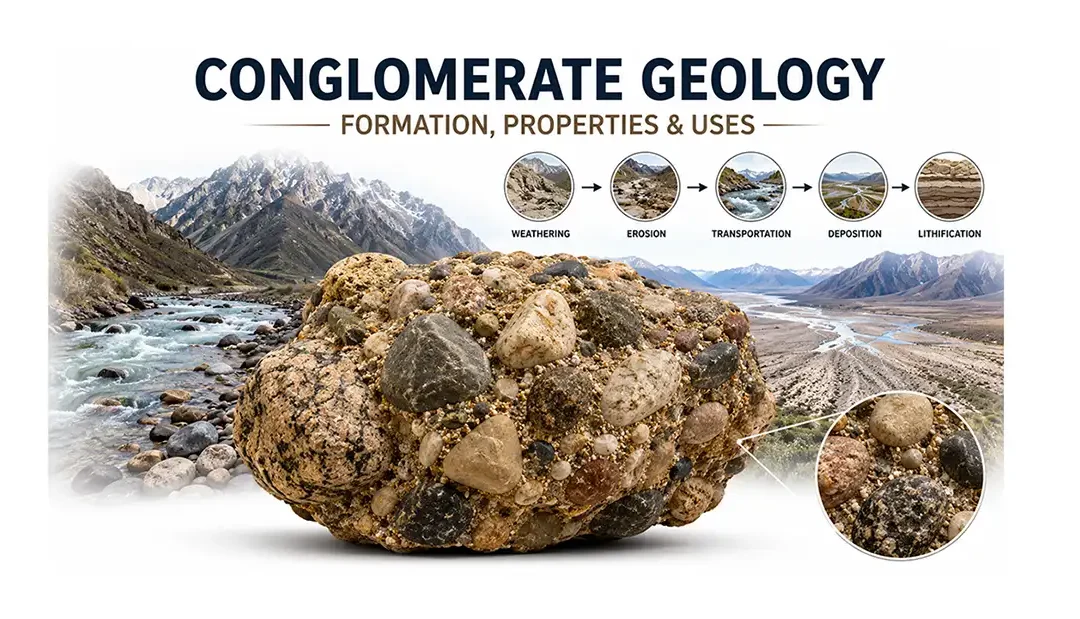
Among the many types of sedimentary rocks, conglomerate is one of the easiest to recognize because of its distinctive appearance. It consists of large, rounded rock fragments cemented together by finer sediments or mineral deposits, giving it a coarse and often colorful texture. These rounded pebbles and cobbles provide valuable clues about the environments in which the rock formed and the geological history of the region.
Conglomerate develops through a series of natural processes that begin with the weathering of older rocks, followed by erosion, transportation, deposition, and finally lithification. Because its clasts are rounded rather than angular, conglomerate indicates that the sediments traveled some distance before being deposited. As a result, geologists frequently use this rock to reconstruct ancient rivers, beaches, alluvial fans, glacial deposits, and other high-energy environments.
Beyond its scientific importance, conglomerate also has practical value. It is used as a decorative building stone, occasionally as construction aggregate, and in petroleum geology where certain conglomerates can serve as excellent reservoir rocks for groundwater, oil, and natural gas.
What Is Conglomerate in Geology?
Conglomerate is a coarse-grained clastic sedimentary rock composed primarily of rounded gravel-sized fragments, known as clasts, that are naturally cemented together by a finer-grained matrix. The clasts are typically larger than 2 millimeters in diameter and may consist of pebbles, cobbles, or even small boulders derived from pre-existing rocks.
The rounded shape of these fragments is one of the defining characteristics of conglomerate. As rock fragments are transported by rivers, waves, glaciers, or other geological agents, repeated collisions and abrasion gradually smooth their sharp edges. By the time the sediments are deposited, the fragments have become well rounded, indicating that they have traveled a considerable distance from their original source.
The spaces between the larger clasts are filled with a matrix of sand, silt, or clay. During lithification, dissolved minerals such as silica, calcite, or iron oxides precipitate from groundwater and act as natural cement, binding the sediments into a solid rock.
Because conglomerate is formed from fragments of older rocks, it belongs to the clastic (detrital) sedimentary rock group. Its composition varies depending on the geology of the source area. For example, a conglomerate formed near granite mountains may contain rounded granite pebbles, while one formed in a volcanic region may contain volcanic rock fragments.
Geologists study conglomerate because it preserves evidence of ancient landscapes, sediment transport, and depositional environments. By examining the size, composition, and roundness of its clasts, they can reconstruct past river systems, coastlines, mountain-building events, and climatic conditions that existed millions of years ago.
How Does Conglomerate Form?
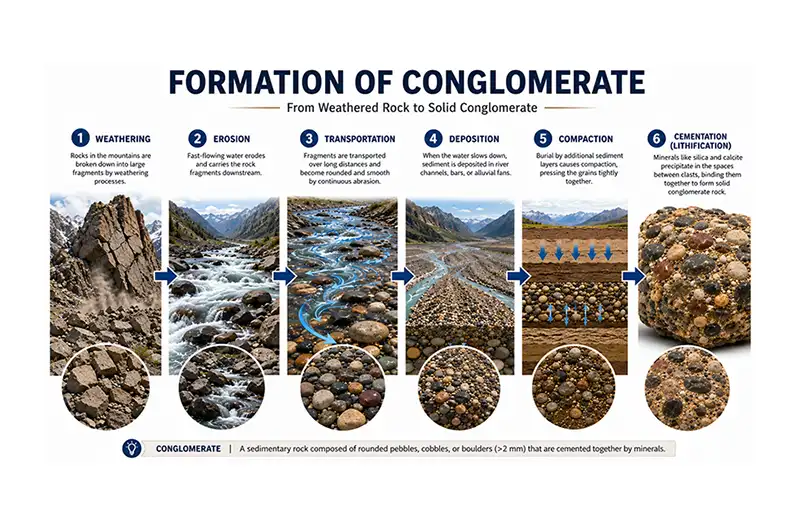
Conglomerate forms through a sequence of geological processes that transform loose rock fragments into a solid sedimentary rock. This process takes place over thousands to millions of years and involves weathering, erosion, transportation, deposition, compaction, and cementation. Each stage plays an essential role in producing the distinctive rounded clasts that make conglomerate easy to identify.
Unlike many fine-grained sedimentary rocks, conglomerate develops in high-energy environments where fast-moving water or glaciers are capable of carrying large rock fragments. The rounded pebbles and cobbles found within the rock provide important evidence of both the transport process and the conditions under which the sediments were deposited.
1. Weathering
The formation of conglomerate begins with weathering, the process that breaks down existing rocks at or near Earth's surface. Physical weathering, such as freezing and thawing, temperature changes, and plant root growth, fractures rocks into smaller pieces. Chemical weathering can also weaken rocks by altering their minerals.
Over time, these processes produce loose fragments ranging from small pebbles to large cobbles and boulders.
2. Erosion
Once rock fragments are produced, they are removed from their original location by erosion. Running water, glaciers, ocean waves, and gravity transport these sediments away from their source.
Among these agents, rivers are the most common transport mechanism for conglomerate-forming sediments because they can carry large gravel-sized particles during periods of strong flow.
3. Transportation
As the rock fragments move downstream or along a coastline, they repeatedly collide with one another and with the riverbed. This continuous abrasion gradually removes sharp edges and smooths the fragments into rounded pebbles and cobbles.
The longer the transport distance, the more rounded the clasts usually become. This is one of the key reasons why conglomerate contains rounded fragments, while breccia contains angular ones.
Transportation also sorts the sediments according to their size and weight. Larger fragments settle sooner, whereas finer particles may travel much farther.
4. Deposition
Eventually, the transporting medium loses enough energy that it can no longer carry the heavy gravel-sized sediments. These materials are then deposited in environments where coarse sediments naturally accumulate.
Common depositional environments include:
- Fast-flowing river channels
- Alluvial fans
- Mountain streams
- Coastal beaches
- Glacial outwash plains
These environments are characterized by strong currents capable of transporting large clasts before depositing them.
5. Compaction
As additional layers of sediment accumulate above the deposited gravel, their increasing weight compresses the lower layers. This process, known as compaction, reduces the pore spaces between sediment grains and brings the particles into closer contact.
Although compaction is important, it has a smaller effect on coarse gravel deposits than it does on fine-grained sediments such as clay.
6. Cementation (Lithification)
The final stage is cementation, also called lithification. Groundwater flowing through the sediment carries dissolved minerals such as silica, calcite, and iron oxides. Over time, these minerals precipitate within the pore spaces, binding the rounded clasts and finer matrix together to form a solid rock.
Once lithification is complete, the loose gravel deposit becomes conglomerate, preserving evidence of the environment in which it formed.
Composition and Characteristics of Conglomerate
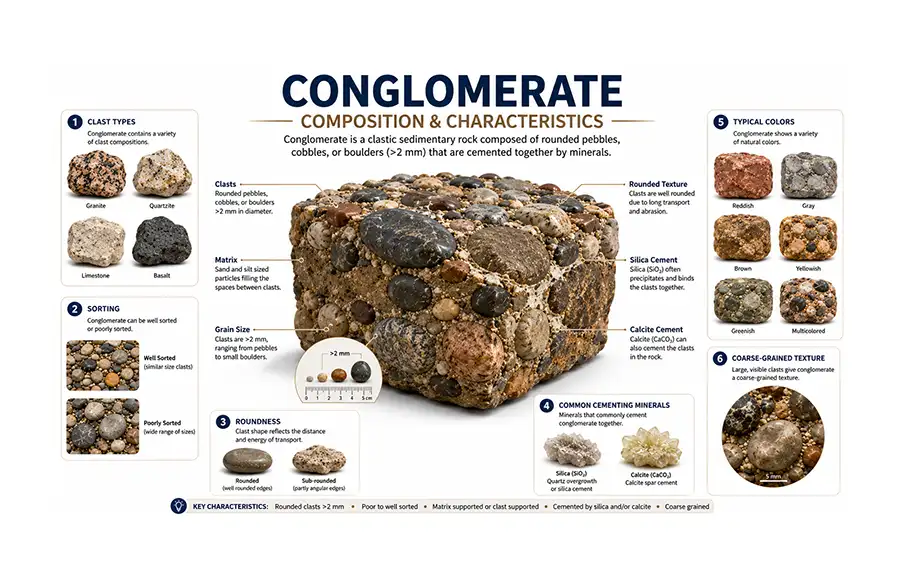
The appearance and properties of conglomerate are determined by the materials from which it is formed. Although all conglomerates contain rounded gravel-sized clasts, their composition can vary significantly depending on the source rocks and the environment in which they were deposited. As a result, no two conglomerates are exactly alike.
Geologists examine the composition, grain size, sorting, matrix, and cement of conglomerate to identify its origin and reconstruct the geological history of an area.
Clasts (Rock Fragments)
The most distinctive feature of conglomerate is the presence of rounded clasts larger than 2 millimeters in diameter. These clasts may include:
- Pebbles (2–64 mm)
- Cobbles (64–256 mm)
- Small boulders (greater than 256 mm)
The clasts can be composed of many different rock types, including:
- Granite
- Quartzite
- Limestone
- Basalt
- Sandstone
- Chert
- Gneiss
Their composition reflects the rocks exposed in the source area where weathering and erosion originally occurred.
Matrix
The spaces between the larger clasts are filled with a finer-grained material known as the matrix.
The matrix commonly consists of:
- Sand
- Silt
- Clay
It helps support the larger clasts and influences the rock's overall texture and appearance. Some conglomerates contain very little matrix, while others are matrix-rich.
Cement
After deposition, groundwater carries dissolved minerals into the sediment. As these minerals precipitate, they bind the grains together in a process known as cementation.
The most common cementing minerals include:
- Silica
- Calcite
- Iron oxides
The type of cement affects the rock's hardness, color, weathering resistance, and durability.
Grain Size
Conglomerate is a coarse-grained sedimentary rock because its clasts are larger than 2 mm. The coarse texture makes individual fragments easy to identify without magnification.
Large grain size indicates that the sediments were deposited in high-energy environments, where strong currents or glaciers could transport heavy rock fragments.
Roundness
One of the most important identifying characteristics of conglomerate is the rounded shape of its clasts.
During transportation, rock fragments collide repeatedly with one another and with the riverbed or shoreline. This abrasion gradually smooths sharp edges, producing rounded pebbles and cobbles.
The degree of roundness often indicates how far the sediments traveled before deposition:
- Well-rounded clasts generally suggest long transport distances.
- Sub-rounded clasts indicate shorter transport.
- Poorly rounded clasts may indicate deposition close to the source area.
Sorting
Sorting describes how uniform the grain sizes are within the rock.
Conglomerates may be:
- Well sorted, where most clasts have similar sizes.
- Poorly sorted, where pebbles, cobbles, sand, and finer sediments occur together.
River deposits often produce moderately to well-sorted conglomerates, whereas glacial deposits are commonly poorly sorted because glaciers transport sediments of many different sizes simultaneously.
Color
Conglomerate displays a wide variety of colors depending on its mineral composition and cementing materials.
Common colors include:
- Gray
- Brown
- Reddish-brown
- Yellowish
- White
- Greenish
Iron oxide cement often gives conglomerate a reddish color, while silica-rich conglomerates tend to appear light gray or white.
Hardness and Durability
The hardness of conglomerate depends largely on the cementing material rather than the clasts themselves.
Conglomerates cemented by silica are generally very hard and resistant to weathering, whereas those cemented by calcite are softer and more easily dissolved in acidic conditions.
Strongly cemented conglomerates can withstand erosion for millions of years and often form prominent cliffs, ridges, and resistant outcrops.
Types of Conglomerate
Although all conglomerates contain rounded gravel-sized clasts, they do not all form under the same geological conditions. Geologists classify conglomerate based on the amount of matrix, variety of clast types, and composition of the rock fragments. These classifications help determine the rock's origin, depositional environment, and geological history.
The most common types of conglomerate include orthoconglomerate, paraconglomerate, monomict conglomerate, oligomict conglomerate, and polymict conglomerate.
Ortho conglomerate
Orthoconglomerate is a clast-supported conglomerate in which the rounded pebbles and cobbles are in direct contact with one another. Only a small amount of fine-grained matrix fills the spaces between the clasts.
Because the fragments touch each other, orthoconglomerate usually forms in high-energy environments where strong water currents remove much of the finer sediment.
Common depositional environments include:
- River channels
- Coastal beaches
- Braided streams
Orthoconglomerates are generally well sorted and indicate prolonged transportation by water.
Para conglomerate
Paraconglomerate is a matrix-supported conglomerate containing abundant sand, silt, or clay between the larger clasts. Unlike orthoconglomerate, the rounded fragments rarely touch each other because they are surrounded by a thick fine-grained matrix.
This type commonly forms in environments where sediments are deposited rapidly without extensive sorting.
Typical environments include:
- Debris flows
- Glacial deposits
- Alluvial fans
- Landslide deposits
Paraconglomerates are usually poorly sorted and contain clasts of many different sizes.
Monomict Conglomerate
A monomict conglomerate consists almost entirely of clasts derived from one rock type.
For example, a conglomerate composed almost entirely of rounded limestone pebbles is classified as a monomict conglomerate.
This type usually develops where erosion affects a region dominated by a single rock formation.
Oligomict Conglomerate
An oligomict conglomerate contains clasts from only a few different rock types. Although more diverse than a monomict conglomerate, its composition is still relatively limited.
For instance, a conglomerate containing mostly quartzite and granite pebbles would be classified as oligomict.
Its composition often reflects erosion from nearby mountains containing only a small variety of resistant rocks.
Polymict Conglomerate
A polymict conglomerate contains clasts derived from many different rock types. The fragments may include granite, basalt, sandstone, limestone, quartzite, chert, gneiss, and numerous other rocks.
This is the most common type of conglomerate because many rivers and glacial systems drain broad regions with diverse geological formations.
Polymict conglomerates provide valuable information about the geology of the source area because they preserve fragments of multiple rock units within a single sedimentary deposit.
Conglomerate vs. Breccia
Conglomerate and breccia are closely related sedimentary rocks because both are composed of gravel-sized clasts larger than 2 millimeters. At first glance, they may appear similar, but a closer examination reveals an important difference: the shape of their rock fragments.
In geology, the roundness of the clasts provides valuable information about how far the sediments traveled and the environment in which they were deposited. This makes the distinction between conglomerate and breccia one of the easiest and most useful methods for interpreting a rock's geological history.
Clast Shape
The most obvious difference between conglomerate and breccia is the shape of their rock fragments.
Conglomerate contains rounded or sub-rounded clasts that have been smoothed through prolonged transportation by rivers, waves, glaciers, or other natural agents. Continuous collisions between the fragments gradually wear away sharp edges, producing the characteristic rounded appearance.
Breccia, in contrast, contains angular, sharp-edged clasts that have experienced little or no transportation. Because the fragments remain close to their source, they retain their original shape.
Transportation Distance
The degree of transportation plays a major role in determining whether a coarse sediment becomes conglomerate or breccia.
Conglomerate usually forms after sediments have traveled long distances, allowing sufficient time for abrasion to round the clasts.
Breccia generally forms near the source rock, where fragments are deposited rapidly before significant rounding can occur.
Depositional Environment
The environments in which these rocks form also differ.
Conglomerate develops in high-energy environments where strong currents can transport large rock fragments over considerable distances.
Common environments include:
- Fast-flowing rivers
- Braided streams
- Alluvial fans
- Coastal beaches
- Glacial outwash plains
Breccia commonly forms in environments involving rapid fragmentation or minimal transport, such as:
- Fault zones
- Landslides
- Talus slopes
- Volcanic eruptions
- Cave collapse deposits
Texture and Appearance
Conglomerate has a smoother and more rounded appearance because of its well-worn clasts. Individual pebbles and cobbles are usually easy to recognize and often display a polished surface.
Breccia appears much more jagged because its angular fragments fit together irregularly. The rock generally looks rough and fractured, reflecting its limited transport history.
Where Is Conglomerate Found?
Conglomerate is commonly found in high-energy depositional environments where water, glaciers, or gravity are strong enough to transport and deposit large gravel-sized sediments. Because these environments can move pebbles, cobbles, and even small boulders, conglomerate often forms where the energy of the transporting medium is relatively high. Its presence provides valuable evidence about ancient landscapes, river systems, mountain ranges, and climatic conditions.
By studying the distribution of conglomerate, geologists can reconstruct past environments and better understand the geological evolution of an area.
River Channels
River channels are among the most common environments for conglomerate formation. Fast-flowing rivers transport gravel-sized sediments downstream, where continuous collisions round the rock fragments. When the river's velocity decreases, these coarse materials settle and accumulate on the riverbed.
Ancient river-channel conglomerates are frequently preserved within sedimentary basins and provide evidence of former drainage systems.
Alluvial Fans
An alluvial fan forms where a steep mountain stream flows onto a flatter plain. As the stream suddenly loses velocity, it deposits coarse sediments near the mountain front.
Conglomerates formed in alluvial fans often contain poorly sorted pebbles, cobbles, and boulders because the sediments are deposited rapidly after leaving the steep slopes.
These deposits are common in arid and mountainous regions around the world.
Coastal Beaches
Powerful waves continuously transport and reshape pebbles along many coastlines. Repeated wave action smooths and rounds the rock fragments before they become buried by newer sediments.
Over time, these beach gravels may undergo compaction and cementation, eventually forming beach conglomerates.
Beach conglomerates often display well-rounded clasts and relatively good sorting due to constant wave activity.
Glacial Deposits
Glaciers transport enormous amounts of rock debris across great distances. As glaciers melt, they release sediments ranging from clay-sized particles to large boulders.
Some glacial deposits become conglomerates after burial and lithification. These rocks often contain a wide range of clast sizes and may be poorly sorted because glaciers transport sediments without separating them by size.
Ancient Sedimentary Basins
Many conglomerates found today were deposited millions of years ago in ancient river systems, deltas, coastlines, and mountain-front basins. Although these environments no longer exist, the rocks preserve a record of Earth's geological past.
Geologists study these ancient conglomerates to determine:
- The direction of ancient rivers.
- The location of former mountain ranges.
- Changes in climate over geological time.
- The tectonic history of sedimentary basins.
- The origin (provenance) of transported sediments.
Famous Conglomerate Occurrences Around the World
Conglomerate is widely distributed across every continent and occurs in many well-known geological formations.
Some notable examples include:
- The Old Red Sandstone (United Kingdom), which contains extensive conglomerate beds deposited by ancient river systems.
- The Shinarump Conglomerate (United States), a Triassic formation famous for preserving river-channel deposits and uranium mineralization.
- The Torridon Group (Scotland), containing Precambrian conglomerates that record some of the oldest sedimentary environments in Europe.
- The Siwalik Group (India, Nepal, and Pakistan), where thick conglomerate layers formed from sediments eroded from the rising Himalayas.
These formations provide valuable insights into ancient landscapes, tectonic activity, and sediment transport over millions of years.
Uses and Importance of Conglomerate
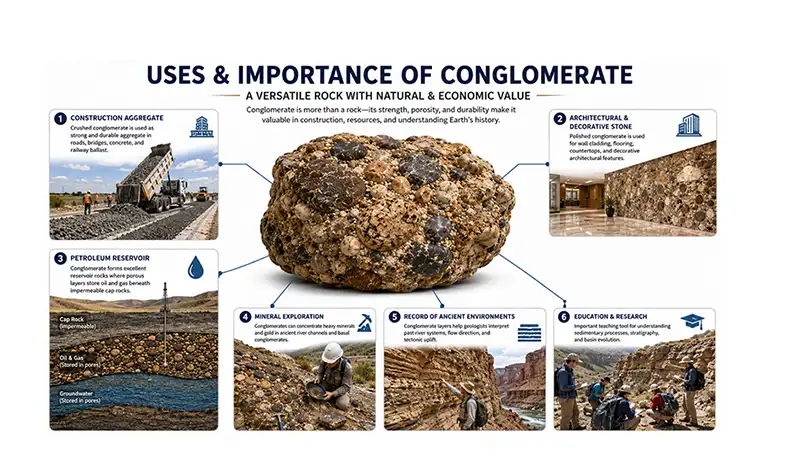
Although conglomerate is not as widely used as rocks such as granite or limestone, it has significant value in geology, construction, natural resource exploration, and scientific research. Its distinctive composition preserves a detailed record of Earth's geological history while also providing practical applications in engineering and industry.
Because conglomerate forms in high-energy depositional environments, it often serves as an important indicator of ancient rivers, mountain-building events, and sediment transport processes. These characteristics make it valuable not only as a building material but also as a key tool for understanding Earth's past.
Construction Material
Strongly cemented conglomerates are sometimes used as dimension stone and construction aggregate. Crushed conglomerate can be incorporated into:
- Road construction
- Building foundations
- Concrete aggregate
- Drainage systems
- Landscaping projects
However, its suitability depends on the strength of the cement and the durability of the clasts. Conglomerates with weak cement are generally unsuitable for heavy structural applications because they may weather or break apart over time.
Decorative and Architectural Stone
Many conglomerates contain colorful, well-rounded pebbles that create attractive natural patterns. These rocks are often polished and used as:
- Decorative wall panels
- Interior flooring
- Countertops
- Garden stones
- Building facades
- Monuments and landscape features
Their unique appearance makes each slab different, giving architects and designers a distinctive natural material.
Petroleum and Groundwater Reservoirs
Some conglomerates possess high porosity and permeability, making them excellent reservoir rocks for groundwater, petroleum, and natural gas.
The spaces between the rounded clasts allow fluids to move and accumulate beneath impermeable rock layers. As a result, conglomerate reservoirs are important targets during:
- Oil exploration
- Natural gas exploration
- Groundwater investigations
- Hydrogeological studies
Reservoir quality depends on the degree of cementation, pore connectivity, and the amount of fine-grained matrix within the rock.
Mineral Exploration
Conglomerate plays an important role in economic geology because certain deposits contain valuable mineral resources.
Some conglomerate formations host:
- Gold
- Uranium
- Diamonds
- Heavy mineral concentrations
For example, ancient river-channel conglomerates may preserve placer deposits where dense minerals accumulated after long periods of erosion and transport. Studying these rocks helps geologists identify potential mining areas and reconstruct the pathways of ancient rivers.
Geological and Paleoenvironmental Studies
One of the greatest scientific values of conglomerate is its ability to preserve evidence of ancient geological environments.
Geologists analyze conglomerates to determine:
- Ancient river directions
- Source rocks (provenance)
- Mountain uplift and erosion
- Past climates
- Tectonic activity
- Depositional environments
- Basin evolution
By studying the composition, size, and roundness of clasts, researchers can reconstruct landscapes that existed millions of years ago.
Educational Importance
Conglomerate is commonly used in geology classrooms and field studies because it is one of the easiest sedimentary rocks to identify.
Students learn to recognize:
- Rounded clasts
- Grain size
- Sorting
- Matrix
- Cement
- Depositional environments
Field observations of conglomerate help students understand the complete sedimentary cycle—from weathering and erosion to transportation, deposition, and lithification.
Conclusion
Conglomerate is a distinctive clastic sedimentary rock composed of rounded gravel-sized clasts that have been transported, deposited, and cemented together over long periods of geological time. Its coarse texture and rounded fragments make it one of the easiest sedimentary rocks to identify, while also providing valuable evidence about the environments in which it formed. From fast-flowing rivers and coastal beaches to alluvial fans and glacial deposits, conglomerate records the dynamic processes that continuously reshape Earth's surface.
In this guide, we've explored what conglomerate is, how it forms, its composition and characteristics, the different types of conglomerate, how it differs from breccia, where it is commonly found, and its practical uses in geology and industry. Each of these aspects helps geologists interpret ancient sedimentary environments, reconstruct past landscapes, and understand the movement of sediments through Earth's geological history.
Beyond its scientific importance, conglomerate also has practical value. It serves as a decorative building stone, construction material, groundwater and petroleum reservoir rock, and a valuable indicator during mineral exploration. Its ability to preserve information about sediment transport, provenance, and depositional environments makes it an essential rock for geological research and education.
Whether you are a geology student, Earth science enthusiast, or professional geologist, understanding conglomerate provides valuable insight into sedimentary processes and the natural forces that have shaped our planet for millions of years.
The clasts become rounded because they collide with one another and the riverbed or shoreline during transportation. Continuous abrasion removes sharp edges, producing the smooth, rounded appearance that distinguishes conglomerate from breccia.
Yes. Well-cemented conglomerates with interconnected pore spaces often have high porosity and permeability, making them effective reservoir rocks for groundwater, crude oil, and natural gas.
Conglomerate is a coarse-grained clastic sedimentary rock composed of rounded gravel-sized fragments larger than 2 millimeters that are cemented together by a finer-grained matrix.
Conglomerate is a sedimentary rock. More specifically, it is classified as a clastic sedimentary rock because it forms from fragments of pre-existing rocks that become compacted and cemented together.