
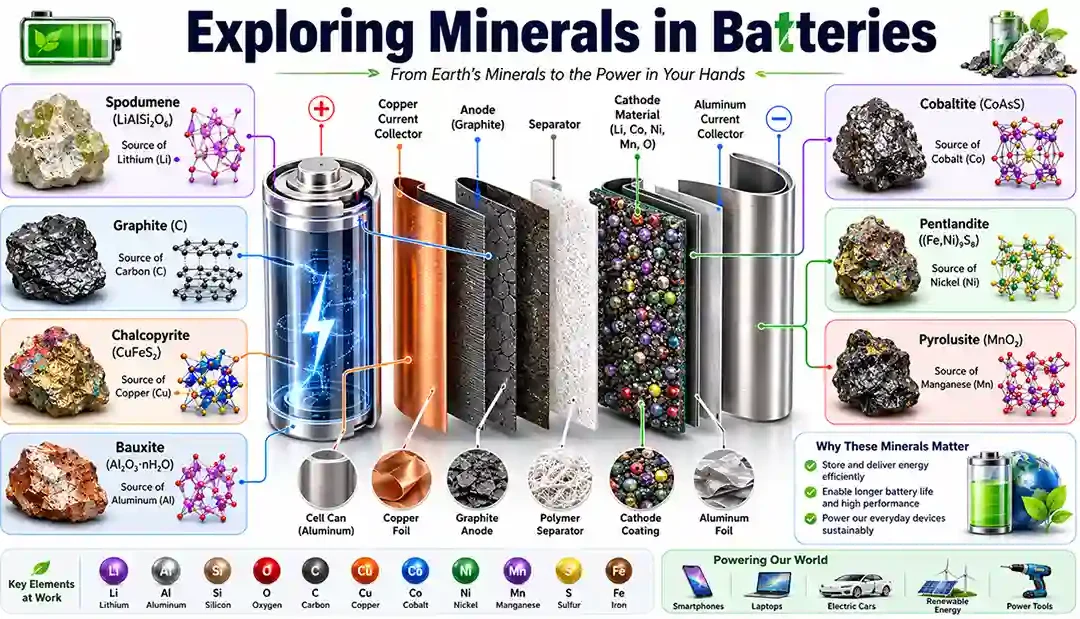
Modern batteries power smartphones, laptops, electric vehicles (EVs), renewable energy storage systems, drones, and countless portable electronic devices. Behind every rechargeable battery lies a combination of carefully selected minerals that store and release electrical energy efficiently.
Minerals in batteries provide the raw materials for electrodes, electrolytes, current collectors, and structural components. Some minerals, such as lithium and graphite, are indispensable in lithium-ion batteries, while others—including cobalt, nickel, and manganese—improve energy density, safety, and battery lifespan.
As global demand for electric vehicles and renewable energy grows, these battery minerals have become some of the world's most important critical mineral resources.
This topic should be studied together with Critical Minerals, Rare Earth Minerals, and Mineralogy.
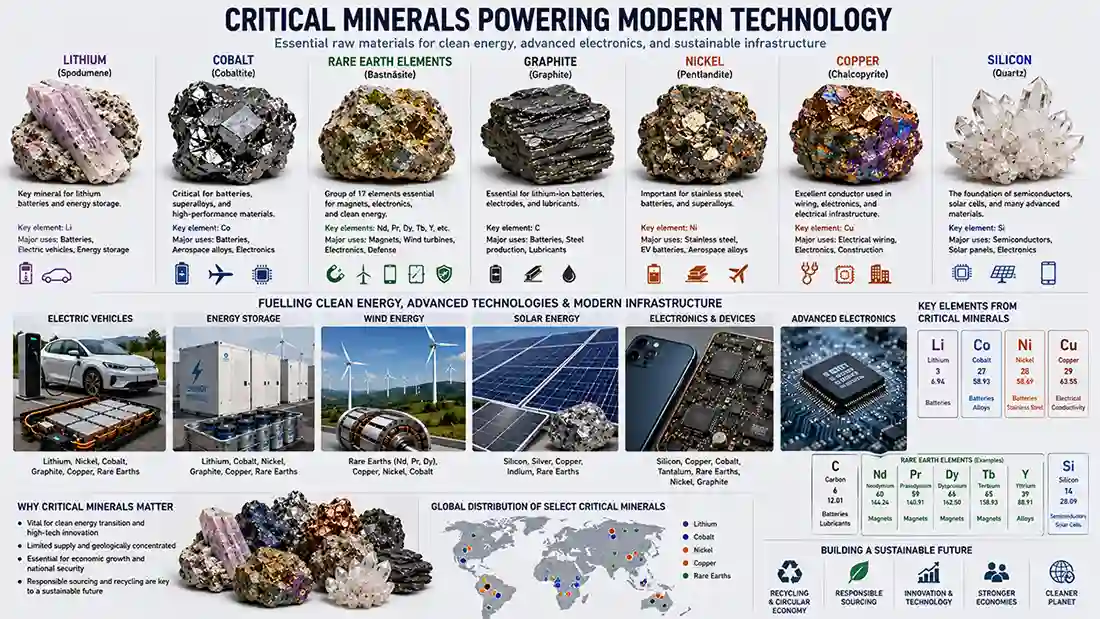
Why Batteries Depend on Minerals
Every battery converts chemical energy into electrical energy through electrochemical reactions.
Minerals provide:
- Energy storage
- Electrical conductivity
- Chemical stability
- Thermal resistance
- Long battery life
- High charging efficiency
- Mechanical durability
Without these minerals, modern rechargeable batteries would not exist.
Major Minerals Used in Batteries
Lithium Minerals
Common source minerals:
- Spodumene
- Lepidolite
- Petalite
Uses:
- Lithium-ion battery cathodes and electrolytes
Importance:
Lithium is lightweight and stores large amounts of energy.
Graphite
Uses:
- Battery anode
Importance:
Graphite stores lithium ions during charging and releases them during discharge. Natural and synthetic graphite are both widely used.
Cobalt Minerals
Common source minerals:
- Cobaltite
- Heterogenite
Uses:
- Cathode materials
Importance:
Improves battery stability, safety, and lifespan.
Nickel Minerals
Common source minerals:
- Pentlandite
- Garnierite
Uses:
- High-energy cathodes
Importance:
Nickel increases battery capacity and driving range in electric vehicles.
Manganese Minerals
Common source mineral:
- Pyrolusite
Uses:
- Cathode materials
Importance:
Improves thermal stability and reduces battery cost.
Copper Minerals
Common source mineral:
- Chalcopyrite
Uses:
- Current collectors
- Internal wiring
Importance:
Excellent electrical conductivity.
Aluminum Minerals
Common source:
- Bauxite
Uses:
- Battery casing
- Cathode current collector
Importance:
Lightweight and corrosion-resistant.
Iron Minerals
Common source:
- Hematite
- Magnetite
Uses:
- Lithium Iron Phosphate (LFP) batteries
Importance:
Provides excellent safety and long cycle life.
Phosphate Minerals
Common source:
- Apatite
Uses:
- Lithium Iron Phosphate cathodes
Importance:
Creates stable and durable battery chemistry.
Silicon Minerals
Common source:
- Quartz
Uses:
- Advanced battery anodes
Importance:
Can store much more lithium than graphite, making it a promising next-generation anode material.
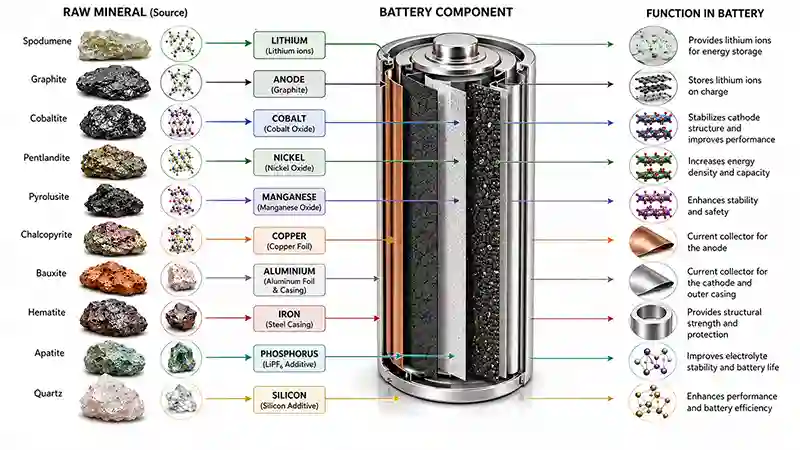
Minerals by Battery Component
| Battery Component | Main Minerals |
|---|---|
| Cathode | Lithium, Cobalt, Nickel, Manganese, Iron, Phosphate |
| Anode | Graphite, Silicon |
| Current Collector | Copper, Aluminum |
| Electrolyte | Lithium compounds |
| Battery Casing | Aluminum, Steel |
Types of Battery Chemistries
Different batteries use different combinations of minerals.
Lithium-Ion (Li-ion)
Main minerals:
- Lithium
- Graphite
- Cobalt
- Nickel
- Manganese
Applications:
- Smartphones
- Laptops
- Electric vehicles
Lithium Iron Phosphate (LFP)
Main minerals:
- Lithium
- Iron
- Phosphate
- Graphite
Applications:
- Electric buses
- Energy storage systems
- Entry-level EVs
Nickel Manganese Cobalt (NMC)
Main minerals:
- Nickel
- Manganese
- Cobalt
- Lithium
Applications:
- Long-range electric vehicles
Nickel Cobalt Aluminum (NCA)
Main minerals:
- Nickel
- Cobalt
- Aluminum
- Lithium
Applications:
- High-performance EVs
From Mine to Battery
Battery minerals undergo several stages before becoming part of a battery.
- Geological exploration
- Mining
- Ore concentration
- Metal refining
- Cathode and anode production
- Battery cell manufacturing
- Battery pack assembly
- Recycling
Each stage requires advanced engineering and quality control.
Environmental Challenges
Growing battery demand presents several environmental challenges.
These include:
- Land disturbance
- Water consumption
- Carbon emissions
- Mine waste
- Supply chain risks
- Electronic waste
Sustainable mining and recycling are essential for reducing these impacts.
Recycling Battery Minerals
Battery recycling recovers valuable materials such as:
- Lithium
- Cobalt
- Nickel
- Copper
- Graphite
- Aluminum
Recycling reduces mining demand and supports a circular economy.
Geological Importance
Battery minerals are among the world's most strategically important mineral resources.
Geologists study them to:
- Discover new deposits
- Estimate mineral reserves
- Evaluate ore quality
- Support sustainable mining
- Secure critical mineral supplies
Many countries now classify battery minerals as critical minerals because they are essential for energy security.
Laboratory Investigation
Scientists analyze battery minerals using:
- X-Ray Diffraction (XRD)
- X-Ray Fluorescence (XRF)
- Scanning Electron Microscopy (SEM)
- Electron Probe Microanalysis (EPMA)
- ICP-MS
- Raman Spectroscopy
These techniques determine mineral composition, purity, crystal structure, and trace elements.
Applications
Battery minerals are essential in:
- Electric vehicles
- Smartphones
- Laptops
- Renewable energy storage
- Grid-scale batteries
- Aerospace
- Consumer electronics
- Medical devices
Advantages of Studying Battery Minerals
Understanding battery minerals helps scientists and engineers:
- Improve battery performance
- Increase energy density
- Extend battery lifespan
- Develop safer batteries
- Support sustainable mining
- Improve recycling technologies
Limitations
Despite their importance, battery minerals present several challenges.
- Supply is concentrated in a limited number of countries.
- Demand is increasing rapidly due to EV adoption.
- Mining can have environmental impacts if poorly managed.
- Recycling infrastructure is still expanding.
- Some battery chemistries depend on scarce critical minerals.
For a broader understanding, study this topic together with:
- Critical Minerals
- Economic Minerals
- Rare Earth Minerals
- Mineral Resources
- Battery Recycling
- Sustainable Mining
- Environmental Geology
- Mineralogy
Comparison Table
| Mineral | Main Battery Function | Example Source Mineral |
| Lithium | Energy Storage | Spodumene |
| Graphite | Anode | Graphite |
| Cobalt | Cathode Stability | Cobaltite |
| Nickel | Increase Capacity | Pentlandite |
| Manganese | Thermal Stability | Pyrolusite |
| Copper | Current Collector | Chalcopyrite |
| Aluminum | Battery Casing | Bauxite |
| Iron | LFP Cathode | Hematite |
| Phosphorus | LFP Cathode | Apatite |
| Silicon | Advanced Anode | Quartz |
Summary Table
| Feature | Minerals in Batteries |
| Main Purpose | Store and Deliver Electrical Energy |
| Key Minerals | Lithium, Graphite, Cobalt, Nickel, Copper |
| Critical Minerals | Lithium, Cobalt, Nickel, Graphite |
| Study Methods | XRD, XRF, SEM, ICP-MS |
| Geological Importance | Critical Mineral Exploration and Energy Transition |
Lithium is the defining mineral, but graphite, cobalt, nickel, copper, and manganese are also essential for battery performance.
Graphite forms the anode, where lithium ions are stored during charging and released during discharge.
Most EV batteries contain lithium, graphite, nickel, cobalt, manganese, copper, and aluminum. Some also use iron and phosphate in LFP battery chemistry.
Yes. Valuable materials such as lithium, cobalt, nickel, copper, aluminum, and graphite can be recovered and reused to manufacture new batteries.
They are considered critical because they are essential for modern technologies, have rapidly growing demand, and may face supply-chain constraints.
Final Thoughts
Modern batteries rely on a diverse range of minerals that make portable electronics, electric vehicles, and renewable energy storage possible. From lithium-rich spodumene and graphite anodes to cobalt, nickel, and manganese cathodes, each mineral contributes unique properties that improve battery efficiency, safety, and durability.
As the global transition toward clean energy accelerates, understanding the geology, mining, processing, and recycling of battery minerals is becoming increasingly important. Responsible resource management and advances in recycling will play a vital role in securing the sustainable supply of these essential materials.
Continue Learning
Continue exploring related topics: