
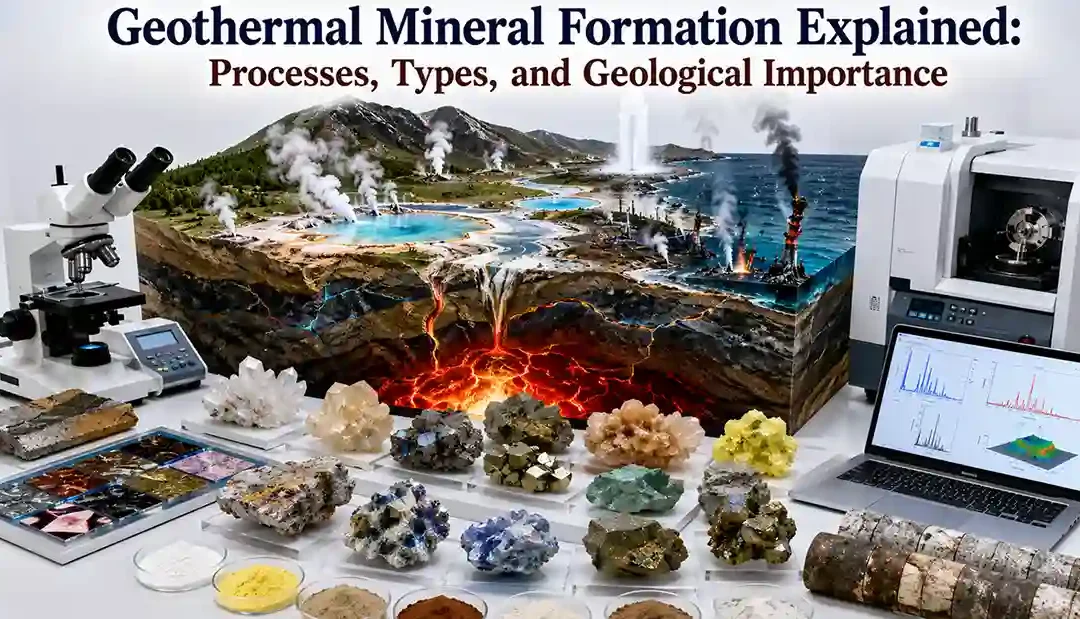
Geothermal mineral formation is the process by which minerals crystallize, precipitate, or replace existing rocks through the circulation of hot, mineral-rich fluids generated by Earth's internal heat. These geothermal fluids dissolve chemical elements from surrounding rocks and transport them through fractures before depositing minerals as temperature, pressure, or fluid chemistry changes.
Geothermal systems occur in volcanic regions, geothermal fields, hot springs, geysers, fumaroles, and deep hydrothermal reservoirs. They produce a wide range of minerals including quartz, calcite, pyrite, chalcopyrite, barite, fluorite, gypsum, silica sinter, travertine, native sulfur, and various clay minerals. Many geothermal systems are also associated with valuable ore deposits containing gold, silver, copper, lithium, and other critical elements.
Understanding geothermal mineral formation is essential in mineralogy, geothermal geology, hydrothermal geology, economic geology, volcanology, and renewable energy exploration.
This topic should be studied together with Hydrothermal Minerals, Hydrothermal Alteration, Metasomatism, and Mineral Veins Explained.
What Is Geothermal Mineral Formation?
Geothermal mineral formation is the creation of minerals by hot groundwater and hydrothermal fluids circulating through Earth's crust.
The process involves:
- Heating of groundwater
- Dissolution of minerals
- Transport of dissolved elements
- Chemical reactions with surrounding rocks
- Precipitation of new minerals
Most geothermal minerals form at temperatures ranging from 50°C to over 400°C, depending on the geothermal system.
How Geothermal Systems Form
A typical geothermal system develops through several stages.
- Magma intrudes the crust.
- Groundwater is heated by the magma.
- Hot fluids circulate through fractures.
- Minerals dissolve into the fluids.
- Cooling and pressure changes occur.
- Minerals precipitate and fill fractures or replace rocks.
This continuous circulation creates hydrothermal alteration zones and mineral deposits.
Sources of Geothermal Fluids
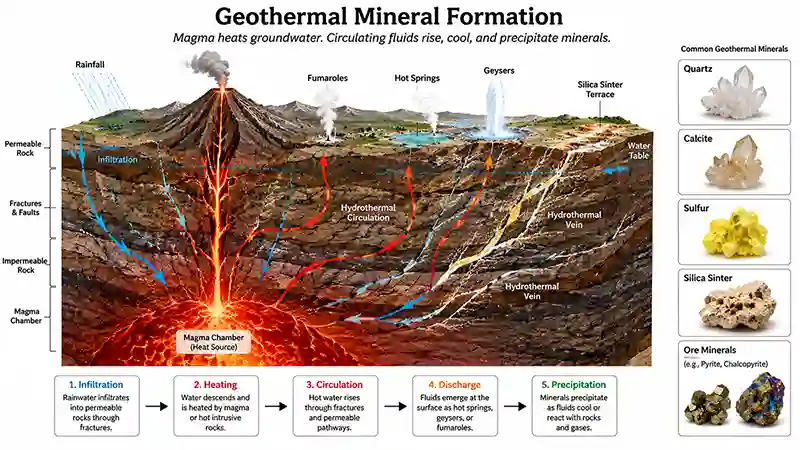
Geothermal fluids may originate from:
- Meteoric water (rainfall)
- Groundwater
- Magmatic fluids
- Seawater
- Metamorphic fluids
These fluids often mix, producing complex chemical compositions.
Major Processes of Geothermal Mineral Formation
Hydrothermal Circulation
Hot fluids move through fractures and porous rocks.
During circulation:
- Minerals dissolve.
- Chemical elements migrate.
- New minerals crystallize.
This is the primary mechanism of geothermal mineral formation.
Silica Precipitation
As silica-rich fluids cool:
- Quartz precipitates at depth.
- Silica sinter forms near the surface.
Silica deposition commonly occurs around hot springs.
Carbonate Precipitation
Carbon dioxide-rich geothermal waters deposit:
- Calcite
- Aragonite
- Travertine
Travertine terraces are common around geothermal springs.
Sulfur Deposition
Hydrogen sulfide released from geothermal fluids oxidizes to produce:
- Native sulfur
- Sulfates
These deposits commonly occur around fumaroles.
Hydrothermal Alteration
Hot fluids chemically alter existing rocks through:
- Silicification
- Argillic alteration
- Propylitic alteration
- Potassic alteration
New minerals replace the original rock-forming minerals.
Common Geothermal Minerals
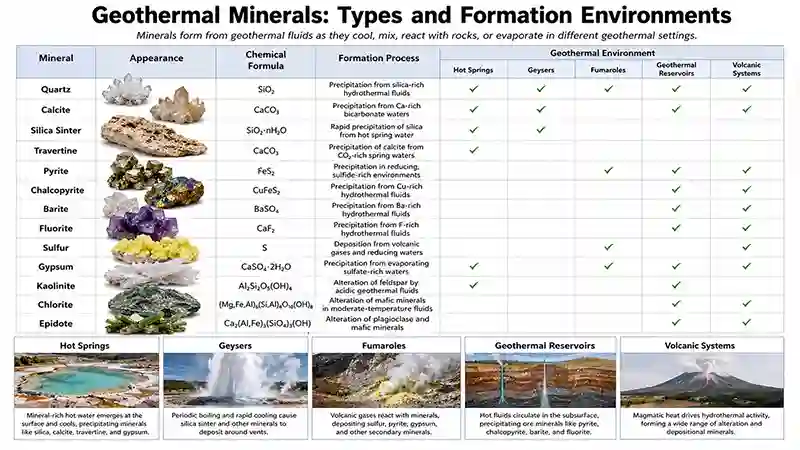
Quartz
Quartz is the most abundant geothermal mineral.
Forms as:
- Veins
- Quartz cement
- Silica sinter
Calcite
Calcite commonly precipitates from carbon dioxide-rich geothermal fluids.
Often forms:
- Travertine
- Vein fillings
Pyrite
- Pyrite forms under reducing conditions.
- Frequently accompanies precious metal deposits.
Chalcopyrite
Important copper ore deposited in high-temperature geothermal systems.
Barite
Forms where barium-rich fluids mix with sulfate-rich water.
Fluorite
Common in fluorine-rich geothermal fluids.
Gypsum
Forms from sulfate-rich geothermal waters in low-temperature environments.
Native Sulfur
- Common around fumaroles and volcanic vents.
- Forms by oxidation of hydrogen sulfide gas.
Silica Sinter
- Silica-rich hot spring waters deposit amorphous silica at the surface.
- Silica sinter is a distinctive indicator of ancient geothermal systems.
Travertine
- Travertine forms by precipitation of calcium carbonate from geothermal waters.
- Common around hot springs and geothermal terraces.
Clay Minerals
Hydrothermal alteration commonly produces:
- Kaolinite
- Illite
- Smectite
- Chlorite
These minerals are widely used in geothermal exploration.
Accessory Geothermal Minerals
Other important geothermal minerals include:
- Epidote
- Adularia
- Albite
- Zeolites
- Hematite
- Magnetite
- Arsenopyrite
- Realgar
- Orpiment
These minerals help indicate temperature, fluid chemistry, and ore-forming conditions.
Types of Geothermal Systems
| Geothermal System | Typical Minerals |
|---|---|
| High-Temperature Volcanic | Quartz, Pyrite, Chalcopyrite |
| Hot Spring | Silica Sinter, Travertine |
| Fumarole | Native Sulfur, Gypsum |
| Geothermal Reservoir | Quartz, Calcite, Epidote |
| Submarine Hydrothermal Vent | Sulfides, Barite |
Each system produces distinctive mineral assemblages.
Geothermal Mineral Formation and Ore Deposits
Many valuable ore deposits originate in geothermal systems.
Common examples include:
- Epithermal gold deposits
- Silver deposits
- Copper deposits
- Mercury deposits
- Antimony deposits
- Lithium-rich geothermal brines
These deposits form through prolonged hydrothermal circulation.
Geological Importance
Geothermal mineral formation helps geologists:
- Understand hydrothermal circulation
- Reconstruct volcanic history
- Interpret geothermal reservoirs
- Identify ore-forming systems
- Study fluid-rock interaction
- Explore renewable geothermal resources
It links Earth's internal heat with surface mineral formation.
Economic Importance
Geothermal systems are important sources of:
- Gold
- Silver
- Copper
- Sulfur
- Silica
- Lithium
- Industrial minerals
- Geothermal energy
They are increasingly important for clean energy development and critical mineral supply.
Laboratory Identification
Geothermal minerals are studied using:
- Petrographic Microscopy
- X-Ray Diffraction (XRD)
- Electron Microprobe Analysis (EPMA)
- Scanning Electron Microscopy (SEM)
- Fluid Inclusion Analysis
- Stable Isotope Geochemistry
- X-Ray Fluorescence (XRF)
- Whole-Rock Geochemistry
These methods reveal mineral chemistry, fluid evolution, and geothermal temperatures.
Applications
Geothermal mineral formation studies are important in:
- Geothermal Geology
- Hydrothermal Geology
- Mineralogy
- Economic Geology
- Volcanology
- Renewable Energy Exploration
- Geochemistry
- Environmental Geology
Advantages of Studying Geothermal Mineral Formation
Studying geothermal mineral formation helps scientists:
- Explore geothermal energy resources
- Discover hydrothermal ore deposits
- Understand fluid-rock interaction
- Predict alteration zones
- Improve mineral exploration
- Reconstruct volcanic and hydrothermal histories
Limitations
Studying geothermal mineral formation may be challenging because:
- Geothermal systems evolve rapidly over geological time.
- Multiple fluid sources can complicate mineral chemistry.
- Surface weathering may alter original geothermal minerals.
- Detailed petrographic, geochemical, and isotope studies are often required to determine fluid origins and temperatures.
For comprehensive interpretation, combine geothermal mineral studies with:
- Hydrothermal Minerals
- Hydrothermal Alteration
- Metasomatism
- Mineral Veins Explained
- Economic Geology
- Petrographic Microscopy
- Mineral Chemistry Analysis
- X-Ray Diffraction in Mineralogy
Comparison Table
| Geothermal Environment | Dominant Minerals | Typical Temperature |
| Hot Springs | Travertine, Silica Sinter | 50–100°C |
| Geysers | Silica Sinter, Quartz | 80–150°C |
| Fumaroles | Sulfur, Gypsum | 100–300°C |
| Geothermal Reservoirs | Quartz, Epidote, Calcite | 150–350°C |
| Hydrothermal Veins | Quartz, Pyrite, Chalcopyrite | 200–400°C |
Summary Table
| Feature | Geothermal Mineral Formation |
| Main Process | Mineral Precipitation from Hot Fluids |
| Primary Heat Source | Magma and Earth's Internal Heat |
| Common Minerals | Quartz, Calcite, Sulfur, Silica Sinter |
| Main Study Methods | Petrography, XRD, EPMA, Fluid Inclusion Analysis |
| Geological Importance | Hydrothermal Alteration, Ore Formation, Geothermal Systems |
Geothermal mineral formation is the process by which hot groundwater and hydrothermal fluids dissolve, transport, and precipitate minerals within geothermal systems such as hot springs, geysers, and volcanic regions.
Common geothermal minerals include quartz, calcite, silica sinter, travertine, pyrite, chalcopyrite, barite, fluorite, gypsum, native sulfur, epidote, and clay minerals.
Geothermal fluids dissolve elements from surrounding rocks while circulating through fractures. As these fluids cool, lose pressure, or react with rocks, dissolved minerals precipitate and crystallize.
They help geologists understand hydrothermal systems, locate geothermal energy resources, identify ore deposits, and reconstruct volcanic and geothermal histories.
Geologists use petrographic microscopy, X-ray diffraction (XRD), electron microprobe analysis (EPMA), scanning electron microscopy (SEM), fluid inclusion analysis, stable isotope geochemistry, X-ray fluorescence (XRF), and whole-rock geochemistry.
Final Thoughts
Geothermal mineral formation is a dynamic process driven by Earth's internal heat and the circulation of hot, mineral-rich fluids. From quartz veins and silica sinter to sulfur deposits and epithermal gold systems, geothermal activity produces a remarkable diversity of minerals while reshaping surrounding rocks through hydrothermal alteration.
By combining field investigations with petrographic microscopy, fluid inclusion studies, geochemical analyses, X-ray diffraction, and electron microprobe analysis, geologists can understand geothermal reservoirs, explore renewable energy resources, and discover valuable mineral deposits. Geothermal mineral formation remains a cornerstone of hydrothermal geology, economic geology, volcanology, mineralogy, and sustainable energy research.
Continue Learning
Continue exploring hydrothermal and economic geology with these related guides: